 AnthropicAnalysis
Anthropic publishes empirical study of 207,000 scientific research sessions

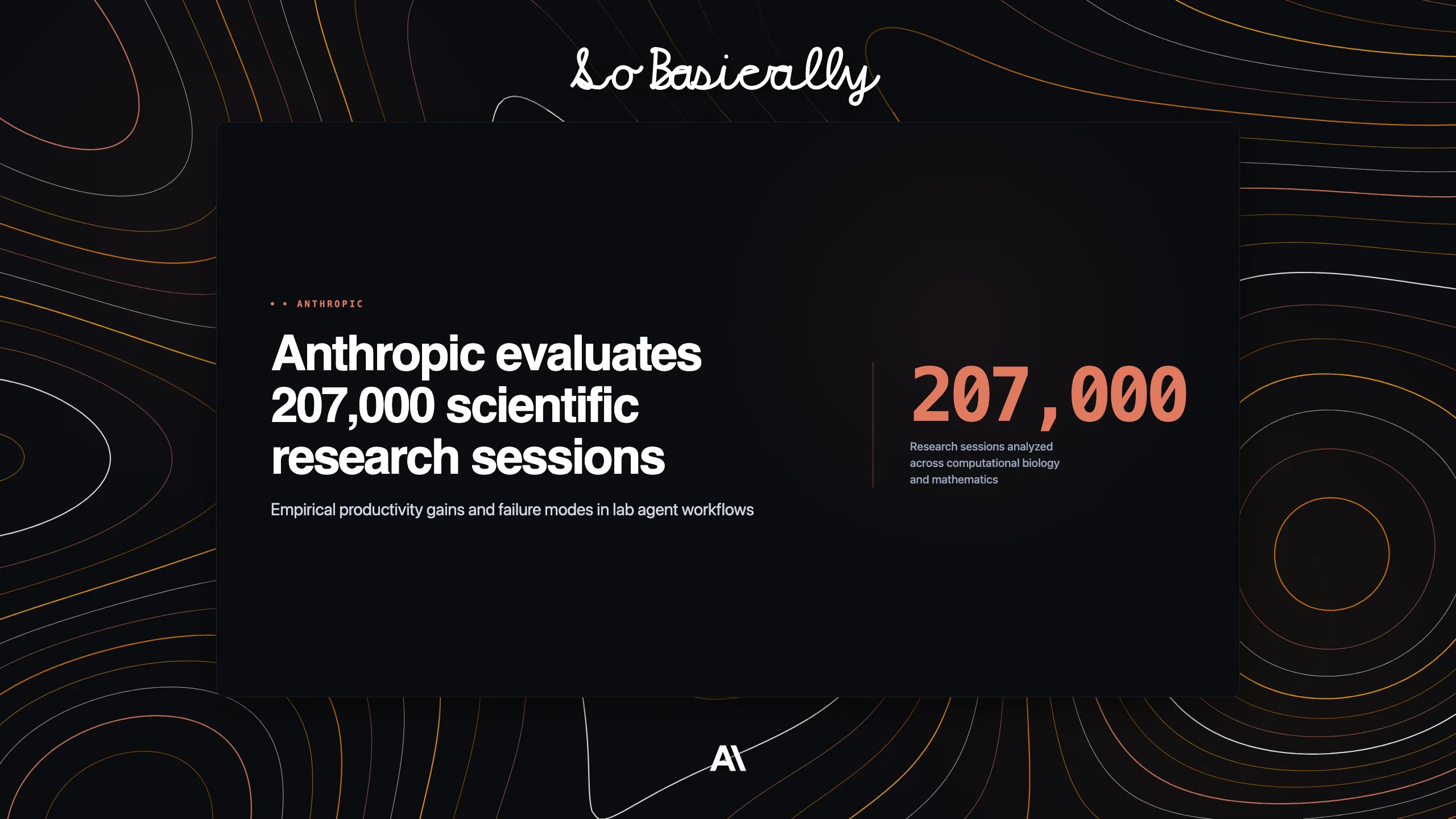
What happened.Anthropic published an empirical evaluation of 207,000 anonymized research sessions, analyzing how scientists deploy autonomous agents to accelerate laboratory and data workflows.
Why it matters.Empirical usage metrics show where agentic tools genuinely help researchers and where they still fail. While agents accelerate routine coding and data transformation, human scientists remain necessary to validate experimental premises, direct research strategy, and catch domain errors.
The technical specifications:
- Corpus scope: Examined interactions across computational biology, statistics, materials science, and physics to identify practical productivity patterns.
- Speed multipliers: Scientists using Claude Code reported 40 percent faster completion of bioinformatics scripts, data parsing scripts, and chart pipelines.
- Workflow bottlenecks: Revealed that agents struggle with multi-week project planning, undocumented proprietary file formats, and citation drift.
- Domain leadership: Life science researchers adopted agent tooling fastest, utilizing models to extract data from genomic databases and format statistical runs.
- Integration impact: Connecting models to standardized Model Context Protocol servers cut erroneous API calls and hallucinations by more than half.
STORYLINE PROGRESSION & CONTEXT
This report represents a verified evolution of prior newsroom intelligence: