 AnthropicAnalysis
Anthropic outlines agent memory architecture and offline dreaming consolidation

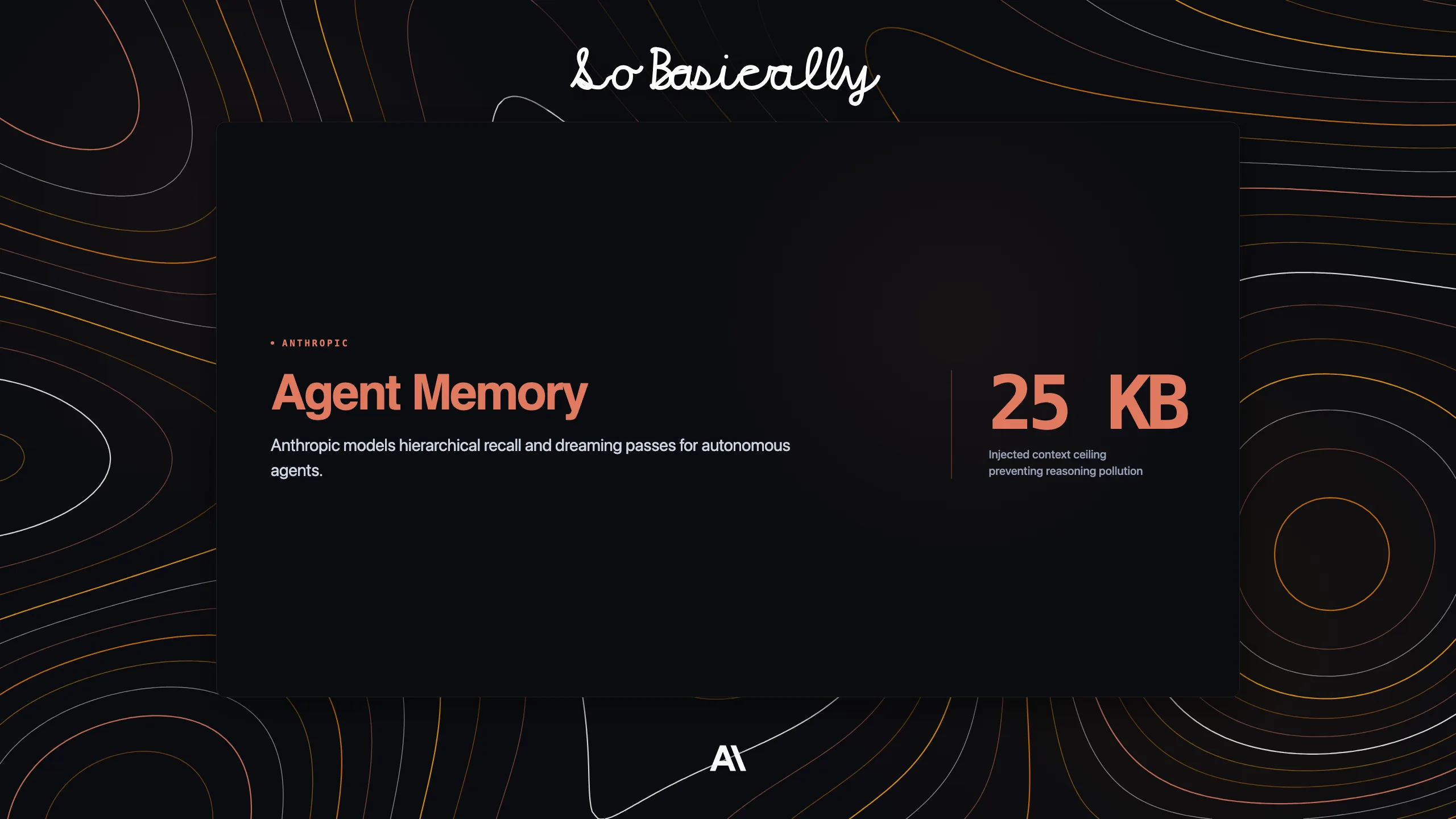
What happened.Anthropic published an architectural framework for long-running AI agents, defining a four-tier memory stack and an offline dreaming process to consolidate knowledge across sessions.
Why it matters.Autonomous software agents operating across persistent environments frequently fail when stale or contradictory context clogs prompt limits. Consolidating memory during offline idle periods mimics human sleep consolidation, giving software agents reliable long-term recall without fine-tuning model weights.
The technical specifications:
- Memory hierarchy: Organizes persistent memory into raw transcripts, mid-task memory notes, linked wiki representations, and a tightly managed injected context index.
- Dreaming pass: Utilizes background compute between active sessions to review execution logs, prune stale assumptions, and resolve conflicting observations.
- Context discipline: Enforces a compact injected context index capped at 25 kilobytes, preventing historical file accumulation from polluting new reasoning loops.
- Hybrid retrieval: Combines agent-authored wiki links with semantic search, achieving higher factual retrieval accuracy and lower token overhead than search alone.
- Empirical findings: Autonomous agents that aggressively hoarded granular state files performed significantly worse on benchmark tasks than agents maintaining lean, curated dashboards.