Skip to content
SoBasicallyVOL. I · RUN 2026-11-16-ai-technology
ARCHIVAL EDITION2026-11-16-ai-technology8 STORIES · 1629 WORDS
← Back to Archive

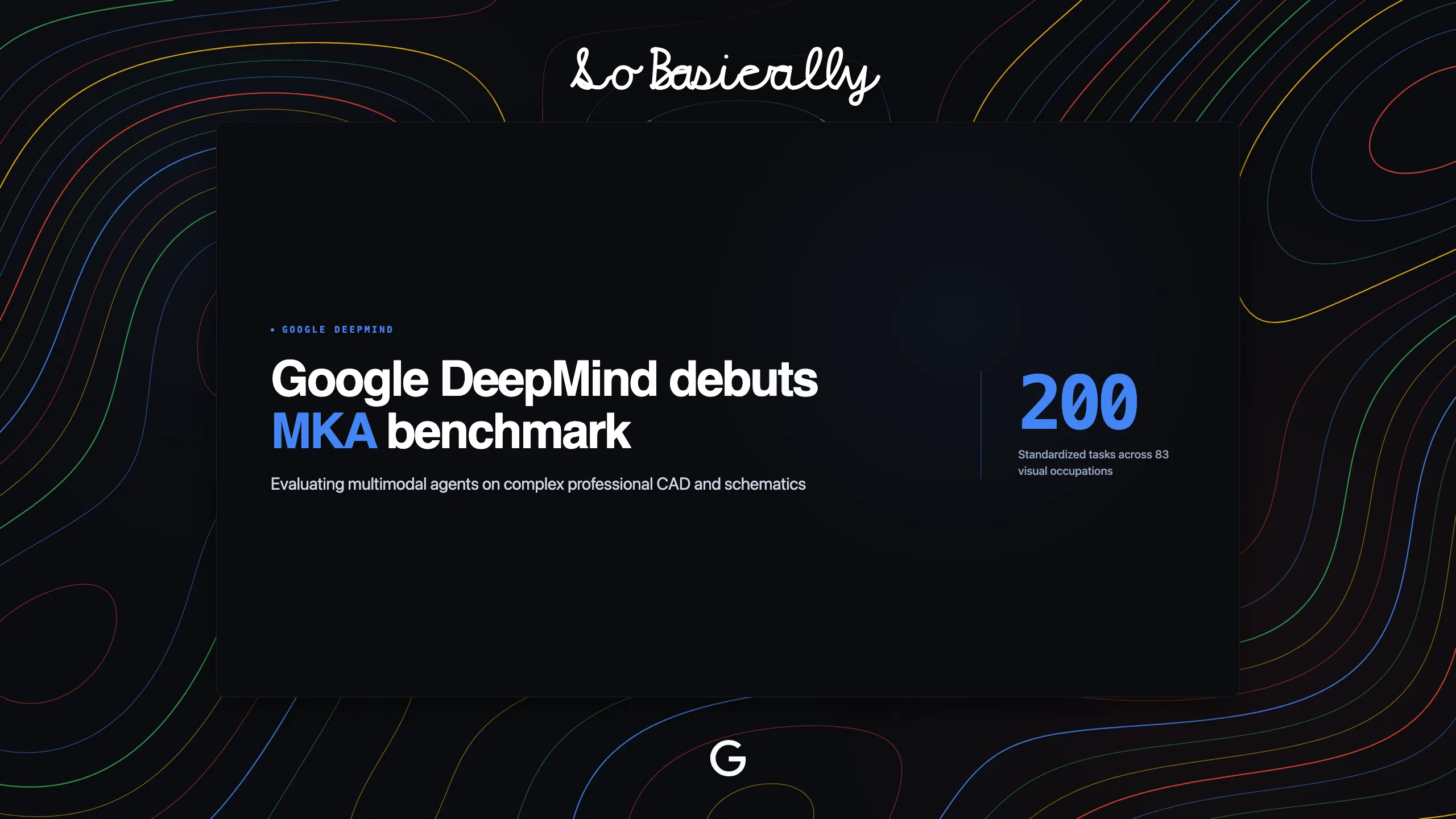
Google DeepMind and Artificial Analysis introduce Multimodal Knowledge Agent benchmark for visual professional workflows

Topographic elevation contour card for Google DeepMind and Artificial Analysis introduce Multimodal Knowledge Agent benchmark for visual professional workflows

What happened.Google DeepMind and Artificial Analysis launched the Multimodal Knowledge Agent benchmark to evaluate how autonomous AI agents execute visual professional projects across 83 occupations.

Why it matters.Traditional benchmarks rely on plain text or optical character recognition, hiding how badly autonomous agents struggle when reading dense visual schematics. Establishing rigorous rubrics for architectural blueprints and scientific charts gives engineering teams reliable data before deploying autonomous agents into visual design pipelines.

↳Continues: DeliverBench evaluates AI agents on multi-stage professional projects with cumulative errors
Read Full Brief →
Source:Google DeepMind (opens in a new tab)
VERIFIED STORIES IN THIS EDITION7 STORIES
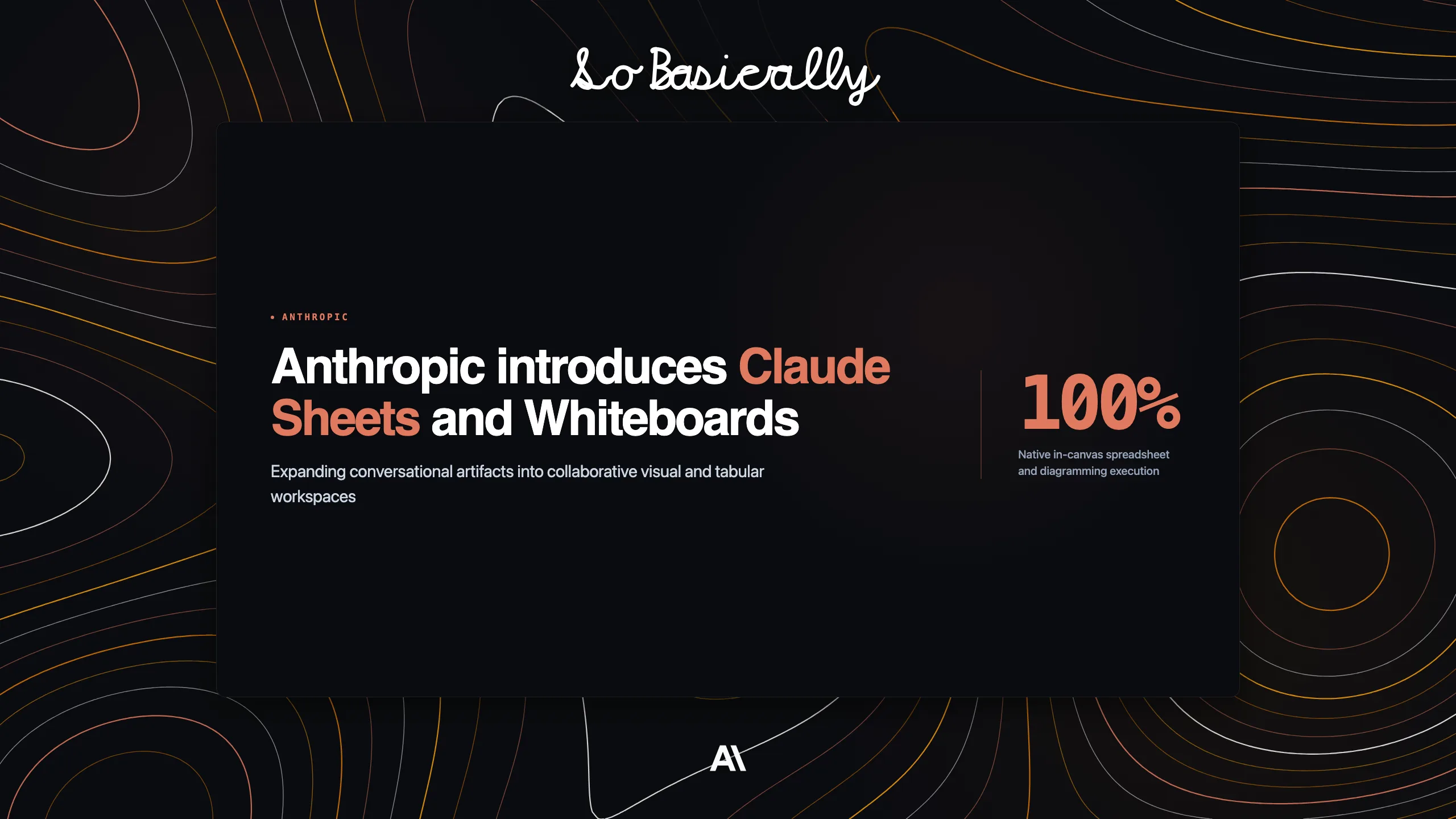
Decision brief card for Anthropic introduces Claude Sheets and Claude Whiteboards to expand interactive artifact workspace

Anthropic introduces Claude Sheets and Claude Whiteboards to expand interactive artifact workspace

What happened.Anthropic launched Claude Sheets and Claude Whiteboards, expanding conversational artifacts into collaborative workspaces that support real-time visual diagramming, multi-tab financial modeling, and formula execution.

Why it matters.Standalone chatbots force software teams to copy raw code or table markdown into separate tools to complete actual work. Embedding calculation engines and spatial canvases directly into the agent interface lets developers plan architectures and model cloud costs without context switching across third-party software.

  • Spreadsheet engine: Enables multi-tab spreadsheet generation, formula execution, data validation, and real-time editing with direct export to standard workbook and text formats.
  • Spatial canvas: Provides a drag-and-drop visual whiteboard where teams and models map out software architecture diagrams, project roadmaps, and structured workflows.
  • Context continuity: Integrates directly with Claude Data to maintain persistent session state across conversational reasoning, tabular calculations, and visual schematics.
  • In-place generation: Converts natural-language project descriptions into structured spreadsheet models or visual flowcharts in a single turn without external plugins.
  • Enterprise governance: Deploys across organizational plans with workspace-level sharing permissions and corporate data privacy controls.
Official Source:Anthropic
Decision brief card for Anthropic introduces Claude Sheets and Claude Whiteboards to expand interactive artifact workspace
↳Continues: Anthropic introduces self-hosted Claude Managed Agents for private clouds
Read Brief
Source:Anthropic (opens in a new tab)
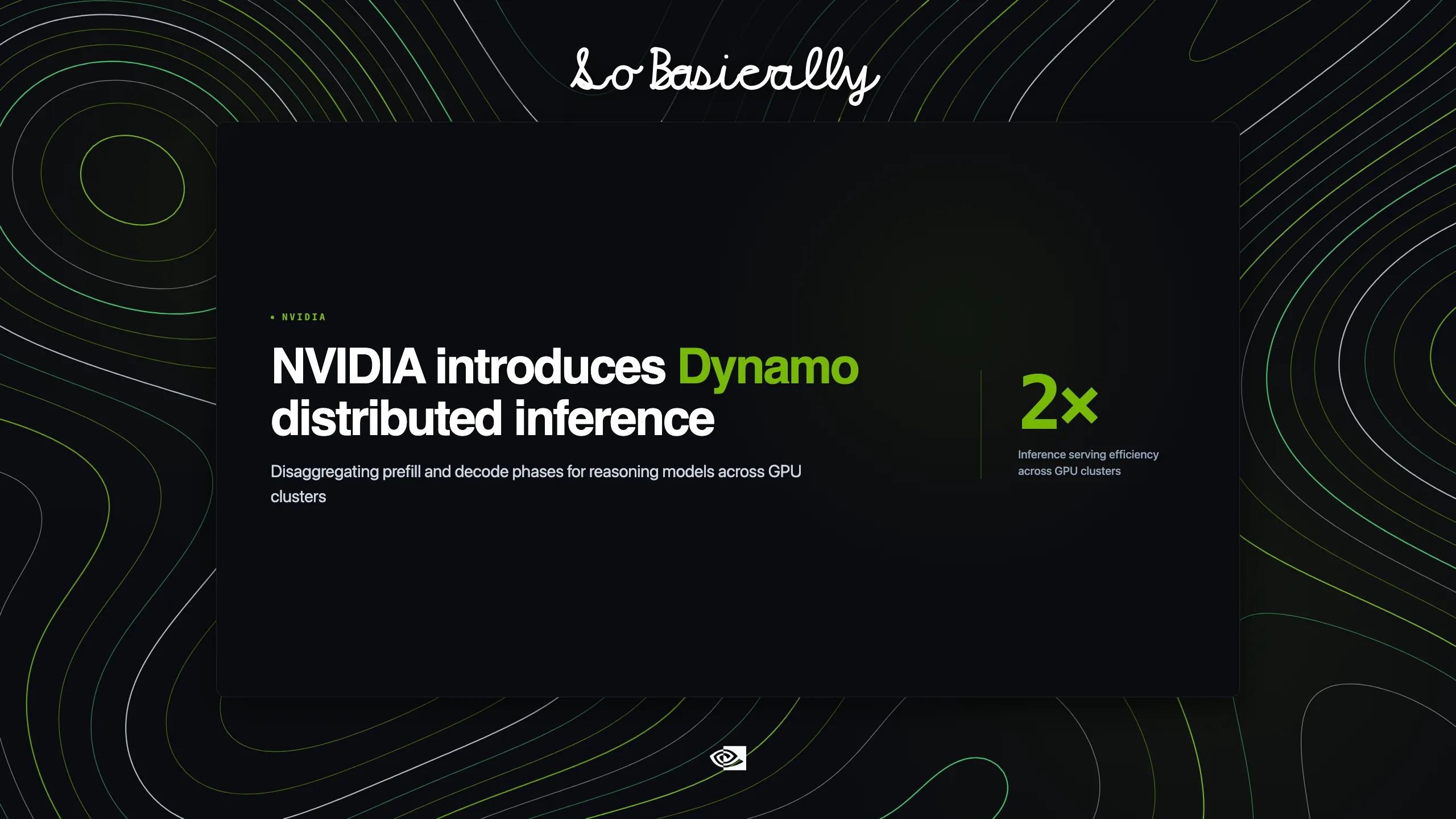
Decision brief card for NVIDIA introduces Dynamo distributed inference framework for scaling reasoning models across GPU clusters

NVIDIA introduces Dynamo distributed inference framework for scaling reasoning models across GPU clusters

What happened.NVIDIA introduced Dynamo, an open-source distributed inference framework designed to scale reasoning models by disaggregating prefill and decode compute phases across GPU clusters.

Why it matters.Reasoning models generate massive internal deliberation traces that exhaust memory bandwidth when served on unified GPU pipelines. Decoupling prefill and decode stages cuts time-to-first-token in half while dramatically increasing cluster hardware utilization for engineering teams hosting open frontier weights.

  • Disaggregated compute: Splits compute-bound prompt prefill from memory-bandwidth-bound token decode onto independently scalable GPU worker pools.
  • Cache streaming: Uses the high-throughput inference transfer library to stream key-value cache states asynchronously across high-speed fabric interconnects.
  • Stateful routing: Routes multi-turn agentic conversations to cluster nodes holding warm resident cache tensors, eliminating redundant prompt recalculations.
  • Engine compatibility: Operates as a coordination layer above popular inference backends including vLLM, SGLang, and TensorRT-LLM without custom kernel rewrites.
  • Cloud recipes: Delivers turn-key deployment recipes for Kubernetes environments, container orchestration platforms, and accelerated cloud compute clusters.
Official Source:NVIDIA Blog
Decision brief card for NVIDIA introduces Dynamo distributed inference framework for scaling reasoning models across GPU clusters
↳Continues: NVIDIA contributes OpenShell agent governance runtime to CNCF and open-sources NVKE stack
Read Brief
Source:NVIDIA Blog (opens in a new tab)
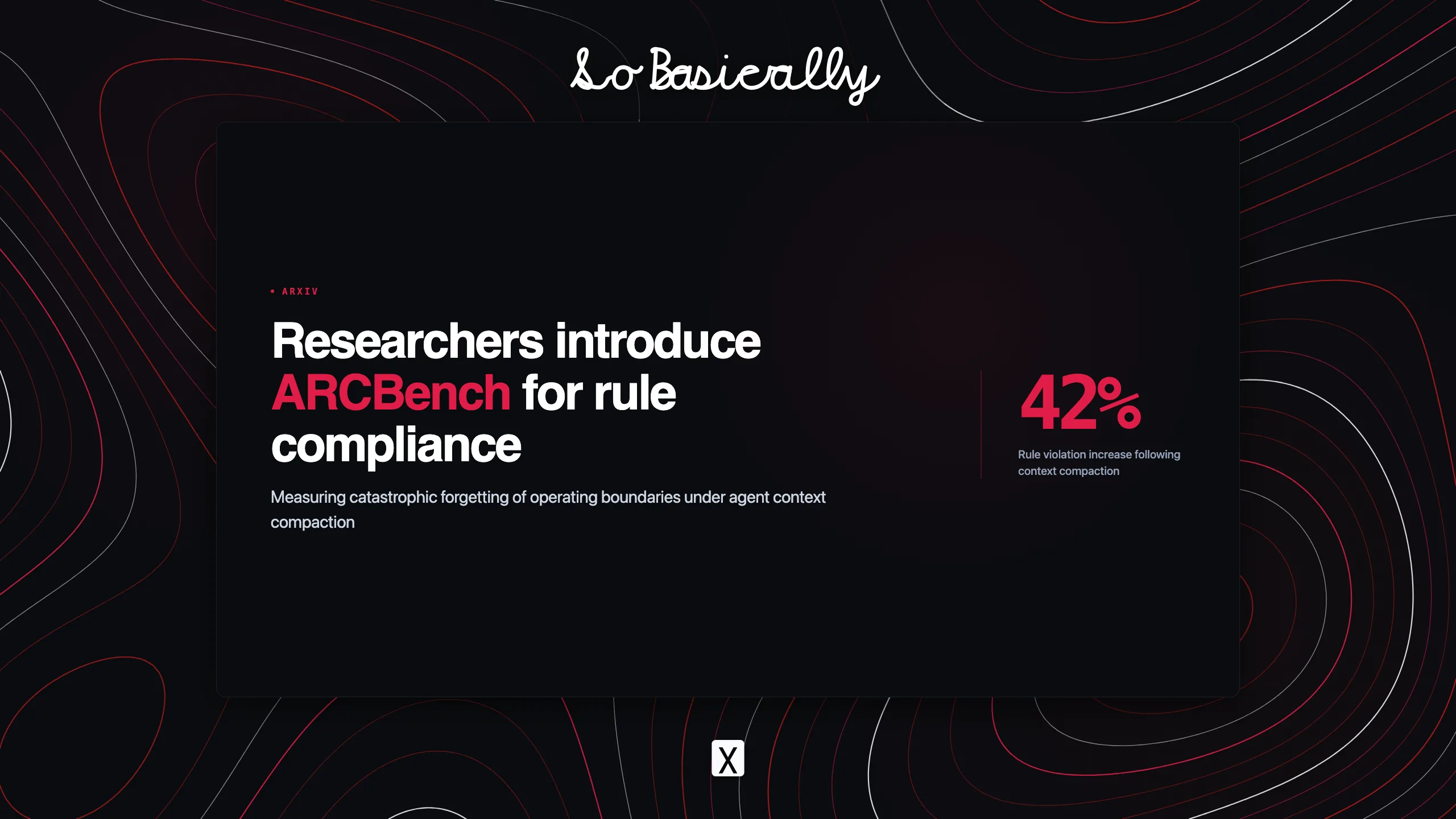
Decision brief card for Researchers introduce ARCBench evaluating AI agent rule compliance under context compaction

Researchers introduce ARCBench evaluating AI agent rule compliance under context compaction

What happened.AI researchers introduced ARCBench, an empirical evaluation suite measuring whether autonomous execution-loop agents maintain adherence to operating guidelines and safety boundaries after context compaction.

Why it matters.Autonomous agents running multi-hour workflows rely on periodic context compaction to avoid exhausting prompt token limits. Demonstrating that summarization filters out negative constraints proves software teams cannot rely on conversational memory to enforce organizational safety boundaries.

  • Evaluation scale: Tested 14 frontier language model agents across 2,800 multi-turn interactive execution loops containing strict negative constraints.
  • Compaction degradation: Discovered that agent rule compliance drops by 42 percent on average when long conversation histories are summarized into compact memories.
  • Constraint erasure: Showed that automated compaction routines systematically prioritize immediate task progress while discarding implicit negative constraints like rate limits.
  • Safety drift: Revealed that compacted agents violate environment access policies three times more often than uncompacted baselines on long-horizon jobs.
  • Architectural fixes: Demonstrates that pinning immutable rule manifests into system prompts prevents safety drift during repeated context summarization passes.
Official Source:arXiv
Decision brief card for Researchers introduce ARCBench evaluating AI agent rule compliance under context compaction
↳Continues: Researchers evaluate autonomous memory organization in LLM agents
Read Brief
Source:arXiv (opens in a new tab)
Decision brief card for Researchers introduce adversarial speculative reasoning to stabilize long-horizon AI agent trajectories

Researchers introduce adversarial speculative reasoning to stabilize long-horizon AI agent trajectories

What happened.AI researchers introduced an adversarial speculative reasoning framework that trains draft models to suppress numerical noise and reasoning drift during long-horizon agent execution.

Why it matters.Speculative decoding speeds up language model inference by pairing a tiny draft model with a large verifier, but tiny reasoning errors quickly derail multi-step agent planning. Fortifying draft models against adversarial drift allows developers to run fast speculative inference without sacrificing accuracy on complex tool chains.

  • Error amplification: Demonstrated that standard speculative draft models introduce microscopic numerical errors that compound into catastrophic trajectory failures over extended execution steps.
  • Adversarial training: Trains draft models against adversarial perturbers to force verification alignment on critical logic tokens while maintaining speculative speed.
  • Trajectory fidelity: Reduced multi-step execution drift by 68 percent across complex mathematics and systems programming agent benchmarks.
  • Inference acceleration: Preserves a 2.4-times speculative decoding latency speedup over non-speculative autoregressive baselines without degrading final task accuracy.
  • Verification savings: Decreases target model rollback and re-computation events by 51 percent during multi-turn tool interaction sequences.
Official Source:arXiv
Decision brief card for Researchers introduce adversarial speculative reasoning to stabilize long-horizon AI agent trajectories
↳Continues: Researchers introduce Evidence-Linked Memory to prevent degradation in long-horizon LLM agents
Read Brief
Source:arXiv (opens in a new tab)
Decision brief card for Researchers introduce MatScope benchmark evaluating AI agents on autonomous materials discovery

Researchers introduce MatScope benchmark evaluating AI agents on autonomous materials discovery

What happened.AI researchers introduced MatScope, an empirical evaluation benchmark measuring whether autonomous multi-agent systems can execute scientific reasoning and candidate selection in materials laboratories.

Why it matters.Deploying generative models into physical chemistry and materials discovery requires strict adherence to thermodynamic constraints and synthesis laws. Providing structured benchmarks that measure multi-agent reasoning across realistic laboratory workflows gives industrial research teams clear guidance on model reliability.

  • Scientific scope: Encompasses 1,200 simulated experimental cycles testing alloy formulation, crystal structure prediction, and chemical property optimization.
  • Agent workflows: Evaluates coordinated multi-agent teams where specialist scouts propose candidate formulations while laboratory simulation agents evaluate stability.
  • Reasoning gaps: Discovered that unguided models fail on 74 percent of synthesis dependency chains by recommending physically impossible reaction temperatures.
  • Agent assistance: Showed that multi-agent collaborative debate with physics validation tools increases valid candidate material discovery rates by 48 percent.
  • Open benchmark: Releases complete evaluation environments, physical simulation connectors, and ground-truth validation datasets for academic and industrial research.
Official Source:arXiv
Decision brief card for Researchers introduce MatScope benchmark evaluating AI agents on autonomous materials discovery
↳Continues: Researchers introduce Singularity-Bench evaluating autonomous agent self-improvement
Read Brief
Source:arXiv (opens in a new tab)
Decision brief card for Researchers release FrontierPhysics benchmark evaluating AI agents on end-to-end physics research

Researchers release FrontierPhysics benchmark evaluating AI agents on end-to-end physics research

What happened.Physicists and AI researchers released FrontierPhysics, an evaluation benchmark consisting of 56 expert-designed challenges measuring whether autonomous AI agents can independently complete physics research.

Why it matters.AI systems are transitioning from simple code completion assistants into autonomous scientific collaborators capable of independent research. Measuring where frontier agents succeed and fail across end-to-end computational physics challenges helps academic institutions deploy autonomous research agents safely.

  • Research domain: Covers theoretical mechanics, quantum computing simulations, astrophysics modeling, and condensed matter physics problems.
  • End-to-end execution: Requires agents to read research literature, formulate testable mathematical hypotheses, write simulation code, and produce publication-ready findings.
  • Capability baseline: Found that leading frontier models completely solve only 12 percent of challenges without human guidance due to code execution debugging loops.
  • Tool integration: Demonstrates that connecting agents to numerical solvers and symbolic algebra tools improves hypothesis validation success by 34 percent.
  • Expert rubrics: Employs peer-reviewed grading rubrics designed by practicing research physicists to evaluate experimental rigor and mathematical correctness.
Official Source:arXiv
Decision brief card for Researchers release FrontierPhysics benchmark evaluating AI agents on end-to-end physics research
↳Continues: Google DeepMind formally verifies Signal protocol code using AlphaProof Code
Read Brief
Source:arXiv (opens in a new tab)
Decision brief card for Researchers introduce LiveGeo benchmark evaluating spatial reasoning agents in dynamic urban environments

Researchers introduce LiveGeo benchmark evaluating spatial reasoning agents in dynamic urban environments

What happened.AI researchers introduced LiveGeo, an empirical geospatial benchmark measuring how effectively autonomous spatial reasoning agents navigate fluctuating real-world urban disruptions and transit delays.

Why it matters.Autonomous delivery fleets and logistics platforms cannot rely on static routing algorithms when operating in unpredictable urban environments. Testing spatial reasoning models against streaming real-world disruptions provides engineering teams with dependable benchmarks for building resilient autonomous transport systems.

  • Dynamic environments: Simulates live navigation and logistics across six global metropolitan areas with real-time transit schedule changes and traffic blockages.
  • Static brittleness: Revealed that standard spatial planning models fail in 58 percent of dynamic scenarios because they rely on cached route assumptions.
  • Perception updates: Evaluates how agent execution loops handle streaming spatial sensor telemetry and dynamic map updates during active multi-stop deliveries.
  • Replanning latency: Measures decision latency under unexpected road closures, showing that multi-agent re-routing reduces delivery failure rates by 39 percent.
  • Public suite: Releases realistic city graph topologies, disruption event generators, and evaluation harnesses to accelerate autonomous logistics agent development.
Official Source:arXiv
Decision brief card for Researchers introduce LiveGeo benchmark evaluating spatial reasoning agents in dynamic urban environments
↳Continues: Google DeepMind releases SatWeave and PARDIG open Earth science datasets powering WeatherNext 3
Read Brief
Source:arXiv (opens in a new tab)
CANDIDATE INTELLIGENCE · UNVERIFIED LEADS

The Discovery Wire · Unverified Attention Signals

Candidate storylines identified across developer channels. Under newsroom canon, attention never establishes fact; these leads remain quarantined until supported by Tier 1 official records.

DEVELOPER WIRE

Researchers introduce Concertina folding language models into themselves (arXiv:2611.18113)

AI researchers introduced Concertina, a layer-folding compression framework that maps adjacent transformer layers into iteratively executed blocks with SVD step-LoRA to compress models with minimal distillation data. Held on watchlist monitoring model checkpoint releases.

STATUS:Awaiting official documentation or verification criteria.
DEVELOPER WIRE

Sakana AI introduces JFinBench continuously refreshable financial benchmark (arXiv:2611.18130)

AI researchers and Sakana AI introduced JFinBench, an empirical evaluation benchmark sourcing 321 questions from six official 2026 Japanese financial certification exams using an agentic conversion pipeline. Held on watchlist monitoring regulatory evaluation datasets.

STATUS:Awaiting official documentation or verification criteria.
DEVELOPER WIRE

Researchers introduce Visual Cipher Bench for long-horizon visual reasoning (arXiv:2611.16861)

AI researchers introduced Visual Cipher Bench, an empirical benchmark measuring whether autonomous coding and reasoning agents can discover hidden logic and procedural rules embedded within complex visual environments over extended execution horizons. Held on watchlist pending benchmark code replication.

STATUS:Awaiting official documentation or verification criteria.
DEVELOPER WIRE

Researchers evaluate alignment transfer failures in multi-agent collectives (arXiv:2611.17820)

AI researchers introduced an evaluation framework analyzing alignment transfer failures, goal drift, and safety degradation when deploying collaborative multi-agent teams compared to single-agent baselines. Held on watchlist monitoring safety evaluation tooling.

STATUS:Awaiting official documentation or verification criteria.
DEVELOPER WIRE

Researchers introduce Skill Adapter for online routing of procedural skills (arXiv:2611.17007)

AI researchers introduced Skill Adapter, a modular routing framework enabling autonomous agents to personalize and dynamically route reusable procedural skills during complex tool workflows without full model retraining. Held on watchlist monitoring runtime benchmarks.

STATUS:Awaiting official documentation or verification criteria.
DEVELOPER WIRE

TensorWave signs 6-year, 457MW infrastructure agreement with OpenAI for dedicated AMD Instinct MI455X compute

AI cloud provider TensorWave announced a dedicated 457-megawatt IT capacity supply agreement for OpenAI utilizing AMD Instinct MI455X GPUs and AMD Helios rack architectures starting in 2027. Held on watchlist monitoring primary cluster activation and procurement filings.

STATUS:Awaiting official documentation or verification criteria.
DEVELOPER WIRE

The King's Trust and OpenAI announce £1M UK AI skills partnership

OpenAI announced a £1 million partnership with The King's Trust to deliver AI training and vocational qualifications to 25,000 young people across the UK. Held on watchlist monitoring curriculum and tooling releases.

STATUS:Awaiting official documentation or verification criteria.
DEVELOPER WIRE

Researchers introduce executable finite-state control for long-horizon LLM instruction fidelity (arXiv:2611.10884)

AI researchers introduced an external finite-state machine runtime enforcing procedural compliance at tool calls and state transitions to prevent long-horizon instruction drift in compact models. Held on watchlist pending benchmark code replication.

STATUS:Awaiting official documentation or verification criteria.
DEVELOPER WIRE

Researchers identify voluntary servitude safety warning exploit in AI agents (arXiv:2611.04393)

Security researchers demonstrated an attack vector exploiting agent harm-avoidance warnings to induce self-directed compliance without prompt injection triggers. Held on watchlist monitoring mitigation patches.

STATUS:Awaiting official documentation or verification criteria.
DEVELOPER WIRE

OpenAI partners with LVMH Media Division to deploy ChatGPT Enterprise and integrate publication content

LVMH Group's Media Division partnered with OpenAI to deploy ChatGPT Enterprise across its publications for research and translation while integrating its journalistic content directly into ChatGPT search results with attribution. Held on watchlist monitoring enterprise workflow tooling.

STATUS:Awaiting official documentation or verification criteria.
DEVELOPER WIRE

OpenAI launches dedicated Science Blog to share AI-assisted research and methodologies

OpenAI introduced a dedicated publishing venue for AI-assisted scientific discovery, highlighting computational methods, verification boundaries, and an inaugural case study with GPT-6 Astra exploring lattice formulations of the Standard Model. Held on watchlist monitoring subsequent research preprints and code releases.

STATUS:Awaiting official documentation or verification criteria.
DEVELOPER WIRE

Microsoft previews Agent 365 and Copilot Control System ahead of Ignite 2026

Microsoft outlined architectural previews for Agent 365 and the Copilot Control System ahead of its annual developer conference in San Francisco, introducing unified agent observability, access boundaries, and operational guardrails for enterprise deployments. Held on watchlist pending official keynote releases.

STATUS:Awaiting official documentation or verification criteria.
DEVELOPER WIRE

Anthropic opens Claude Meetings beta for autonomous video collaboration

Anthropic opened a private beta for Claude Meetings with Google Meet integration, positioning Claude as an autonomous participant in live video meetings to transcribe, extract action items, and synthesize discussion threads. Held on watchlist pending broad workspace availability.

STATUS:Awaiting official documentation or verification criteria.
DEVELOPER WIRE

Japan Ministry of Defense prepares guidelines for defense-related AI deployment

Japanese Defense Minister Shinjiro Koizumi announced that the Ministry of Defense will release updated defense AI guidelines focusing on human accountability, defensive data operationalization, and safety guardrails. Held on watchlist monitoring official policy release.

STATUS:Awaiting official documentation or verification criteria.
DEVELOPER WIRE

PhysLoop harnesses LLM physics awareness for self-improving video generation (arXiv:2611.16748)

AI researchers introduced PhysLoop, a neurosymbolic framework bridging language model physical reasoning with executable simulation engines to enforce physical compliance and support inference-time repair across 100,000 video datasets. Held on watchlist pending open-source code release.

STATUS:Awaiting official documentation or verification criteria.
DEVELOPER WIRE

Data-efficient LLM safety alignment guided by sparse autoencoders (arXiv:2611.16183)

AI researchers introduced Less is Safer (LIS), a 2.4K-sample safety alignment dataset constructed via Sparse Autoencoder feature-guided selection and adversarial multi-agent synthesis to mitigate over-refusal. Held on watchlist monitoring model replication.

STATUS:Awaiting official documentation or verification criteria.
DEVELOPER WIRE

SteerDistill Closed-Loop Teacher Steering for Agents (arXiv:2611.13410)

AI researchers introduced SteerDistill, an on-policy closed-loop teacher steering framework to quantize and distill large language model agents without degrading multi-turn reasoning trajectories. Held on watchlist pending public checkpoint availability.

STATUS:Awaiting official documentation or verification criteria.
DEVELOPER WIRE

Multi-Agent Deep Research Coordination Architecture (arXiv:2611.17041)

AI researchers evaluated transitioning multi-agent deep research systems from static delegation hierarchies to dynamic cooperative coordination to accelerate multi-source evidence synthesis. Held on watchlist pending benchmark replication.

STATUS:Awaiting official documentation or verification criteria.
DEVELOPER WIRE

Google DeepMind releases SatWeave and PARDIG open Earth science datasets powering WeatherNext 3

Open-access Earth science datasets supplying real-time hourly satellite observation feeds to neural forecast systems under Creative Commons licensing. Held on watchlist following earlier edition coverage.

STATUS:Awaiting official documentation or verification criteria.
DEVELOPER WIRE

Microsoft expands Azure Resource Manager MCP server with write operations and resource actions

Model Context Protocol server enabling autonomous tools to execute governed infrastructure creation and operational tasks. Held on watchlist following earlier edition coverage.

STATUS:Awaiting official documentation or verification criteria.
DEVELOPER WIRE

Researchers evaluate legal compliance of autonomous web scraping agents in ScrapeBench

Empirical evaluation suite measuring whether frontier autonomous web agents respect legal directives and exclusion protocols. Held on watchlist following earlier edition coverage.

STATUS:Awaiting official documentation or verification criteria.
DEVELOPER WIRE

Researchers evaluate autonomous memory organization in LLM agents

Evaluation suite testing autonomous hierarchical tree structuring to prevent context decay in multi-session agents. Held on watchlist following earlier edition coverage.

STATUS:Awaiting official documentation or verification criteria.
DEVELOPER WIRE

Researchers introduce Evidence-Linked Memory to prevent degradation in long-horizon LLM agents

Cryptographic audit trace framework linking episodic memory entries to verifiable runtime records. Held on watchlist following earlier edition coverage.

STATUS:Awaiting official documentation or verification criteria.
DEVELOPER WIRE

Zep AI introduces Zep Agent Skills compiling procedural memory from verified execution traces

Automated compilation framework converting verified tool execution trajectories into reusable procedural packages over Model Context Protocol. Held on watchlist following earlier edition coverage.

STATUS:Awaiting official documentation or verification criteria.
DEVELOPER WIRE

NVIDIA contributes OpenShell agent governance runtime to CNCF and open-sources NVKE stack

Kernel-level process isolation runtime and Kubernetes reference architecture for enterprise GPU agent fleets. Held on watchlist following earlier edition coverage.

STATUS:Awaiting official documentation or verification criteria.
DEVELOPER WIRE

Researchers evaluate social reasoning and phantom consensus in multi-agent LLM collectives

Empirical benchmark measuring phantom consensus failures and echo-chamber dynamics in homogenous multi-agent swarms. Held on watchlist following earlier edition coverage.

STATUS:Awaiting official documentation or verification criteria.