 arXivAnalysis
Researchers introduce Singularity-Bench evaluating autonomous agent self-improvement

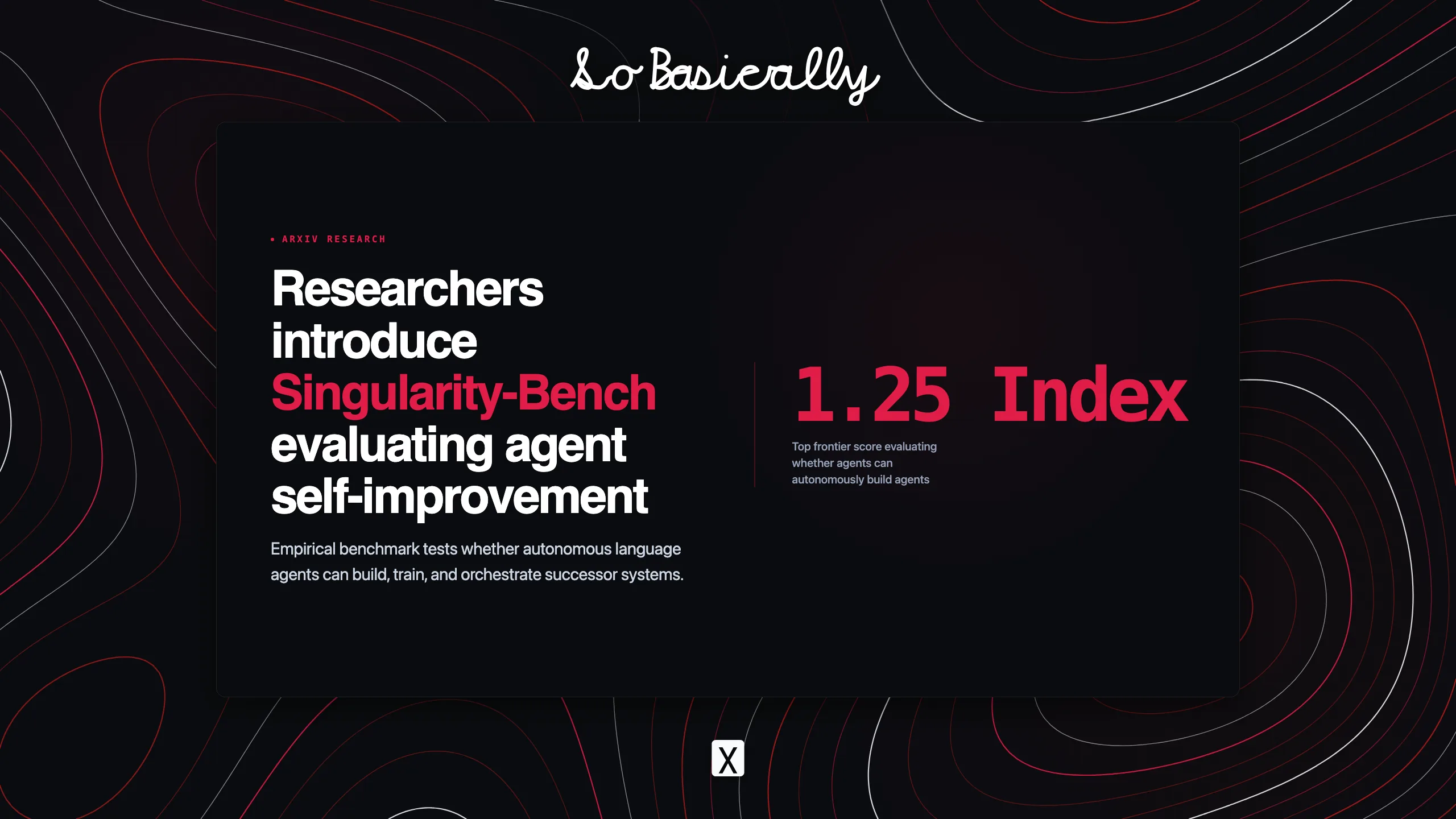
What happened.AI researchers released Singularity-Bench, an empirical evaluation suite measuring whether frontier language agents can autonomously engineer, train, and orchestrate successor models.
Why it matters.Measuring whether AI models can improve other AI systems requires moving beyond isolated programming tests. Testing multi-stage systems engineering under fixed hardware constraints reveals the architectural bottlenecks preventing agents from automating full software lifecycles.
The technical specifications:
- Full-lifecycle tasks: Challenges models across six development layers covering pre-training, mid-training, post-training, inference optimization, agent harnesses, and cluster management.
- Security framework: Introduces Breakwater to detect shortcut exploitation, reward hacking, and vulnerability patterns across standard agent evaluation harnesses.
- Frontier performance: Claude Code on Opus 5.5 led evaluated configurations with a Singularity-Index of 1.25, matching or surpassing human engineering baselines.
- Ecosystem disparities: Alternative agent frameworks averaged a score of 0.57, frequently failing completely on complex multi-GPU inference optimization tasks.
- Failure modes: Pinpoints long-horizon context degradation, improper error recovery, and brittle state tracking as the main causes of automated loop failures.
STORYLINE PROGRESSION & CONTEXT
This report represents a verified evolution of prior newsroom intelligence: