Skip to content
INTELLIGENCE BEAT2 Briefs

Simulation

2 Briefs

Verified technical decision briefs tracking simulation developments

Filter:

Researchers introduce MatScope benchmark evaluating AI agents on autonomous materials discovery

Topographic elevation contour card for Researchers introduce MatScope benchmark evaluating AI agents on autonomous materials discovery

What happened.AI researchers introduced MatScope, an empirical evaluation benchmark measuring whether autonomous multi-agent systems can execute scientific reasoning and candidate selection in materials laboratories.

Why it matters.Deploying generative models into physical chemistry and materials discovery requires strict adherence to thermodynamic constraints and synthesis laws. Providing structured benchmarks that measure multi-agent reasoning across realistic laboratory workflows gives industrial research teams clear guidance on model reliability.

↳Continues: Researchers introduce Singularity-Bench evaluating autonomous agent self-improvement
Read Full Brief →
Source:arXiv (opens in a new tab)
All Stories1 story
Decision brief card for Researchers release FrontierPhysics benchmark evaluating AI agents on end-to-end physics research

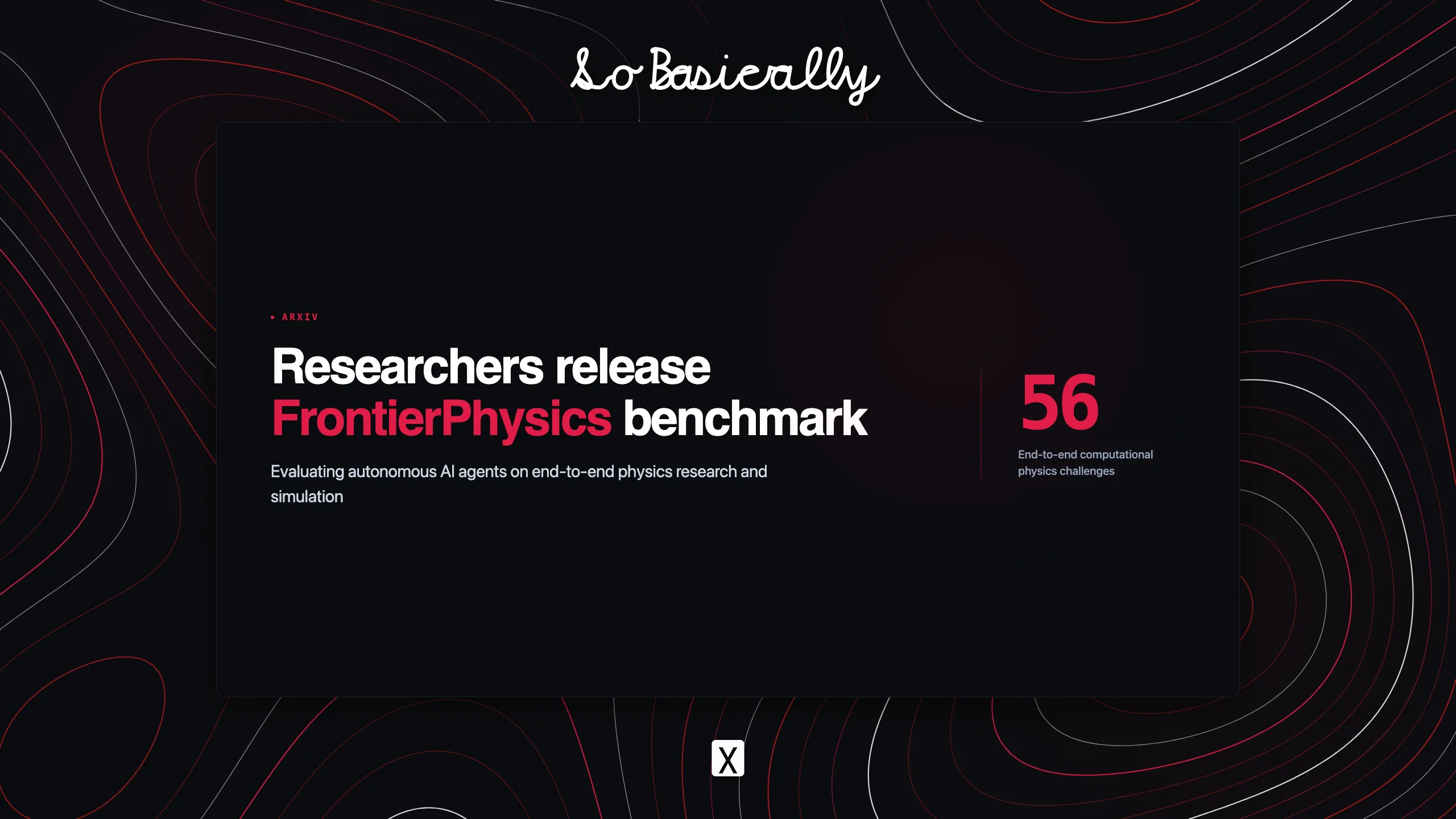
Researchers release FrontierPhysics benchmark evaluating AI agents on end-to-end physics research

What happened.Physicists and AI researchers released FrontierPhysics, an evaluation benchmark consisting of 56 expert-designed challenges measuring whether autonomous AI agents can independently complete physics research.

Why it matters.AI systems are transitioning from simple code completion assistants into autonomous scientific collaborators capable of independent research. Measuring where frontier agents succeed and fail across end-to-end computational physics challenges helps academic institutions deploy autonomous research agents safely.

  • Research domain: Covers theoretical mechanics, quantum computing simulations, astrophysics modeling, and condensed matter physics problems.
  • End-to-end execution: Requires agents to read research literature, formulate testable mathematical hypotheses, write simulation code, and produce publication-ready findings.
  • Capability baseline: Found that leading frontier models completely solve only 12 percent of challenges without human guidance due to code execution debugging loops.
  • Tool integration: Demonstrates that connecting agents to numerical solvers and symbolic algebra tools improves hypothesis validation success by 34 percent.
  • Expert rubrics: Employs peer-reviewed grading rubrics designed by practicing research physicists to evaluate experimental rigor and mathematical correctness.
Official Source:arXiv
Decision brief card for Researchers release FrontierPhysics benchmark evaluating AI agents on end-to-end physics research
↳Continues: Google DeepMind formally verifies Signal protocol code using AlphaProof Code
Read Brief
Source:arXiv (opens in a new tab)