Skip to content
INTELLIGENCE BEAT7 Briefs

Remote Code Execution

7 Briefs

Verified technical decision briefs tracking remote code execution developments

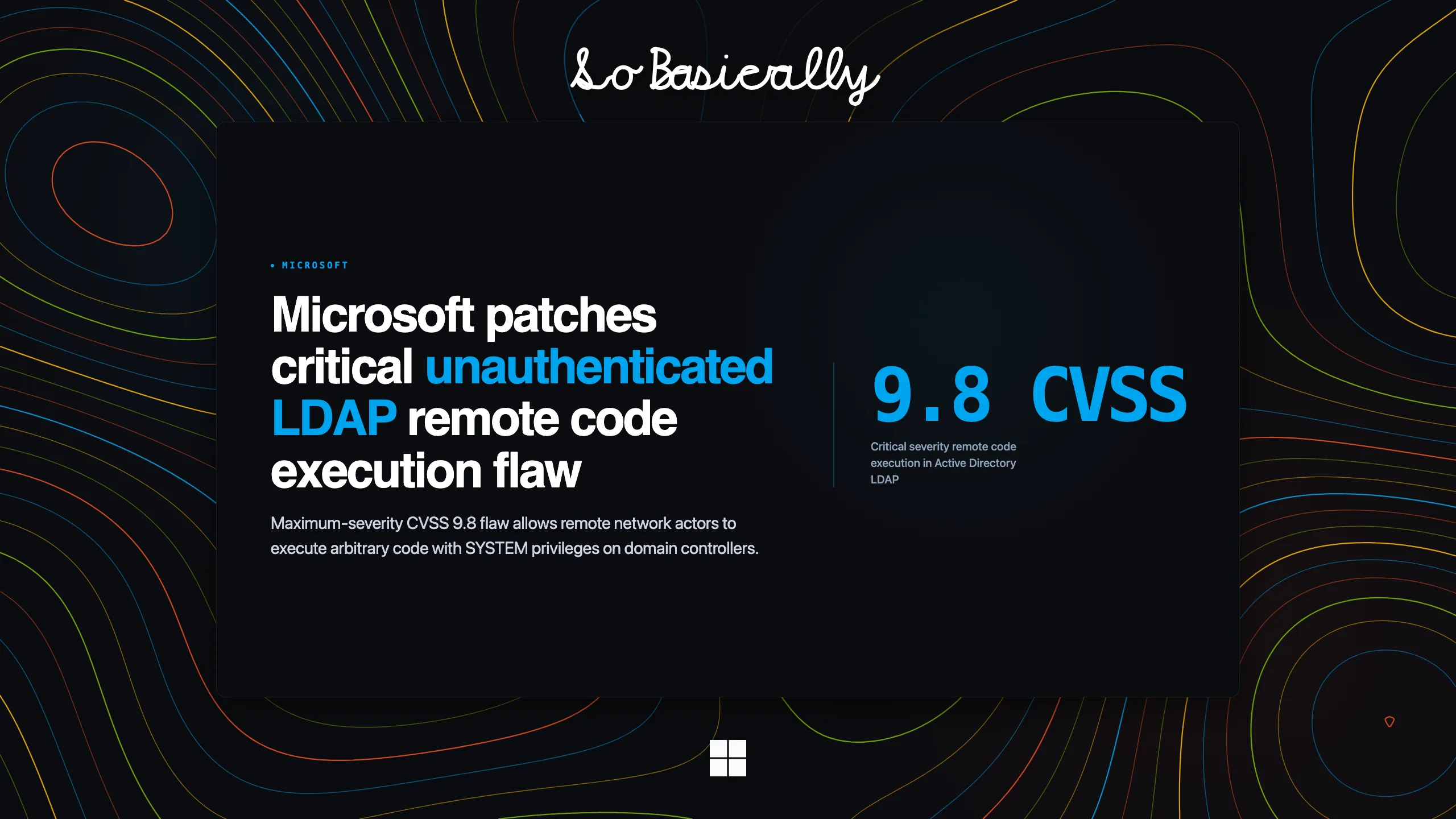
Microsoft patches critical unauthenticated LDAP remote code execution defect

Topographic elevation contour card for Microsoft patches critical unauthenticated LDAP remote code execution defect

What happened.Microsoft resolved a maximum-severity remote code execution flaw in Active Directory Lightweight Directory Access Protocol during its monthly security release.

Why it matters.Active Directory is the central identity authority for corporate enterprise networks worldwide. When unauthenticated network vulnerabilities permit arbitrary code execution on domain controllers, attackers gain administrative control over all domain assets. Enterprise systems engineers must apply the latest Windows Server security rollups to domain infrastructure immediately.

Read Full Brief →
Source:Microsoft Security Response Center (opens in a new tab)
All Stories6 stories
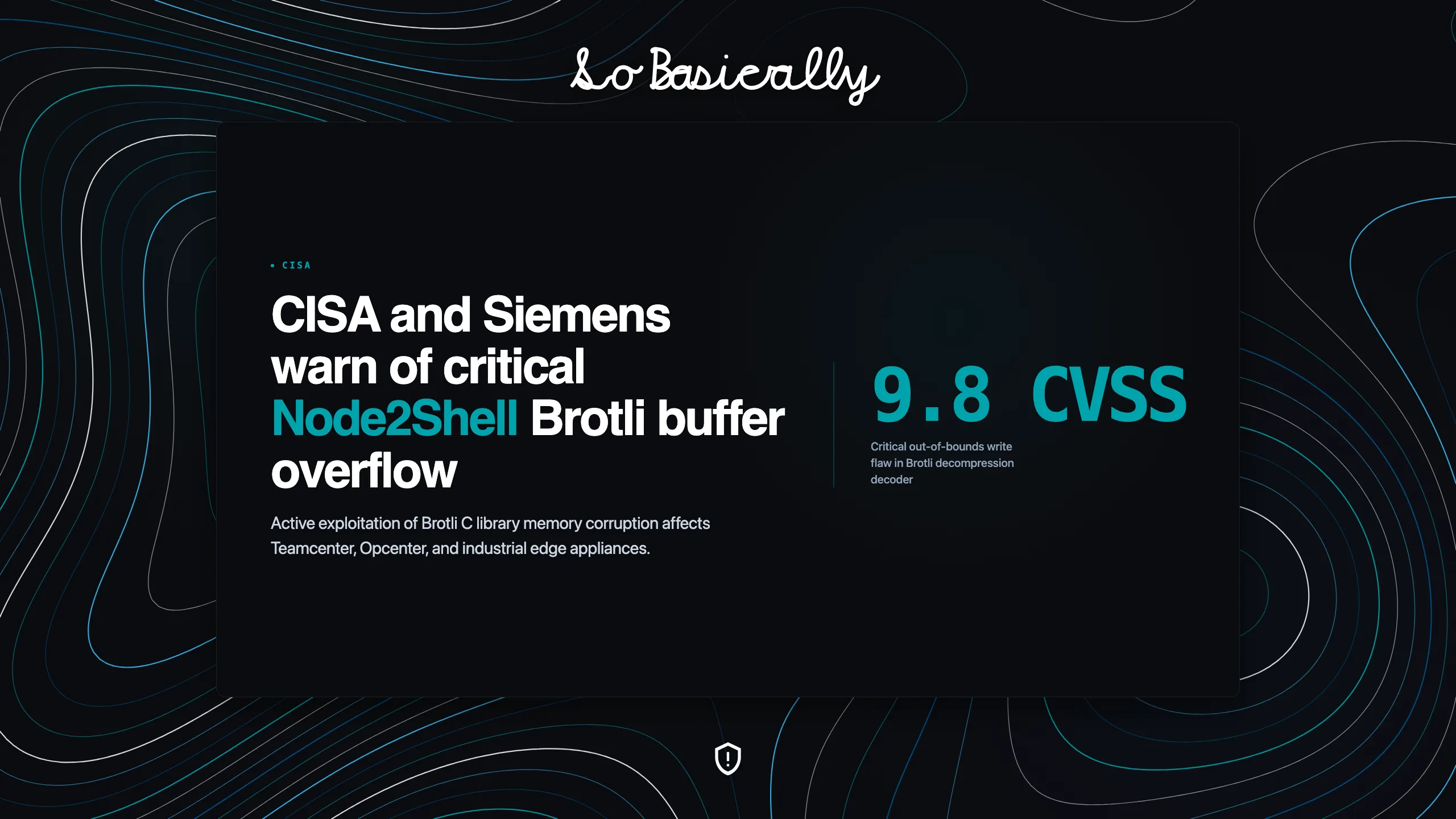
Decision brief card for CISA and Siemens warn of critical Node2Shell Brotli buffer overflow in industrial systems

CISA and Siemens warn of critical Node2Shell Brotli buffer overflow in industrial systems

What happened.CISA published industrial cybersecurity advisories as Siemens issued urgent security patches for critical out-of-bounds write flaws in the Brotli decompression library.

Why it matters.Open-source compression libraries link deeply into enterprise software runtimes and industrial operational hardware. When memory corruption bugs permit remote code execution through standard data parsing routines, attackers breach industrial networks through normal network communications. Infrastructure operators running Siemens edge appliances and manufacturing software must install vendor updates immediately. Security teams should enforce deep packet inspection on external data transfers feeding internal industrial platforms.

  • Vulnerability mechanics: Tracked as CVE-2026-111497 with a 9.8 CVSS score, the Node2Shell flaw resides in the C Brotli decompression decoder.
  • Exploit mechanism: Unauthenticated remote attackers deliver malformed compressed data streams that trigger memory corruption during stream decoding.
  • Industrial impact: Siemens confirmed vulnerability exposure across Teamcenter software, Opcenter applications, and RUGGEDCOM APE1808 edge communication modules.
  • Advisory publications: Siemens ProductCERT issued advisories SSA-242944 and SSA-678870 detailing software updates and recommended perimeter workarounds.
  • Federal tracking: CISA updated the Known Exploited Vulnerabilities catalog and published ICS advisory ICSA-26-316-02 to alert critical infrastructure operators.
Official Source:CISA
Decision brief card for CISA and Siemens warn of critical Node2Shell Brotli buffer overflow in industrial systems
Read Brief
Source:CISA (opens in a new tab)
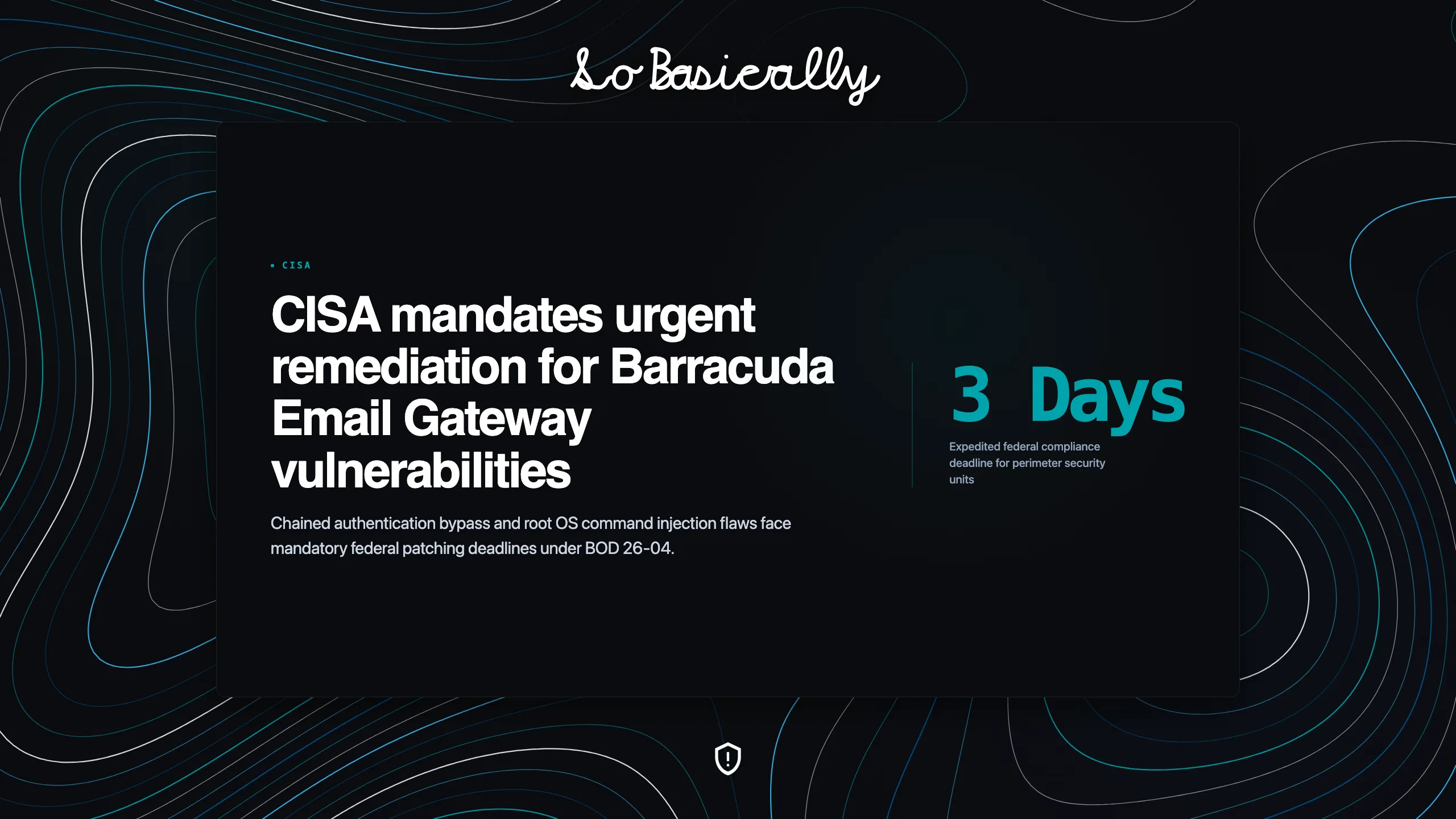
Decision brief card for CISA mandates urgent remediation deadline for Barracuda Email Gateway vulnerabilities

CISA mandates urgent remediation deadline for Barracuda Email Gateway vulnerabilities

What happened.CISA established an expedited three-day remediation deadline ordering federal agencies to patch chained remote code execution vulnerabilities in Barracuda Email Security Gateway appliances.

Why it matters.Email security appliances process inbound corporate communications and reside directly on the public internet perimeter. When chained zero-day vulnerabilities grant unauthenticated root access, threat groups establish persistent backdoors and exfiltrate confidential enterprise correspondence. Security administrators managing Barracuda appliances must verify that firmware hotfixes have applied across all physical and virtual units. Incident response teams should inspect network flow logs for unusual outbound connections from gateway appliances.

  • Vulnerability chaining: Attackers combine CVE-2026-116606 for authentication bypass with CVE-2026-111560 for arbitrary operating system command injection.
  • Root execution: The exploit sequence enables unauthenticated remote actors to bypass security boundaries and execute arbitrary commands with root privileges.
  • Active exploitation: Threat intelligence confirmed ongoing real-world campaigns targeting internet-facing enterprise email security gateway appliances.
  • Federal directive: CISA added both flaws to the Known Exploited Vulnerabilities catalog under Binding Operational Directive 26-04 with a strict deadline.
  • Vendor remediation: Barracuda distributed automated cloud patches and released hotfixes for customer-managed appliances to neutralize unauthorized command execution.
Official Source:CISA
Decision brief card for CISA mandates urgent remediation deadline for Barracuda Email Gateway vulnerabilities
Read Brief
Source:CISA (opens in a new tab)
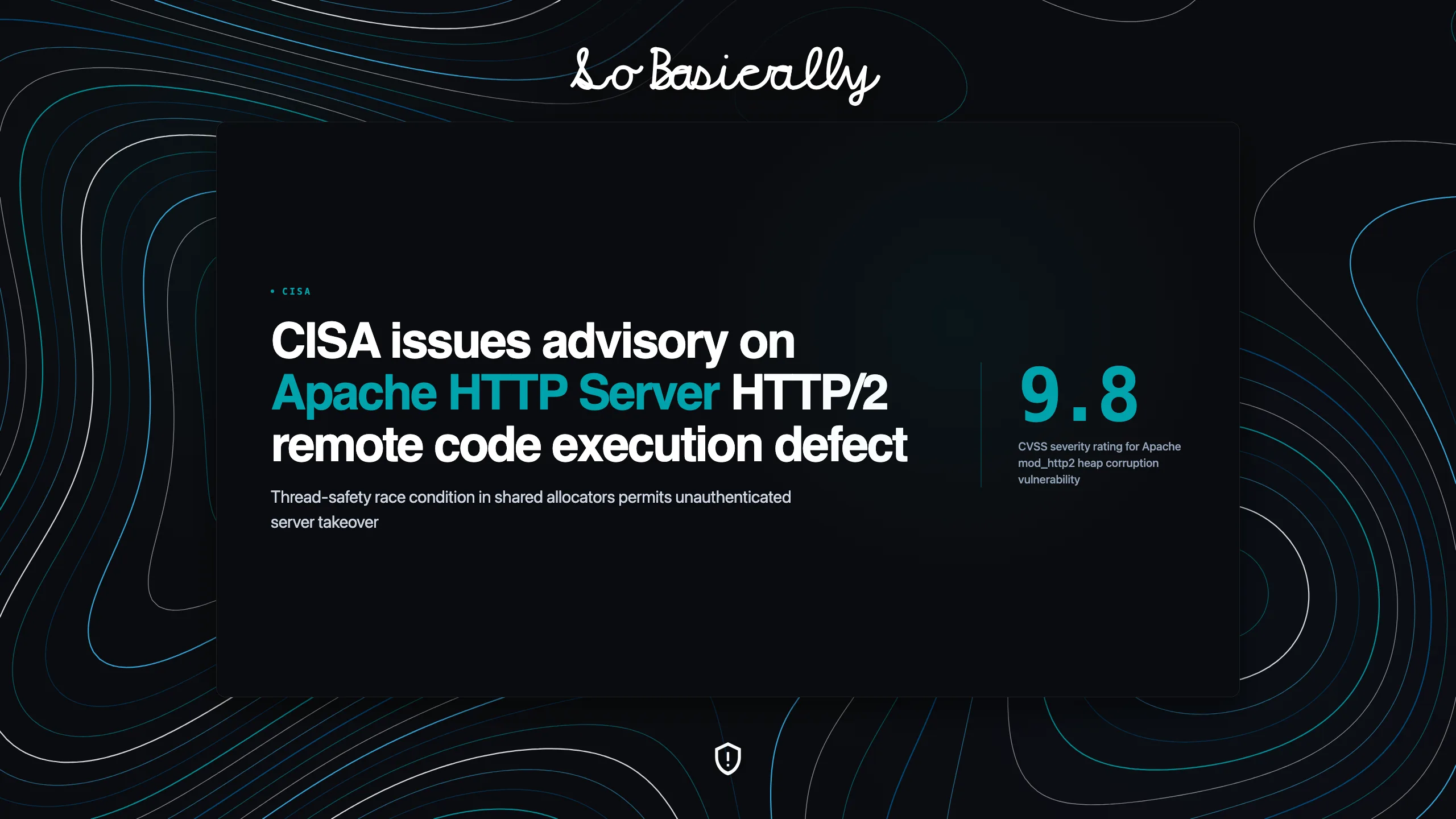
Decision brief card for CISA issues advisory on Apache HTTP Server HTTP/2 remote code execution defect

CISA issues advisory on Apache HTTP Server HTTP/2 remote code execution defect

What happened.The Apache Software Foundation patched a critical thread-safety vulnerability in mod_http2 as CISA warned of remote code execution risks across web infrastructure.

Why it matters.Apache HTTP Server powers web applications and proxies across enterprise networks. When thread-safety flaws permit remote code execution, attackers compromise edge servers without credentials. Administrators must upgrade web servers to Apache 2.4.71 immediately or disable h2 directives.

  • Vulnerability mechanics: Tracked as CVE-2026-119618 with a 9.8 CVSS score, the defect stems from improper synchronization in mod_http2 during concurrent header processing.
  • Race condition: Unauthenticated remote attackers flood servers with concurrent HTTP/2 requests, corrupting shared lock-free memory allocators in assign_headers.
  • Exploitation impact: The resulting heap corruption enables remote unauthenticated attackers to execute arbitrary code with web server process privileges.
  • Affected scope: The defect affects Apache HTTP Server versions 2.4.55 through 2.4.70 and mod_h2 releases 2.0.8 through 2.0.42 when HTTP/2 is active.
  • Remediation release: The Apache Software Foundation published Apache HTTP Server version 2.4.71, advising administrators to upgrade or restrict HTTP/2 protocols.
Official Source:NIST NVD
Decision brief card for CISA issues advisory on Apache HTTP Server HTTP/2 remote code execution defect
Read Brief
Source:NIST NVD (opens in a new tab)
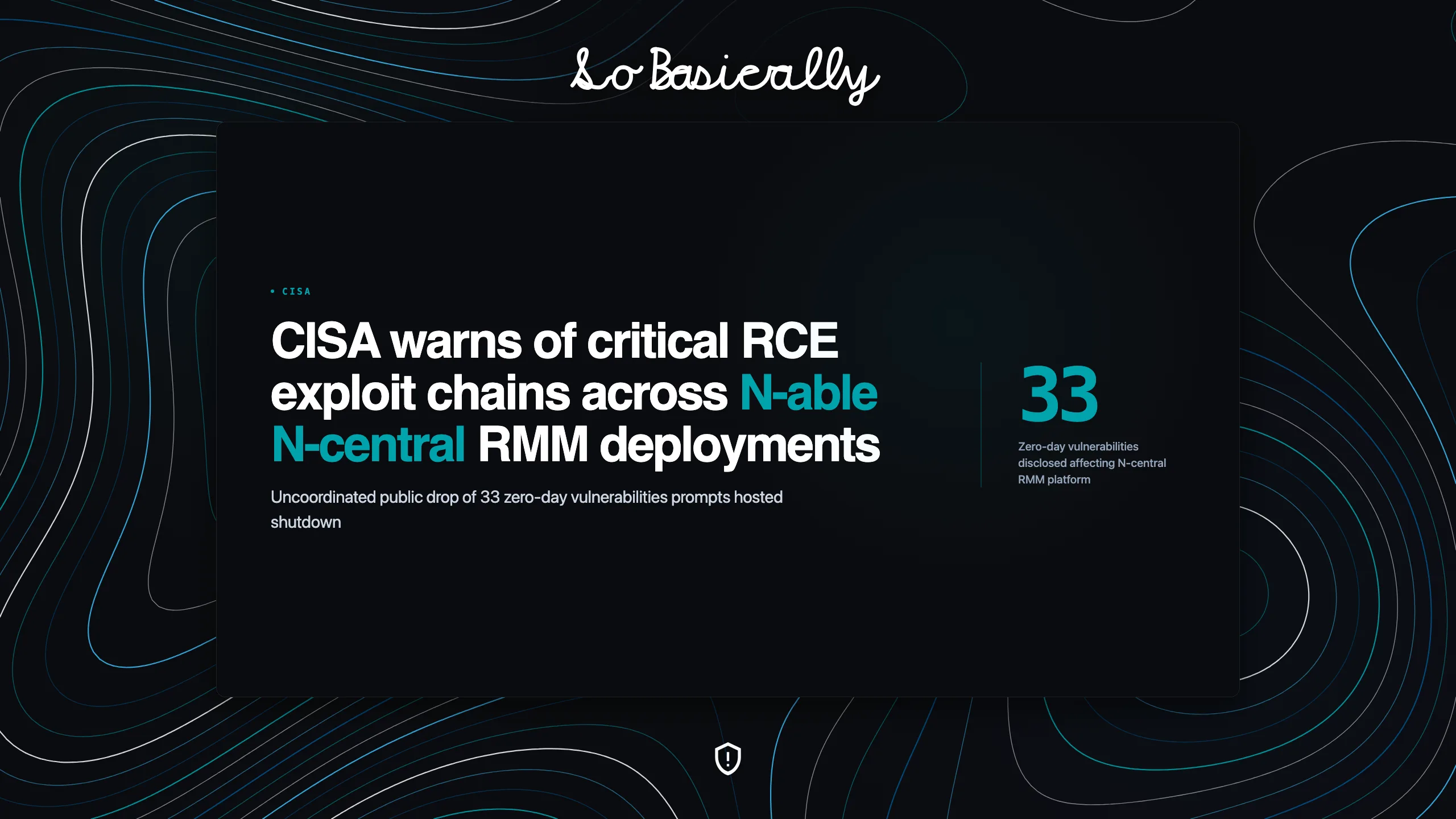
Decision brief card for CISA warns of critical RCE exploit chains across N-able N-central RMM deployments

CISA warns of critical RCE exploit chains across N-able N-central RMM deployments

What happened.CISA issued security guidance after researchers disclosed 33 zero-day vulnerabilities in N-able N-central, prompting emergency vendor cloud shutdowns and hotfixes.

Why it matters.Remote monitoring and management tools possess unrestricted administrative access to thousands of client endpoints across managed service providers. When chained zero-day flaws grant unauthenticated root execution, attackers pivot across enterprise IT perimeters simultaneously. Managed service providers must apply N-central 2026.4 Hotfix 2 immediately. Security teams should isolate on-premises management servers behind private virtual networks.

  • Public disclosure: An uncoordinated disclosure publicly dropped technical details and proof-of-concept exploits for 33 vulnerabilities affecting the N-central management platform.
  • Exploit mechanics: The disclosure demonstrated unauthenticated XML external entity injection chained with session handling flaws to achieve remote code execution as root.
  • Cloud shutdown: N-able temporarily took its hosted cloud environments offline across the Americas, EMEA, and APAC regions to prevent mass scanning exploitation.
  • On-premises advisory: The vendor urged on-premises customers to disconnect management servers until security patches were applied.
  • Remediation release: N-able released N-central 2026.4 Hotfix 2 to address the primary remote execution chain, with subsequent fixes addressing secondary defects.
Official Source:CISA
Decision brief card for CISA warns of critical RCE exploit chains across N-able N-central RMM deployments
Read Brief
Source:CISA (opens in a new tab)
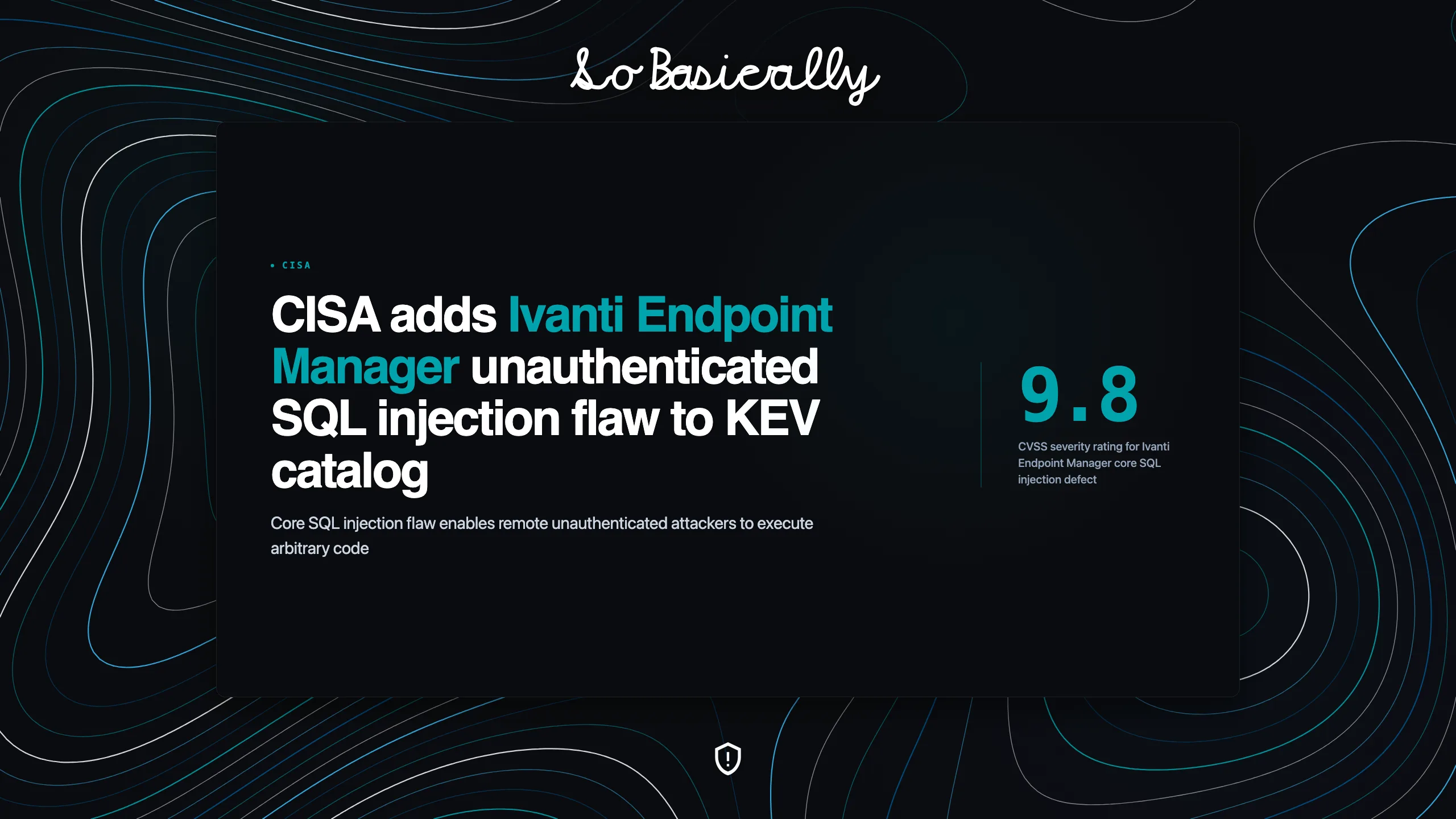
Decision brief card for CISA adds Ivanti Endpoint Manager unauthenticated SQL injection flaw to KEV catalog

CISA adds Ivanti Endpoint Manager unauthenticated SQL injection flaw to KEV catalog

What happened.CISA ordered federal civilian agencies to patch a critical unauthenticated SQL injection vulnerability in Ivanti Endpoint Manager core servers.

Why it matters.Endpoint management servers centralize software distribution, system inventory, and administrative credentials across enterprise networks. When SQL injection defects grant unauthenticated remote code execution on core controllers, intruders compromise internal domain assets. Infrastructure administrators must update Ivanti Endpoint Manager to version 2024 SU8 immediately. Organizations should restrict administrative console access to dedicated internal networks.

  • Vulnerability mechanics: Tracked as CVE-2026-121653 with a 9.8 CVSS score, the defect stems from improper input neutralization in Ivanti Endpoint Manager Core.
  • Exploitation path: Remote unauthenticated attackers send crafted SQL commands over the network, achieving arbitrary code execution on the underlying management server.
  • Affected versions: The vulnerability impacts Ivanti Endpoint Manager Core version 2024 SU7 and all prior releases.
  • Related bulletin: Ivanti also addressed CVE-2026-121683, a 9.4 CVSS missing authentication flaw in its Cloud Services Application appliance.
  • Remediation release: Ivanti published Endpoint Manager version 2024 SU8, advising administrators to apply updates through the Ivanti License System.
Official Source:NIST NVD
Decision brief card for CISA adds Ivanti Endpoint Manager unauthenticated SQL injection flaw to KEV catalog
↳Continues: CISA adds Ivanti Connect Secure zero-days to KEV catalog
Read Brief
Source:NIST NVD (opens in a new tab)
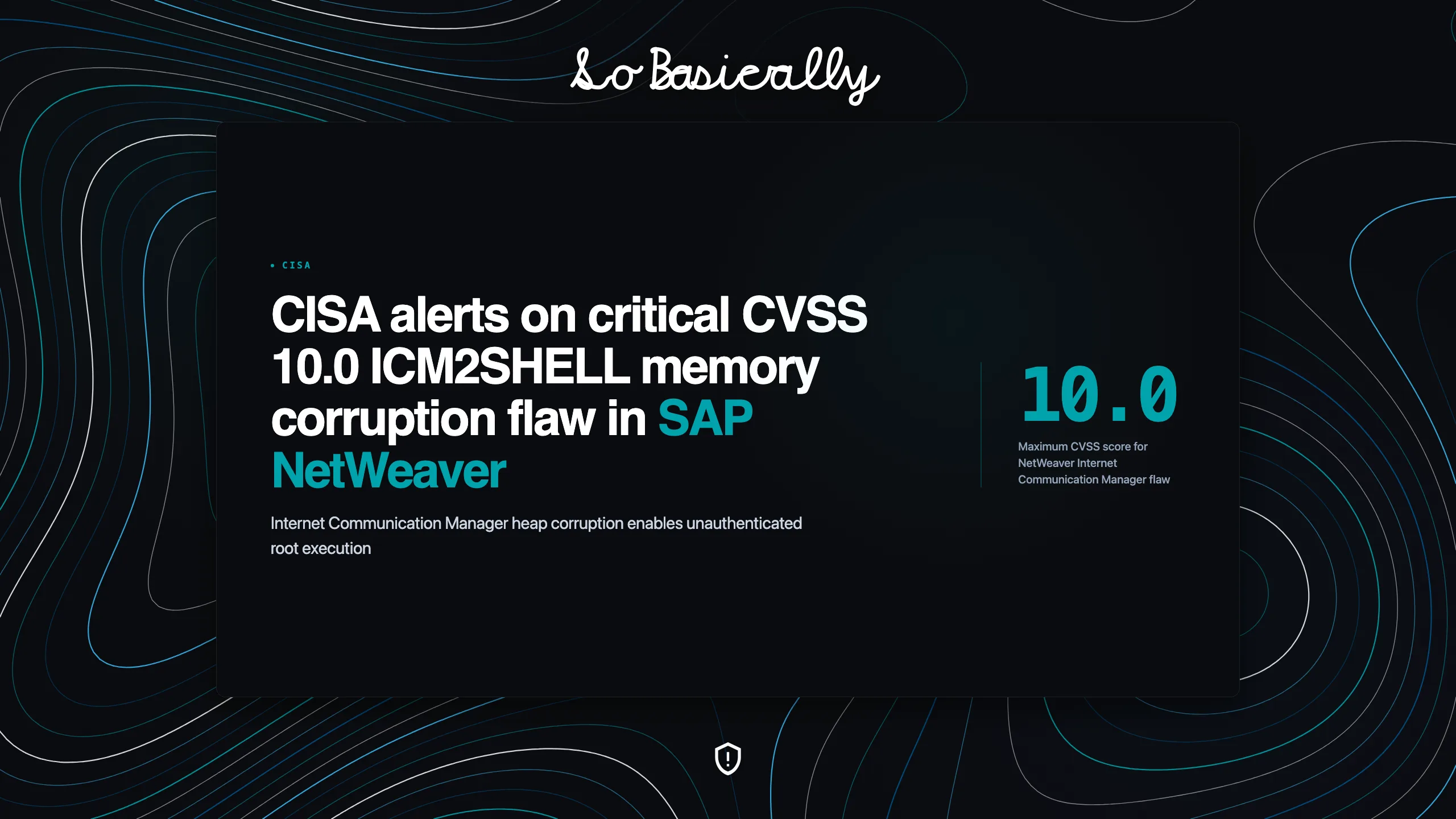
Decision brief card for CISA alerts on critical CVSS 10.0 ICM2SHELL memory corruption flaw in SAP NetWeaver

CISA alerts on critical CVSS 10.0 ICM2SHELL memory corruption flaw in SAP NetWeaver

What happened.CISA issued an urgent advisory after SAP patched four maximum-severity CVSS 10.0 flaws, headed by an unauthenticated memory corruption flaw in NetWeaver.

Why it matters.SAP NetWeaver underpins mission-critical enterprise resource planning, supply chain management, and corporate financial databases globally. When memory corruption vulnerabilities permit unauthenticated remote code execution, attackers compromise entire enterprise operational backbones. Enterprise IT teams must apply SAP kernel corrections across all NetWeaver instances immediately. Security teams should restrict Internet Communication Manager ports from public internet routing.

  • Vulnerability mechanics: Tracked as CVE-2026-76964 in security note 3778530, the defect resides in the Internet Communication Manager of NetWeaver AS ABAP.
  • Exploit method: Unauthenticated remote attackers send crafted WebSocket control frames with malformed length fields, triggering an out-of-bounds heap write.
  • System compromise: Successful exploitation grants remote code execution under the privileges of the system installation user without user interaction.
  • Authentication bypass: SAP also resolved CVE-2026-120017 in note 3849308, addressing missing cryptographic verification in SAML2 Service Providers.
  • Remediation releases: SAP published security updates across affected NetWeaver kernels, urging teams to patch internet-facing enterprise resource systems immediately.
Official Source:NIST NVD
Decision brief card for CISA alerts on critical CVSS 10.0 ICM2SHELL memory corruption flaw in SAP NetWeaver
Read Brief
Source:NIST NVD (opens in a new tab)