Skip to content
INTELLIGENCE BEAT2 Briefs

Computer Vision

2 Briefs

Verified technical decision briefs tracking computer vision developments

Filter:

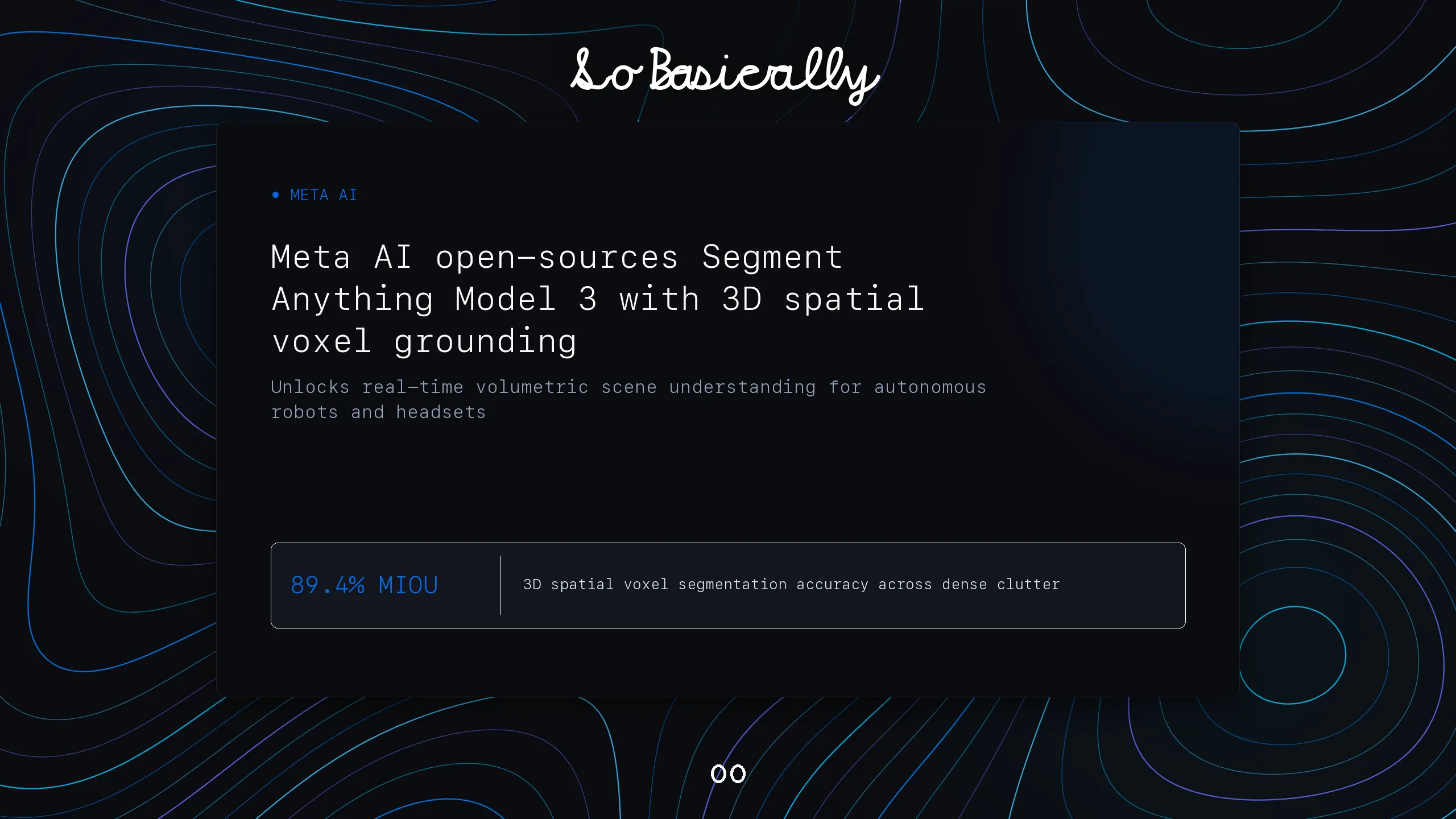
Meta AI open-sources Segment Anything Model 3 with 3D spatial voxel grounding
Topographic elevation contour card for Meta AI open-sources Segment Anything Model 3 with 3D spatial voxel grounding

What happened.Meta AI released Segment Anything Model 3 under an open-source license, expanding foundation vision segmentation from two-dimensional images into three-dimensional point clouds and volumetric voxel grids.

Why it matters.Autonomous driving vehicles and delivery robots require precise spatial awareness to navigate around physical obstacles safely. Open foundation models for 3D segmentation allow robotics engineers to build spatial navigation stacks without collecting proprietary training datasets.
↳Continues: Researchers use Meta open-weight AI models to accelerate medical breakthroughs
Read Full Brief →
Source:Meta AI (opens in a new tab)
All Stories1 story
Decision brief card for Meta FAIR and NYU unbundle multimodal vision encoding recipes

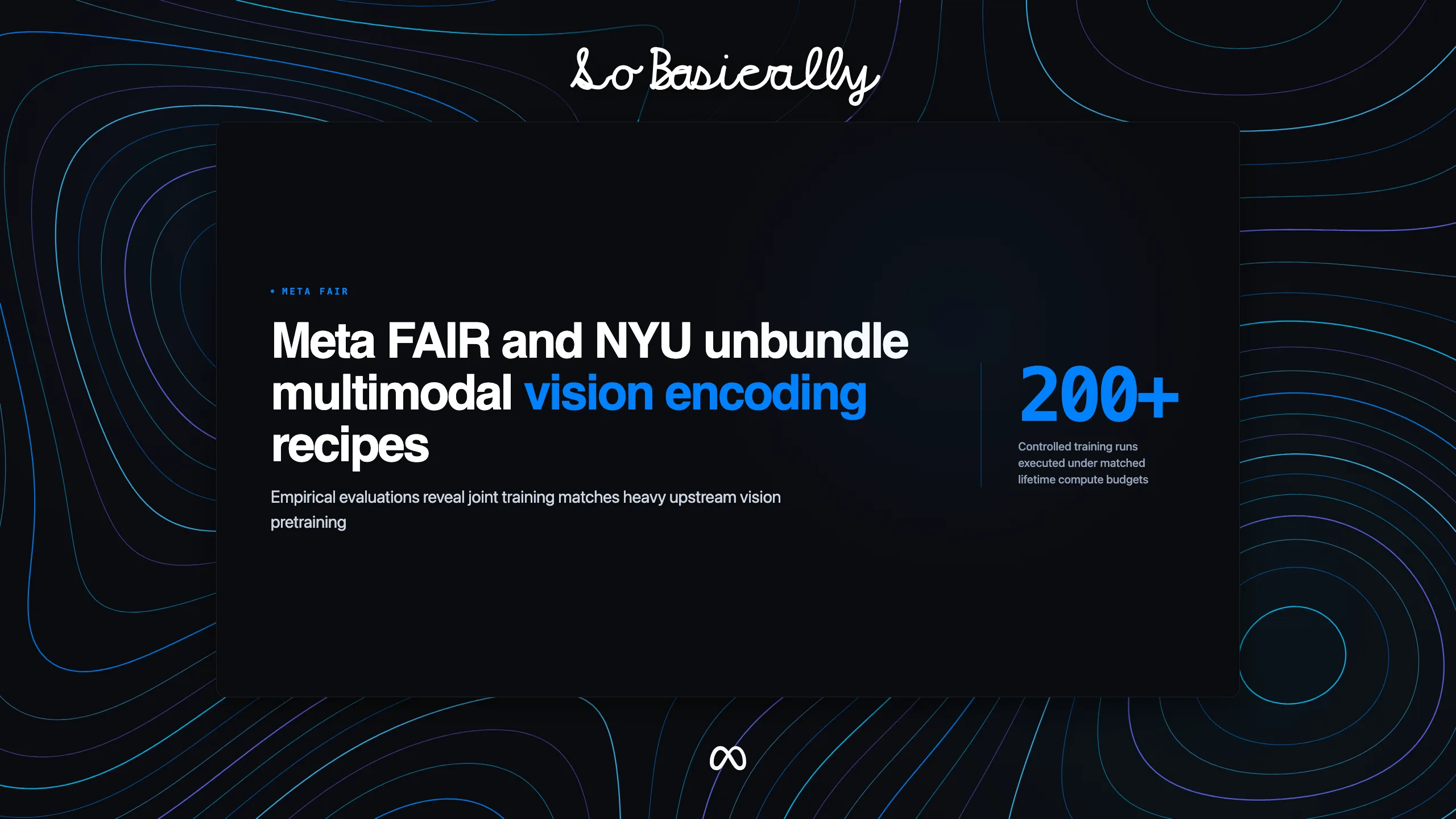
Meta FAIR and NYU unbundle multimodal vision encoding recipes

What happened.Meta Fundamental AI Research and New York University released a comprehensive empirical study isolating visual encoding choices in multimodal language models.

Why it matters.Developers building multimodal models have inherited legacy two-stage vision training pipelines without verifying whether standalone vision pretraining adds value. Disentangling encoder designs allows engineering teams to train efficient vision-language models in a single training run.

  • Controlled evaluations: Executed over two hundred training runs from scratch under matched lifetime compute budgets to compare encoder designs.
  • Pretraining findings: Proves that training visual encoders from scratch jointly with language models matches the accuracy of heavy upstream contrastive pretraining.
  • Capacity requirements: Discloses that encoder-free models dumping raw image patches into language backbones degrade visual understanding even when parameter counts match.
  • In-fusion placement: Demonstrates that placing dedicated visual parameters inside early language layers matches pre-fusion encoders while reducing time-to-first-token latency.
Official Source:Meta AI
Decision brief card for Meta FAIR and NYU unbundle multimodal vision encoding recipes
↳Continues: Meta FAIR introduces Self-Improving Memory for autonomous AI agents
Read Brief
Source:Meta AI (opens in a new tab)