 MetaAnalysis
Researchers use Meta open-weight AI models to accelerate medical breakthroughs

Listen to Briefing
0:00/1:49
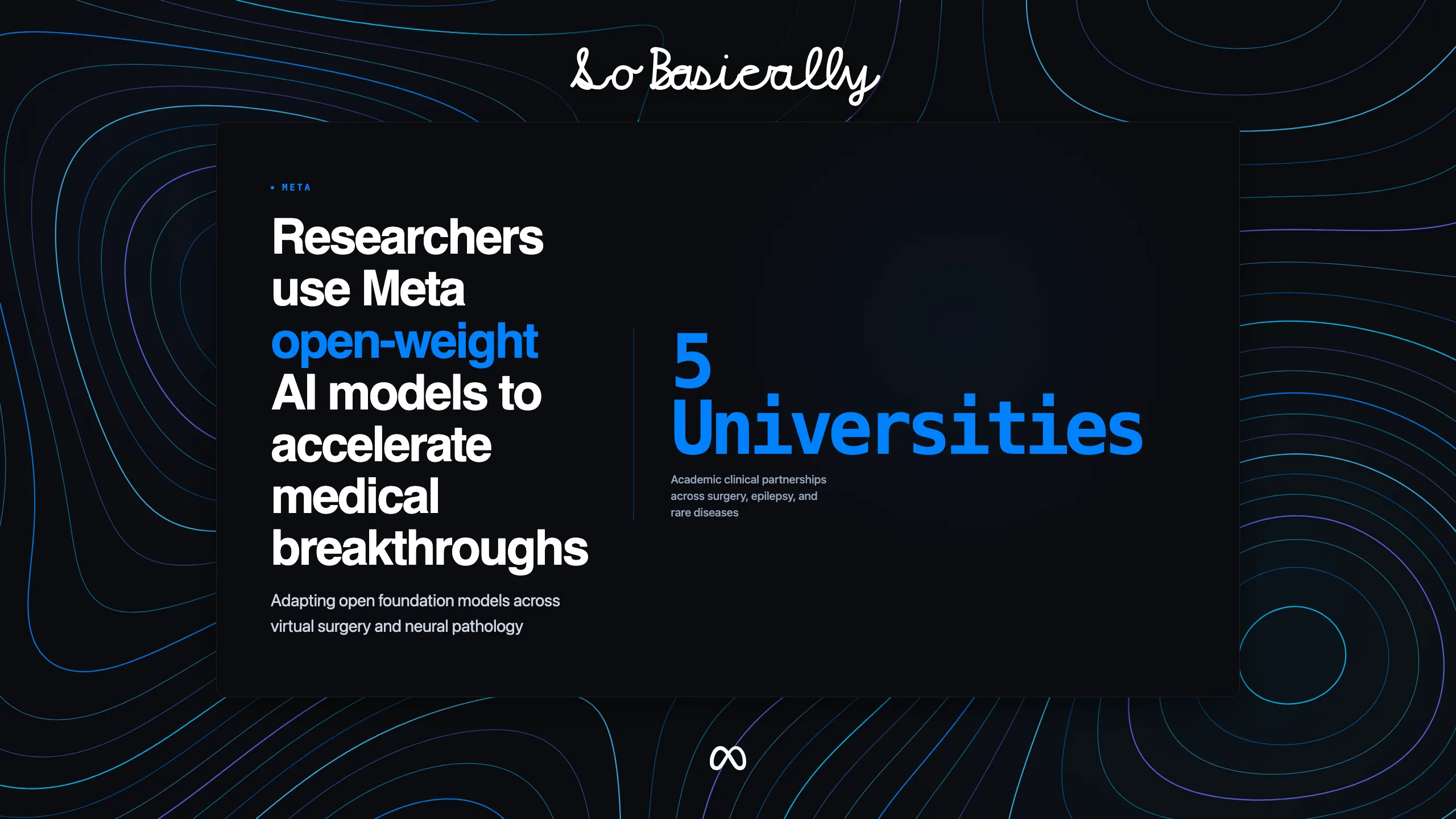
What happened.Meta partnered with academic medical centers to adapt open-weight foundation models. The initiative targets virtual surgical training, epilepsy localization, and rare disease pathology.
Why it matters.Clinical software developers often face restrictive terms and compliance hurdles when deploying proprietary commercial models in healthcare settings. Permissive open-weight architectures allow engineering teams to run multimodal models on private clinical servers without risking sensitive patient records.
The technical specifications:
- Virtual surgical training: Dr. Peter DeBlieux and Louisiana State University researchers created COPES. The coaching system pairs Quest headsets with Muse Glimmer to guide medical trainees during complex procedures.
- Epilepsy source localization: Dr. Pierre Bourdillon at Rothschild Hospital Foundation implemented brain simulation pipelines using Brain2Qwertyv2. The models identify seizure pathways that standard imaging scans miss.
- Cellular pathology decoding: Dr. Wolfgang Pernice at Columbia University adapted DINO models into Cell-DINO and FINO. The tools generate unbiased representations of cellular microscopy to speed rare disease drug discovery.
- Academic research grants: Meta expanded open science funding across five American research universities without proprietary licensing constraints.
STORYLINE PROGRESSION & CONTEXT
This report represents a verified evolution of prior newsroom intelligence: