Skip to content
SoBasicallyVOL. I · RUN 2026-11-24-ai-technology
ARCHIVAL EDITION2026-11-24-ai-technology8 STORIES · 1542 WORDS
← Back to Archive
DAILY BRIEFTUESDAY, NOVEMBER 24, 202619 MIN

CISA mandates federal remediation for MONAI medical imaging and...

0:00
-19:26

NVIDIA Board reinstates Jensen Huang as CEO and Director

Topographic elevation contour card for NVIDIA Board reinstates Jensen Huang as CEO and Director

What happened.NVIDIA's Board of Directors announced the unanimous reinstatement of founder Jensen Huang as President, Chief Executive Officer, and Board Director, concluding an eleven-day interim leadership transition.

Why it matters.Executive stability at the primary artificial intelligence hardware supplier anchors multi-year infrastructure investments for software teams and cloud providers. The rapid resolution of leadership uncertainty reassures global enterprise customers who depend on predictable delivery schedules for high-performance computing clusters.

↳Continues: NVIDIA reports record $115B Q3 revenue under Colette Kress
Read Full Brief →
Source:NVIDIA Newsroom (opens in a new tab)
VERIFIED STORIES IN THIS EDITION7 STORIES
Decision brief card for Cisco and OpenAI launch Shirudo open-source autonomous security infrastructure

Cisco and OpenAI launch Shirudo open-source autonomous security infrastructure

What happened.Cisco and OpenAI released Shirudo, an open-source framework pairing Linux kernel tracing with autonomous reasoning models to defend production systems before vendor patches deploy.

Why it matters.The interval between software vulnerability disclosure and widespread automated exploit scripts has shrunk from weeks to minutes, overwhelming manual engineering teams. Automated kernel-level micro-shields allow platform operators to block hostile network packets across distributed clusters while permanent code fixes undergo review.

  • Kernel-level interception: Deploys dynamic bytecode micro-mitigations directly into the Linux operating system kernel using Extended Berkeley Packet Filter technology without restarting host applications.
  • Agent mitigation synthesis: Uses OpenAI Codex reasoning agents to inspect incoming vulnerability reports, write targeted filter policies, and test mitigations against production workload traffic.
  • Cryptographic safety: Enforces kernel verifier safety checks and Trusted Platform Module hardware signatures before runtime code blocks network packets.
  • Exploit validation: Neutralized active remote code execution attacks against Java and PHP server defects in staging environments without interrupting active services. Systems stay online.
Official Source:OpenAI
Decision brief card for Cisco and OpenAI launch Shirudo open-source autonomous security infrastructure
↳Continues: OpenAI details Performance Factory autonomous engineering system
Read Brief
Source:OpenAI (opens in a new tab)
Decision brief card for Anthropic launches Claude Ship for automated pull request workflows

Anthropic launches Claude Ship for automated pull request workflows

What happened.Anthropic launched Claude Ship, an agentic developer suite integrated into GitHub repositories to automate code review, continuous integration repair, and policy-governed pull request approvals.

Why it matters.As generative coding assistants dramatically increase code production volumes, human pull request review has become a severe engineering bottleneck. Automating repetitive review-fix-merge cycles under repository policies accelerates software deployment velocity without compromising codebase integrity.

  • Code Review availability: Evaluates code pull requests across repository contexts, filtering stylistic noise to highlight genuine logic flaws and security issues with configurable review depths.
  • Pull request steward: Automatically responds to failing test suites, linting errors, and merge conflicts by committing code repairs directly to feature branches.
  • Claude Approvals: Evaluates pull requests against machine-readable team policies stored in repository trees, automatically merging low-risk modifications while routing complex changes to human engineers.
  • Authority boundaries: Decouples bug fixing permissions from final merge authority, preventing repair agents from self-approving their own code submissions.
Official Source:Anthropic
Decision brief card for Anthropic launches Claude Ship for automated pull request workflows
↳Continues: Anthropic expands Computer Use beta to Team and Enterprise
Read Brief
Source:Anthropic (opens in a new tab)
Decision brief card for Google DeepMind and Quantum AI discover verified quantum programs with Gemini

Google DeepMind and Quantum AI discover verified quantum programs with Gemini

What happened.Google DeepMind and Google Quantum AI published research detailing Gemini agent teams discovering and optimizing quantum algorithms formally verified with the Lean 4 interactive theorem prover.

Why it matters.Quantum computing algorithms scaling across thousands of logical qubits exceed the simulation capabilities of classical supercomputers. Combining autonomous reasoning models with formal proof engines guarantees circuit correctness before scheduling expensive jobs on physical quantum hardware.

  • Spacetime reduction: Slashing quantum circuit spacetime volume by over two hundred ninety times on twenty-five-bit arcsin state preparation, reducing non-Clifford gate counts to thirty-six hundred across one hundred qubits.
  • Physical simulation gains: Lowered required quantum resources by eleven point eight times for warm dense plasma stopping power calculations and eight times for molecular photochemistry dynamics.
  • Formal verification: Formalized quantum Hoare logic inside the Lean theorem prover to verify algorithm preconditions, execution invariants, and postconditions without approximation.
  • Open repository: Released problem specifications and verified Lean quantum modules publicly on GitHub to support reproducible scientific discovery.
Official Source:Google DeepMind
Decision brief card for Google DeepMind and Quantum AI discover verified quantum programs with Gemini
↳Continues: Google DeepMind unveils AlphaProof Code to formally verify software, Google DeepMind releases Gemini 4 Hydrogen for agentic workflows
Read Brief
Source:Google DeepMind (opens in a new tab)
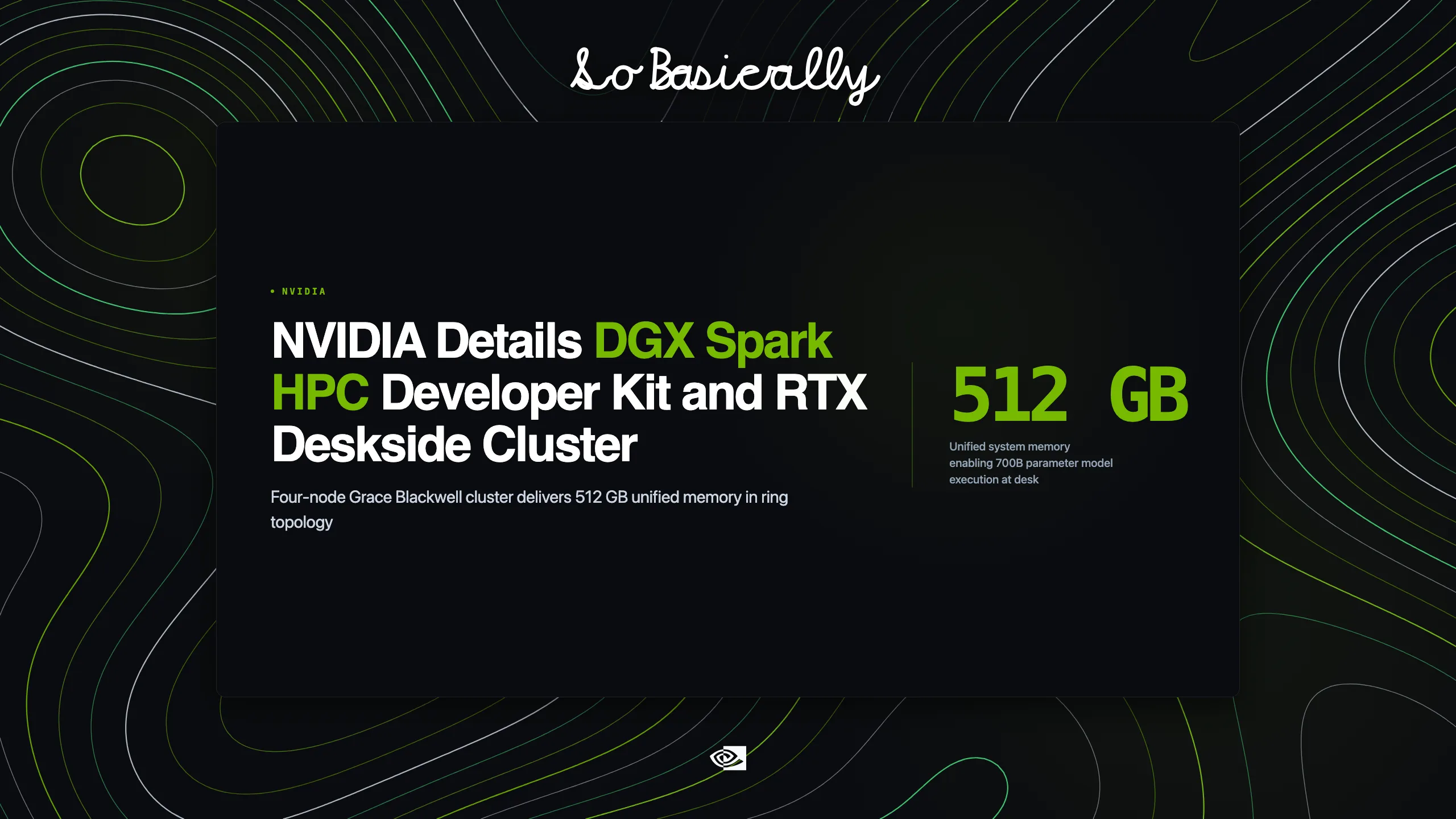
Decision brief card for NVIDIA details DGX Spark HPC Developer Kit and RTX Spark deskside cluster

NVIDIA details DGX Spark HPC Developer Kit and RTX Spark deskside cluster

What happened.NVIDIA detailed the DGX Spark HPC Developer Kit, introducing a four-node deskside supercomputing cluster powered by GB10 Grace Blackwell Superchips configured in a switchless ring topology.

Why it matters.Computational scientists frequently endure multiday delays waiting in shared supercomputer job queues to debug multi-node distributed code. Providing deskside multi-node Grace Blackwell hardware allows research teams to validate distributed communication primitives locally before launching massive jobs on cloud clusters.

  • Switchless ring topology: Connects four Grace Blackwell nodes directly using ConnectX-7 high-speed networking adapters, eliminating external enterprise network switch requirements.
  • Unified memory footprint: Delivers five hundred twelve gigabytes of unified system memory across the cluster, enabling local execution of models containing up to seven hundred billion parameters.
  • Scientific software bundles: Ships pre-configured with containerized scientific packages including LAMMPS molecular dynamics, NeMo agent frameworks, and Kokkos parallel programming runtimes.
  • OEM market availability: System manufacturers including ASUS and MSI opened general shipments of RTX Spark compact systems equipped with one hundred twenty-eight gigabytes of memory for local agent workflows.
Official Source:NVIDIA Blog
Decision brief card for NVIDIA details DGX Spark HPC Developer Kit and RTX Spark deskside cluster
↳Continues: NVIDIA launches Nemotron for Science and LitmusBench dataset
Read Brief
Source:NVIDIA Blog (opens in a new tab)
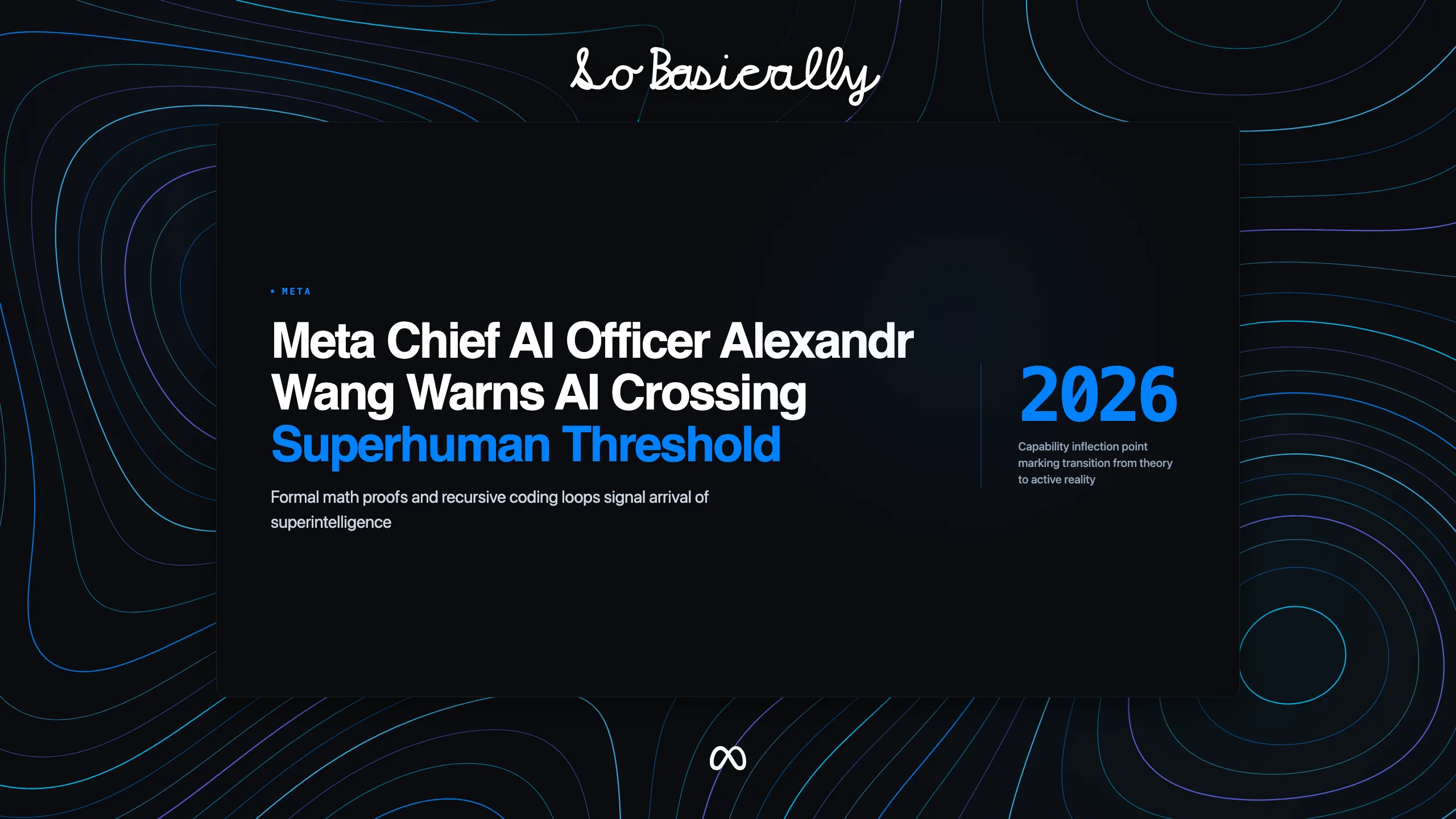
Decision brief card for Meta Chief AI Officer Alexandr Wang warns AI crossing superhuman threshold

Meta Chief AI Officer Alexandr Wang warns AI crossing superhuman threshold

What happened.Meta Chief AI Officer Alexandr Wang published an assessment warning that recent autonomous mathematical proofs and recursive software loops indicate frontier artificial intelligence systems are entering superhuman territory.

Why it matters.When technical leadership at major open-source research organizations issues public superintelligence warnings, it marks an important turning point for industry governance. Consensus regarding superhuman capability thresholds accelerates formal verification requirements and international safety coordination across frontier labs.

  • Empirical milestone: Points to machine-checked mathematical proofs and automated kernel patch synthesis as direct evidence of superhuman analytical reasoning in production models.
  • Timeline revision: Argues that artificial superintelligence is transitioning from a distant academic debate into an active engineering reality that requires immediate institutional preparation.
  • Safety protocols: Calls on frontier laboratories and public authorities to establish binding safety benchmarks, alignment verifications, and infrastructure monitoring standards.
  • Open research posture: Reaffirms Meta's commitment to open foundation model research while advocating for third-party auditing standards across autonomous agent systems.
Official Source:Meta Newsroom
Decision brief card for Meta Chief AI Officer Alexandr Wang warns AI crossing superhuman threshold
↳Continues: Anthropic mathematician claims Riemann Hypothesis proof using Claude, Meta FAIR and NYU unbundle multimodal vision encoding recipes
Read Brief
Source:Meta Newsroom (opens in a new tab)
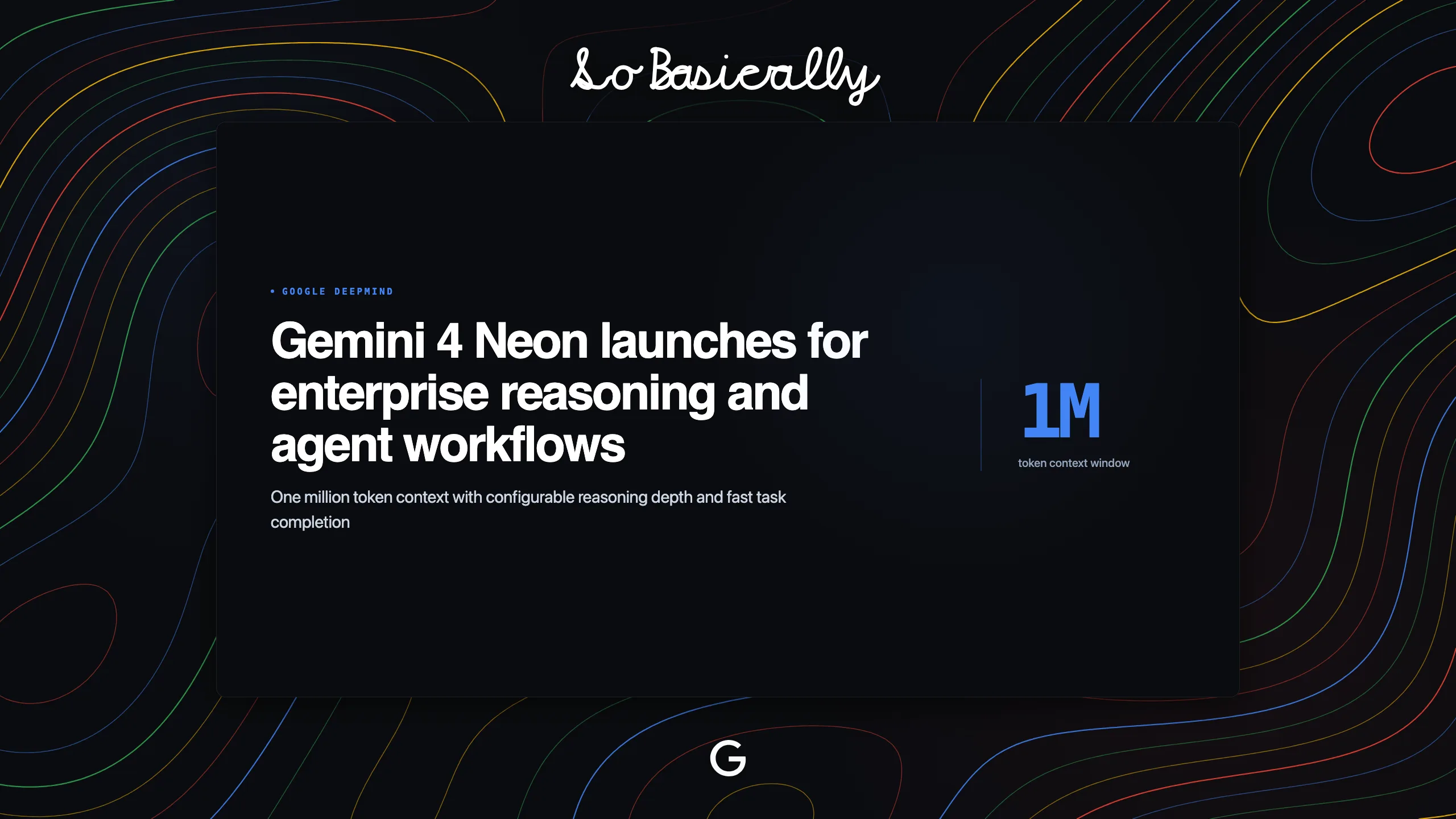
Decision brief card for Google DeepMind releases Gemini 4 Neon for enterprise reasoning

Google DeepMind releases Gemini 4 Neon for enterprise reasoning

What happened.Google DeepMind released Gemini 4 Neon, introducing a frontier reasoning model optimized for end-to-end software engineering and enterprise workflows.

Why it matters.Deploying frontier reasoning models across production developer environments has historically required choosing between extreme latency and prohibitive token costs. Providing a mid-tier model with deep reasoning and cached pricing enables teams to automate multi-turn coding and analytical pipelines reliably.

  • Context window: Delivers a one-million-token unified context window with long-decode capabilities to ingest full code repositories and technical documents.
  • Thinking levels: Provides four configurable reasoning levels, allowing engineering teams to balance inference speed against mathematical deliberation depth.
  • Inference economics: Prices input tokens at three dollars per million with a ninety-five percent cache discount, alongside fifteen dollars per million output tokens.
  • Platform availability: Launches across the Gemini Application Programming Interface, Google Artificial Intelligence Studio, Google Antigravity, and Vertex AI.
Official Source:Google The Keyword
Decision brief card for Google DeepMind releases Gemini 4 Neon for enterprise reasoning
↳Continues: Google DeepMind releases Gemini 4 Hydrogen for agentic workflows, Google DeepMind unveils Genie 4 real-time interactive world model
Read Brief
Source:Google The Keyword (opens in a new tab)
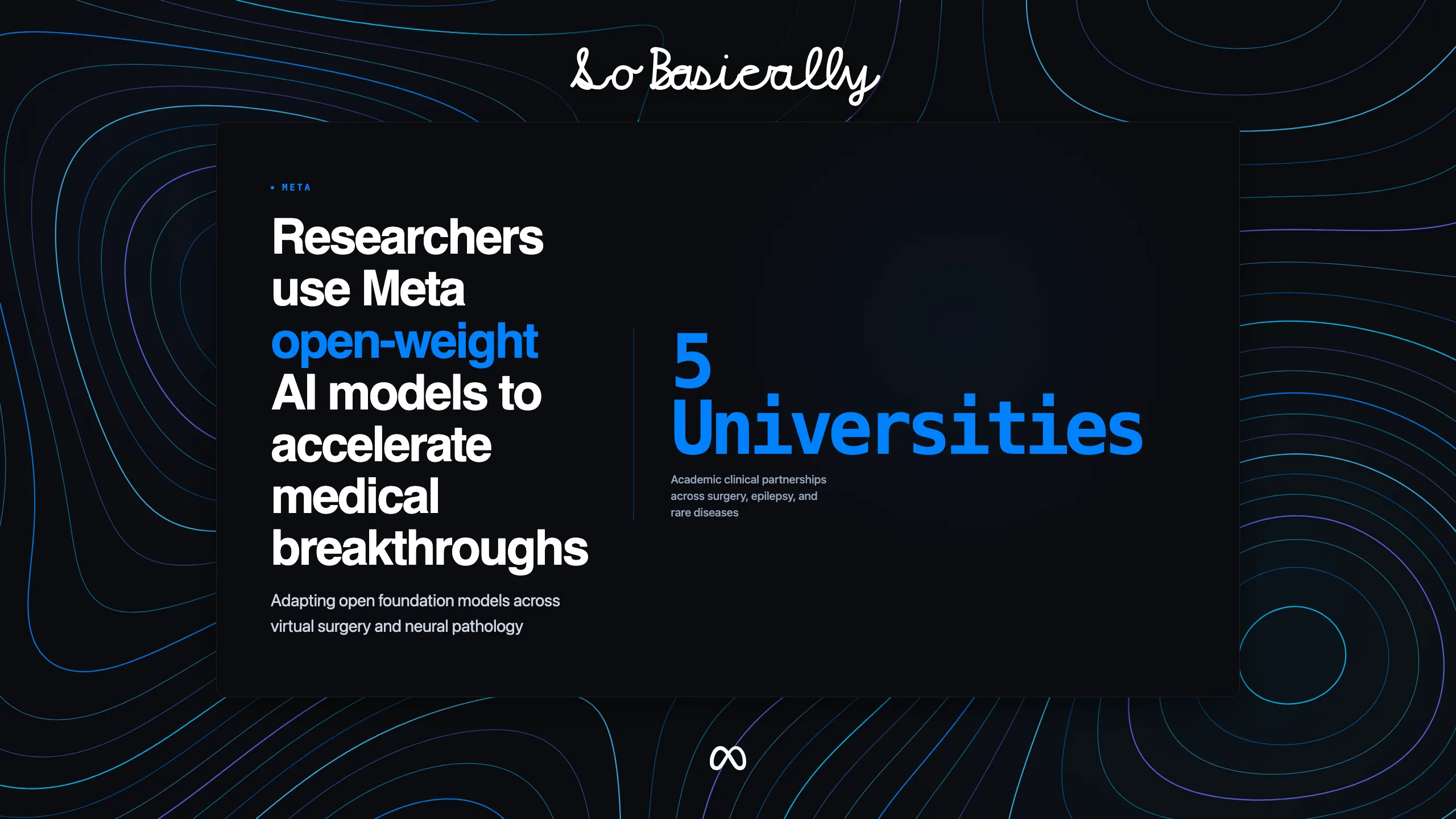
Decision brief card for Researchers use Meta open-weight AI models to accelerate medical breakthroughs

Researchers use Meta open-weight AI models to accelerate medical breakthroughs

What happened.Meta partnered with academic medical centers to adapt open-weight foundation models. The initiative targets virtual surgical training, epilepsy localization, and rare disease pathology.

Why it matters.Clinical software developers often face restrictive terms and compliance hurdles when deploying proprietary commercial models in healthcare settings. Permissive open-weight architectures allow engineering teams to run multimodal models on private clinical servers without risking sensitive patient records.

  • Virtual surgical training: Dr. Peter DeBlieux and Louisiana State University researchers created COPES. The coaching system pairs Quest headsets with Muse Glimmer to guide medical trainees during complex procedures.
  • Epilepsy source localization: Dr. Pierre Bourdillon at Rothschild Hospital Foundation implemented brain simulation pipelines using Brain2Qwertyv2. The models identify seizure pathways that standard imaging scans miss.
  • Cellular pathology decoding: Dr. Wolfgang Pernice at Columbia University adapted DINO models into Cell-DINO and FINO. The tools generate unbiased representations of cellular microscopy to speed rare disease drug discovery.
  • Academic research grants: Meta expanded open science funding across five American research universities without proprietary licensing constraints.
Official Source:Meta Newsroom
Decision brief card for Researchers use Meta open-weight AI models to accelerate medical breakthroughs
↳Continues: Meta FAIR and NYU unbundle multimodal vision encoding recipes
Read Brief
Source:Meta Newsroom (opens in a new tab)
CANDIDATE INTELLIGENCE · UNVERIFIED LEADS

The Discovery Wire · Unverified Attention Signals

Candidate storylines identified across developer channels. Under newsroom canon, attention never establishes fact; these leads remain quarantined until supported by Tier 1 official records.

DEVELOPER WIRE

OpenAI Businesses in ChatGPT and Business Agents expansion

OpenAI continues beta rollout of verified Business Hub profiles and dedicated Business Agents for US e-commerce and services. Held on watchlist monitoring merchant expansion metrics and international availability.

STATUS:Awaiting official documentation or verification criteria.
DEVELOPER WIRE

OpenAI Images 2.6 multimodal generation and SVG vector export rollout

Developer adoption of gpt-image-2.6-flare and sunburst models with markup-guided edits and native animated GIF support. Held on watchlist tracking production latency benchmarks and vector export fidelity.

STATUS:Awaiting official documentation or verification criteria.
DEVELOPER WIRE

OpenAI GPT-6.2 Sol Chat tab global rollout and GPT-5.6 retirement notice

OpenAI rolling out GPT-6.2 Sol to consumer Chat tabs for Plus and Pro subscribers while issuing retirement notices for legacy GPT-5.6 Sol and Terra models by late December. Held on watchlist tracking production latency and model deprecation migrations.

STATUS:Awaiting official documentation or verification criteria.
DEVELOPER WIRE

Microsoft MAI models and partner integrations post-Ignite

Enterprise partners expanding agentic implementations on MAI Code 2 and Azure AI Gateway. Held on watchlist tracking commercial tenant adoption.

STATUS:Awaiting official documentation or verification criteria.
DEVELOPER WIRE

NVIDIA Slurm quantum HPC integration followup

National laboratories deploying hybrid classical-quantum scheduling controllers. Held on watchlist tracking supercomputing benchmark deployments.

STATUS:Awaiting official documentation or verification criteria.
DEVELOPER WIRE

Meta Muse AI in Instagram DMs and Muse Code 3D mesh synthesis rollout

Meta rolling out personal AI assistant Muse into Instagram Direct Messages across five countries and deploying 3D mesh modeling tools to Muse Code subscribers. Held on watchlist monitoring developer API availability and consumer adoption metrics.

STATUS:Awaiting official documentation or verification criteria.