 OpenAIAnalysis
OpenAI releases GPT-6 intrinsic protein design preprint and wet-lab findings

Listen to Briefing
0:00/1:43
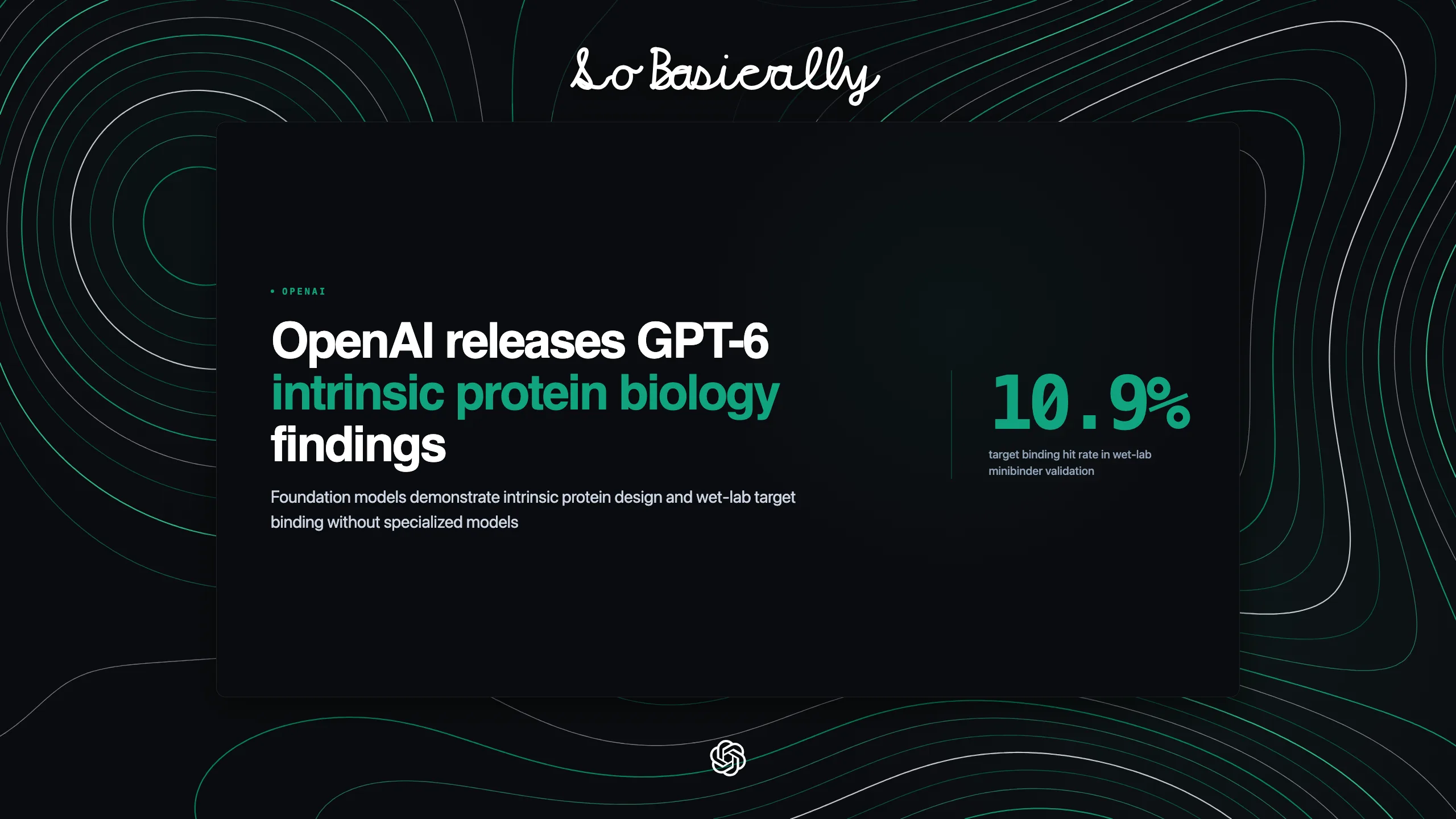
What happened.OpenAI published research demonstrating that the GPT-6 foundation model family possesses intrinsic protein design capabilities using natural language reasoning and executable code without specialized biology models.
Why it matters.Eliminating the need for separate, highly specialized machine learning pipelines simplifies biotechnology software development. Multidisciplinary engineering teams can now prototype therapeutics and molecular structures through standard foundation model interfaces.
The technical specifications:
- Wet-lab binding: Physical laboratory tests with research partner Onava yielded 35 binding hits out of 322 synthesized minibinders across five human target proteins.
- Natural language guidance: Computational biologists directed structural topologies, helix configurations, and target attachment sites using plain-text prompts rather than domain-specific scoring software.
- Antibody redesign: The models redesigned therapeutic antibody loops while preserving binding affinity across experimental oncology and inflammation targets.
- Architectural efficiency: General reasoning chains generated functional molecular structures directly, matching specialized motif-scaffolding systems on public docking benchmarks.