 OpenAIAnalysis
OpenAI proves arithmetic lower bound establishing 9/4 matrix multiplication exponent

Listen to Briefing
0:00/1:43
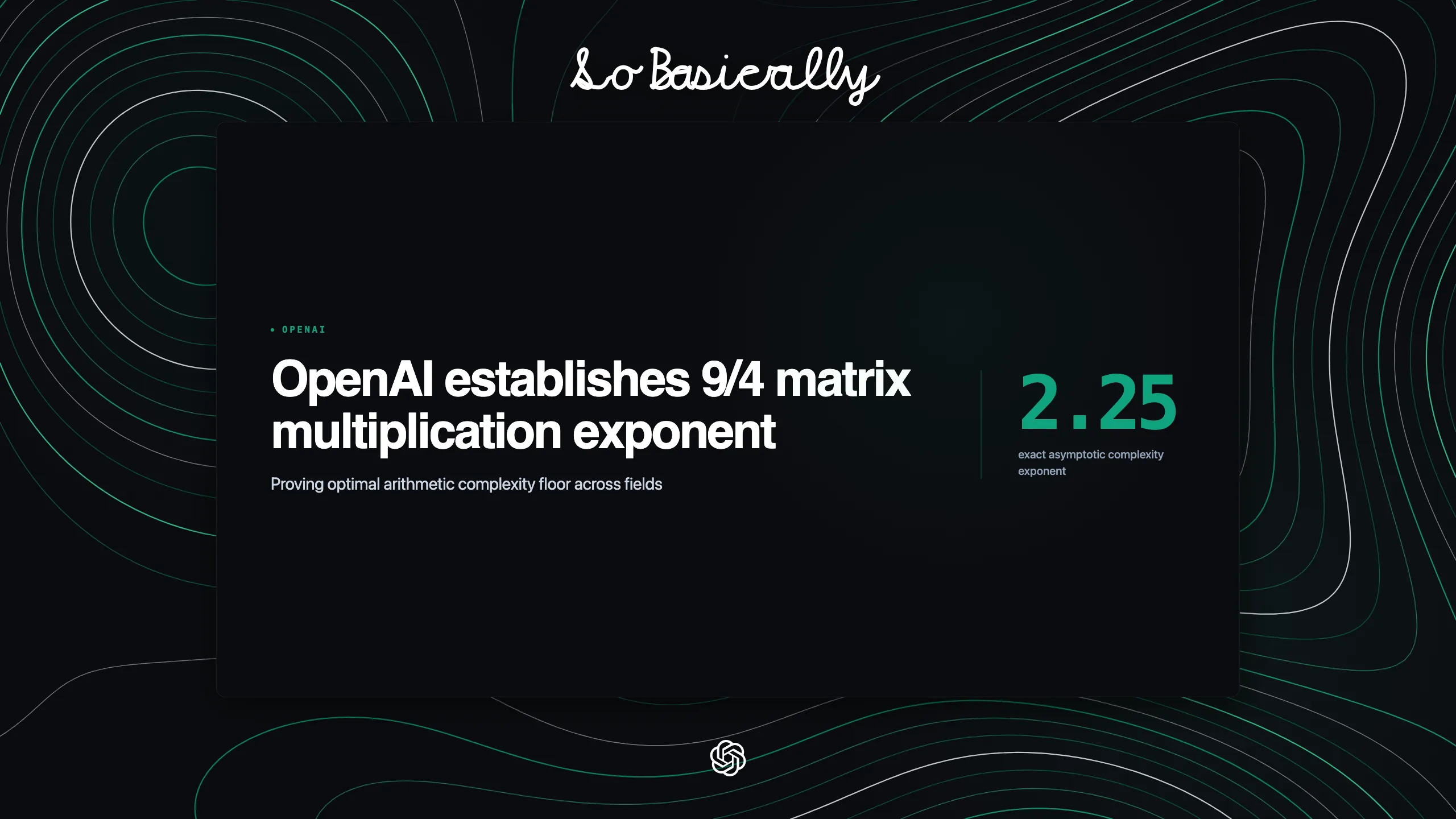
What happened.OpenAI researchers published a mathematical preprint and formalized program demonstrating that the square matrix multiplication exponent is exactly nine fourths over every field.
Why it matters.Deep neural network training and inference depend heavily on dense matrix multiplication kernels. Establishing a mathematical lower bound of 2.25 proves that current cubic algorithms cannot be accelerated indefinitely, defining theoretical efficiency limits for hardware architects designing future tensor processing units.
The technical specifications:
- Optimal exponent: Establishes the matrix multiplication exponent omega at exactly 2.25, resolving long-standing theoretical conjecture regarding asymptotic tensor complexity.
- Lower bound proof: Proves that formal arithmetic circuits require at least half of n to the 2.25 power non-scalar multiplication gates to multiply n-by-n matrices.
- Formal verification: Formalizes division-free algebraic pathways within the Lean interactive theorem prover to eliminate human clerical proof errors.
- Tensor geometry: Analyzes asymptotic spectra of tensors and circuit lower bounds across Family 379 within OpenAI public mathematics repositories.