 CISAAnalysis
CISA adds Apple Pointer Authentication bypass to Known Exploited Vulnerabilities catalog

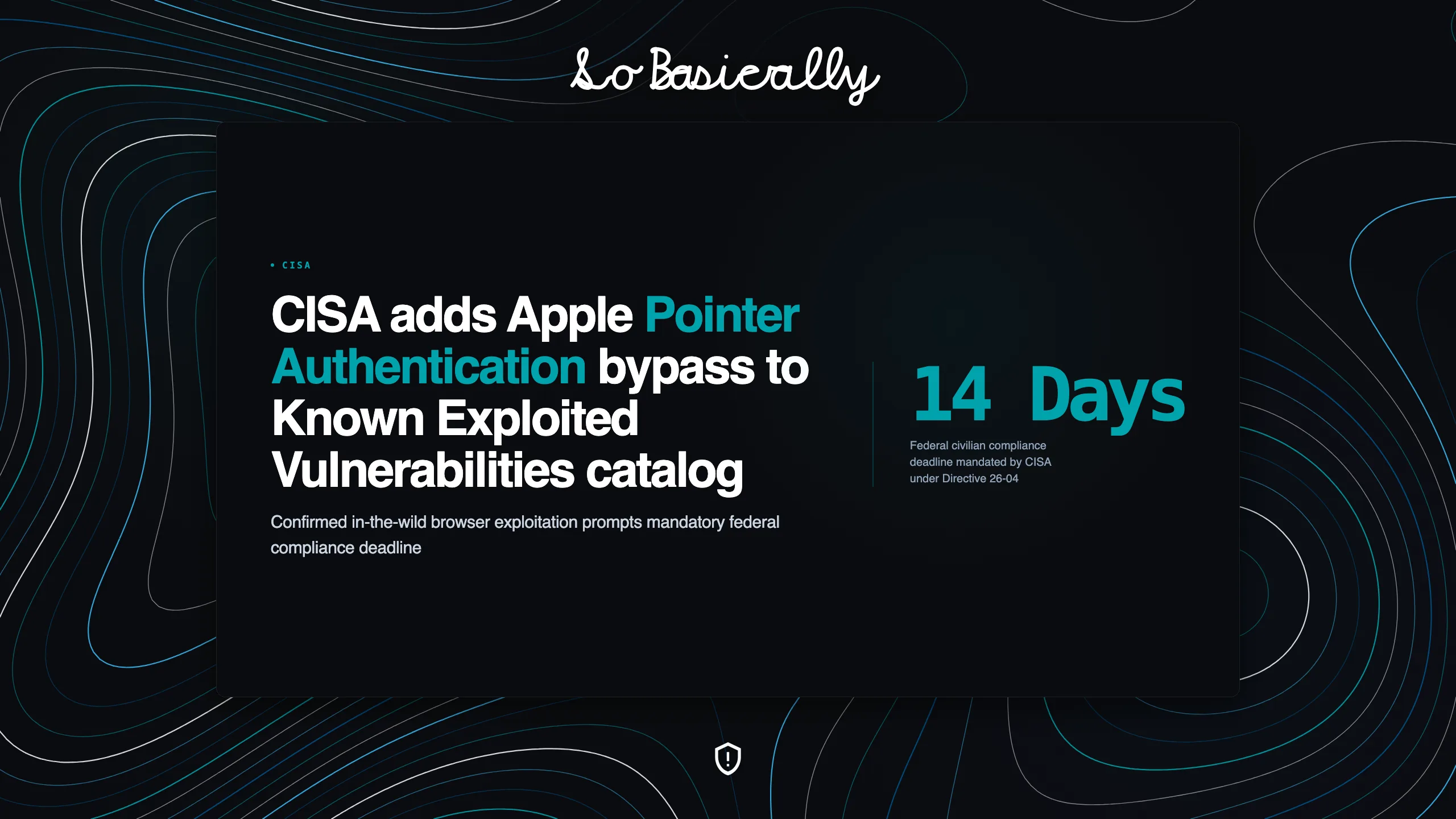
What happened.The Cybersecurity and Infrastructure Security Agency added Apple pointer authentication bypass vulnerability CVE-2024-27834 to its Known Exploited Vulnerabilities catalog following confirmed in-the-wild exploitation.
Why it matters.Hardware-assisted pointer authentication protects low-level operating system registers against memory manipulation and code diversion techniques. When threat actors successfully chain authentication bypasses into active browser attack workflows, kernel security guarantees collapse across mobile fleets and developer workstations. Systems engineers managing enterprise Apple devices must confirm deployment of current platform updates across all managed endpoints. Security operations teams should review network telemetry for signs of targeted browser redirection campaigns.
The technical specifications:
- Vulnerability mechanics: Tracked as CVE-2024-27834, an improper authentication defect allows an attacker with existing arbitrary memory read and write capabilities to bypass Pointer Authentication Codes.
- Exploitation context: Threat intelligence confirmed that advanced actors chained the defect within targeted browser exploit sequences against Safari and Chrome to deploy surveillance payloads.
- Affected platforms: The weakness spans Apple iOS, iPadOS, macOS, Safari, tvOS, and watchOS runtimes that enforce hardware-based pointer signing security primitives.
- Federal directive: Under Binding Operational Directive 26-04, CISA mandated that federal civilian agencies apply vendor-provided security patches or disconnect unmitigated devices by November 18, 2026.