Skip to content
SoBasicallyVOL. I · RUN 2026-11-26-cybersecurity-advisories
ARCHIVAL EDITION2026-11-26-cybersecurity-advisories8 STORIES · 1664 WORDS
← Back to Archive
DAILY BRIEFTHURSDAY, NOVEMBER 26, 202618 MIN

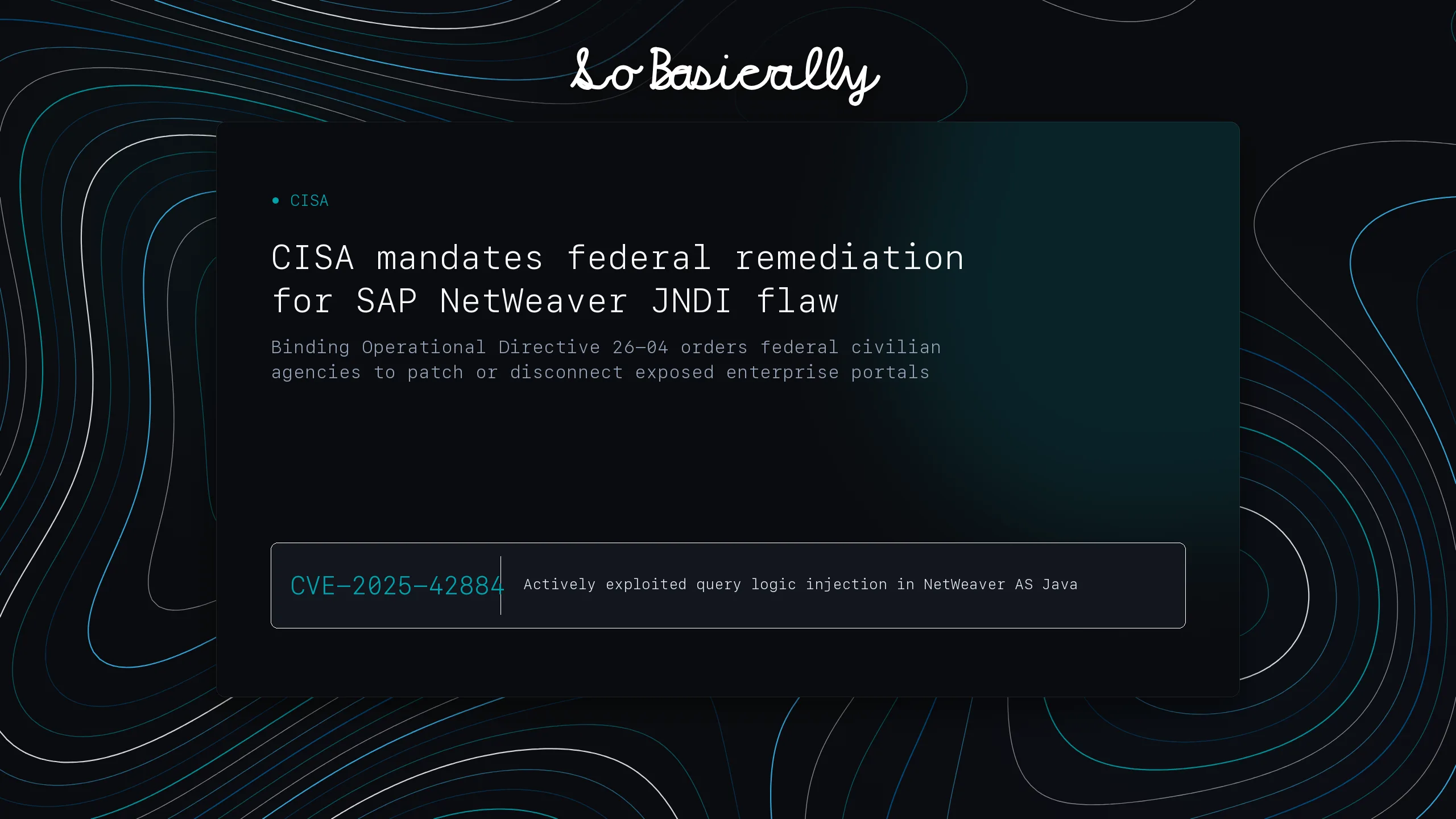
CISA mandates federal remediation for SAP NetWeaver JNDI flaw

0:00
-18:08

CISA mandates federal remediation for SAP NetWeaver JNDI flaw

Topographic elevation contour card for CISA mandates federal remediation for SAP NetWeaver JNDI flaw

What happened.The Cybersecurity and Infrastructure Security Agency added an actively exploited query logic injection flaw in SAP NetWeaver Enterprise Portal to its catalog.

Why it matters.Threat groups target enterprise resource management portals because they bridge public internet traffic to core corporate databases. When attackers force internal directory lookups, boundary network firewalls cannot block the resulting data theft. Systems teams must act quickly. Administrators should audit all exposed Java portal instances and restrict directory resolution to authenticated local subnets.

↳Continues: CISA mandates federal civilian remediation for Drupal Core installer remote code execution
Read Full Brief →
Source:CISA Known Exploited Vulnerabilities (opens in a new tab)
VERIFIED STORIES IN THIS EDITION7 STORIES
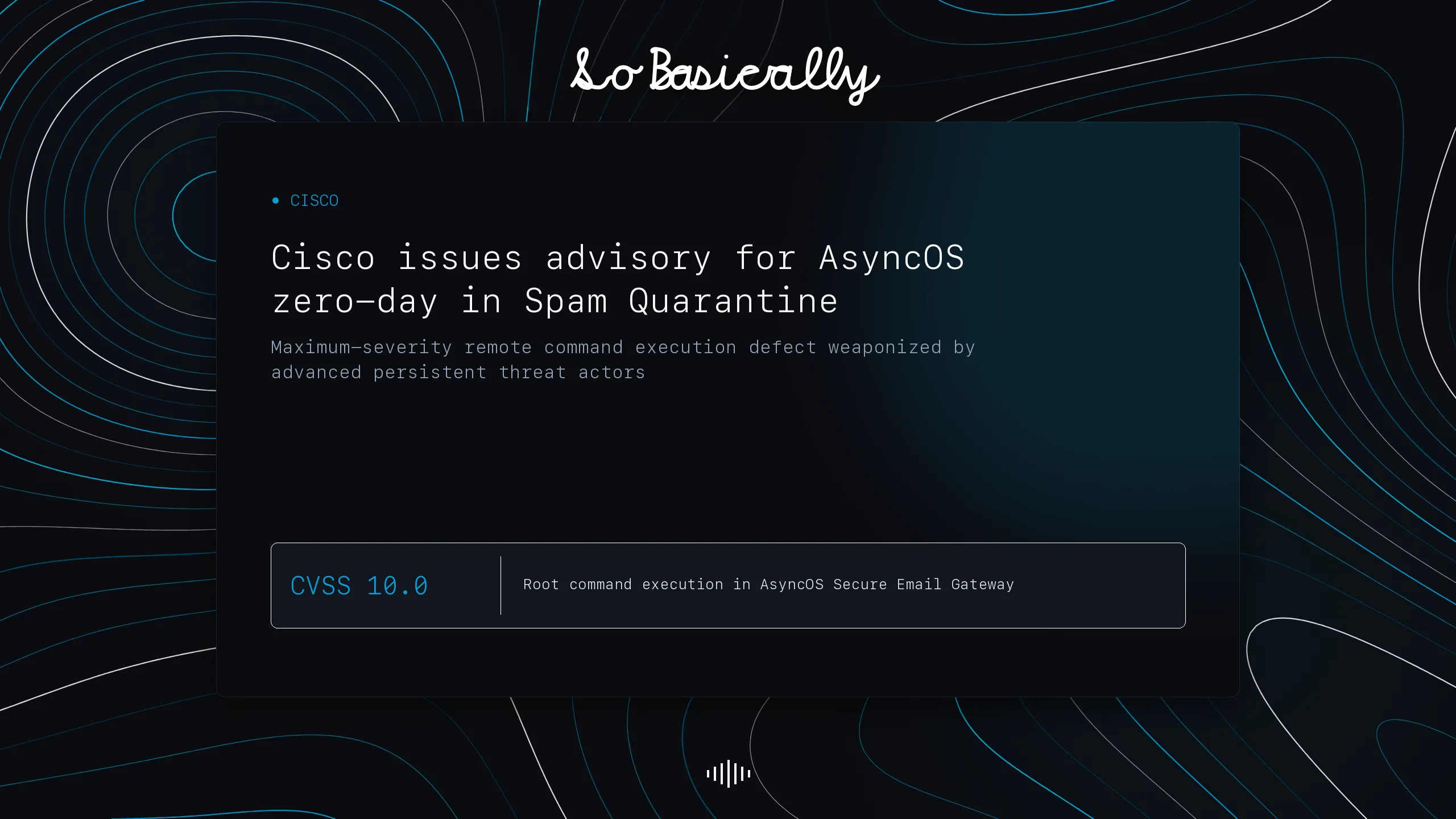
Decision brief card for Cisco issues advisory for AsyncOS zero-day in Spam Quarantine

Cisco issues advisory for AsyncOS zero-day in Spam Quarantine

What happened.Cisco released a security advisory addressing a zero-day command execution flaw in the Spam Quarantine feature of Cisco AsyncOS for Secure Email Gateway appliances.

Why it matters.Email security gateways sit at the perimeter of corporate networks and inspect all inbound communications. When an unauthenticated adversary gains root control over an email gateway, perimeter logging becomes untrustworthy and internal email routing can be manipulated silently. Security engineers must apply the vendor hotfixes immediately or place quarantine portals behind private virtual private networks.

  • Maximum severity: Tracked as CVE-2025-20393 with a CVSS score of 10.0, the vulnerability enables unauthenticated remote code execution with root privileges.
  • Request validation: Attackers send crafted HTTP packets to the web management interface of appliances running the optional Spam Quarantine feature.
  • Adversary weaponization: Threat intelligence telemetry identified advanced persistent threat group UAT-9686 exploiting the bug to install Python backdoors and reverse network tunnels.
  • Remediation releases: Cisco published updated AsyncOS builds across branches 15.0, 15.5, and 16.0, advising operators to block public internet access to quarantine endpoints immediately.
Official Source:Cisco Security Advisories
Decision brief card for Cisco issues advisory for AsyncOS zero-day in Spam Quarantine
↳Continues: Cisco releases security advisory for critical upstream NGINX remote code execution flaws
Read Brief
Source:Cisco Security Advisories (opens in a new tab)
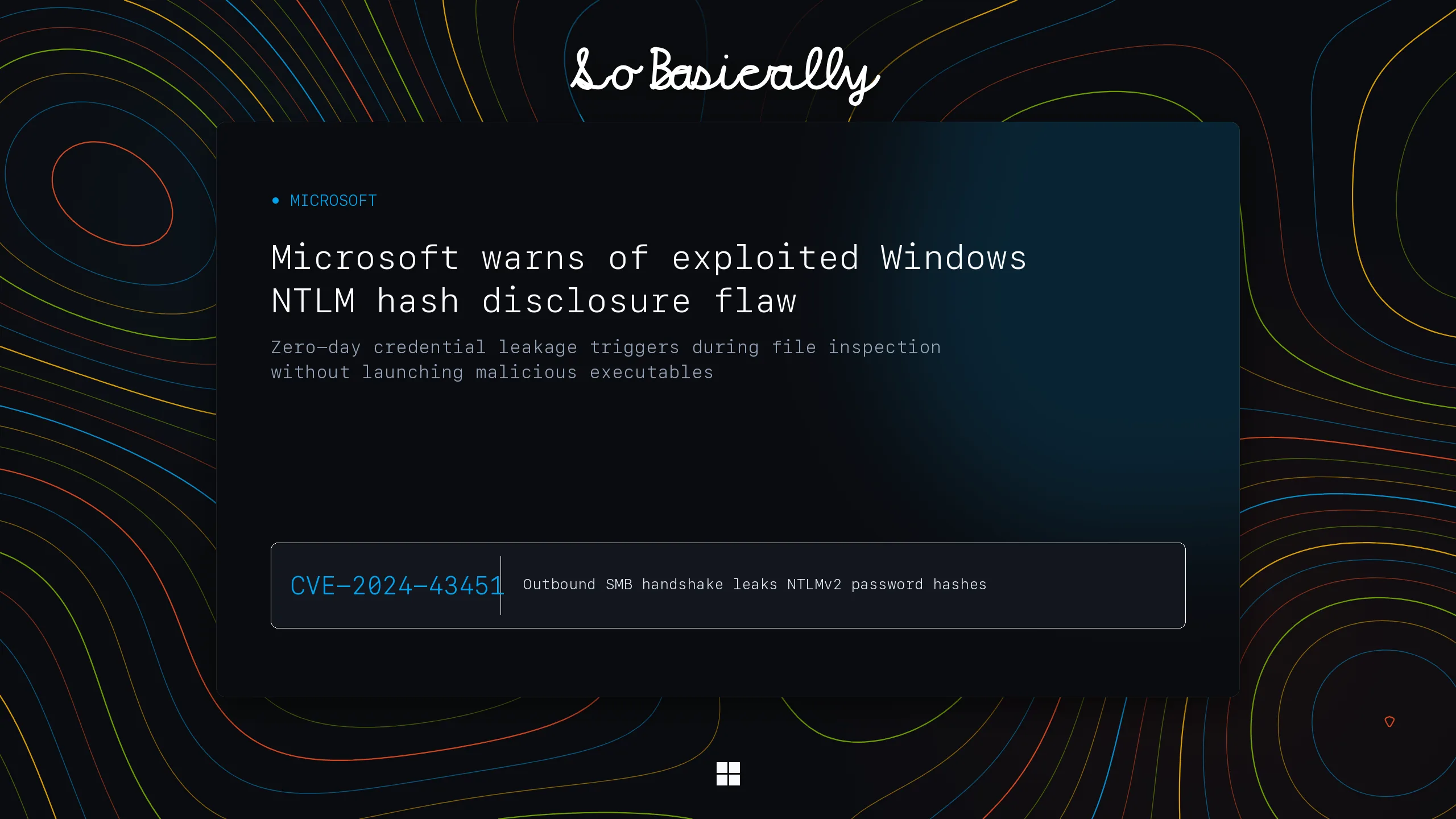
Decision brief card for Microsoft warns of exploited Windows NTLM hash disclosure flaw

Microsoft warns of exploited Windows NTLM hash disclosure flaw

What happened.Microsoft issued a security update warning that threat actors actively weaponized a zero-day NTLM hash disclosure spoofing vulnerability across multiple Windows releases.

Why it matters.Attackers combine credential leakage bugs with pass-the-hash techniques to leapfrog perimeter firewalls and impersonate authenticated corporate staff. Because the exploit triggers during simple file browsing without running an executable, standard end-user awareness training cannot prevent credential leakage. Infrastructure teams must deploy the cumulative Windows update and block outbound traffic on TCP port 445 at corporate firewalls.

  • Vulnerability tracking: Tracked as CVE-2024-43451 with a CVSS score of 6.5, the flaw exposes user credentials during routine file management operations.
  • Minimal interaction: Unlike conventional malware requiring double-click execution, single-clicking, right-clicking to inspect, or dragging a weaponized shortcut file triggers the leak.
  • Outbound handshake: The malicious file initiates an automated Server Message Block connection to an external server, sending the user password hash across the wire.
  • Targeted campaigns: Threat intelligence researchers observed threat groups deploying weaponized archive files against commercial infrastructure to facilitate rapid credential harvesting.
Official Source:Microsoft Security Response Center
Decision brief card for Microsoft warns of exploited Windows NTLM hash disclosure flaw
↳Continues: Microsoft issues security alert for actively exploited Azure APIM Classic credential exposure
Read Brief
Source:Microsoft Security Response Center (opens in a new tab)
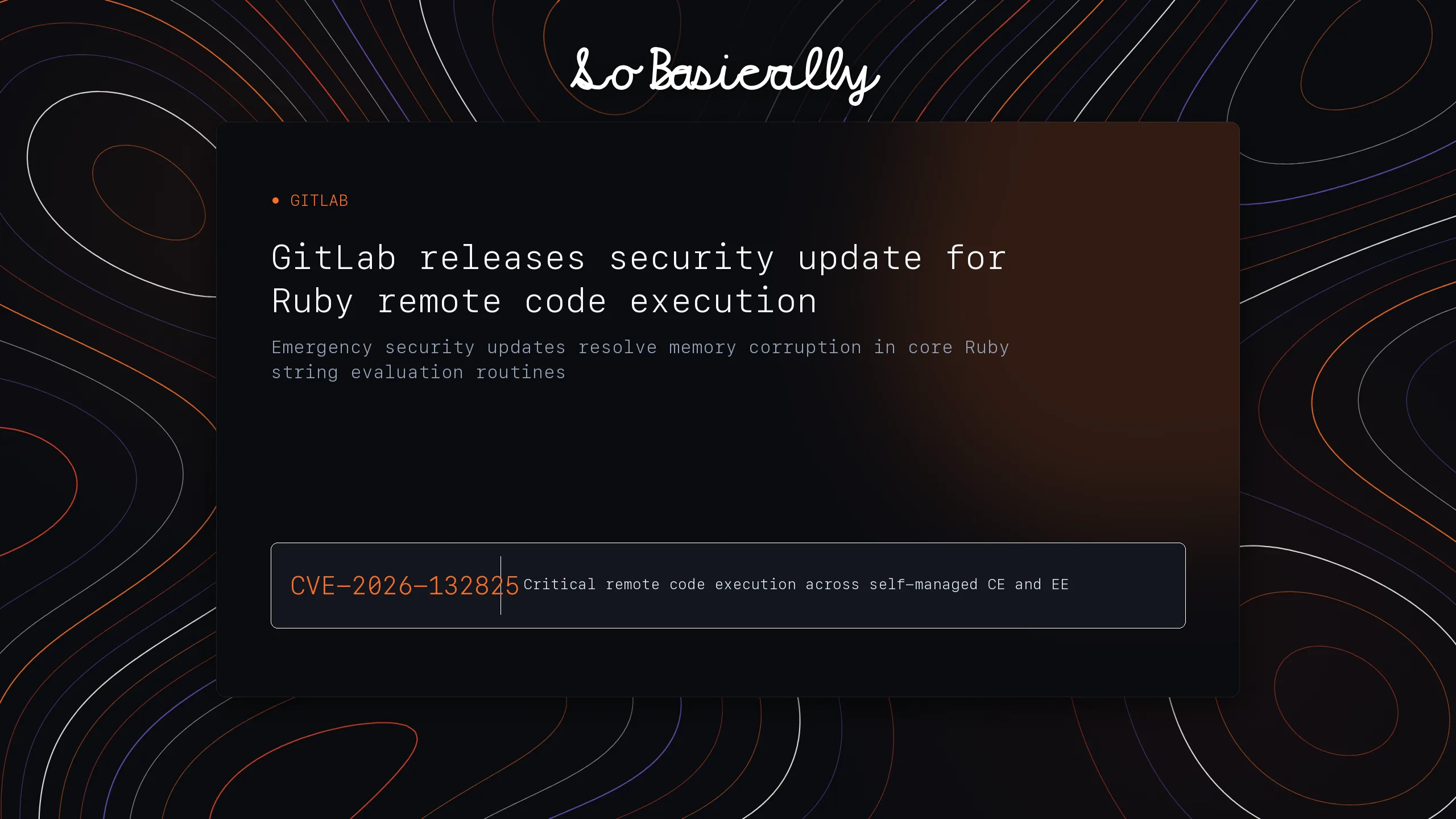
Decision brief card for GitLab releases security update for Ruby remote code execution

GitLab releases security update for Ruby remote code execution

What happened.GitLab published security releases for Community Edition and Enterprise Edition to resolve a remote code execution vulnerability originating in core Ruby string evaluation routines.

Why it matters.Centralized code repositories hold proprietary application source code, automated build pipelines, and production deployment credentials. An unauthenticated remote execution vulnerability inside a source control server allows adversaries to tamper with software dependencies and compromise downstream release artifacts. Engineering teams should audit their self-hosted version control nodes and verify automated daily database backups.

  • Advisory scope: Tracked as CVE-2026-132825, the defect affects self-managed GitLab installations running versions prior to 19.6.1, 19.5.8, or 19.4.10.
  • Execution vector: Malformed string inputs passed into backend text evaluation pipelines trigger memory corruption in the underlying Ruby runtime, enabling arbitrary system command execution.
  • Managed environments: GitLab confirmed that cloud instances on GitLab.com and GitLab Dedicated were patched automatically prior to public disclosure.
  • Upgrade mandate: Systems administrators operating self-managed servers must apply the point releases immediately to neutralize unauthorized access attempts.
Official Source:GitLab Security
Decision brief card for GitLab releases security update for Ruby remote code execution
Read Brief
Source:GitLab Security (opens in a new tab)
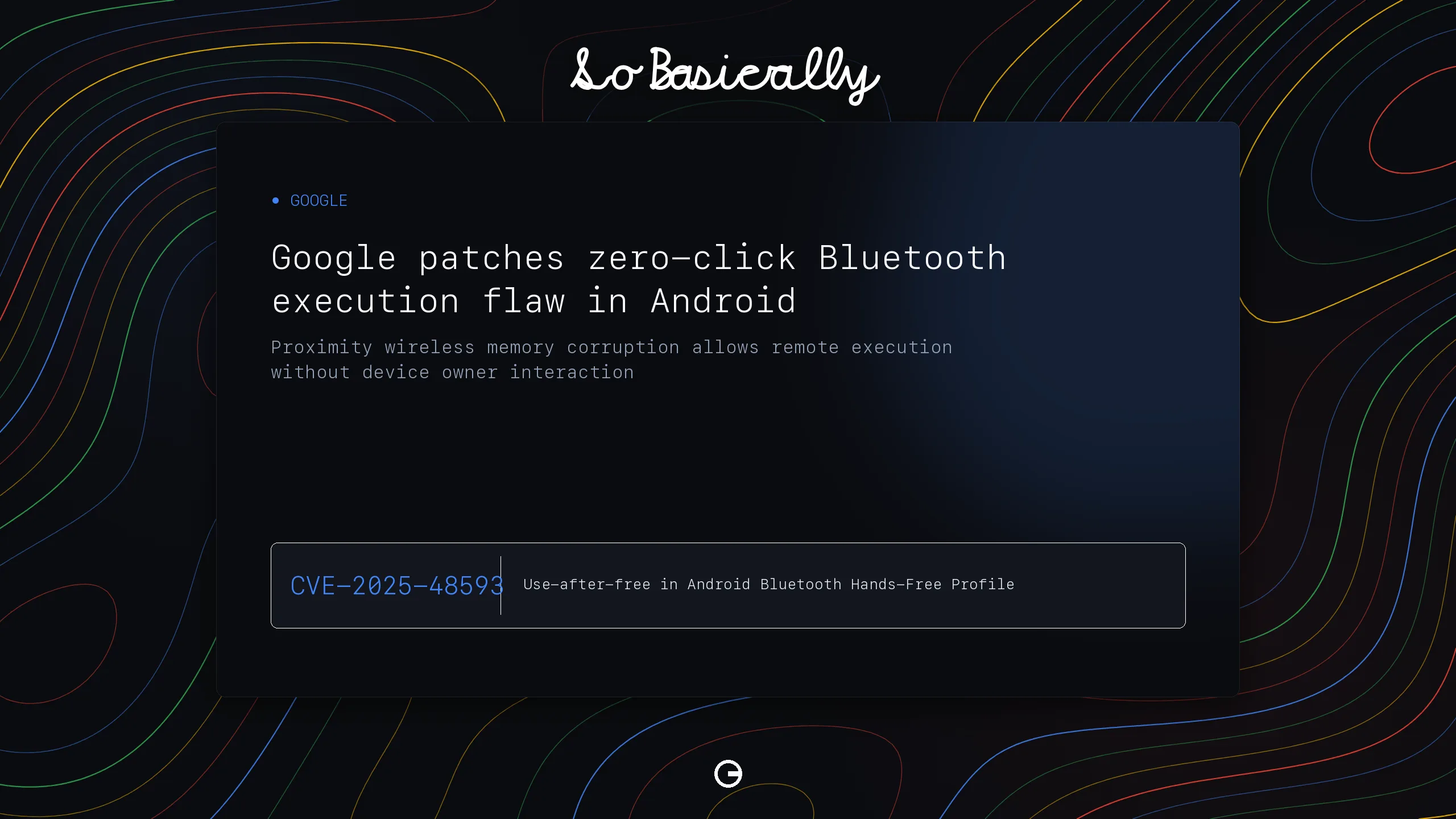
Decision brief card for Google patches zero-click Bluetooth execution flaw in Android

Google patches zero-click Bluetooth execution flaw in Android

What happened.Google published the Android Security Bulletin resolving a use-after-free vulnerability in the system Bluetooth module that allowed remote code execution without user interaction.

Why it matters.Zero-click wireless vulnerabilities represent severe operational threats to enterprise mobile workforces because physical proximity replaces network perimeter penetration. Attackers positioned in public venues or airport lounges can compromise adjacent employee hardware silently. Corporate mobility teams should enforce mandatory operating system patch compliance and encourage staff to disable unused wireless interfaces in crowded transit hubs.

  • Vulnerability tracking: Tracked as CVE-2025-48593 with a critical severity rating, the memory corruption flaw resides in bta_hf_client_main.cc within the Hands-Free Profile client.
  • Zero-click proximity: Attackers within physical wireless range can transmit crafted Bluetooth packets to seize control of device execution threads without prompting the owner.
  • Platform exposure: The defect affects devices running Android versions 13, 14, 15, and 16 using unpatched Bluetooth stack implementations.
  • Patch level: Remediation is bundled into the 2025-11-01 security patch level across compatible mobile handsets and enterprise field hardware.
Official Source:Google Cloud Security Bulletins
Decision brief card for Google patches zero-click Bluetooth execution flaw in Android
↳Continues: Google updates Chrome desktop channels for critical input validation flaw in Variations
Read Brief
Source:Google Cloud Security Bulletins (opens in a new tab)
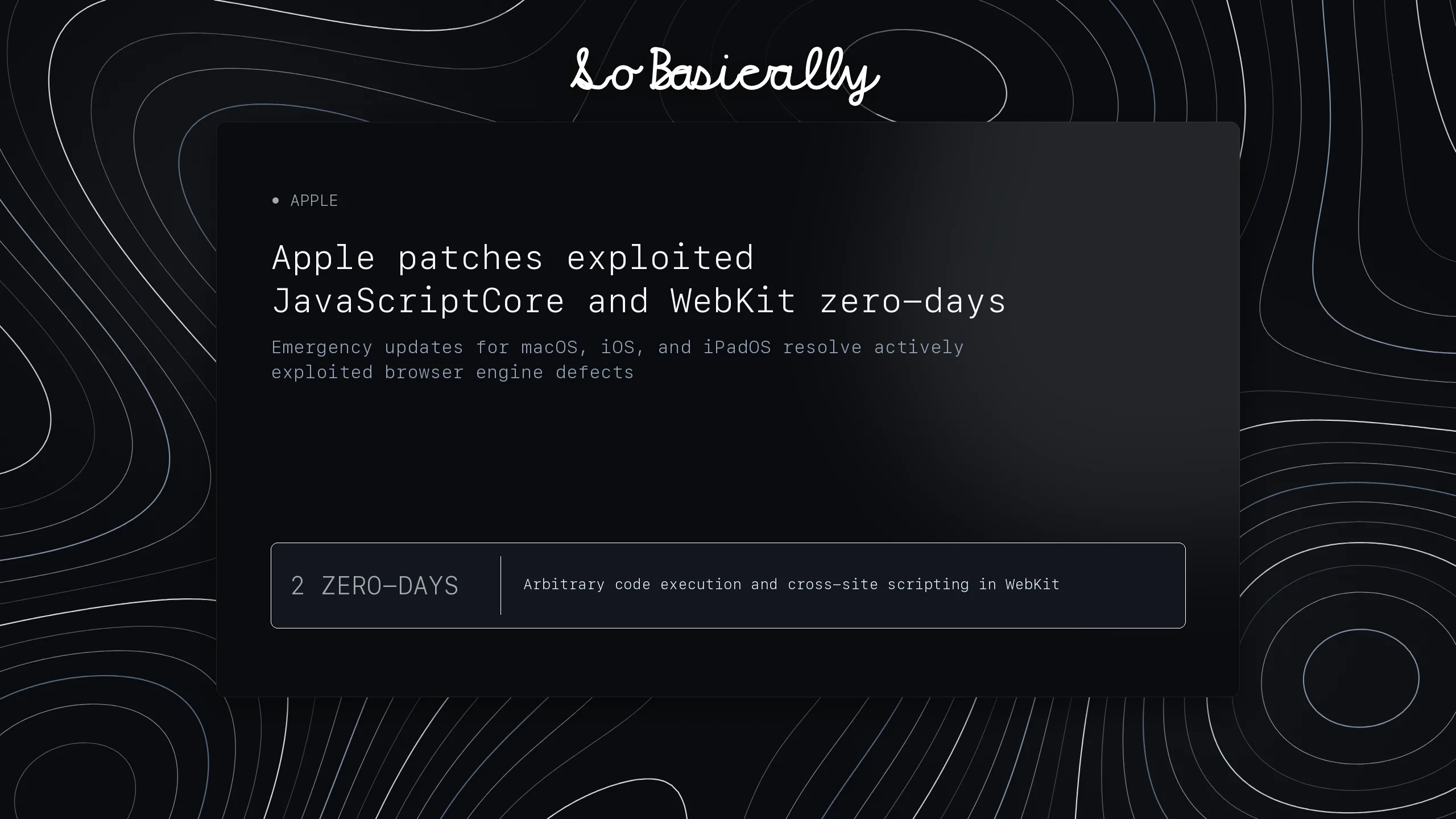
Decision brief card for Apple patches exploited JavaScriptCore and WebKit zero-days

Apple patches exploited JavaScriptCore and WebKit zero-days

What happened.Apple deployed security updates across macOS, iOS, and iPadOS platforms to patch two actively exploited zero-day vulnerabilities in the JavaScriptCore and WebKit browser engines.

Why it matters.Browser engine zero-days allow threat actors to infect corporate endpoints simply by luring employees to visit compromised landing pages. When chained together, execution and state bypass bugs grant adversaries access to active cloud sessions and internal web services. Enterprise patching must be swift. IT administrators should verify rapid update deployment across all employee Mac laptops and mobile devices to prevent browser-based perimeter breaches.

  • Zero-day pair: Tracked as CVE-2024-44308 in JavaScriptCore and CVE-2024-44309 in WebKit, both flaws were discovered by researchers in Google Threat Analysis Group.
  • Arbitrary execution: The JavaScriptCore defect permits arbitrary code execution when processing maliciously crafted web content on affected devices.
  • Cross-site scripting: The WebKit flaw involves state management weaknesses that allow malicious web pages to bypass cookie restrictions and execute cross-site scripts.
  • Exploitation context: Apple acknowledged reports that attackers actively weaponized both vulnerabilities against Intel-based macOS systems in targeted cyber operations.
Official Source:Apple Security Releases
Decision brief card for Apple patches exploited JavaScriptCore and WebKit zero-days
↳Continues: Apple releases macOS Golden Gate 27.2.2 and iOS 27.2.2 for WebKit memory corruption
Read Brief
Source:Apple Security Releases (opens in a new tab)
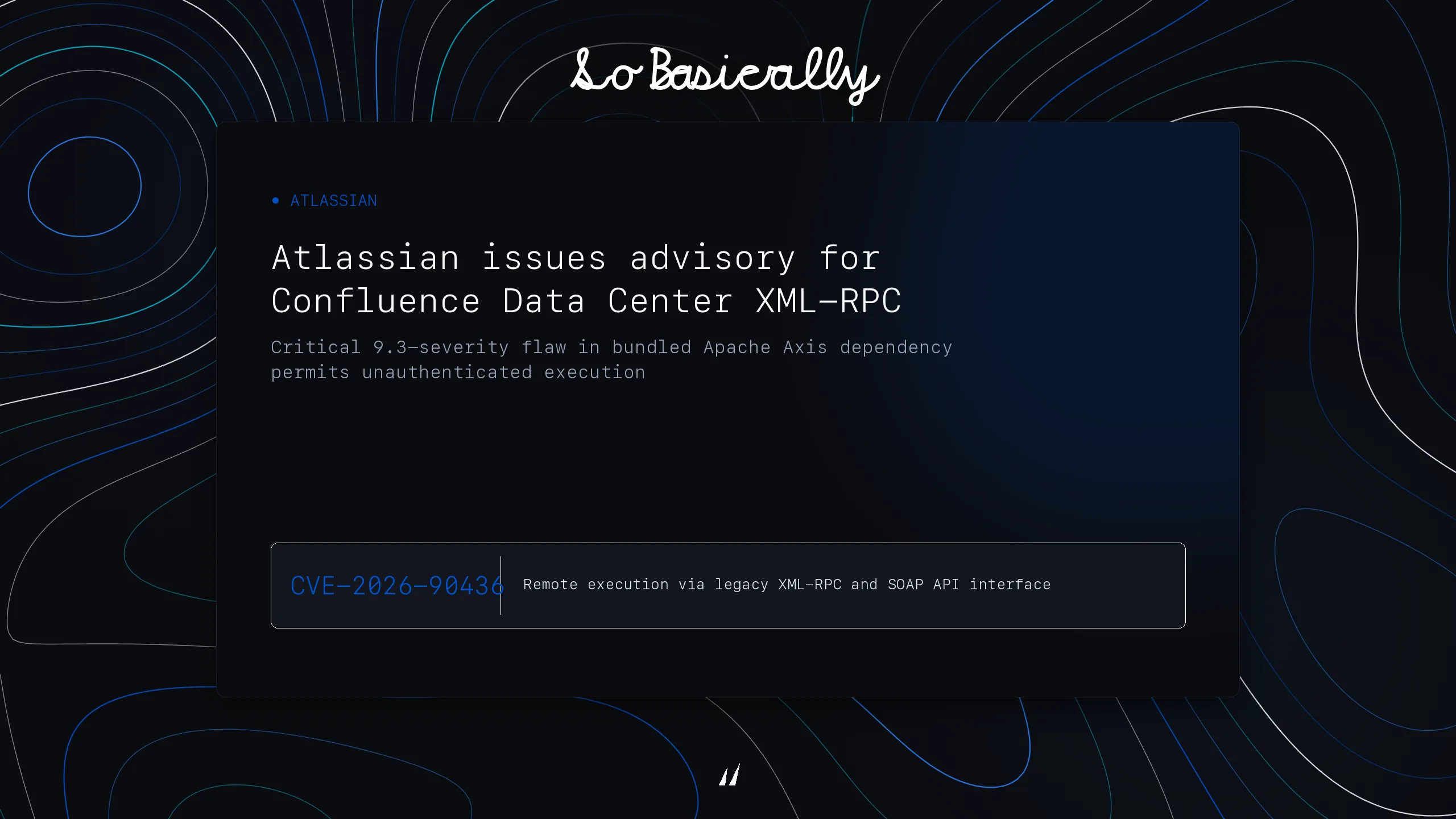
Decision brief card for Atlassian issues advisory for Confluence Data Center XML-RPC

Atlassian issues advisory for Confluence Data Center XML-RPC

What happened.Atlassian published a security advisory resolving an unauthenticated remote code execution vulnerability in the legacy XML-RPC and SOAP API interface of Confluence Data Center.

Why it matters.Enterprise wiki platforms house architectural diagrams, operational runbooks, and internal infrastructure roadmaps. Threat actors exploit unauthenticated knowledge base vulnerabilities to establish permanent beachheads inside corporate intranets. Systems teams should immediately apply the vendor release or disable legacy remote interfaces on all internal documentation servers.

  • Vulnerability tracking: Tracked as CVE-2026-90436 with a CVSS v4.0 score of 9.3, the defect resides within the bundled Apache Axis third-party dependency.
  • Attack surface: Instances configured with the legacy Remote API setting enabled permit remote attackers to submit crafted requests that execute arbitrary code on the server.
  • Remediation releases: Atlassian delivered fixed releases including version 9.2.28, noting that modern Confluence 10 releases have removed the legacy interface entirely.
  • Interim mitigation: Organizations unable to patch immediately can neutralize the exploit path by disabling the Remote API toggle in administrative settings.
Official Source:Atlassian Security Advisories
Decision brief card for Atlassian issues advisory for Confluence Data Center XML-RPC
Read Brief
Source:Atlassian Security Advisories (opens in a new tab)
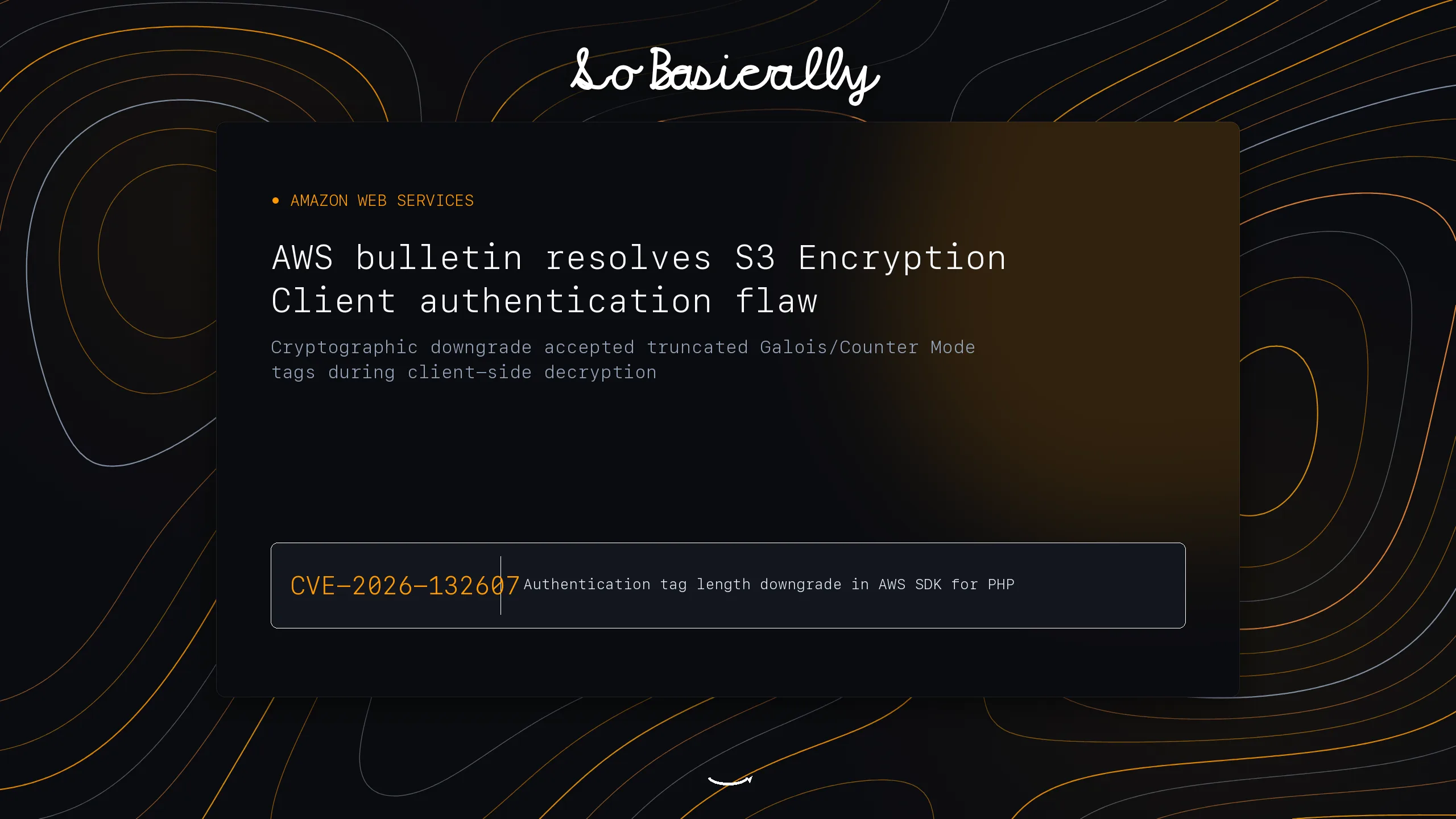
Decision brief card for AWS bulletin resolves S3 Encryption Client authentication flaw

AWS bulletin resolves S3 Encryption Client authentication flaw

What happened.Amazon Web Services issued security bulletin 2026-191-AWS resolving an authentication tag length downgrade vulnerability in the Amazon S3 Encryption Client for PHP.

Why it matters.Client-side storage encryption ensures data remains confidential and tamper-proof even if intermediate storage repositories are accessed by third parties. Weakened authentication tags undermine data integrity guarantees and permit silent data modification in cloud storage pipelines. Cryptographic flaws demand fast action. Application developers should update the PHP SDK across all worker environments and re-verify object integrity in critical storage buckets.

  • Vulnerability tracking: Tracked as CVE-2026-132607, the flaw affects developers using the AWS SDK for PHP in versions prior to 3.383.1.
  • Cryptographic downgrade: The client accepted truncated Galois/Counter Mode authentication tags during decryption routines, significantly lowering the difficulty of tag forgery.
  • Data tampering: Attackers with access to encrypted storage buckets could alter stored ciphertext without triggering customary integrity verification errors.
  • SDK remediation: AWS published AWS SDK for PHP version 3.383.1, enforcing strict 128-bit authentication tag verification across all client-side decryption workflows.
Official Source:AWS Security Bulletins
Decision brief card for AWS bulletin resolves S3 Encryption Client authentication flaw
↳Continues: AWS security bulletin resolves sensitive data redaction bypass in Amazon ECS MCP Server
Read Brief
Source:AWS Security Bulletins (opens in a new tab)
CANDIDATE INTELLIGENCE · UNVERIFIED LEADS

The Discovery Wire · Unverified Attention Signals

Candidate storylines identified across developer channels. Under newsroom canon, attention never establishes fact; these leads remain quarantined until supported by Tier 1 official records.

DEVELOPER WIRE

HPE Juniper Session Smart Conductor and Router Remote Root Command Injection (CVE-2026-103406)

CISA added the critical 9.8-severity OS command injection vulnerability in the AutomatedProvisioner salt minion ID handler to the Known Exploited Vulnerabilities catalog with a 3-day emergency remediation mandate under BOD 26-04.

STATUS:Awaiting official documentation or verification criteria.
DEVELOPER WIRE

Mitel MiCollab Audio, Web and Video Conferencing Remote Code Execution (MISA-2026-0012 / CVE-2026-133323, CVE-2026-133303)

CISA added five actively exploited flaws to the KEV catalog, including a 10.0-severity unauthenticated OS command injection and a 9.0-severity XML injection in the AWV conferencing component.

STATUS:Awaiting official documentation or verification criteria.
DEVELOPER WIRE

Palo Alto Networks PAN-OS Kernel Privilege Escalation ("Fragnesia" PAN-SA-2026-0015 / CVE-2026-46300)

Palo Alto Networks delivered maintenance updates resolving an actively targeted Linux kernel ESP-in-TCP privilege escalation flaw used to compromise firewall perimeters.

STATUS:Awaiting official documentation or verification criteria.
DEVELOPER WIRE

Microsoft Outlook Zero-Day NTLM Hash Disclosure Vulnerability (CVE-2026-124194)

Microsoft issued an out-of-band advisory for an actively exploited spoofing flaw where opening crafted attachments silently leaks user NTLMv2 hashes to external endpoints.

STATUS:Awaiting official documentation or verification criteria.
DEVELOPER WIRE

Danfoss Refrigeration and HVAC Controller Stack-Based Buffer Overflow (CVE-2026-129713)

CISA issued ICS advisory warnings for a critical 9.8-severity buffer overflow affecting Danfoss AK-SM 8xxA supermarket refrigeration and climate controllers actively targeted across European critical infrastructure. Held on watchlist monitoring industrial control system firmware patch releases and edge network isolation guidance.

STATUS:Awaiting official documentation or verification criteria.
DEVELOPER WIRE

Broadcom VMware ESXi IOFilterVP and vCenter Critical Vulnerabilities (VMSA-2026-0011 / CVE-2026-123903, CVE-2026-123910)

Broadcom published emergency advisory VMSA-2026-0011 resolving 23 flaws, including critical 9.8-severity remote code execution in the ESXi IOFilterVP service on port 9080 and vCenter directory service authentication bypass.

STATUS:Awaiting official documentation or verification criteria.
DEVELOPER WIRE

Broadcom VMware vCenter Directory Service Authentication Bypass (CVE-2026-123890)

Broadcom issued emergency security bulletins for a 9.8-severity authentication bypass flaw in the vCenter directory service actively targeted by state-sponsored espionage groups.

STATUS:Awaiting official documentation or verification criteria.
DEVELOPER WIRE

Node.js binary-parser Dynamic Code Injection (CVE-2026-134814)

Security researchers disclosed an 8.1-severity code injection flaw in the popular npm binary-parser library allowing arbitrary JavaScript execution via unvalidated parser schemas.

STATUS:Awaiting official documentation or verification criteria.
DEVELOPER WIRE

GL.iNet GoodCloud Remote Management Hardware Backdoors and Reverse Shells

Threat actors weaponized cloud-side management vulnerabilities to deploy persistent root-level reverse shells on customer routers and remote-access KVM devices.

STATUS:Awaiting official documentation or verification criteria.
DEVELOPER WIRE

AWS pgactive Stack-Based Buffer Overflow in Replication Origin Name Parsing (Bulletin 2026-198-AWS / CVE-2026-134068)

Amazon Web Services released pgactive 2.1.10 resolving a critical buffer overflow enabling authenticated database operators to execute arbitrary commands.

STATUS:Awaiting official documentation or verification criteria.
DEVELOPER WIRE

Cisco Expressway Series Hard-Coded Credentials Remote Root Flaw (CVE-2026-76466)

CISA added the critical 9.8-severity Expressway database service execution flaw to the KEV catalog following active in-the-wild exploitation.

STATUS:Awaiting official documentation or verification criteria.
DEVELOPER WIRE

Palo Alto Networks Advisory for Upstream NGINX HTTP/2 Memory Corruption (PAN-SA-2026-0012 / CVE-2026-123633)

Palo Alto Networks delivered security updates addressing HTTP/2 flow control use-after-free and integer underflow flaws across PAN-OS and Panorama.

STATUS:Awaiting official documentation or verification criteria.
DEVELOPER WIRE

Docker Desktop Ask Gordon AI Assistant Meta-Context Injection (DockerDash / CVE-2025-9074)

Contextual trust flaw in Model Context Protocol Gateway allows arbitrary command execution and host data exfiltration via malicious image metadata.

STATUS:Awaiting official documentation or verification criteria.
DEVELOPER WIRE

GitLab CI/CD Runner Token Replay Vulnerabilities (CVE-2026-121885)

GitLab published maintenance releases resolving an 8.7-severity token replay defect enabling pipeline artifact exfiltration across shared runner pools.

STATUS:Awaiting official documentation or verification criteria.
DEVELOPER WIRE

Google Cloud Bulletin GCP-2026-091 Dataform and BigQuery Studio Workspace Traversal (CVE-2026-126054)

Google Cloud resolved a 9.3-severity path traversal vulnerability exposing workspace files during Git repository synchronization.

STATUS:Awaiting official documentation or verification criteria.
DEVELOPER WIRE

Microsoft Entra Connect Health API Metadata Leakage (ADV260002)

Microsoft mitigated unauthenticated API endpoints that allowed external actors to query directory synchronization topology and admin records.

STATUS:Awaiting official documentation or verification criteria.
DEVELOPER WIRE

PHP Core Session Deserialization Memory Corruption ("phpAfterShell" CVE-2026-115560)

The PHP development team deployed updates resolving a 9.2-severity session serializer mismatch allowing remote code execution via multipart form uploads.

STATUS:Awaiting official documentation or verification criteria.
DEVELOPER WIRE

ConnectWise ScreenConnect Guest Session Command Execution (CVE-2026-84869)

ConnectWise issued urgent patches for a 9.9-severity flaw that permitted remote guests to execute unauthorized payloads on technician management workstations.

STATUS:Awaiting official documentation or verification criteria.
DEVELOPER WIRE

REDCap Clinical Research Platform Code Injection (CVE-2026-90817)

Vanderbilt University and CISA warned healthcare institutions of active exploitation targeting unauthenticated code injection vulnerabilities in clinical research data portals.

STATUS:Awaiting official documentation or verification criteria.
DEVELOPER WIRE

Apache Roller Blog Engine Deserialization Vulnerability (CVE-2026-129448)

The Apache Software Foundation published patches resolving an untrusted object deserialization defect enabling remote shell access on Java enterprise application servers.

STATUS:Awaiting official documentation or verification criteria.
DEVELOPER WIRE

Synology DiskStation Manager Code Execution Campaign (CVE-2024-10441)

Network defenders observed automated ransomware crews continuing to target unpatched NAS storage arrays following recent CISA KEV catalog additions.

STATUS:Awaiting official documentation or verification criteria.
DEVELOPER WIRE

Ivanti Endpoint Manager SQL Injection Remote Code Execution (CVE-2026-121653)

Ivanti published emergency hotfixes resolving an unauthenticated SQL injection vulnerability that permitted administrative database compromise.

STATUS:Awaiting official documentation or verification criteria.
DEVELOPER WIRE

Check Point Gaia OS DynamicCLI Root Privilege Escalation (CVE-2026-123039)

Check Point delivered security hotfixes after threat actors weaponized world-writable IPC sockets in the DynamicCLI daemon to deploy persistent backdoors.

STATUS:Awaiting official documentation or verification criteria.
DEVELOPER WIRE

Ubiquiti UniFi Access Application Critical Remote Exploitation (CVE-2026-132802)

Ubiquiti published Security Advisory Bulletin 073 resolving critical authentication and execution flaws in physical access management controllers.

STATUS:Awaiting official documentation or verification criteria.
DEVELOPER WIRE

NetScaler Console Authentication Bypass (CTX697320 / CVE-2026-120869)

Citrix delivered emergency hotfixes for an authentication bypass vulnerability affecting management consoles in hybrid cloud deployments.

STATUS:Awaiting official documentation or verification criteria.
DEVELOPER WIRE

OpenJDK Base64 Intrinsic Buffer Overflow ("Java4Shell" CVE-2026-114938)

OpenJDK and enterprise Linux distributors issued advisories for HotSpot JVM hardware-accelerated Base64 decoders on AVX-512 VBMI architectures.

STATUS:Awaiting official documentation or verification criteria.
DEVELOPER WIRE

ASUS Control Center Express Hardcoded Cryptographic Key (CVE-2026-114202)

Hardware vendors delivered firmware updates to eliminate static cryptographic keys embedded within centralized IT management suites.

STATUS:Awaiting official documentation or verification criteria.
DEVELOPER WIRE

SonicWall SonicOS SSL-VPN Authentication Bypass via SAML (SNWLID-2026-0014 / CVE-2026-19868)

SonicWall patched an actively exploited SSL-VPN authentication bypass affecting Gen 7 and Gen 8 firewalls.

STATUS:Awaiting official documentation or verification criteria.
DEVELOPER WIRE

AWS Config Remediation Runbook Input Sanitization (CVE-2026-134070 / Bulletin 2026-203-AWS)

Amazon Web Services resolved improper input sanitization in systems manager session manager audit logging automation.

STATUS:Awaiting official documentation or verification criteria.