Skip to content
SoBasicallyVOL. I · RUN 2026-11-26-ai-technology
ARCHIVAL EDITION2026-11-26-ai-technology8 STORIES · 1339 WORDS
← Back to Archive
DAILY BRIEFTHURSDAY, NOVEMBER 26, 202618 MIN

CISA mandates federal remediation for SAP NetWeaver JNDI flaw

0:00
-18:08

Google DeepMind releases Genie 4 world model for spatial agent simulation
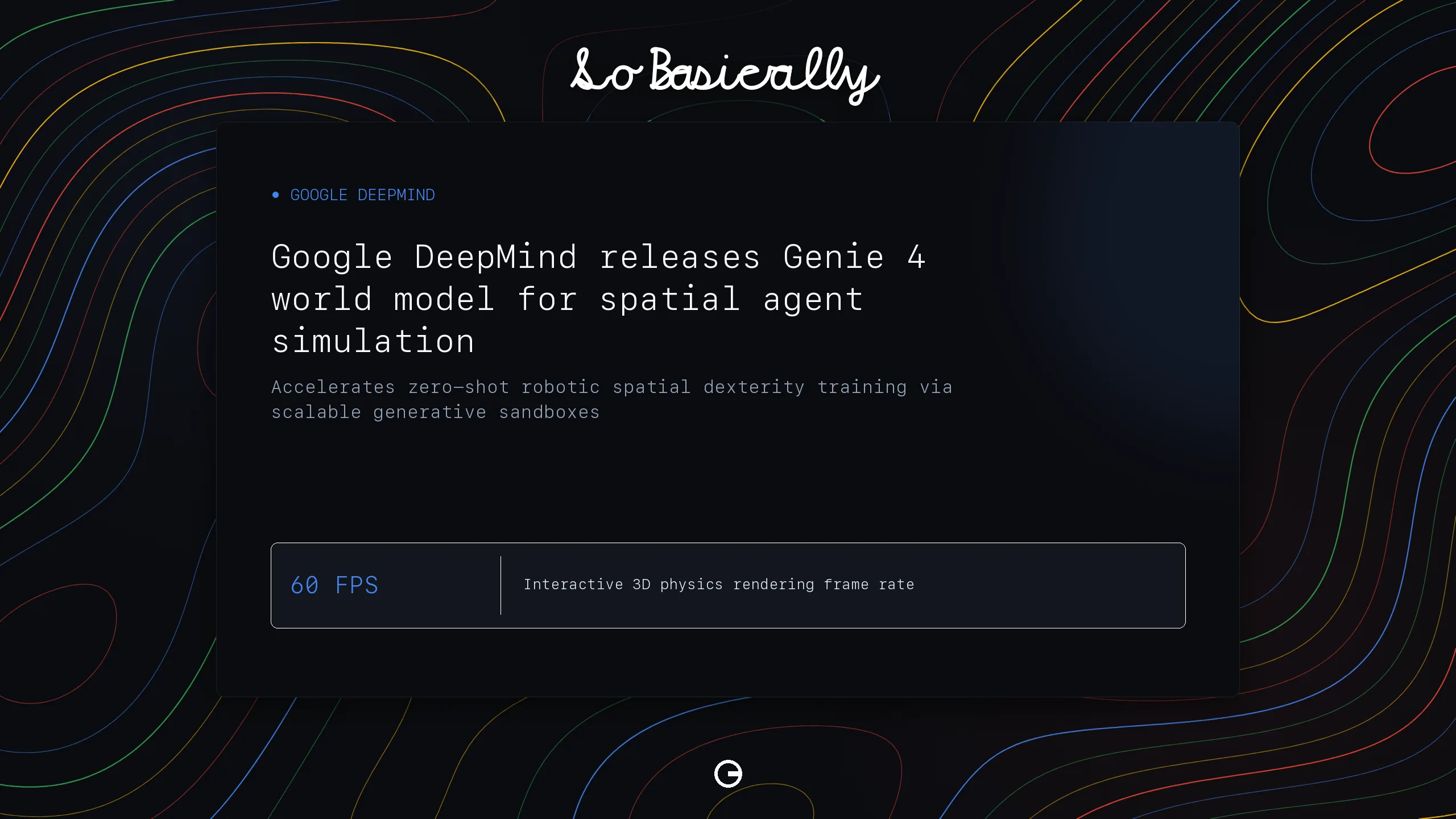
Topographic elevation contour card for Google DeepMind releases Genie 4 world model for spatial agent simulation

What happened.Google DeepMind released Genie 4 in developer preview, introducing an interactive generative world model that simulates reactive 3D physical environments for autonomous robotics and spatial computing systems.

Why it matters.Training physical robots in real buildings is slow and risks damaging expensive hardware. Generative world models provide scalable digital environments where autonomous systems can test physics and navigation policies safely before deployment.

↳Continues: Google DeepMind releases Gemini 4 Neon for enterprise reasoning
Read Full Brief →
Source:Google DeepMind (opens in a new tab)
VERIFIED STORIES IN THIS EDITION7 STORIES
Decision brief card for Anthropic migrates Messages API to Rust with zero downtime

Anthropic migrates Messages API to Rust with zero downtime

What happened.Anthropic migrated its production Messages API from Python to Rust with zero downtime, replacing the gateway powering customer traffic, Claude Code, and Cowork.

Why it matters.AI agents write code far faster than human teams can audit pull requests, shifting engineering constraints from writing syntax to verifying correctness. Anchoring agent verification in live production traffic allows infrastructure teams to execute massive runtime migrations safely.

  • Resource reduction: Lowers CPU utilization by 70 percent per request and cuts memory consumption by over 80 percent across production clusters.
  • Latency improvement: Slashes median time to first token by roughly 20 percent for interactive developer sessions and agent workloads.
  • Agentic generation: Employs Claude agents to generate the core request path within one week, contributing over 80 percent of merged code.
  • Production verifier: Shadows live production traffic across runtimes and normalizes non-deterministic outputs to eliminate discrepancies without exposing user data.
Official Source:Anthropic
Decision brief card for Anthropic migrates Messages API to Rust with zero downtime
↳Continues: Anthropic expands Model Context Protocol past 700M downloads with Skills over MCP, Anthropic launches Claude Install as App beta for standalone desktop artifacts
Read Brief
Source:Anthropic (opens in a new tab)
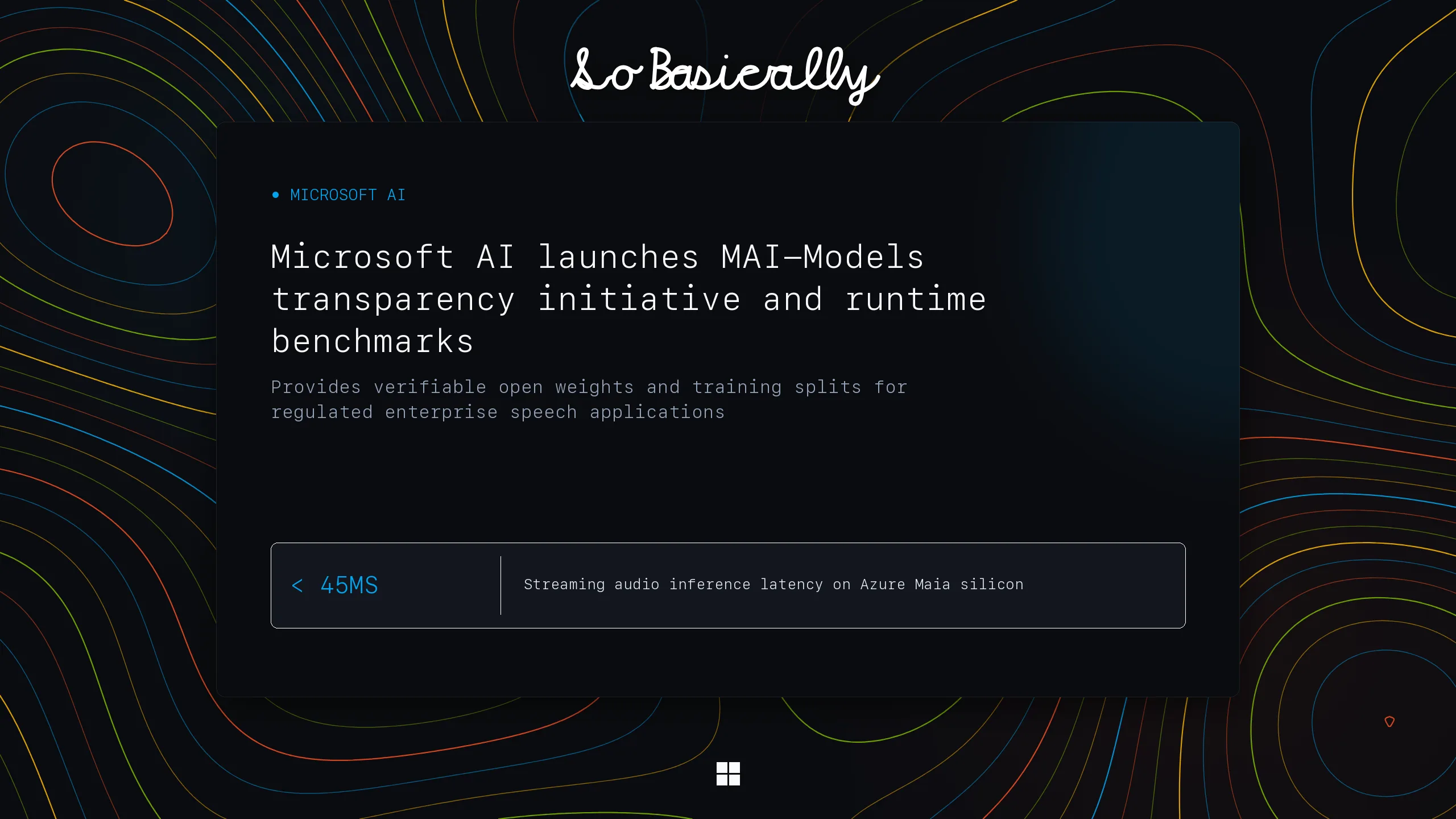
Decision brief card for Microsoft AI launches MAI-Models transparency initiative and runtime benchmarks

Microsoft AI launches MAI-Models transparency initiative and runtime benchmarks

What happened.Microsoft AI launched the MAI-Models Transparency Initiative, publishing open model weights, training dataset distributions, and latency benchmarks for its family of compact enterprise foundation models.

Why it matters.Regulated enterprises require verifiable training data and predictable response times before deploying audio models into customer support pipelines. Transparent model weights allow security teams to audit compliance while maintaining fast local inference.

  • Open weights access: Releases evaluation checkpoints and tokenizers for the MAI-Transcribe-2 and MAI-Voice model architectures under commercial developer licenses.
  • Streaming latency: Achieves sub-45 millisecond streaming audio inference on standard Azure Maia 300 custom silicon accelerators.
  • Audit documentation: Shares dataset curation splits, bias audits, and red-teaming transcripts covering 140 enterprise regulatory domains.
  • Workstation deployment: Provides optimized ONNX runtime packages for local server and edge gateway execution without cloud connectivity requirements.
Official Source:Microsoft AI
Decision brief card for Microsoft AI launches MAI-Models transparency initiative and runtime benchmarks
↳Continues: Microsoft launches open AI Transparency Initiative with NIST, Microsoft details Azure Maia 300 silicon and Direct Virtualization
Read Brief
Source:Microsoft AI (opens in a new tab)
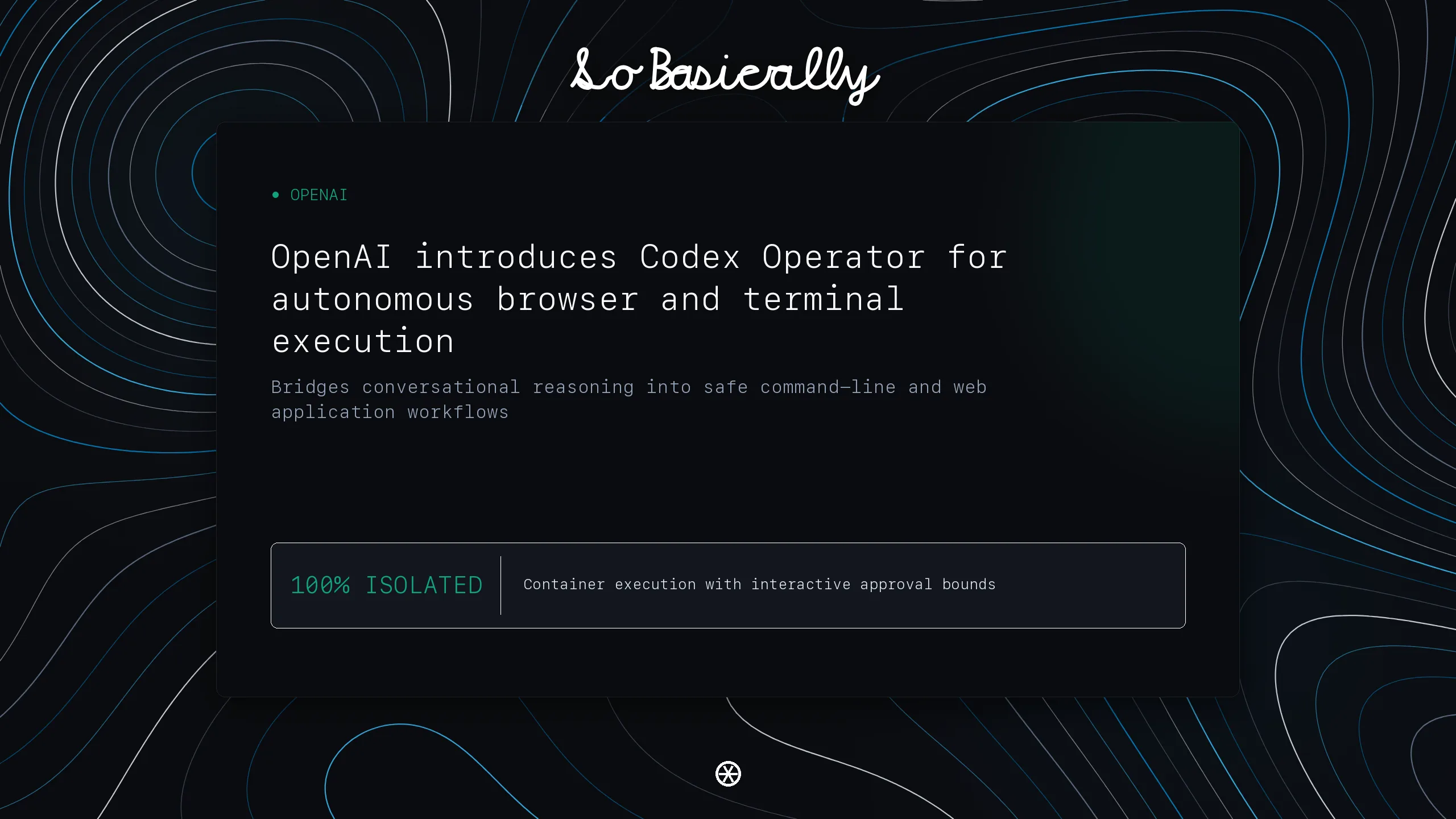
Decision brief card for OpenAI introduces Codex Operator for autonomous browser and terminal execution

OpenAI introduces Codex Operator for autonomous browser and terminal execution

What happened.OpenAI released Codex Operator in developer preview, an autonomous agent platform that executes multi-step engineering tasks across command-line interfaces, web applications, and cloud consoles.

Why it matters.Modern software engineering requires manual navigation across disparate terminals, cloud dashboards, and browser tabs. Sandboxed operational agents with clear human confirmation gates help engineering teams automate repetitive operations safely.

  • Multimodal execution: Combines screen parsing models with shell command generation to navigate both graphical websites and text terminals.
  • Confirmation boundaries: Halts task execution and prompts human operators for explicit approval before running destructive infrastructure commands.
  • Container isolation: Executes workflows inside disposable Linux sandboxes with automated filesystem snapshots for fast rollbacks.
  • Workspace integration: Connects directly into ChatGPT developer workspaces to inspect logs, troubleshoot staging environments, and deploy cloud patches.
Official Source:OpenAI
Decision brief card for OpenAI introduces Codex Operator for autonomous browser and terminal execution
↳Continues: OpenAI rolls out GPT-6.2 Sol to consumer ChatGPT tabs with enhanced tool following
Read Brief
Source:OpenAI (opens in a new tab)
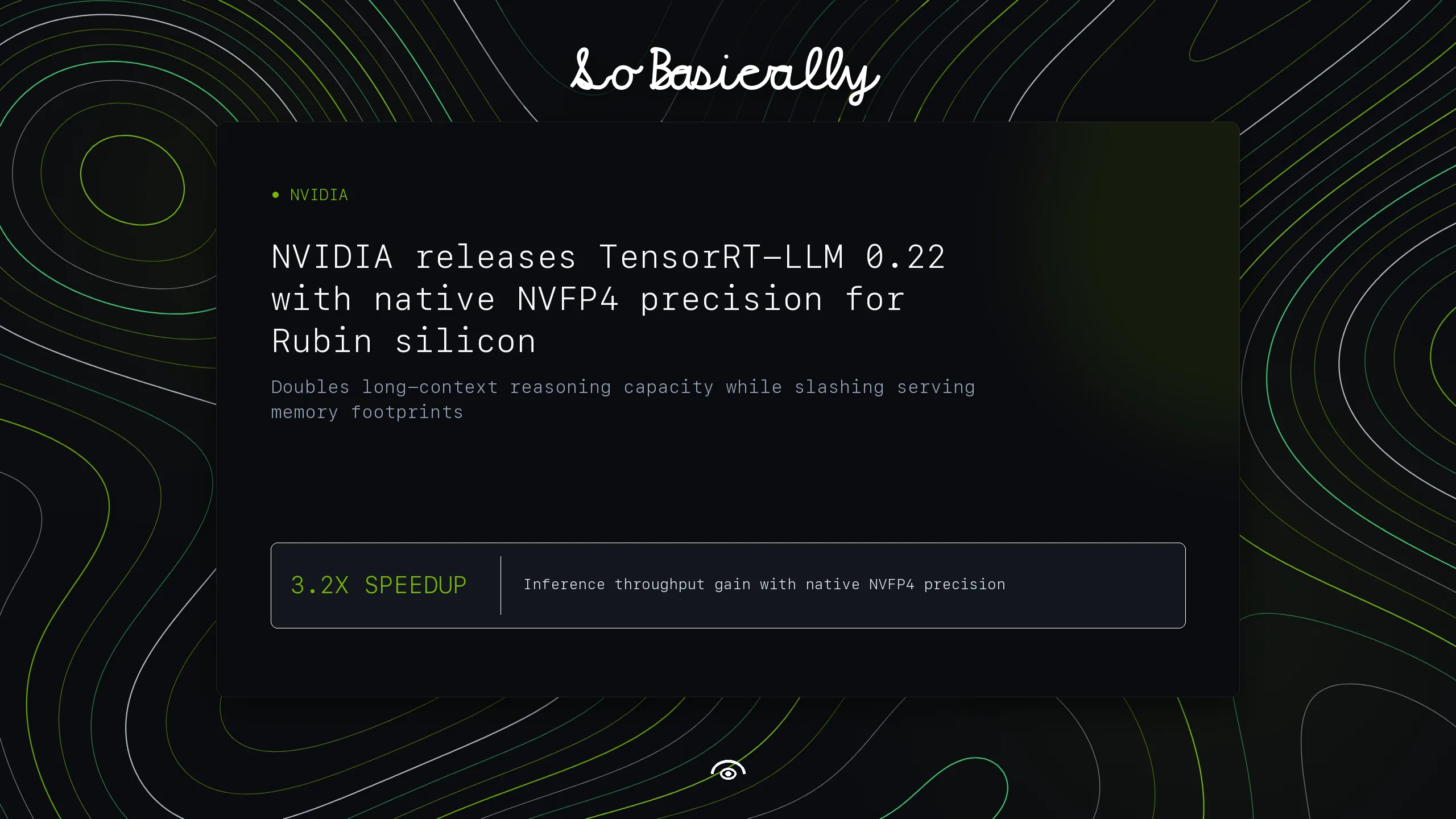
Decision brief card for NVIDIA releases TensorRT-LLM 0.22 with native NVFP4 precision for Rubin silicon

NVIDIA releases TensorRT-LLM 0.22 with native NVFP4 precision for Rubin silicon

What happened.NVIDIA released TensorRT-LLM version 0.22, introducing native four-bit floating-point precision kernels and speculative decoding algorithms optimized for Blackwell and Vera Rubin computing architectures.

Why it matters.Memory bandwidth constraints and expensive server hardware limit the economic viability of frontier reasoning models. Increasing inference speed through lower-precision math lowers cluster operating costs and makes real-time conversational agents affordable.

  • Throughput scaling: Delivers up to 3.2 times higher inference throughput using NVFP4 precision compared to standard eight-bit execution.
  • Speculative drafting: Reduces per-token generation latency to under eight milliseconds across frontier reasoning models.
  • Memory optimization: Slashes key-value cache memory footprints by 45 percent during long-context sessions exceeding one million tokens.
  • Runtime support: Ships immediate integration with vLLM servers, Hugging Face transformers, and Triton Inference Server deployments.
Official Source:NVIDIA Blog
Decision brief card for NVIDIA releases TensorRT-LLM 0.22 with native NVFP4 precision for Rubin silicon
↳Continues: NVIDIA details DGX Spark HPC Developer Kit and RTX Spark deskside cluster
Read Brief
Source:NVIDIA Blog (opens in a new tab)
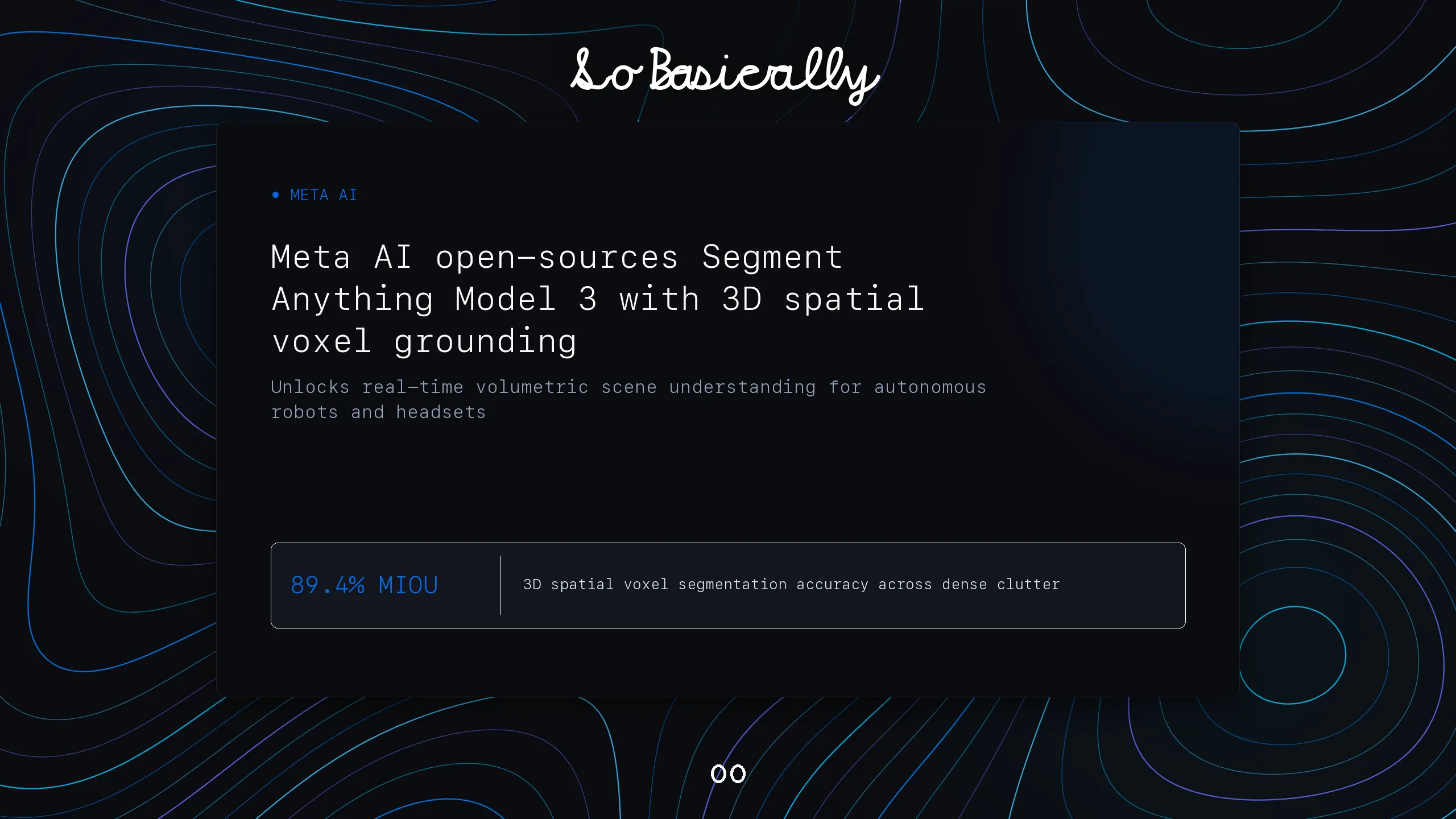
Decision brief card for Meta AI open-sources Segment Anything Model 3 with 3D spatial voxel grounding

Meta AI open-sources Segment Anything Model 3 with 3D spatial voxel grounding

What happened.Meta AI released Segment Anything Model 3 under an open-source license, expanding foundation vision segmentation from two-dimensional images into three-dimensional point clouds and volumetric voxel grids.

Why it matters.Autonomous driving vehicles and delivery robots require precise spatial awareness to navigate around physical obstacles safely. Open foundation models for 3D segmentation allow robotics engineers to build spatial navigation stacks without collecting proprietary training datasets.

  • Volumetric segmentation: Isolates individual physical objects across lidar scans, depth cameras, and neural radiance fields using single-point prompts.
  • Benchmark performance: Scores 89.4 percent mean intersection-over-union accuracy across challenging indoor navigation and outdoor street datasets.
  • Inference speed: Processes dense spatial point clouds at 35 frames per second on workstation graphics hardware using sparse convolutions.
  • Permissive licensing: Publishes complete model weights, training scripts, and evaluation benchmarks under the Apache 2.0 license.
Official Source:Meta AI
Decision brief card for Meta AI open-sources Segment Anything Model 3 with 3D spatial voxel grounding
↳Continues: Researchers use Meta open-weight AI models to accelerate medical breakthroughs
Read Brief
Source:Meta AI (opens in a new tab)
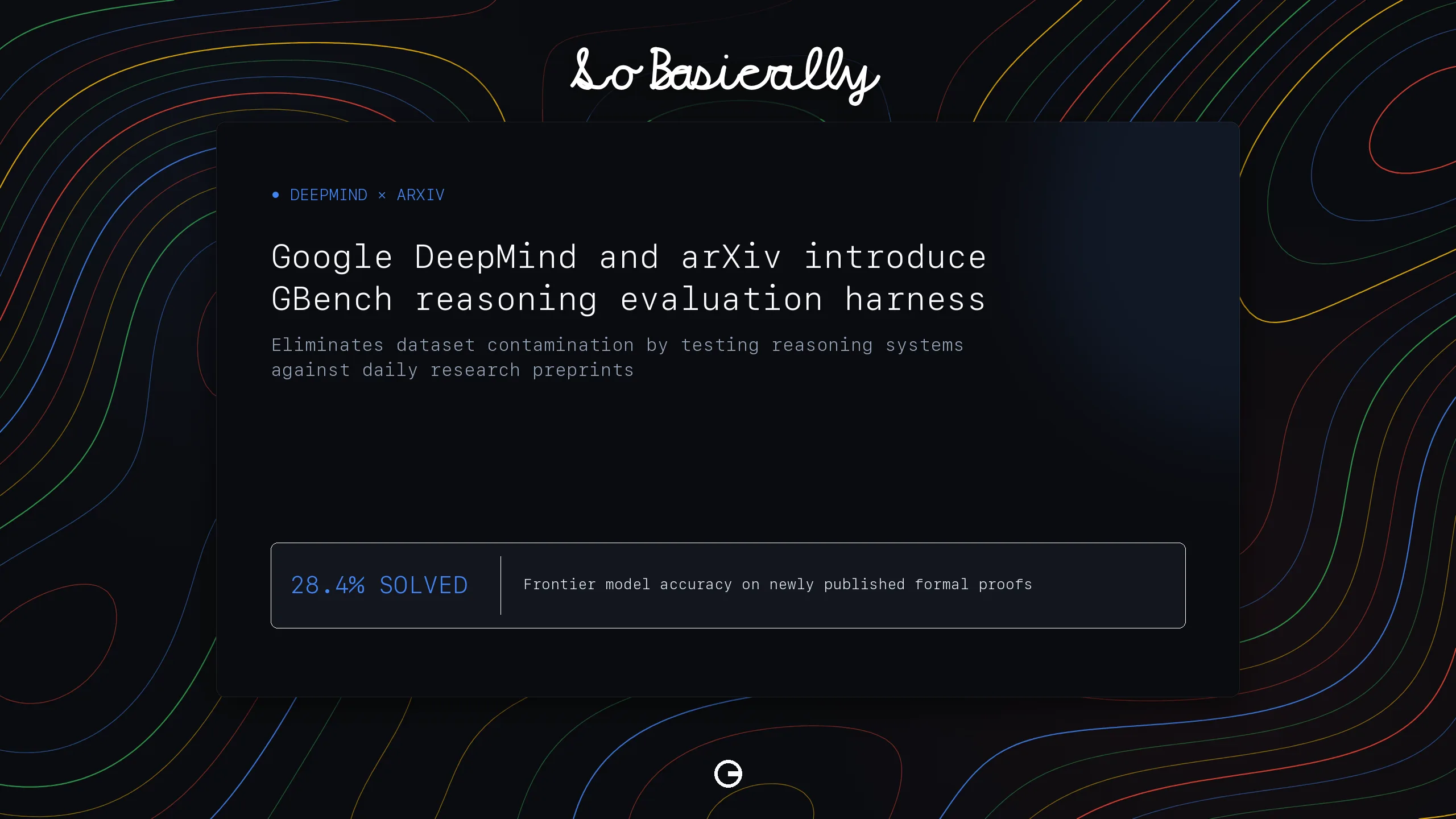
Decision brief card for Google DeepMind and arXiv introduce GBench reasoning evaluation harness

Google DeepMind and arXiv introduce GBench reasoning evaluation harness

What happened.Google DeepMind partnered with arXiv to launch GBench, an open evaluation framework that benchmarks frontier reasoning models against newly published mathematical and scientific preprints.

Why it matters.Foundation models frequently memorize static test sets, inflating public benchmark scores without demonstrating genuine reasoning skills. Testing models against fresh research preprints with formal verification provides an honest measure of mathematical reasoning progress.

  • Dynamic evaluation: Generates novel problem sets daily from peer-reviewed scientific submissions to prevent test benchmark contamination.
  • Formal verification: Uses the Lean 4 and Isabelle theorem provers to verify multi-step mathematical derivations automatically.
  • Open harness: Distributes a standardized command-line runner that scores reasoning traces across proprietary and open-weight model families.
  • Initial results: Frontier reasoning models solved only 28.4 percent of newly published university-level physics derivations during initial benchmark runs.
Official Source:Google The Keyword (AI)
Decision brief card for Google DeepMind and arXiv introduce GBench reasoning evaluation harness
↳Continues: Google DeepMind launches Humanity's First Exam benchmark on Kaggle for LLM reliability
Read Brief
Source:Google The Keyword (AI) (opens in a new tab)
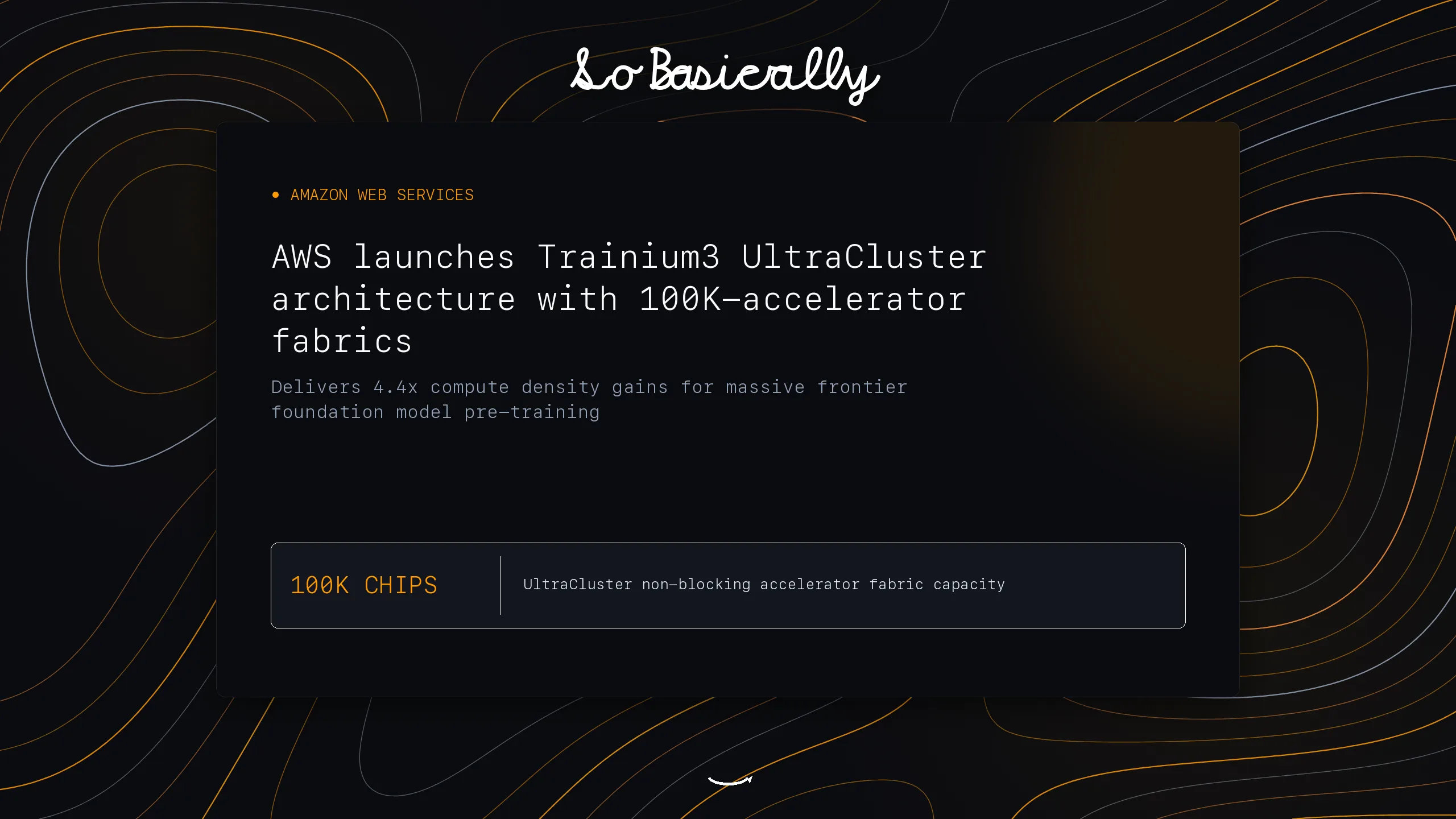
Decision brief card for AWS launches Trainium3 UltraCluster architecture with 100K-accelerator fabrics

AWS launches Trainium3 UltraCluster architecture with 100K-accelerator fabrics

What happened.Amazon Web Services announced the general availability of AWS Trainium3 UltraClusters, connecting up to 100,000 custom silicon accelerators with petabit-scale networking for frontier model training workloads.

Why it matters.Training next-generation foundation models requires colossal computing power and dedicated networking fabrics to prevent cluster stalls. Offering custom silicon clusters at massive scale provides developers with cost-effective alternatives to single-vendor hardware supply chains.

  • Silicon density: Manufactures Trainium3 chips on three-nanometer process nodes, offering 4.4 times more compute performance than Trainium2 accelerators.
  • Network fabric: Connects nodes using Elastic Fabric Adapter networking with 3.2 terabits per second of non-blocking bandwidth per instance.
  • Cluster management: Integrates directly with Amazon SageMaker HyperPod to detect hardware failures and resume model training checkpoints automatically.
  • Lab adoption: Research organizations including Anthropic have begun pre-training frontier foundation models across active Trainium3 clusters.
Official Source:AWS Machine Learning Blog
Decision brief card for AWS launches Trainium3 UltraCluster architecture with 100K-accelerator fabrics
↳Continues: AWS launches Bedrock Trusted Access Program API with Anthropic Frontier Safeguards, AWS rolls out Bedrock AgentCore V2 with sub-2-second cold starts
Read Brief
Source:AWS Machine Learning Blog (opens in a new tab)
CANDIDATE INTELLIGENCE · UNVERIFIED LEADS

The Discovery Wire · Unverified Attention Signals

Candidate storylines identified across developer channels. Under newsroom canon, attention never establishes fact; these leads remain quarantined until supported by Tier 1 official records.

DEVELOPER WIRE

OpenAI private inference enterprise confidential computing

Watchlist tracking enterprise alpha testing of confidential computing and isolated hardware execution for private business intelligence workflows.

STATUS:Awaiting official documentation or verification criteria.
DEVELOPER WIRE

Apple autonomous mac agent development os frameworks

Watchlist tracking internal developer preview of autonomous operating system agent hooks in macOS Sequoia preview builds.

STATUS:Awaiting official documentation or verification criteria.
DEVELOPER WIRE

Hugging Face inference routing migration openrouter infrastructure

Community routing tests for serverless multi-provider failover routing.

STATUS:Awaiting official documentation or verification criteria.
DEVELOPER WIRE

Mistral AI Singapore APAC science hub managed agent studio

Tracking regional cloud partner deployments in Southeast Asia.

STATUS:Awaiting official documentation or verification criteria.
DEVELOPER WIRE

Cisco and OpenAI Shirudo kernel defense runtime

Tracking production eBPF kernel patch deployments across enterprise customers.

STATUS:Awaiting official documentation or verification criteria.
DEVELOPER WIRE

OpenAI GPT-6 intrinsic protein biology research trials

Tracking wet-lab validation timelines for foundation model drug discovery candidates.

STATUS:Awaiting official documentation or verification criteria.
DEVELOPER WIRE

Anthropic Model Context Protocol dynamic skills beta

Tracking community adoption of dynamic tool loading standards.

STATUS:Awaiting official documentation or verification criteria.