Skip to content
SoBasicallyVOL. I · RUN 2026-11-17-cybersecurity-advisories
ARCHIVAL EDITION2026-11-17-cybersecurity-advisories8 STORIES · 1545 WORDS
← Back to Archive

Linux kernel patches decade-old NoisyTCP remote denial of service race condition

Topographic elevation contour card for Linux kernel patches decade-old NoisyTCP remote denial of service race condition

What happened.Upstream Linux kernel maintainers published security patches resolving an eleven-year-old race condition in TCP connection lookups that lets remote actors trigger immediate kernel panics.

Why it matters.Container sandboxes share the host operating system kernel. When a network packet crashes the TCP connection lookup handler, every container running on the physical node fails simultaneously. Infrastructure operators must deploy updated distribution kernels and reboot production worker nodes.

↳Continues: Google Cloud warns of Linux kernel TCP use-after-free flaw in GKE, AWS issues security advisory for Linux kernel IPv4 TCP use-after-free flaw
Read Full Brief →
Source:NIST NVD (opens in a new tab)
VERIFIED STORIES IN THIS EDITION7 STORIES
Decision brief card for Microsoft patches critical Xbox Live networking heap overflow remote code execution

Microsoft patches critical Xbox Live networking heap overflow remote code execution

What happened.Microsoft released cumulative security updates resolving a critical heap-based buffer overflow flaw in the Windows Xbox Live Networking Service that permits unauthenticated remote code execution.

Why it matters.Default background networking services expose listening sockets directly to local and enterprise network boundaries. When packet parsers suffer heap overflows with system privileges, unauthenticated network attackers execute arbitrary payloads. System administrators must deploy the latest Windows cumulative security updates.

  • Memory safety defect: Tracked as CVE-2026-112967 with a 9.8 CVSS score, the defect stems from a memory corruption condition in packet processing routines.
  • Universal deployment: The service runs out of the box with elevated system privileges across consumer and enterprise Windows 10 and Windows 11 editions.
  • Network attack vector: Remote attackers send crafted network packets to exposed service ports, triggering heap memory corruption without requiring user credentials.
  • Cumulative rollups: Remediation is available in the November cumulative update rollups, addressing multiple affected Windows 10 and Windows 11 release branches.
Official Source:Microsoft Security Response Center
Decision brief card for Microsoft patches critical Xbox Live networking heap overflow remote code execution
↳Continues: Microsoft patches zero-click Windows Search remote code execution defect, Microsoft resolves critical SharePoint Server elevation of privilege flaw
Read Brief
Source:Microsoft Security Response Center (opens in a new tab)
Decision brief card for Git patches recursive submodule integer truncation code execution flaw

Git patches recursive submodule integer truncation code execution flaw

What happened.The Git project published security maintenance updates fixing an integer truncation flaw that lets attackers overwrite submodule configuration with symlinks to execute arbitrary code during recursive clones.

Why it matters.Automated continuous integration workers and developer workstations regularly run recursive repository clones. When path validation flaws permit symlink execution hooks, untrusted repositories seize local build environments immediately. Engineering teams must update Git packages to version 2.56.1 across developer fleets.

  • Integer truncation flaw: Tracked as CVE-2026-111760 with an 8.0 CVSS score, the defect stems from length validation truncation when handling index paths.
  • Symlink hook hijacking: Malicious repositories pass path validation checks to replace a submodule's git directory with a symbolic link pointing to malicious hooks.
  • Recursive clone trigger: When developers clone repositories with recursive submodule options, client environments execute attacker-controlled scripts without interactive confirmation.
  • Maintenance releases: Fixes are available in Git 2.56.1 and backported across maintenance branches including versions 2.50.2 through 2.55.1.
Official Source:NIST NVD
Decision brief card for Git patches recursive submodule integer truncation code execution flaw
↳Continues: Git patches recursive submodule arbitrary code execution flaw across all versions, GitLab releases security updates addressing Git execution flaws in Gitaly engine
Read Brief
Source:NIST NVD (opens in a new tab)
Decision brief card for Google Cloud resolves transient execution scheduler flaws on Turin processors

Google Cloud resolves transient execution scheduler flaws on Turin processors

What happened.Google Cloud issued security bulletin GCP-2026-081 detailing hypervisor isolation updates that protect cloud compute instances against transient execution side-channel attacks on fifth-generation processors.

Why it matters.Multi-tenant cloud clouds rely on hardware isolation to separate customer workloads. When processor scheduling flaws leak speculative memory states across virtual machines, co-located attackers attempt cross-tenant memory snooping. Cloud infrastructure operators should review Compute Engine maintenance notices.

  • Transient execution defect: Addressed under security bulletin GCP-2026-081, microarchitectural scheduler flaws in Zen 5 CPU architectures allow speculative execution data extraction across virtual boundaries.
  • Hypervisor isolation updates: Google deployed automated infrastructure patches to cloud hypervisors, establishing strict barrier boundaries between multi-tenant virtual machines.
  • Reboot coordination: Certain managed Compute Engine clusters required scheduled live migration and instance reboot cycles to enforce microarchitectural mitigation states.
  • Customer action: Most managed cloud environments received transparent updates, with administrators of self-managed images instructed to install updated Google Cloud SDK packages.
Official Source:Google Cloud Security Bulletins
Decision brief card for Google Cloud resolves transient execution scheduler flaws on Turin processors
↳Continues: Google Cloud issues security advisory on AMD Turin CPU Transient Scheduler Attacks, Google Cloud resolves credential URL SSRF in Google Auth library
Read Brief
Source:Google Cloud Security Bulletins (opens in a new tab)
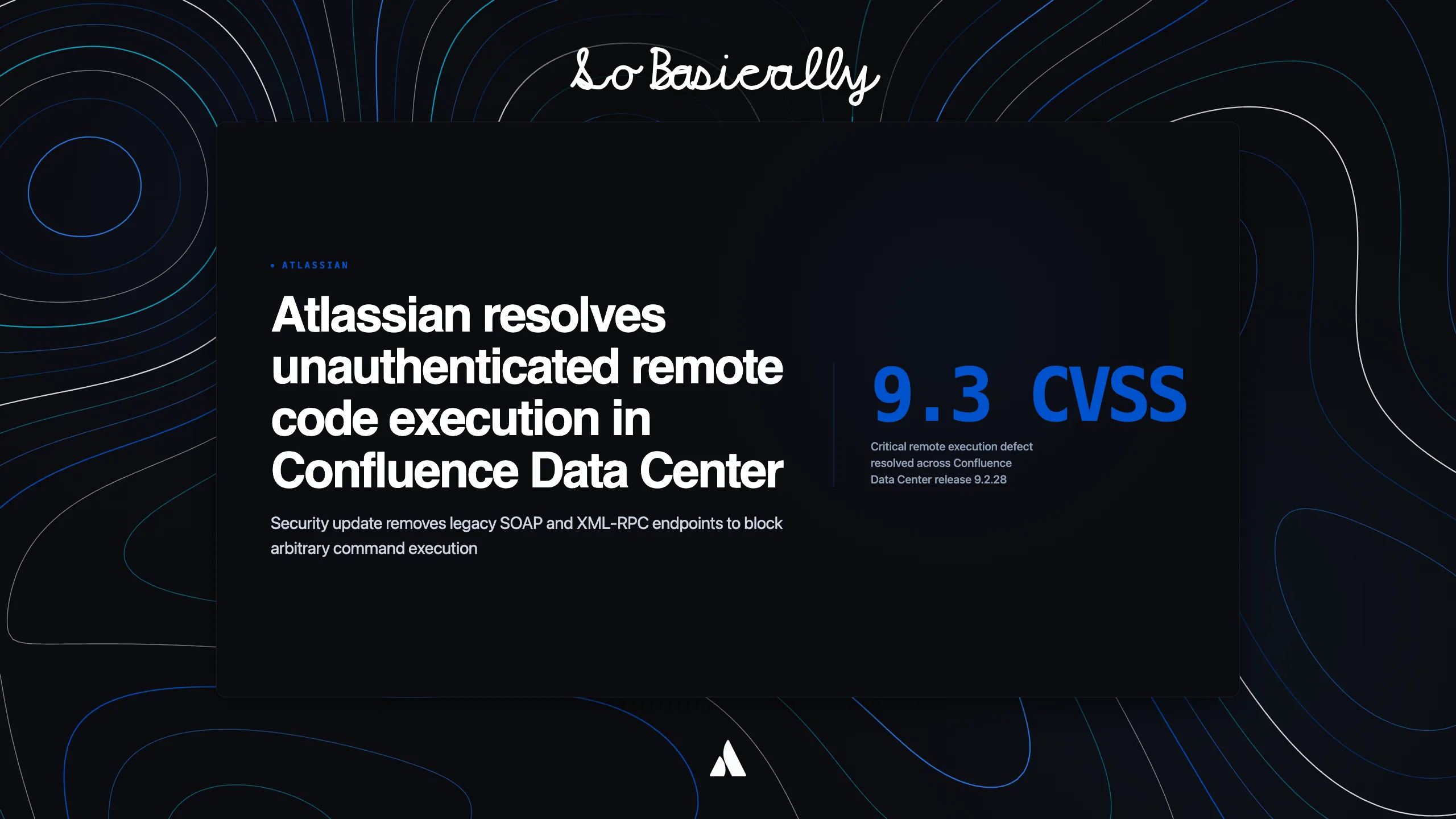
Decision brief card for Atlassian resolves unauthenticated remote code execution in Confluence Data Center

Atlassian resolves unauthenticated remote code execution in Confluence Data Center

What happened.Atlassian delivered emergency security updates resolving a critical unauthenticated remote code execution vulnerability in legacy web service endpoints across Confluence Data Center and Confluence Server.

Why it matters.Knowledge management platforms store confidential corporate documentation and source repositories. When legacy management endpoints allow unauthenticated actors to execute arbitrary commands, entire enterprise data archives face compromise. Enterprise security teams must deploy Confluence release 9.2.28 across internal instances.

  • Legacy protocol flaw: Tracked as CVE-2026-90436 with a 9.3 CVSS score, the defect involves flawed request handling in deprecated Apache Axis SOAP and XML-RPC communication interfaces.
  • Remote code execution: Network attackers send crafted payloads to exposed administrative service ports, executing operating system commands with full web application service privileges.
  • Impacted deployments: The vulnerability affects Confluence Data Center and Server versions prior to release 9.2.28 when legacy remote application programming interfaces are enabled.
  • Remediation release: Atlassian published Confluence version 9.2.28, permanently disabling the vulnerable legacy endpoints and urging customers to upgrade enterprise clusters immediately.
Official Source:NIST NVD
Decision brief card for Atlassian resolves unauthenticated remote code execution in Confluence Data Center
↳Continues: Atlassian patches critical Confluence Data Center remote code execution vulnerability, Atlassian addresses critical path traversal flaw across Confluence and Jira
Read Brief
Source:NIST NVD (opens in a new tab)
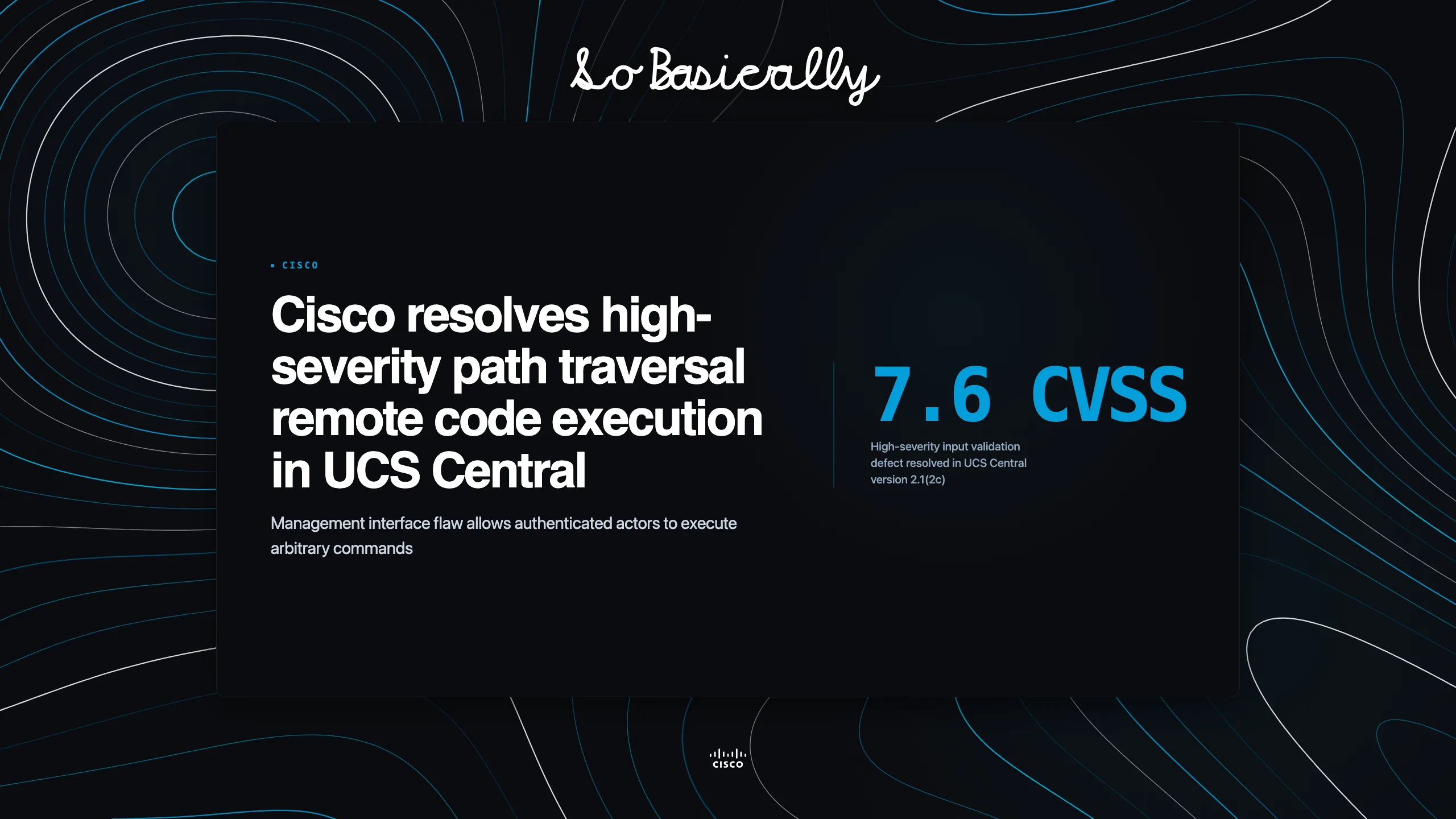
Decision brief card for Cisco resolves high-severity path traversal remote code execution in UCS Central

Cisco resolves high-severity path traversal remote code execution in UCS Central

What happened.Cisco Systems published security advisories resolving a high-severity path traversal vulnerability in UCS Central Software that permits authenticated network attackers to execute arbitrary system commands.

Why it matters.Unified computing management consoles coordinate physical datacenter compute, storage, and networking hardware. When management consoles permit path traversal and remote code execution, attackers compromise physical host fabrics beneath hypervisors. Datacenter administrators must schedule immediate upgrades to release 2.1(2c).

  • Path traversal defect: Tracked as CVE-2026-76506 with a 7.6 CVSS score, the defect stems from insufficient input validation within the web management interface.
  • Arbitrary file manipulation: Authenticated actors transmit crafted HTTP requests to write arbitrary files to the underlying operating system and execute commands with elevated service rights.
  • Affected software: The vulnerability impacts deployments running unpatched Cisco UCS Central Software across enterprise datacenter server management clusters.
  • Maintenance build: Cisco delivered fixed software in UCS Central release 2.1(2c), confirming that no administrative workaround options exist to neutralize the flaw without patching.
Official Source:Cisco Security Advisories
Decision brief card for Cisco resolves high-severity path traversal remote code execution in UCS Central
↳Continues: Cisco patches critical arbitrary file write vulnerability in Secure Email Gateway, Cisco patches high-severity RCE flaw in UCS Central Software
Read Brief
Source:Cisco Security Advisories (opens in a new tab)
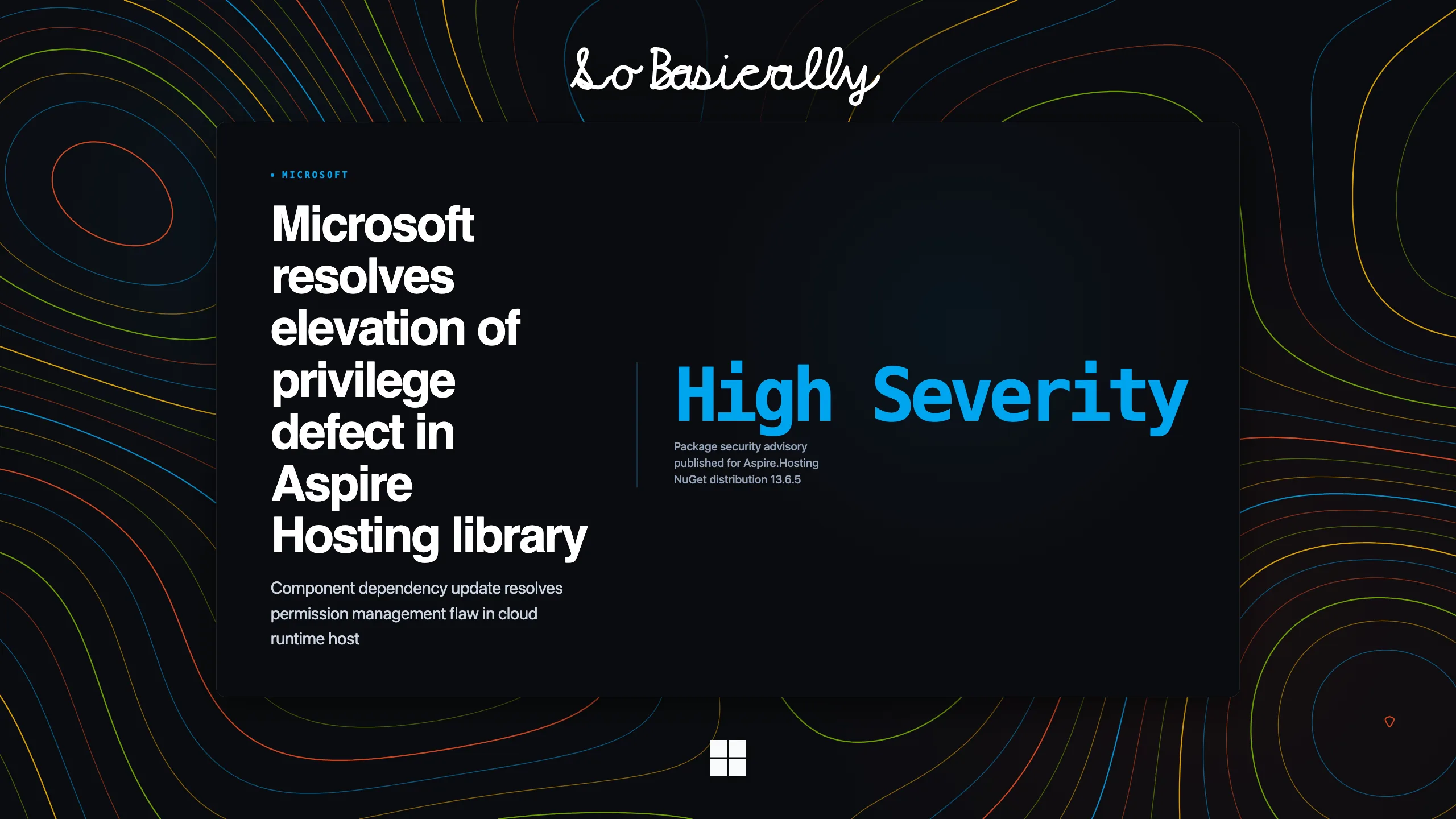
Decision brief card for Microsoft resolves elevation of privilege defect in Aspire Hosting library

Microsoft resolves elevation of privilege defect in Aspire Hosting library

What happened.Microsoft published security advisories and package updates resolving an elevation of privilege vulnerability in the Aspire Hosting library for cloud-native application runtimes.

Why it matters.Cloud-native application stacks orchestrate interconnected containers, databases, and message queues. When hosting libraries mishandle permission boundaries during local orchestration, low-privilege microservices compromise developer workstations and build infrastructure. Teams building with Aspire should update dependencies to version 13.6.5.

  • Elevation of privilege: Tracked as CVE-2026-120006 with high severity in the GitHub Advisory Database, the flaw involves improper privilege handling in Aspire.Hosting components.
  • Container orchestrator context: Applications deploying distributed microservices via the Aspire developer framework risk local unauthorized access during container orchestration handshakes.
  • Local execution vector: Attackers with local service access manipulate orchestrator environment parameters to elevate privileges within the host developer environment.
  • Package update: Microsoft issued patched NuGet package version 13.6.5 for Aspire.Hosting, instructing developers to update project references across cloud-native solutions.
Official Source:NIST NVD
Decision brief card for Microsoft resolves elevation of privilege defect in Aspire Hosting library
↳Continues: Microsoft patches zero-click Windows Search remote code execution defect, Microsoft resolves critical SharePoint Server elevation of privilege flaw
Read Brief
Source:NIST NVD (opens in a new tab)
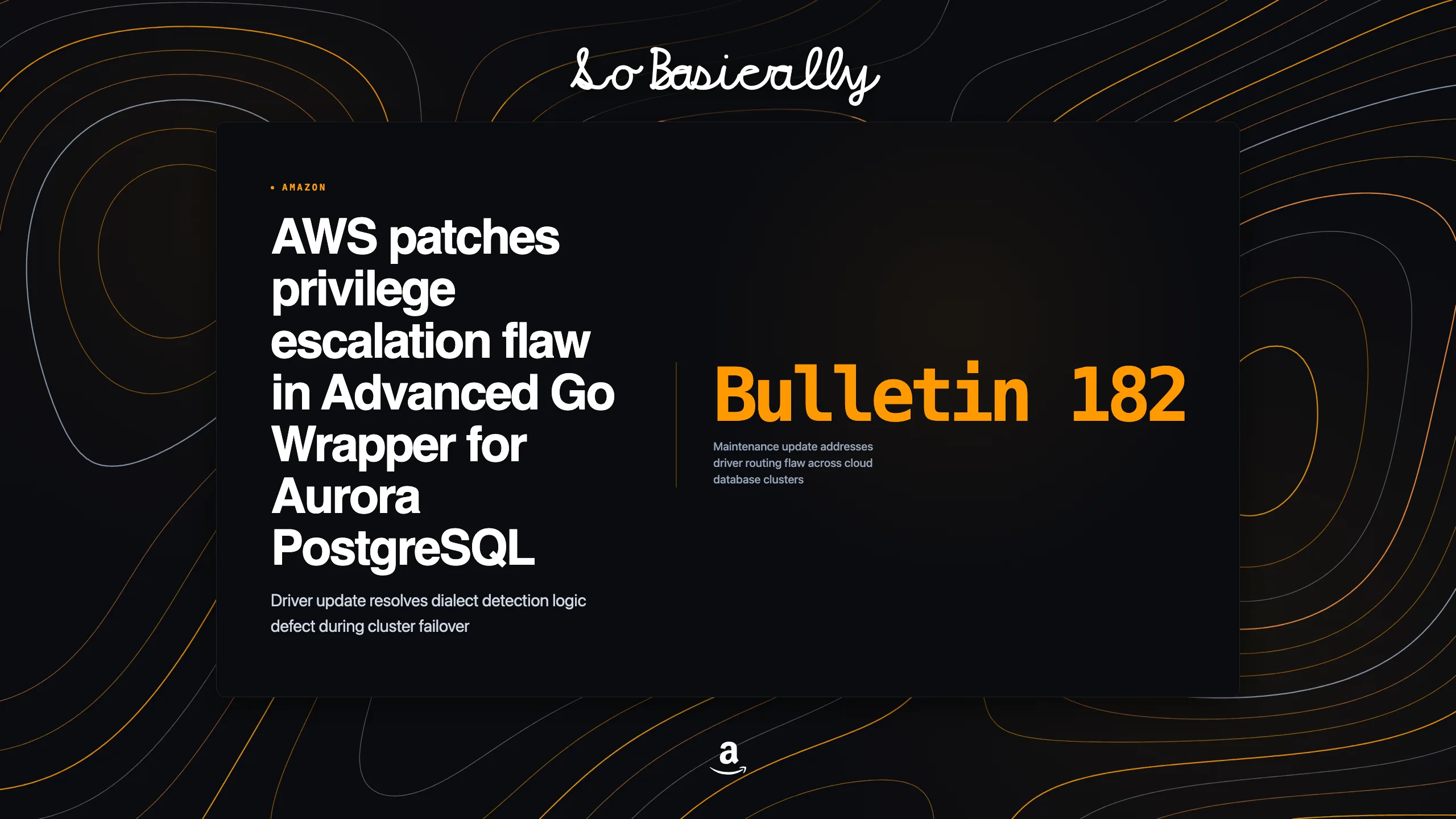
Decision brief card for AWS patches privilege escalation flaw in Advanced Go Wrapper for Aurora PostgreSQL

AWS patches privilege escalation flaw in Advanced Go Wrapper for Aurora PostgreSQL

What happened.Amazon Web Services published security bulletin 2026-182-AWS detailing updates for the AWS Advanced Go Wrapper that resolve a privilege escalation flaw during Aurora PostgreSQL dialect detection.

Why it matters.Database connection wrappers optimize cluster failover and read scaling. When client drivers misidentify cluster connection dialects, connection contexts risk unintended privilege inheritance across pooled sessions. Go developers connecting to Aurora PostgreSQL clusters should update the driver module to version 1.4.0.

  • Privilege escalation defect: Tracked as CVE-2026-126793, the vulnerability involves flawed dialect detection logic when establishing database connections to managed Aurora clusters.
  • Dialect routing flaw: When client applications initialize pooled connections without strict dialect parameters, attackers manipulate session handshake states to escalate privileges within connection pools.
  • Impacted components: The issue impacts applications using the open-source AWS Advanced Go Wrapper driver for PostgreSQL during automated cluster failover transitions.
  • Driver maintenance update: AWS released wrapper version 1.4.0, enforcing strict validation of server dialect responses before granting connection session permissions.
Official Source:AWS Security Bulletins
Decision brief card for AWS patches privilege escalation flaw in Advanced Go Wrapper for Aurora PostgreSQL
↳Continues: AWS fixes S3 bucket ownership defect in Pandas SDK EMR logging, AWS patches Aurora PostgreSQL dialect privilege escalation in Advanced Go Wrapper
Read Brief
Source:AWS Security Bulletins (opens in a new tab)
CANDIDATE INTELLIGENCE · UNVERIFIED LEADS

The Discovery Wire · Unverified Attention Signals

Candidate storylines identified across developer channels. Under newsroom canon, attention never establishes fact; these leads remain quarantined until supported by Tier 1 official records.

DEVELOPER WIRE

Apache HTTP/2 mod_http2 Race Condition Heap Corruption

Tracked as CVE-2026-119618 with an 8.8 CVSS score, concurrent HTTP/2 stream multiplexing corrupts heap memory in Apache HTTP Server versions 2.4.55 through 2.4.70; patched in release 2.4.71.

STATUS:Awaiting official documentation or verification criteria.
DEVELOPER WIRE

CISA Known Exploited Vulnerabilities GPUStack Loopback Spoofing RCE

Added to CISA KEV catalog under CVE-2026-102895 with a 9.8 CVSS score, improper authentication in loopback address handling permits unauthenticated remote code execution across AI GPU clusters.

STATUS:Awaiting official documentation or verification criteria.
DEVELOPER WIRE

CISA Known Exploited Vulnerabilities IBM Aspera Faspex Authorization Bypass

Added to CISA KEV catalog under CVE-2026-123218 with a 9.8 CVSS score, missing authorization checks allow administrative privilege escalation across enterprise file transfer platforms.

STATUS:Awaiting official documentation or verification criteria.
DEVELOPER WIRE

SignalWire FreeSWITCH SIP MESSAGE Header Split Command Injection Flaw

Tracked as CVE-2026-116779 with a 9.8 CVSS score, improper delimiter splitting in inbound session initiation message handlers permits operating system command injection.

STATUS:Awaiting official documentation or verification criteria.
DEVELOPER WIRE

Microsoft Entra ID Device Registration Authorization Bypass

Tracked as CVE-2026-109469 with a 10.0 CVSS score, cloud-side mitigations resolve a maximum-severity user-controlled key flaw permitting remote elevation of privilege.

STATUS:Awaiting official documentation or verification criteria.
DEVELOPER WIRE

Microsoft Outlook NTLMv2 Hash Disclosure Spoofing Zero-Day

Added to CISA KEV catalog under CVE-2026-124194 with a 6.5 CVSS score, opening specially crafted email messages triggers background connections to remote attacker systems and leaks NTLMv2 credentials.

STATUS:Awaiting official documentation or verification criteria.
DEVELOPER WIRE

Check Point Gaia OS DynamicCLI Local Privilege Escalation Zero-Day

Added to CISA KEV catalog under CVE-2026-123039 with a 7.8 CVSS score and vendor bulletin sk1000362, an unauthenticated local control socket in DynamicCLI allows attackers to escalate to root permissions.

STATUS:Awaiting official documentation or verification criteria.
DEVELOPER WIRE

OpenSSH "SSHole" musl libc Authentication Bypass

Tracked as CVE-2026-123158 with an 8.1 CVSS score and added to CISA KEV catalog, an unexpected return value flaw in musl libc crypt() enables unauthenticated remote attackers to bypass password authentication on Alpine Linux.

STATUS:Awaiting official documentation or verification criteria.
DEVELOPER WIRE

SAP ICM2SHELL and PROXYGATE Memory Corruption and Gateway Bypasses

Disclosed under CVE-2026-76964, CVE-2026-89126, and CVE-2026-89103 with maximum 10.0 CVSS scores, unauthenticated WebSocket parsing and gateway proxy flaws allow remote code execution across NetWeaver and Web Dispatcher stacks.

STATUS:Awaiting official documentation or verification criteria.
DEVELOPER WIRE

SonicWall SonicOS SSL-VPN SAML Multi-Factor Authentication Bypass

Added to CISA KEV catalog under CVE-2026-19868 with advisory SNWLID-2026-0014, an authentication enforcement flaw allows attackers with alternate credentials to bypass SAML MFA controls across Gen 7 and Gen 8 firewalls.

STATUS:Awaiting official documentation or verification criteria.
DEVELOPER WIRE

UnrealIRCd Labeled Response Command Injection Flaw

Tracked as CVE-2026-114713 with an 8.6 CVSS score, improper neutralization of delimiters in IRCv3 label tags permits unprivileged network users to inject administrative server commands.

STATUS:Awaiting official documentation or verification criteria.
DEVELOPER WIRE

Windows CLFS "SignDrop" Zero-Day Privilege Escalation

Disclosed by security researchers with public exploit code targeting the clfs.sys driver, attackers abuse RPC calls to Microsoft Defender to spawn SYSTEM shells across unpatched systems without a vendor patch.

STATUS:Awaiting official documentation or verification criteria.
DEVELOPER WIRE

Windows LDAP Domain Controller Out-of-Bounds Write RCE

Tracked as CVE-2026-119958 with a 9.8 CVSS score under CWE-787, unauthenticated network attackers transmit crafted directory requests to execute arbitrary code within the LDAP service context.

STATUS:Awaiting official documentation or verification criteria.
DEVELOPER WIRE

Cisco ASA and Secure Firewall Threat Defense SSL VPN Reload DoS

Tracked as CVE-2026-76418 with an 8.6 CVSS score, unauthenticated remote attackers send crafted requests to Remote Access SSL VPN tunnels configured with secondary authentication, forcing appliance reloads.

STATUS:Awaiting official documentation or verification criteria.
DEVELOPER WIRE

Palo Alto Networks PAN-OS Dataplane Leak and Panorama Root RCE

Tracked as CVE-2026-0331 and CVE-2026-0330, an unauthenticated dataplane information disclosure flaw in PAN-OS and an authenticated root execution defect in Panorama prompted enterprise hotfixes.

STATUS:Awaiting official documentation or verification criteria.
DEVELOPER WIRE

Barracuda Networks ESG Authentication Bypass and Command Injection

Added to CISA KEV catalog under CVE-2026-116606 and CVE-2026-111560, attackers actively targeted email security appliances using unauthenticated command execution vectors to deploy root persistence.

STATUS:Awaiting official documentation or verification criteria.
DEVELOPER WIRE

ConnectWise ScreenConnect Client Authorization Flaw Weaponized by SCKit

Tracked as CVE-2026-84869 with a 9.9 CVSS score, threat actors deployed the RelayTrap worm framework across Managed Service Providers to harvest tokens and pivot across managed customer environments.

STATUS:Awaiting official documentation or verification criteria.
DEVELOPER WIRE

Citrix NetScaler Packet Processing Memory Overflow

Tracked as CVE-2026-120868 under security bulletin CTX697305 with a 9.3 CVSS score, heap buffer corruption in core packet processing permits remote unauthenticated code execution or service denial.

STATUS:Awaiting official documentation or verification criteria.
DEVELOPER WIRE

AWS Pandas SDK EMR Logging S3 Bucket Ownership Defect

Tracked as CVE-2026-127119 in security bulletin 2026-181-AWS, predictable default bucket naming exposed EMR cluster telemetry and job logs to third parties.

STATUS:Awaiting official documentation or verification criteria.
DEVELOPER WIRE

Apple Bluetooth Packet State Tracking Memory Corruption

Tracked as CVE-2026-113968 and CVE-2026-113970, memory safety defects and pairing bypass logic in wireless subsystem daemons prompted out-of-band updates across iOS, iPadOS, and macOS.

STATUS:Awaiting official documentation or verification criteria.