Skip to content
SoBasicallyVOL. I · RUN 2026-11-13-cybersecurity-advisories
ARCHIVAL EDITION2026-11-13-cybersecurity-advisories8 STORIES · 1559 WORDS
← Back to Archive

Google Cloud issues security advisory on AMD Turin CPU Transient Scheduler Attacks

Topographic elevation contour card for Google Cloud issues security advisory on AMD Turin CPU Transient Scheduler Attacks

What happened.Google Cloud published a security bulletin detailing three processor side-channel vulnerabilities affecting virtual machines running on fifth-generation AMD EPYC Turin processors.

Why it matters.Virtual machine isolation is the core boundary of multi-tenant cloud hosting. When speculative execution flaws allow unprivileged processes to infer kernel memory, application data faces exposure. Cloud infrastructure teams using AMD Turin instances must schedule maintenance windows to complete full stop-start cycles immediately.

Read Full Brief →
Source:Google Cloud Security Bulletins (opens in a new tab)
VERIFIED STORIES IN THIS EDITION7 STORIES
Decision brief card for Microsoft patches critical unauthenticated LDAP remote code execution defect

Microsoft patches critical unauthenticated LDAP remote code execution defect

What happened.Microsoft resolved a maximum-severity remote code execution flaw in Active Directory Lightweight Directory Access Protocol during its monthly security release.

Why it matters.Active Directory is the central identity authority for corporate enterprise networks worldwide. When unauthenticated network vulnerabilities permit arbitrary code execution on domain controllers, attackers gain administrative control over all domain assets. Enterprise systems engineers must apply the latest Windows Server security rollups to domain infrastructure immediately.

  • Vulnerability mechanics: Tracked as CVE-2026-119958 with a 9.8 CVSS score, the defect stems from improper memory handling in Windows LDAP services.
  • Exploitation path: Remote unauthenticated attackers send crafted network payloads directly to exposed directory service endpoints without entering valid domain credentials.
  • System compromise: Successful exploitation triggers heap memory corruption and executes arbitrary code with privileged SYSTEM permissions on domain controllers.
  • Remediation release: Microsoft distributed cumulative monthly security updates across supported Windows Server operating system versions to patch vulnerable services.
Official Source:Microsoft Security Response Center
Decision brief card for Microsoft patches critical unauthenticated LDAP remote code execution defect
Read Brief
Source:Microsoft Security Response Center (opens in a new tab)
Decision brief card for CISA and Siemens warn of critical Node2Shell Brotli buffer overflow in industrial systems

CISA and Siemens warn of critical Node2Shell Brotli buffer overflow in industrial systems

What happened.CISA published industrial cybersecurity advisories as Siemens issued urgent security patches for critical out-of-bounds write flaws in the Brotli decompression library.

Why it matters.Open-source compression libraries link deeply into enterprise software runtimes and industrial operational hardware. When memory corruption bugs permit remote code execution through standard data parsing routines, attackers breach industrial networks through normal network communications. Infrastructure operators running Siemens edge appliances and manufacturing software must install vendor updates immediately. Security teams should enforce deep packet inspection on external data transfers feeding internal industrial platforms.

  • Vulnerability mechanics: Tracked as CVE-2026-111497 with a 9.8 CVSS score, the Node2Shell flaw resides in the C Brotli decompression decoder.
  • Exploit mechanism: Unauthenticated remote attackers deliver malformed compressed data streams that trigger memory corruption during stream decoding.
  • Industrial impact: Siemens confirmed vulnerability exposure across Teamcenter software, Opcenter applications, and RUGGEDCOM APE1808 edge communication modules.
  • Advisory publications: Siemens ProductCERT issued advisories SSA-242944 and SSA-678870 detailing software updates and recommended perimeter workarounds.
  • Federal tracking: CISA updated the Known Exploited Vulnerabilities catalog and published ICS advisory ICSA-26-316-02 to alert critical infrastructure operators.
Official Source:CISA
Decision brief card for CISA and Siemens warn of critical Node2Shell Brotli buffer overflow in industrial systems
Read Brief
Source:CISA (opens in a new tab)
Decision brief card for AWS addresses relative path traversal flaw in ParallelCluster CLI log exports

AWS addresses relative path traversal flaw in ParallelCluster CLI log exports

What happened.Amazon Web Services published a security bulletin resolving a relative path traversal vulnerability affecting cluster log export commands in the AWS ParallelCluster command-line tool.

Why it matters.High-performance computing clusters rely on ParallelCluster to orchestrate massive distributed computational workloads across cloud resources. When command-line tooling allows directory traversal file writes, attackers tamper with orchestration scripts and elevate privileges. Cloud operations teams must upgrade local ParallelCluster installations to version 3.13.0 immediately.

  • Vulnerability mechanics: Tracked as CVE-2026-124033 in bulletin 2026-174-AWS, the flaw stems from insufficient input sanitization during export-cluster-logs operations.
  • Exploitation path: An attacker with cluster access provides manipulated directory parameters to write exported log archives outside intended storage directories.
  • Arbitrary file write: The directory escape permits unauthorized file creation or overwrites on the local administrative machine executing orchestration commands.
  • Remediation release: AWS published ParallelCluster version 3.13.0 with strict file path validation routines to block unauthorized path traversal attempts.
Official Source:AWS Security Bulletins
Decision brief card for AWS addresses relative path traversal flaw in ParallelCluster CLI log exports
Read Brief
Source:AWS Security Bulletins (opens in a new tab)
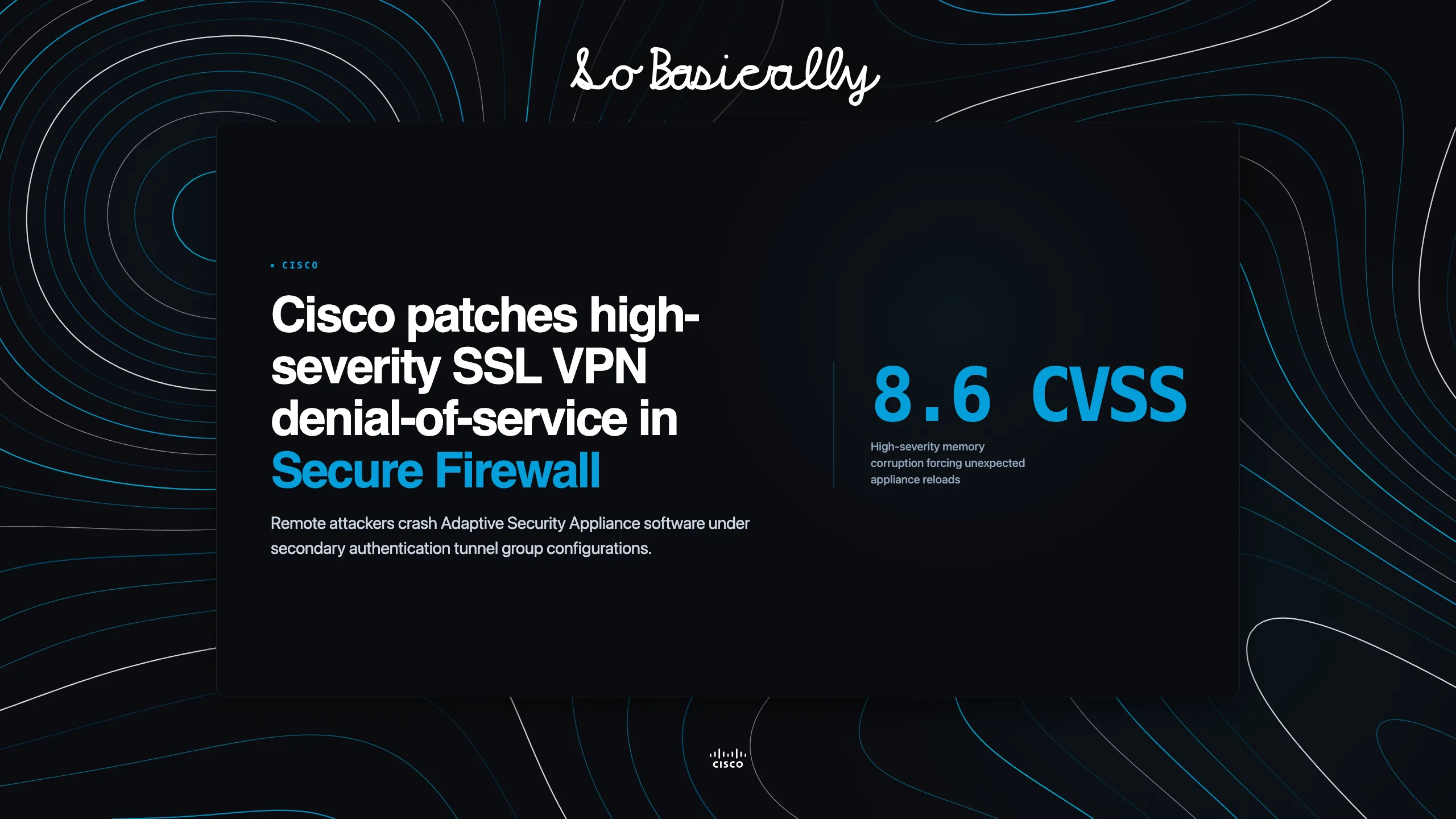
Decision brief card for Cisco patches high-severity SSL VPN denial-of-service vulnerability in Secure Firewall ASA

Cisco patches high-severity SSL VPN denial-of-service vulnerability in Secure Firewall ASA

What happened.Cisco Systems published security updates addressing a high-severity denial-of-service vulnerability affecting the Remote Access SSL VPN service in Adaptive Security Appliance software.

Why it matters.Enterprise firewalls maintain remote worker connectivity and protect internal corporate perimeters. When unauthenticated network traffic crashes edge appliances, corporate operations experience sudden remote access outages. Network security teams must apply Cisco software maintenance updates to internet-facing firewall appliances immediately.

  • Vulnerability mechanics: Tracked as CVE-2026-76418 with an 8.6 CVSS score, the defect resides in the SSL VPN subsystem of Cisco ASA and FTD software.
  • Trigger condition: The flaw activates when administrators configure secondary authentication schemes on an active Remote Access VPN tunnel group.
  • Exploitation impact: Unauthenticated remote attackers send crafted network traffic to the VPN endpoint, triggering memory corruption that forces unexpected device reloads.
  • Remediation release: Cisco released software maintenance updates for supported ASA and FTD trains, advising operators to update software or adjust authentication configurations.
Official Source:Cisco Security Advisories
Decision brief card for Cisco patches high-severity SSL VPN denial-of-service vulnerability in Secure Firewall ASA
Read Brief
Source:Cisco Security Advisories (opens in a new tab)
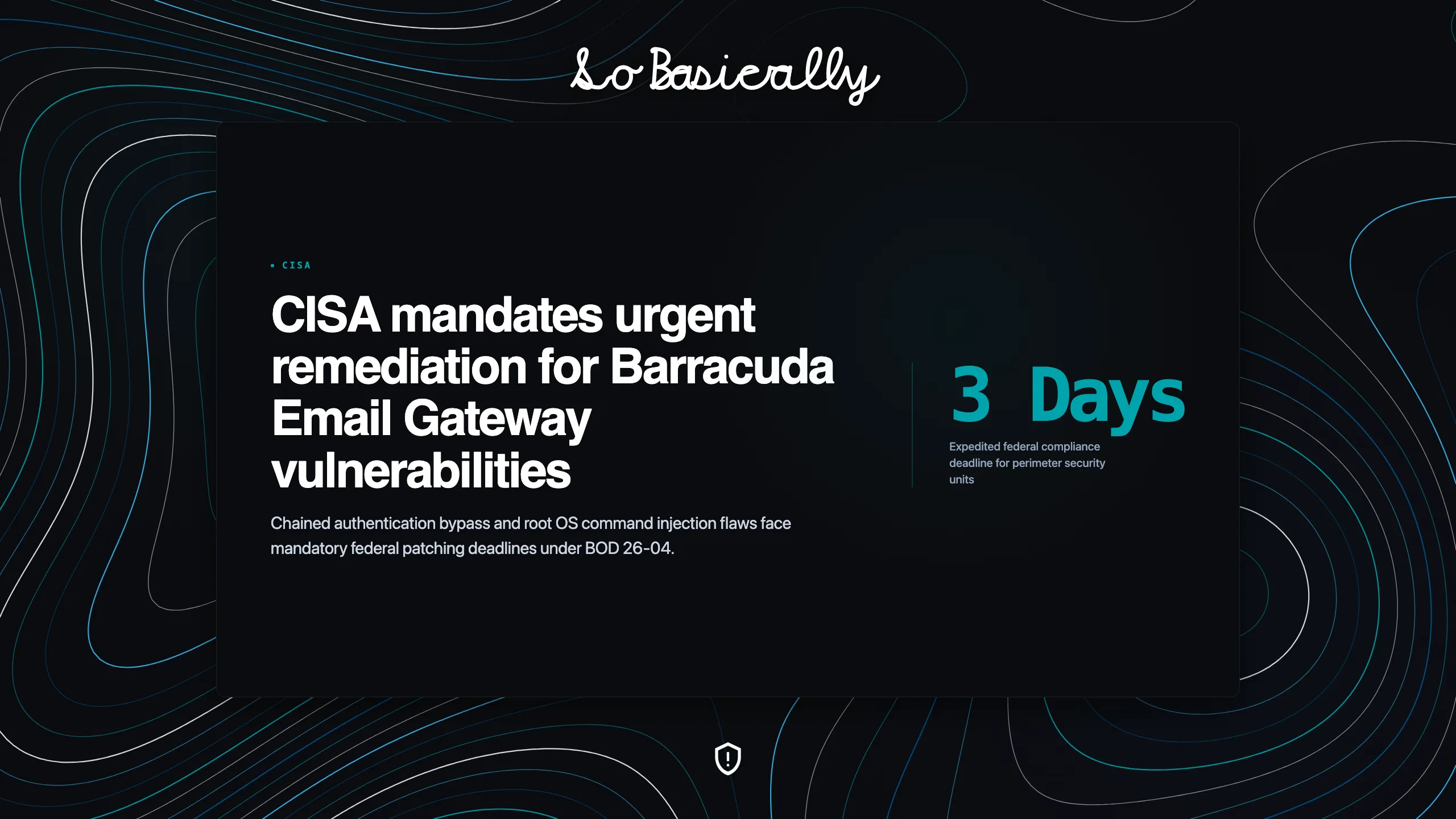
Decision brief card for CISA mandates urgent remediation deadline for Barracuda Email Gateway vulnerabilities

CISA mandates urgent remediation deadline for Barracuda Email Gateway vulnerabilities

What happened.CISA established an expedited three-day remediation deadline ordering federal agencies to patch chained remote code execution vulnerabilities in Barracuda Email Security Gateway appliances.

Why it matters.Email security appliances process inbound corporate communications and reside directly on the public internet perimeter. When chained zero-day vulnerabilities grant unauthenticated root access, threat groups establish persistent backdoors and exfiltrate confidential enterprise correspondence. Security administrators managing Barracuda appliances must verify that firmware hotfixes have applied across all physical and virtual units. Incident response teams should inspect network flow logs for unusual outbound connections from gateway appliances.

  • Vulnerability chaining: Attackers combine CVE-2026-116606 for authentication bypass with CVE-2026-111560 for arbitrary operating system command injection.
  • Root execution: The exploit sequence enables unauthenticated remote actors to bypass security boundaries and execute arbitrary commands with root privileges.
  • Active exploitation: Threat intelligence confirmed ongoing real-world campaigns targeting internet-facing enterprise email security gateway appliances.
  • Federal directive: CISA added both flaws to the Known Exploited Vulnerabilities catalog under Binding Operational Directive 26-04 with a strict deadline.
  • Vendor remediation: Barracuda distributed automated cloud patches and released hotfixes for customer-managed appliances to neutralize unauthorized command execution.
Official Source:CISA
Decision brief card for CISA mandates urgent remediation deadline for Barracuda Email Gateway vulnerabilities
Read Brief
Source:CISA (opens in a new tab)
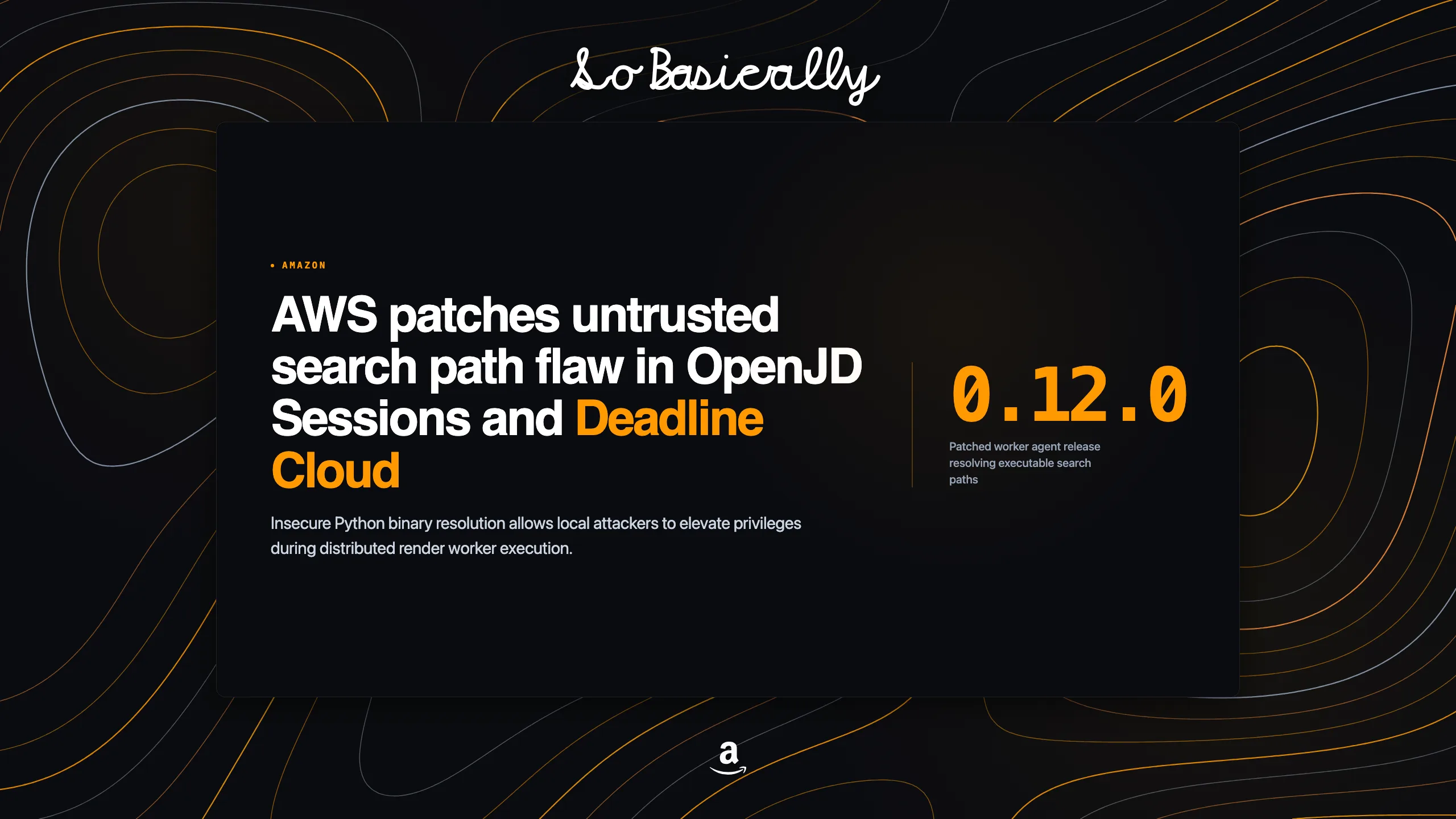
Decision brief card for AWS patches untrusted search path flaw in OpenJD Sessions and Deadline Cloud worker

AWS patches untrusted search path flaw in OpenJD Sessions and Deadline Cloud worker

What happened.Amazon Web Services released security updates fixing an untrusted search path vulnerability in the OpenJD Sessions runtime and AWS Deadline Cloud worker agent.

Why it matters.Cloud render farms process complex computational tasks across multi-user environments. When task runners load executable code from untrusted working directories, malicious users elevate privileges and access shared worker assets. Pipeline technical directors must update OpenJD Sessions and Deadline Cloud worker agents to the latest releases across all compute nodes.

  • Vulnerability mechanics: Tracked as CVE-2026-126087 in bulletin 2026-177-AWS, the flaw involves insecure Python binary search resolution during job execution.
  • Exploitation path: Local users with filesystem write access place malicious executable files inside working directories processed by the worker agent.
  • Privilege escalation: When the worker agent launches render tasks, the runtime executes attacker-supplied binaries under elevated worker system privileges.
  • Remediation release: AWS published updated package versions to package repositories and advised administrators to update worker fleets immediately.
Official Source:AWS Security Bulletins
Decision brief card for AWS patches untrusted search path flaw in OpenJD Sessions and Deadline Cloud worker
Read Brief
Source:AWS Security Bulletins (opens in a new tab)
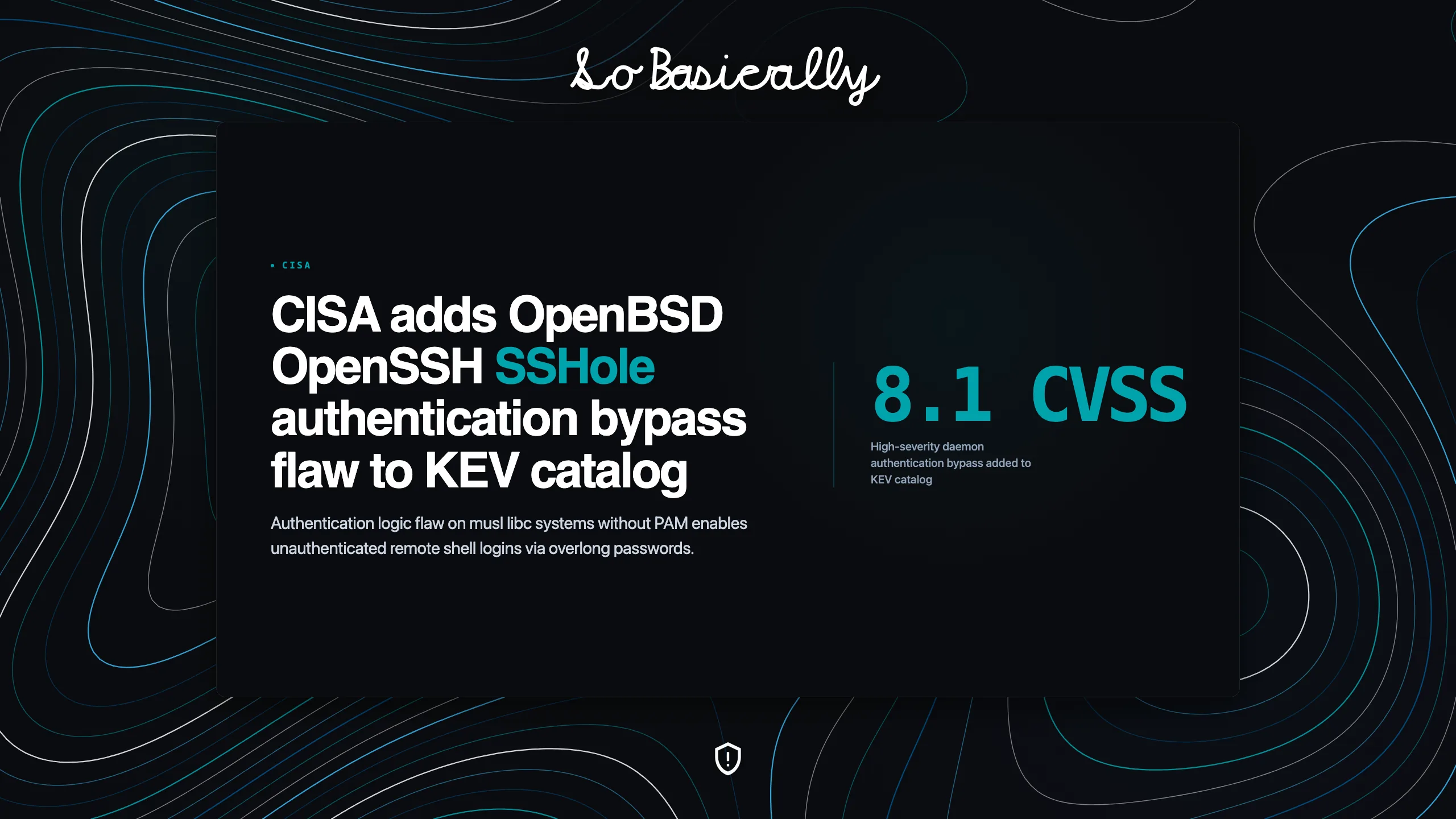
Decision brief card for CISA adds OpenBSD OpenSSH SSHole authentication bypass flaw to KEV catalog

CISA adds OpenBSD OpenSSH SSHole authentication bypass flaw to KEV catalog

What happened.CISA added the high-severity OpenSSH SSHole authentication bypass vulnerability to its Known Exploited Vulnerabilities catalog following observed attacks against Linux systems.

Why it matters.Secure Shell daemons represent the standard administrative access pathway into production Linux servers and container environments. When authentication logic errors allow attackers to log into accounts without valid credentials, automated botnets compromise cloud instances rapidly. Infrastructure engineers running lightweight container images based on musl libc must upgrade OpenSSH packages immediately and restart SSH daemons.

  • Vulnerability mechanics: Tracked as CVE-2026-123158 with an 8.1 CVSS score, the defect involves an authentication bypass in OpenSSH daemon implementations.
  • Root cause: Systems running OpenSSH on musl libc without PAM incorrectly authenticate overlong passwords against accounts configured without active passwords.
  • Exploitation impact: Remote unauthenticated attackers send crafted password strings between 256 and 1024 bytes to gain shell access to target user accounts.
  • Remediation release: OpenSSH maintainers published version 10.6p2, and Linux distributions including Alpine issued updated security packages.
Official Source:CISA
Decision brief card for CISA adds OpenBSD OpenSSH SSHole authentication bypass flaw to KEV catalog
Read Brief
Source:CISA (opens in a new tab)
CANDIDATE INTELLIGENCE · UNVERIFIED LEADS

The Discovery Wire · Unverified Attention Signals

Candidate storylines identified across developer channels. Under newsroom canon, attention never establishes fact; these leads remain quarantined until supported by Tier 1 official records.

DEVELOPER WIRE

ConnectWise ScreenConnect Critical Privilege Flaw & SCKit Reverse-Pivots

Tracked as CVE-2026-84869 (CVSS 9.9), an authorization bypass flaw in the ScreenConnect client allows unauthorized file transfer and command execution; actively abused in the wild via the SCKit malware toolkit using RelayTrap reverse-pivot techniques to compromise technician workstations.

STATUS:Awaiting official documentation or verification criteria.
DEVELOPER WIRE

Microsoft Office Outlook NTLM Hash-Leaking Zero-Day Spoofing

Tracked as CVE-2026-124194, an actively exploited zero-day flaw in Outlook allows unauthenticated remote actors to trigger silent connections leaking NTLMv2 hashes; added by CISA to the KEV catalog under BOD 26-04.

STATUS:Awaiting official documentation or verification criteria.
DEVELOPER WIRE

Node.js November 2026 Scheduled Security Release

The Node.js Foundation patched 16 vulnerabilities across active release lines 22, 24, and 26, headed by high-severity HTTP/2 teardown assertion crashes (CVE-2026-123863) and TLS zero-length write memory exposure leaking private keys (CVE-2026-123864).

STATUS:Awaiting official documentation or verification criteria.
DEVELOPER WIRE

Palo Alto Networks PAN-OS Panorama Remote Code Execution

Tracked as CVE-2026-0330 (CVSS 8.1), an authenticated remote code execution defect in Panorama allows administrative attackers to execute arbitrary code with root privileges; accompanied by GlobalProtect authorization bypass flaws (CVE-2026-0328).

STATUS:Awaiting official documentation or verification criteria.
DEVELOPER WIRE

Windows CLFS SignDrop Zero-Day Privilege Escalation Exploit

Security researchers published functional SignDrop proof-of-concept exploits abusing the Windows Common Log File System driver (clfs.sys) to elevate unprivileged local accounts to NT AUTHORITY\SYSTEM.

STATUS:Awaiting official documentation or verification criteria.
DEVELOPER WIRE

Cisco BroadWorks Open Client Interface Blind XXE Injection

Tracked as CVE-2026-20320 (CVSS 7.5), unauthenticated remote attackers send crafted XML messages to provisioning endpoints to exfiltrate tenant configuration files and credentials; added to CISA KEV catalog.

STATUS:Awaiting official documentation or verification criteria.
DEVELOPER WIRE

Atlassian Confluence Data Center Legacy Remote API Remote Code Execution

Tracked as CVE-2026-90436, on-premises Confluence Data Center instances running legacy XML-RPC and SOAP endpoints via Apache Axis 1.x face unauthenticated remote code execution.

STATUS:Awaiting official documentation or verification criteria.

DEVELOPER WIRE

GitHub CI/CD wfx-loot Automated Secret-Stealing Attack Campaign

Threat actors leveraged 4,837 hijacked GitHub accounts to inject self-erasing workflow scripts harvesting cloud credentials, AI tokens, and package secrets before deleting execution logs.

STATUS:Awaiting official documentation or verification criteria.