Skip to content
SoBasicallyVOL. I · RUN 2026-11-12-cybersecurity-advisories
ARCHIVAL EDITION2026-11-12-cybersecurity-advisories8 STORIES · 1658 WORDS
← Back to Archive

Microsoft patches critical Azure OpenAI missing authentication defect
Topographic elevation contour card for Microsoft patches critical Azure OpenAI missing authentication defect

What happened.Microsoft addressed a critical missing authentication flaw in Azure OpenAI during its November update cycle that allowed remote privilege escalation.

Why it matters.Enterprise teams integrate Azure OpenAI endpoints to deploy private language models and process proprietary corporate documents. When missing authentication vulnerabilities expose model infrastructure, attackers access private machine learning models and manipulate enterprise artificial intelligence workloads. Cloud security architects should review API management firewall rules and restrict model endpoint access to private virtual networks.
↳Continues: Microsoft patches actively exploited zero-day Outlook NTLM hash theft vulnerability
Read Full Brief →
Source:Microsoft Security Response Center (opens in a new tab)
VERIFIED STORIES IN THIS EDITION7 STORIES
Decision brief card for CISA adds Google Chrome XML use-after-free zero-day flaw to KEV catalog

CISA adds Google Chrome XML use-after-free zero-day flaw to KEV catalog

What happened.CISA ordered federal agencies to remediate an actively exploited high-severity Google Chrome use-after-free vulnerability affecting browser XML components.

Why it matters.Web browsers serve as the primary interactive boundary between enterprise workstations and untrusted internet assets. When memory corruption vulnerabilities escape XML processing routines, attackers compromise employee endpoints through drive-by downloads. Infrastructure teams must deploy Chrome 157 stable updates across all corporate endpoints immediately. Security operations centers should monitor workstation logs for abnormal browser sub-processes.

  • Vulnerability mechanics: Tracked as CVE-2026-125350, the defect resides in the browser XML parsing engine during extensible stylesheet language transformations.
  • Exploit vector: Remote attackers trick victims into visiting specially crafted web pages, triggering memory corruption to execute arbitrary code within the browser sandbox.
  • Exploitation status: Google confirmed active zero-day exploitation in the wild targeting desktop users prior to coordinated patch distribution.
  • Federal mandate: CISA added the defect to its Known Exploited Vulnerabilities catalog under Binding Operational Directive 26-04, setting an immediate patch deadline.
  • Remediation release: Google published desktop browser updates 157.0.8103.50 for Linux and 157.0.8103.50/.51 for Windows and macOS.
Official Source:NIST NVD
Decision brief card for CISA adds Google Chrome XML use-after-free zero-day flaw to KEV catalog
↳Continues: Microsoft resolves out-of-bounds memory read flaw in Edge Chromium
Read Brief
Source:NIST NVD (opens in a new tab)
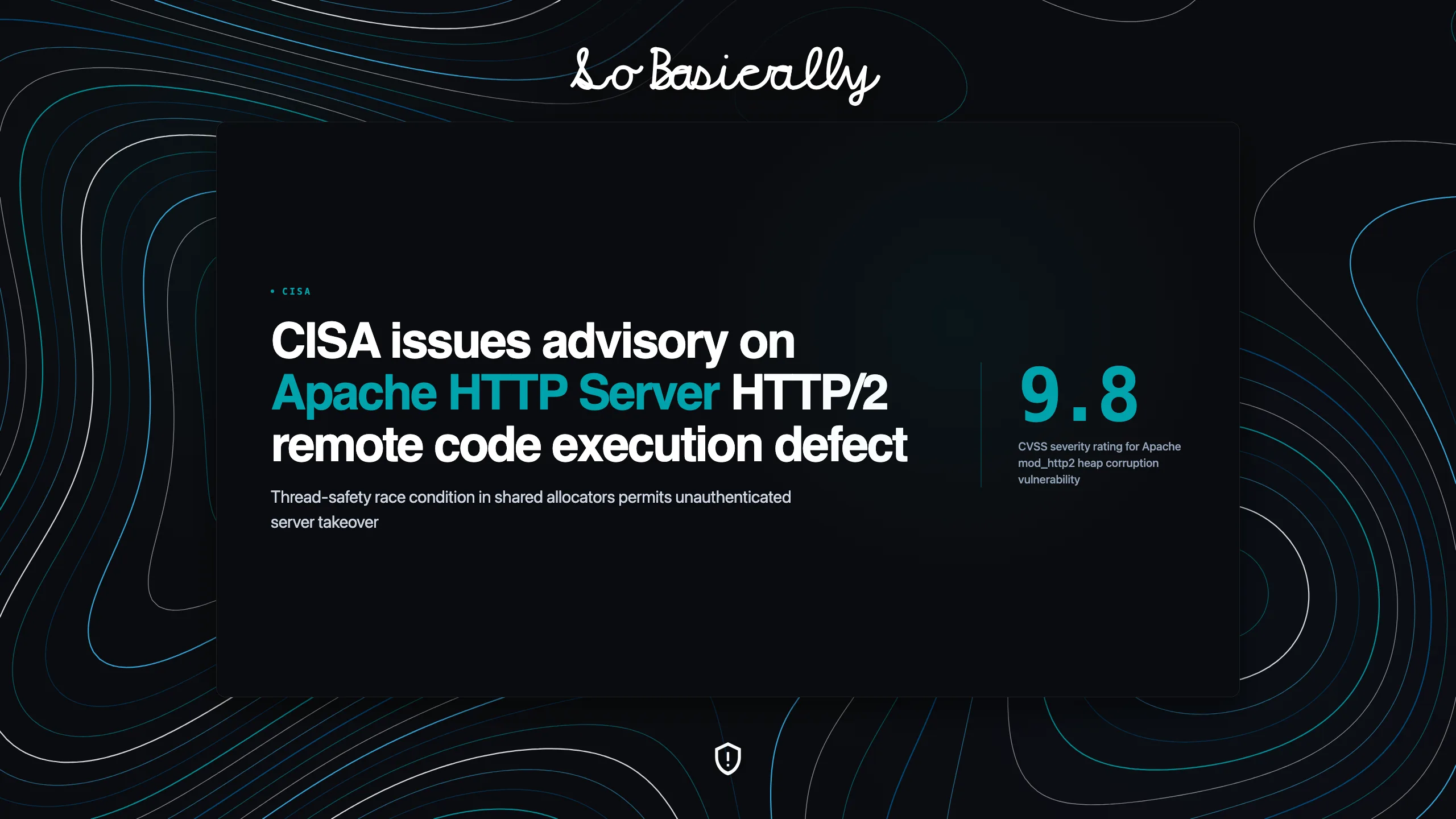
Decision brief card for CISA issues advisory on Apache HTTP Server HTTP/2 remote code execution defect

CISA issues advisory on Apache HTTP Server HTTP/2 remote code execution defect

What happened.The Apache Software Foundation patched a critical thread-safety vulnerability in mod_http2 as CISA warned of remote code execution risks across web infrastructure.

Why it matters.Apache HTTP Server powers web applications and proxies across enterprise networks. When thread-safety flaws permit remote code execution, attackers compromise edge servers without credentials. Administrators must upgrade web servers to Apache 2.4.71 immediately or disable h2 directives.

  • Vulnerability mechanics: Tracked as CVE-2026-119618 with a 9.8 CVSS score, the defect stems from improper synchronization in mod_http2 during concurrent header processing.
  • Race condition: Unauthenticated remote attackers flood servers with concurrent HTTP/2 requests, corrupting shared lock-free memory allocators in assign_headers.
  • Exploitation impact: The resulting heap corruption enables remote unauthenticated attackers to execute arbitrary code with web server process privileges.
  • Affected scope: The defect affects Apache HTTP Server versions 2.4.55 through 2.4.70 and mod_h2 releases 2.0.8 through 2.0.42 when HTTP/2 is active.
  • Remediation release: The Apache Software Foundation published Apache HTTP Server version 2.4.71, advising administrators to upgrade or restrict HTTP/2 protocols.
Official Source:NIST NVD
Decision brief card for CISA issues advisory on Apache HTTP Server HTTP/2 remote code execution defect
Read Brief
Source:NIST NVD (opens in a new tab)
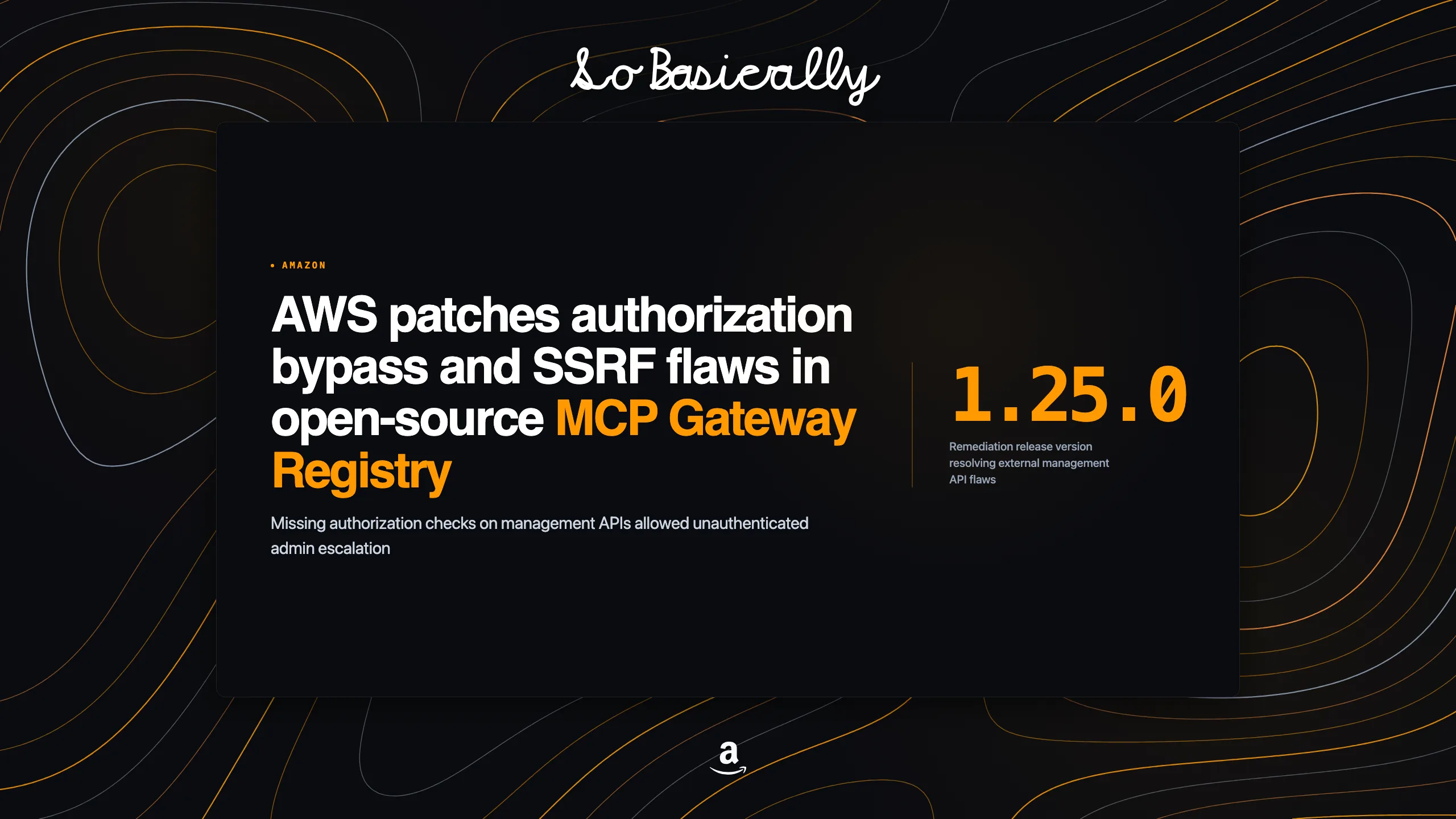
Decision brief card for AWS patches authorization bypass and SSRF flaws in open-source MCP Gateway Registry

AWS patches authorization bypass and SSRF flaws in open-source MCP Gateway Registry

What happened.Amazon Web Services published security bulletins resolving missing authorization and server-side request forgery vulnerabilities in its open-source MCP Gateway Registry.

Why it matters.Model Context Protocol registries connect artificial intelligence agents to cloud tools. When authorization checks fail, threat actors hijack agent tool routing and intercept private requests. Cloud architects must upgrade registries to version 1.25.0 immediately and audit scope databases.

  • Authorization bypass: Tracked as CVE-2026-100307 in bulletin 2026-179-AWS, management endpoints authenticated callers but failed to enforce role-based authorization checks.
  • Privilege escalation: Low-privileged callers submitted group import requests to map identity groups to registry administrator scopes, securing full control over registered tools.
  • Request forgery flaw: Tracked as CVE-2026-125926 in bulletin 2026-180-AWS, improper upstream validation allowed users to force the gateway into probing internal networks.
  • Affected versions: Vulnerabilities affected mcp-gateway-registry versions 1.0.9 through 1.24.7 for authorization and 1.0.3 through 1.34.0 for request forgery.
  • Remediation release: AWS published patched version 1.25.0 and advised administrators to audit DocumentDB scope stores for rogue group mapping entries.
Official Source:AWS Security Bulletins
Decision brief card for AWS patches authorization bypass and SSRF flaws in open-source MCP Gateway Registry
↳Continues: AWS patches security policy bypass in AWS API MCP Server allowing unauthorized tool calls
Read Brief
Source:AWS Security Bulletins (opens in a new tab)
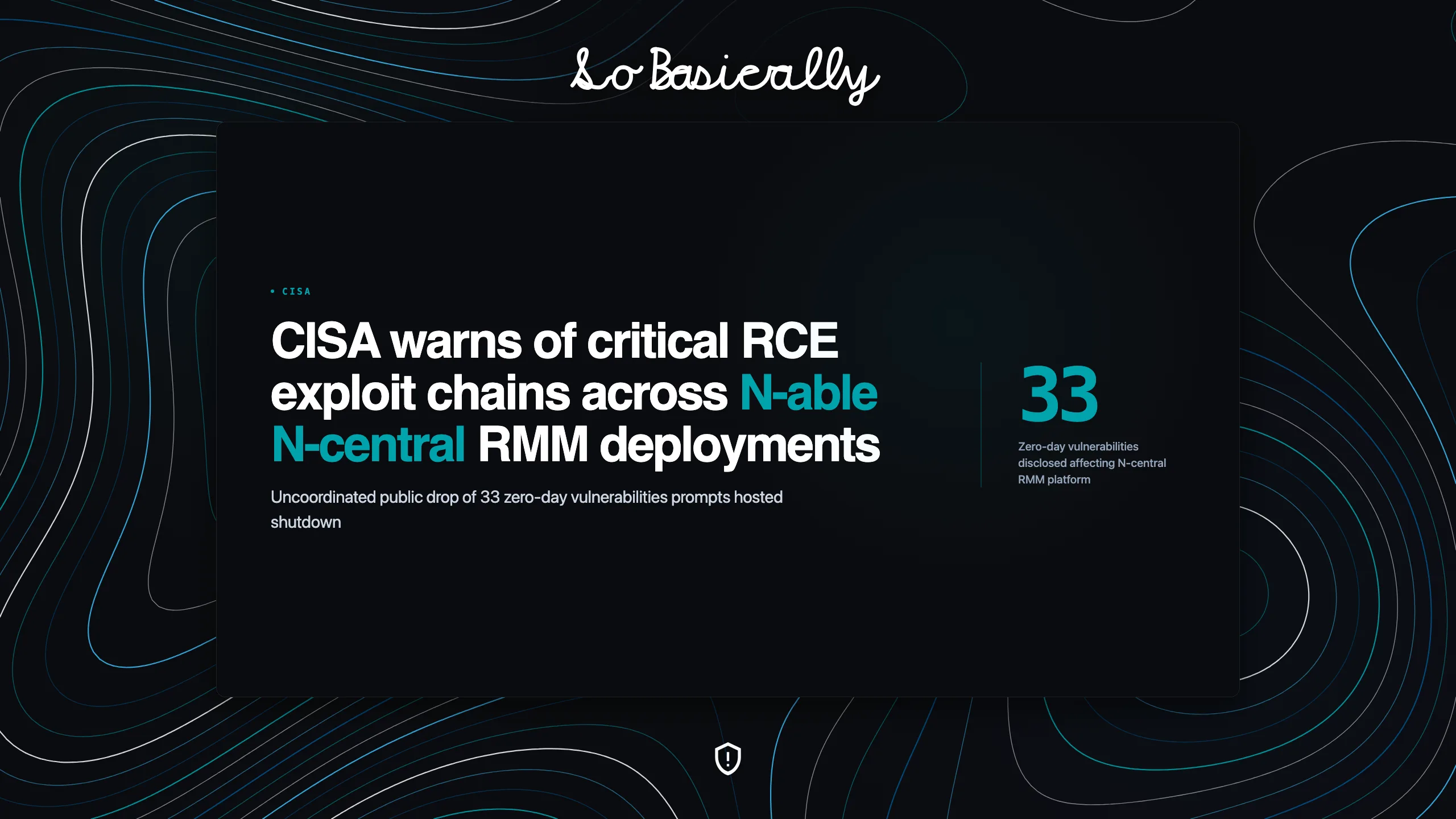
Decision brief card for CISA warns of critical RCE exploit chains across N-able N-central RMM deployments

CISA warns of critical RCE exploit chains across N-able N-central RMM deployments

What happened.CISA issued security guidance after researchers disclosed 33 zero-day vulnerabilities in N-able N-central, prompting emergency vendor cloud shutdowns and hotfixes.

Why it matters.Remote monitoring and management tools possess unrestricted administrative access to thousands of client endpoints across managed service providers. When chained zero-day flaws grant unauthenticated root execution, attackers pivot across enterprise IT perimeters simultaneously. Managed service providers must apply N-central 2026.4 Hotfix 2 immediately. Security teams should isolate on-premises management servers behind private virtual networks.

  • Public disclosure: An uncoordinated disclosure publicly dropped technical details and proof-of-concept exploits for 33 vulnerabilities affecting the N-central management platform.
  • Exploit mechanics: The disclosure demonstrated unauthenticated XML external entity injection chained with session handling flaws to achieve remote code execution as root.
  • Cloud shutdown: N-able temporarily took its hosted cloud environments offline across the Americas, EMEA, and APAC regions to prevent mass scanning exploitation.
  • On-premises advisory: The vendor urged on-premises customers to disconnect management servers until security patches were applied.
  • Remediation release: N-able released N-central 2026.4 Hotfix 2 to address the primary remote execution chain, with subsequent fixes addressing secondary defects.
Official Source:CISA
Decision brief card for CISA warns of critical RCE exploit chains across N-able N-central RMM deployments
Read Brief
Source:CISA (opens in a new tab)
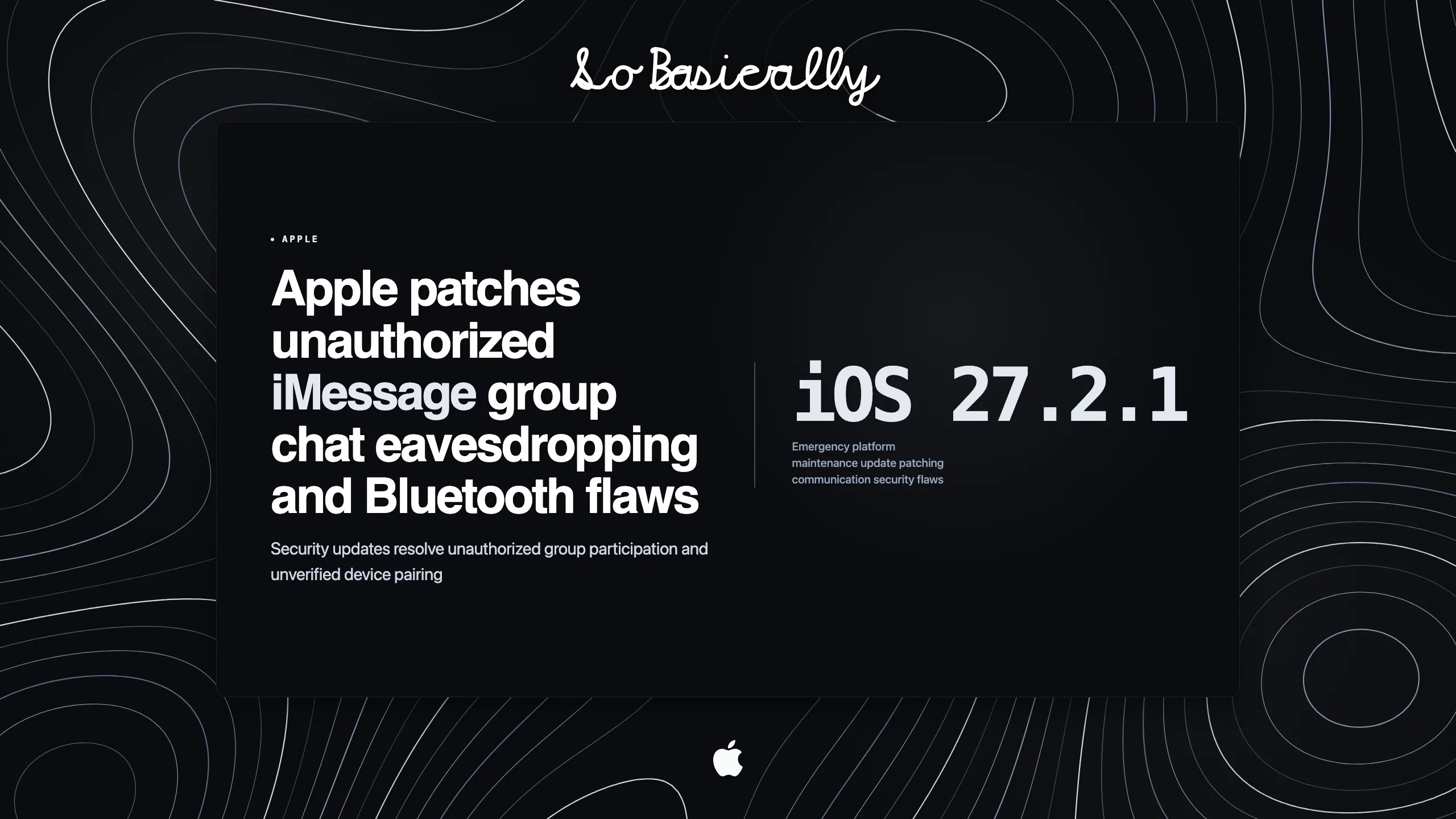
Decision brief card for Apple patches unauthorized iMessage group chat eavesdropping and Bluetooth flaws

Apple patches unauthorized iMessage group chat eavesdropping and Bluetooth flaws

What happened.Apple published iOS 27.2.1 and iPadOS 27.2.1 addressing vulnerabilities that permitted unauthorized users to join iMessage group chats and bypass Bluetooth pairing.

Why it matters.Mobile operating systems safeguard sensitive executive communications and handle confidential business correspondence. When messaging protocols leak group messages to unauthorized participants, corporate privacy and confidentiality are compromised. Corporate mobility teams must enforce iOS 27.2.1 and iPadOS 27.2.1 installations across managed device fleets. Users should verify Bluetooth pairing lists and remove unknown connected accessories.

  • Messaging eavesdropping: Tracked as CVE-2026-113961, an authorization flaw allowed remote attackers to join active iMessage group chats and receive participant messages without approval.
  • History exposure: Tracked as CVE-2026-113960, a related privacy defect allowed newly added group members to access chat history created before they joined.
  • Bluetooth pairing bypass: Tracked as CVE-2026-113964 and CVE-2026-113965, CoreUtils logic flaws let nearby malicious Bluetooth accessories pair without user confirmation.
  • AirPlay rate limits: CVE-2026-113968 and CVE-2026-113969 addressed pairing code brute-force issues by restoring rate limits across network services.
  • Remediation releases: Updates shipped for iPhone 11 and later, iPad Pro models, iPad Air 4th generation and later, and iPad mini 6th generation.
Official Source:NIST NVD
Decision brief card for Apple patches unauthorized iMessage group chat eavesdropping and Bluetooth flaws
Read Brief
Source:NIST NVD (opens in a new tab)
Decision brief card for CISA adds Ivanti Endpoint Manager unauthenticated SQL injection flaw to KEV catalog

CISA adds Ivanti Endpoint Manager unauthenticated SQL injection flaw to KEV catalog

What happened.CISA ordered federal civilian agencies to patch a critical unauthenticated SQL injection vulnerability in Ivanti Endpoint Manager core servers.

Why it matters.Endpoint management servers centralize software distribution, system inventory, and administrative credentials across enterprise networks. When SQL injection defects grant unauthenticated remote code execution on core controllers, intruders compromise internal domain assets. Infrastructure administrators must update Ivanti Endpoint Manager to version 2024 SU8 immediately. Organizations should restrict administrative console access to dedicated internal networks.

  • Vulnerability mechanics: Tracked as CVE-2026-121653 with a 9.8 CVSS score, the defect stems from improper input neutralization in Ivanti Endpoint Manager Core.
  • Exploitation path: Remote unauthenticated attackers send crafted SQL commands over the network, achieving arbitrary code execution on the underlying management server.
  • Affected versions: The vulnerability impacts Ivanti Endpoint Manager Core version 2024 SU7 and all prior releases.
  • Related bulletin: Ivanti also addressed CVE-2026-121683, a 9.4 CVSS missing authentication flaw in its Cloud Services Application appliance.
  • Remediation release: Ivanti published Endpoint Manager version 2024 SU8, advising administrators to apply updates through the Ivanti License System.
Official Source:NIST NVD
Decision brief card for CISA adds Ivanti Endpoint Manager unauthenticated SQL injection flaw to KEV catalog
↳Continues: CISA adds Ivanti Connect Secure zero-days to KEV catalog
Read Brief
Source:NIST NVD (opens in a new tab)
Decision brief card for CISA alerts on critical CVSS 10.0 ICM2SHELL memory corruption flaw in SAP NetWeaver

CISA alerts on critical CVSS 10.0 ICM2SHELL memory corruption flaw in SAP NetWeaver

What happened.CISA issued an urgent advisory after SAP patched four maximum-severity CVSS 10.0 flaws, headed by an unauthenticated memory corruption flaw in NetWeaver.

Why it matters.SAP NetWeaver underpins mission-critical enterprise resource planning, supply chain management, and corporate financial databases globally. When memory corruption vulnerabilities permit unauthenticated remote code execution, attackers compromise entire enterprise operational backbones. Enterprise IT teams must apply SAP kernel corrections across all NetWeaver instances immediately. Security teams should restrict Internet Communication Manager ports from public internet routing.

  • Vulnerability mechanics: Tracked as CVE-2026-76964 in security note 3778530, the defect resides in the Internet Communication Manager of NetWeaver AS ABAP.
  • Exploit method: Unauthenticated remote attackers send crafted WebSocket control frames with malformed length fields, triggering an out-of-bounds heap write.
  • System compromise: Successful exploitation grants remote code execution under the privileges of the system installation user without user interaction.
  • Authentication bypass: SAP also resolved CVE-2026-120017 in note 3849308, addressing missing cryptographic verification in SAML2 Service Providers.
  • Remediation releases: SAP published security updates across affected NetWeaver kernels, urging teams to patch internet-facing enterprise resource systems immediately.
Official Source:NIST NVD
Decision brief card for CISA alerts on critical CVSS 10.0 ICM2SHELL memory corruption flaw in SAP NetWeaver
Read Brief
Source:NIST NVD (opens in a new tab)
CANDIDATE INTELLIGENCE · UNVERIFIED LEADS

The Discovery Wire · Unverified Attention Signals

Candidate storylines identified across developer channels. Under newsroom canon, attention never establishes fact; these leads remain quarantined until supported by Tier 1 official records.

DEVELOPER WIRE

Microsoft Office Outlook NTLM Hash-Leaking Zero-Day Spoofing

Tracked as CVE-2026-124194, an actively exploited zero-day flaw in Outlook allows unauthenticated remote actors to trigger silent connections leaking NTLMv2 hashes; added by CISA to the KEV catalog under BOD 26-04.

STATUS:Awaiting official documentation or verification criteria.
DEVELOPER WIRE

Cisco BroadWorks Open Client Interface Blind XXE Injection

Tracked as CVE-2026-20320 (CVSS 7.5), unauthenticated remote attackers send crafted XML messages to provisioning endpoints to exfiltrate tenant configuration files and credentials; added to CISA KEV catalog.

STATUS:Awaiting official documentation or verification criteria.
DEVELOPER WIRE

Microsoft Entra ID Device Registration Authorization Bypass

Tracked as CVE-2026-109469 (CVSS 10.0), cloud-side mitigation resolves a maximum-severity user-controlled key flaw permitting remote elevation of privilege.

STATUS:Awaiting official documentation or verification criteria.
DEVELOPER WIRE

Palo Alto Networks PAN-OS GlobalProtect Authentication Bypass

Tracked as CVE-2026-0328, an unauthenticated authorization bypass flaw allows remote attackers to establish unauthorized VPN sessions; awaiting confirmation of in-the-wild exploitation.

STATUS:Awaiting official documentation or verification criteria.
DEVELOPER WIRE

Node.js HTTP/2 Teardown Remote Crash and HTTPS Heap Leak

Tracked as CVE-2026-123863 and CVE-2026-123864, security releases patch assertion aborts and zero-length TLS write re-entrancy memory exposure across active release lines.

STATUS:Awaiting official documentation or verification criteria.
DEVELOPER WIRE

Cisco UCS Central Software Authenticated Remote Code Execution

Tracked as CVE-2026-76506 (CVSS 7.6), path traversal in the web management interface permits authenticated command execution and arbitrary file creation.

STATUS:Awaiting official documentation or verification criteria.
DEVELOPER WIRE

WordPress Core TOCTOU Race Condition Exploitation

Active scanning observed targeting unpatched WordPress instances following coordinated disclosure of transient option updates.

STATUS:Awaiting official documentation or verification criteria.
DEVELOPER WIRE

AWS Deadline Cloud Worker Agent Search Path Vulnerability

Security bulletin 2026-177-AWS documents untrusted search path execution in OpenJD Sessions for Python; awaiting independent corroboration.

STATUS:Awaiting official documentation or verification criteria.