Skip to content
SoBasicallyVOL. I · RUN 2026-11-07-cybersecurity-advisories
ARCHIVAL EDITION2026-11-07-cybersecurity-advisories8 STORIES · 1681 WORDS
← Back to Archive

CISA adds SonicWall SonicOS SSLVPN bypass zero-day to KEV catalog
Topographic elevation contour card for CISA adds SonicWall SonicOS SSLVPN bypass zero-day to KEV catalog

What happened.The Cybersecurity and Infrastructure Security Agency added an actively exploited SonicWall SonicOS SSLVPN authentication bypass vulnerability to its Known Exploited Vulnerabilities catalog.

Why it matters.Perimeter firewalls terminate remote tunnels and enforce access controls. When single-factor bypasses disable SAML multifactor authentication, stolen secondary credentials grant access to internal corporate networks. Incident response teams must audit SSLVPN session logs for irregular access patterns. Security administrators should apply updated SonicOS firmware and isolate management interfaces.
Read Full Brief →
Source:SonicWall (opens in a new tab)
VERIFIED STORIES IN THIS EDITION7 STORIES
Decision brief card for AWS SDK for pandas patches high-severity Iceberg SQL identifier injection

AWS SDK for pandas patches high-severity Iceberg SQL identifier injection

What happened.Amazon Web Services issued security bulletin 2026-166-AWS detailing an improper quoting vulnerability in the AWS SDK for pandas Apache Iceberg write pathway.

Why it matters.Cloud data pipelines run ETL transformations using high-privilege service roles to process analytics. When metadata attributes inject raw SQL identifiers into Iceberg transactions, lower-privileged users escalate access into protected tables. Data platform engineers must upgrade awswrangler packages across scheduled pipelines. Security teams should enforce strict least-privilege IAM policies on AWS Glue Data Catalog update operations.

  • Vulnerability mechanics: Tracked as CVE-2026-119301 with a CVSS score of 7.9, the flaw stems from unneutralized quoting syntax during SQL identifier generation in to_iceberg operations.
  • Privilege escalation: Authenticated users with AWS Glue Data Catalog edit permissions can craft malicious column names that alter table schemas during automated pipelines.
  • Unauthorized access: Exploiting the defect enables unauthorized principals to read restricted tables or overwrite data across shared warehouse partitions.
  • Affected versions: The vulnerability impacts awswrangler versions 3.5.2 through 3.17.0 across Python data engineering environments.
  • Remediation release: AWS released awswrangler version 3.17.1, advising teams to upgrade libraries and restrict AWS Glue catalog update permissions.
Official Source:AWS
Decision brief card for AWS SDK for pandas patches high-severity Iceberg SQL identifier injection
Read Brief
Source:AWS (opens in a new tab)
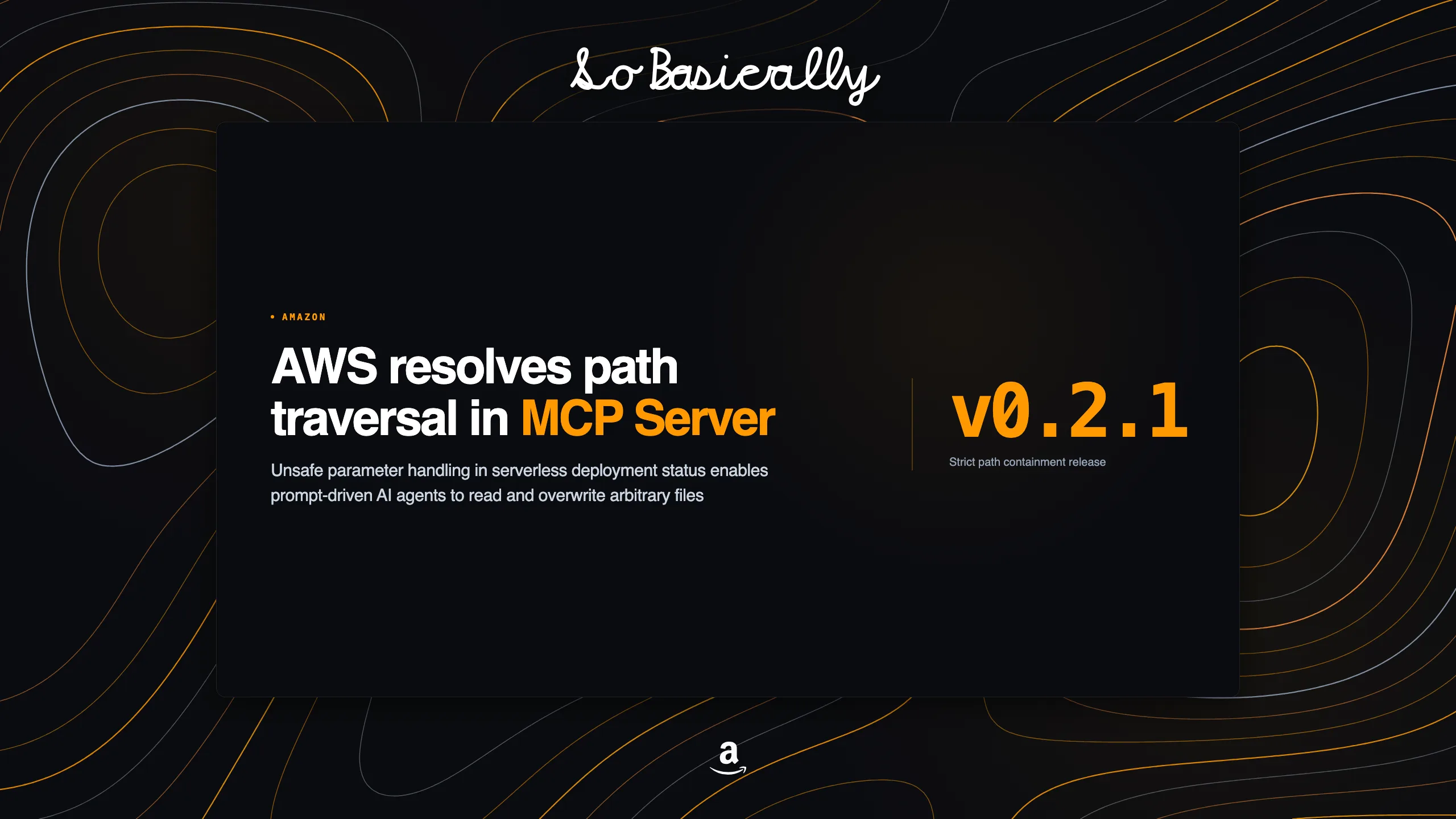
Decision brief card for AWS resolves path traversal flaw in open-source Serverless MCP Server

AWS resolves path traversal flaw in open-source Serverless MCP Server

What happened.Amazon Web Services published security bulletin 2026-164-AWS addressing a path traversal vulnerability in its open-source Serverless Model Context Protocol Server.

Why it matters.Model Context Protocol servers connect agentic AI systems directly to development environments and cloud tooling. When path traversal defects permit prompt-driven file overwrites, autonomous agents become vectors for arbitrary code execution and local credential theft. Platform teams deploying MCP servers must upgrade to version v0.2.1 immediately. Developers should run agent sidecars within isolated containers with read-only root filesystems.

  • Vulnerability mechanics: Tracked as CVE-2026-116635, the flaw exists in the deployment status component of the awslabs.aws-serverless-mcp-server package.
  • Traversal mechanics: The component unsafely joined the project_name parameter, allowing directory traversal sequences and absolute paths to escape the designated status folder.
  • Exploit implications: Attackers prompting connected AI agents could read arbitrary JSON files or overwrite host configuration files when write permissions were enabled.
  • Affected releases: All versions prior to v0.2.1 running on developer machines or containerized agent runtimes are vulnerable.
  • Remediation release: AWS published package version v0.2.1, implementing strict path validation to confine all file reads and writes within the target deployment folder.
Official Source:AWS
Decision brief card for AWS resolves path traversal flaw in open-source Serverless MCP Server
Read Brief
Source:AWS (opens in a new tab)
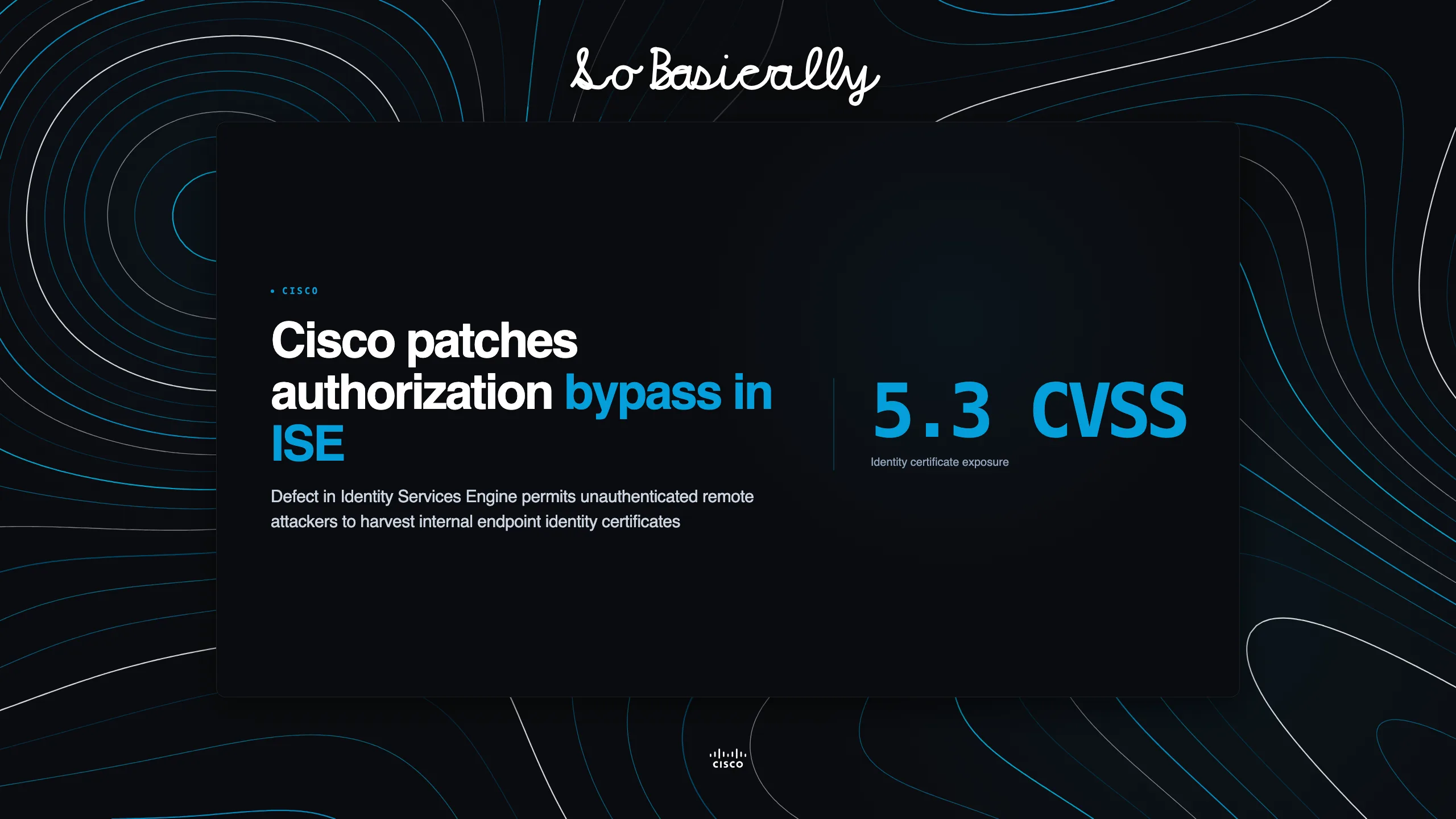
Decision brief card for Cisco patches authorization bypass in Identity Services Engine

Cisco patches authorization bypass in Identity Services Engine

What happened.Cisco published security advisory cisco-sa-ise-cert-mE9BD5GO detailing an authorization bypass vulnerability in Identity Services Engine software.

Why it matters.Endpoint identity certificates authenticate managed devices onto corporate wireless and wired network segments. When authorization checks fail on identity appliances, unauthenticated attackers harvest trusted certificates to spoof legitimate enterprise endpoints. Network security teams must verify installed ISE releases and install updated packages. Organizations should implement continuous mutual authentication checks to prevent spoofed client connections.

  • Vulnerability mechanics: Tracked as CVE-2026-20241 with a CVSS base score of 5.3, the defect resides in the authorization verification subsystem of Cisco ISE.
  • Certificate disclosure: Unauthenticated remote attackers can craft specific network requests to obtain internal endpoint identity certificates without valid credentials.
  • Affected products: The issue affects Cisco ISE and Cisco ISE Passive Identity Connector running vulnerable software releases.
  • Disclosure finality: Cisco noted this advisory concludes its scheduled 2026 publications as part of its transition to a risk-based disclosure model resuming in January 2027.
  • Remediation guidance: Cisco published software maintenance fixes and advised enterprise network administrators to apply available patch bundles.
Official Source:Cisco
Decision brief card for Cisco patches authorization bypass in Identity Services Engine
Read Brief
Source:Cisco (opens in a new tab)
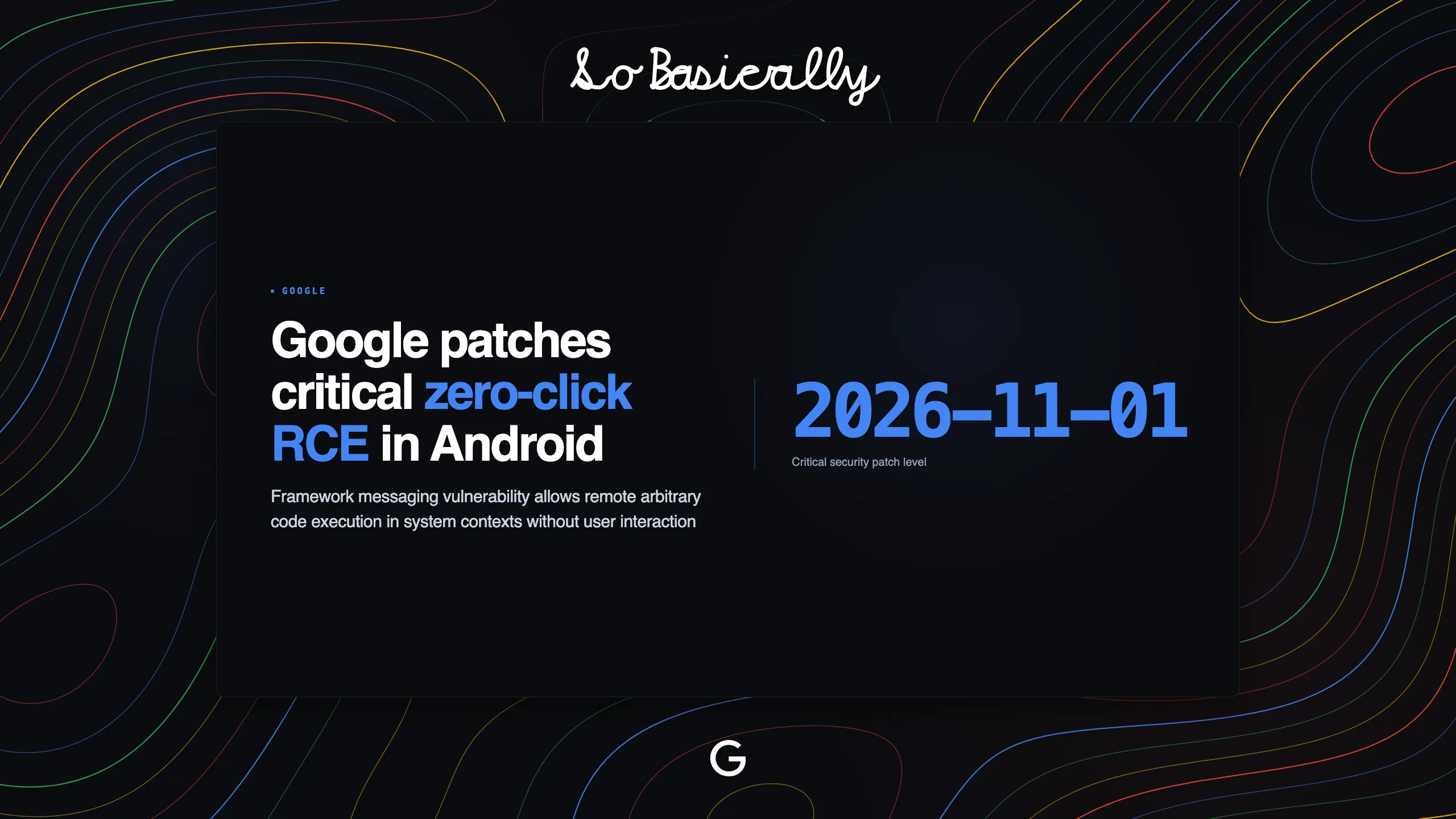
Decision brief card for Google patches critical zero-interaction RCE flaw in Android Framework

Google patches critical zero-interaction RCE flaw in Android Framework

What happened.Google published its November 2026 Android Security Bulletin addressing a critical zero-interaction remote code execution vulnerability in the Android Framework.

Why it matters.Core operating system frameworks manage inter-process communication and security sandboxes across mobile operating environments. When zero-click code execution bugs compromise framework boundaries, threat actors install rootkits or intercept corporate tokens without triggering user suspicion. Enterprise mobility administrators should mandate the 2026-11-01 patch level across corporate fleets. Device vendors must expedite over-the-air firmware deployments.

  • Vulnerability mechanics: Tracked as CVE-2026-58868, the flaw exists within core Framework IPC messaging components across modern Android versions.
  • Exploit execution: The vulnerability allows remote attackers to execute arbitrary code within system contexts without requiring user interaction or elevated permissions.
  • Platform scope: The flaw affects Android versions 14, 15, 16, and 17 deployed across mobile devices, enterprise tablets, and connected endpoints.
  • Patch distribution: Google released fixes under security patch level 2026-11-01, distributing source updates to Android Open Source Project repositories.
  • Carrier coordination: Ecosystem device manufacturers received vulnerability details one month prior to public disclosure to stage carrier firmware updates.
Official Source:Google
Decision brief card for Google patches critical zero-interaction RCE flaw in Android Framework
Read Brief
Source:Google (opens in a new tab)
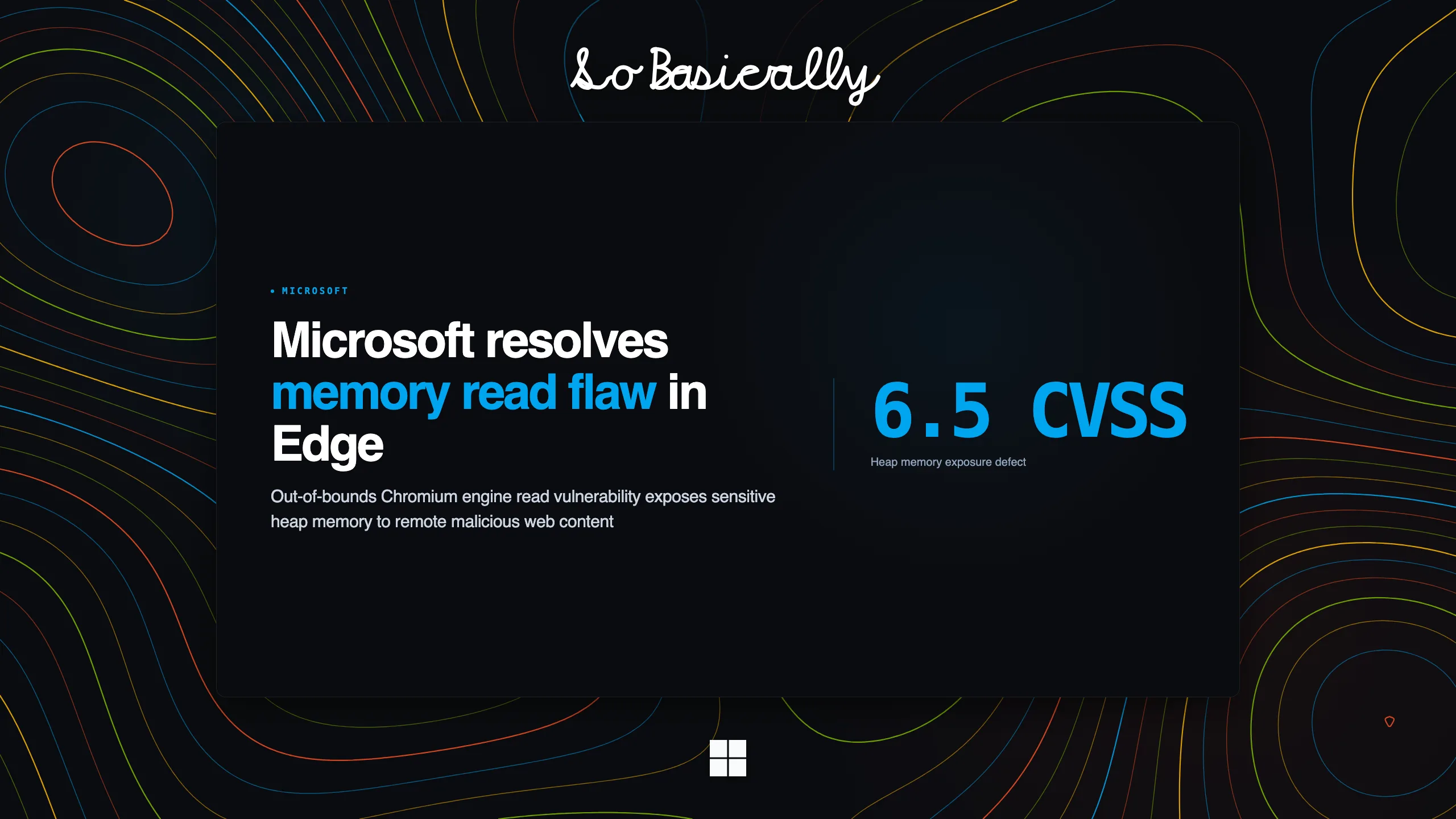
Decision brief card for Microsoft resolves out-of-bounds memory read flaw in Edge Chromium

Microsoft resolves out-of-bounds memory read flaw in Edge Chromium

What happened.Microsoft released security updates for Microsoft Edge addressing an out-of-bounds memory read vulnerability in the Chromium browser engine.

Why it matters.Enterprise web browsers process untrusted public web scripts alongside sensitive corporate SaaS sessions. When out-of-bounds memory read flaws disclose heap memory, threat actors extract session cookies, cryptographic keys, and internal memory layouts. IT administrators should verify that Microsoft Edge clients receive the 142.0.3595.65 update. Security teams should enforce strict process isolation policies across enterprise browsing environments.

  • Vulnerability mechanics: Tracked as CVE-2026-122518 with a CVSS score of 6.5, the flaw occurs during memory buffer indexing in core browser processing routines.
  • Information exposure: Remote attackers hosting malicious web content can cause the browser process to read adjacent memory blocks, leaking sensitive heap data.
  • Exploit chaining: Attackers commonly chain memory disclosure defects with separate write primitives to bypass address space layout randomization defenses.
  • Affected versions: The vulnerability impacts Microsoft Edge Stable channel builds prior to release 142.0.3595.65 on Windows, macOS, and Linux.
  • Patch deployment: Microsoft published Edge version 142.0.3595.65, delivering automated client updates through background browser servicing tasks.
Official Source:Microsoft Security Response Center
Decision brief card for Microsoft resolves out-of-bounds memory read flaw in Edge Chromium
Read Brief
Source:Microsoft Security Response Center (opens in a new tab)
Decision brief card for AWS Nitro Enclaves SDK fixes use-after-free and KMS spoofing flaws

AWS Nitro Enclaves SDK fixes use-after-free and KMS spoofing flaws

What happened.Amazon Web Services published security bulletin 2026-157-AWS detailing memory corruption and service impersonation vulnerabilities in the AWS Nitro Enclaves SDK for C.

Why it matters.Confidential computing enclaves protect high-value cryptographic keys and proprietary algorithms from compromised host operating systems. When socket messages corrupt enclave memory and input defects permit KMS response spoofing, host-level attackers breach confidential computing guarantees. Infrastructure engineers running Nitro enclaves must rebuild enclave binaries with SDK v0.4.6. Security teams should audit attestation configurations to verify enclave image integrity.

  • Vulnerability mechanics: Tracked as CVE-2026-119116, a use-after-free defect in the kmstool-enclave example permits code execution inside enclaves via crafted vsock messages.
  • Service spoofing: Tracked as CVE-2026-119148, an input validation flaw allows third parties to supply crafted region strings, impersonating AWS KMS to the enclave.
  • Security boundary impact: The flaws weaken isolation boundaries between parent EC2 host instances and confidential computing enclaves processing cryptographic material.
  • Affected packages: Both vulnerabilities affect the aws-nitro-enclaves-sdk-c library across versions preceding v0.4.6.
  • Remediation release: AWS released SDK version v0.4.6, instructing engineering teams to rebuild and redeploy all enclave images using the updated C library.
Official Source:AWS
Decision brief card for AWS Nitro Enclaves SDK fixes use-after-free and KMS spoofing flaws
Read Brief
Source:AWS (opens in a new tab)
Decision brief card for Microsoft patches zero-interaction remote code execution flaw in Paint

Microsoft patches zero-interaction remote code execution flaw in Paint

What happened.Microsoft published a security update for the Windows Paint application resolving a high-severity remote code execution vulnerability.

Why it matters.Built-in desktop utilities often handle media files received through collaboration software and web downloads. When zero-interaction rendering bugs execute arbitrary code, attackers weaponize routine desktop applications to achieve initial corporate endpoint compromise. System administrators should configure group policies to allow automated Microsoft Store updates for inbox apps. Security teams should monitor endpoint process trees for unexpected command shells spawned from desktop utilities.

  • Vulnerability mechanics: Tracked as CVE-2026-83844 with a CVSS score of 8.1, the flaw stems from memory corruption during automated file rendering operations.
  • Zero-interaction risk: Under specific image processing conditions, crafted media streams trigger arbitrary code execution without requiring interactive user consent.
  • Servicing channel: Fixes are distributed exclusively via the Microsoft Store rather than standard monthly Windows Update operating system packages.
  • Affected releases: Paint application builds prior to package version 11.2609.401.0 across Windows 11 and Windows 10 installations are affected.
  • Remediation release: Microsoft published version 11.2609.401.0 through the Microsoft Store, urging endpoint administrators to enable automated store app updates.
Official Source:Microsoft Security Response Center
Decision brief card for Microsoft patches zero-interaction remote code execution flaw in Paint
Read Brief
Source:Microsoft Security Response Center (opens in a new tab)
CANDIDATE INTELLIGENCE · UNVERIFIED LEADS

The Discovery Wire · Unverified Attention Signals

Candidate storylines identified across developer channels. Under newsroom canon, attention never establishes fact; these leads remain quarantined until supported by Tier 1 official records.

DEVELOPER WIRE

Kapibala threat actor network targeting Zyxel GS1900 switches

Security teams monitor ongoing global exploitation attempts following recent out-of-bounds write zero-day disclosures (CVE-2026-107441), with over one thousand appliances exposed to configuration theft.

STATUS:Awaiting official documentation or verification criteria.
DEVELOPER WIRE

D-Link DGS-3130 Discovery Protocol credential leakage

Network operators investigate reports of unpatched authentication and SNMP community string disclosure vectors affecting managed enterprise switch firmware.

STATUS:Awaiting official documentation or verification criteria.
DEVELOPER WIRE

GitLab CI/CD compiler integer overflow exploit activity

Defensive telemetry tracks active automated scanning against internet-exposed GitLab instances lacking patches for maximum-severity regular expression vulnerabilities (CVE-2026-110264).

STATUS:Awaiting official documentation or verification criteria.
DEVELOPER WIRE

QNAP NAS Plex2Shell compromise campaigns

Storage administrators track coordinated exploit chains targeting Plex Media Server deployments on network-attached storage appliances to deploy persistent backdoors.

STATUS:Awaiting official documentation or verification criteria.
DEVELOPER WIRE

AWS Trusted Remote Execution SSM documents command injection (CVE-2026-122193)

Cloud security teams audit custom Systems Manager documents after AWS identified an input parameter handling flaw in sample scripts allowing callers to break out of the Cedar isolation boundary. Kept on watchlist pending broader runtime exposure telemetry.

STATUS:Awaiting official documentation or verification criteria.
DEVELOPER WIRE

CISA multi-agency warning on industrial refrigeration and cold chain monitoring systems

Federal agencies and critical infrastructure operators track global threat campaigns exploiting authentication bypasses and arbitrary code injection in electronic temperature controllers. Held on watchlist pending vendor-specific firmware patch disclosures.

STATUS:Awaiting official documentation or verification criteria.
DEVELOPER WIRE

Anthropic Claude Code settings credential exposure

Security researchers at Apiiro identified over 2,500 active credentials across nearly 2,000 public GitHub repositories leaked when developers approve shell commands in Claude Code, which logs inline command secrets in plaintext to local settings files.

STATUS:Awaiting official documentation or verification criteria.
DEVELOPER WIRE

OpenSSH "sshole" authentication bypass exploitation (CVE-2026-123158)

Threat intelligence tracks active automated exploitation campaigns targeting OpenSSH on Alpine Linux and musl libc environments, where overlong password inputs trigger an asterisk error return matching locked shadow entries.

STATUS:Awaiting official documentation or verification criteria.