Skip to content
SoBasicallyVOL. I · RUN 2026-11-06-ai-technology
ARCHIVAL EDITION2026-11-06-ai-technology8 STORIES · 1538 WORDS
← Back to Archive

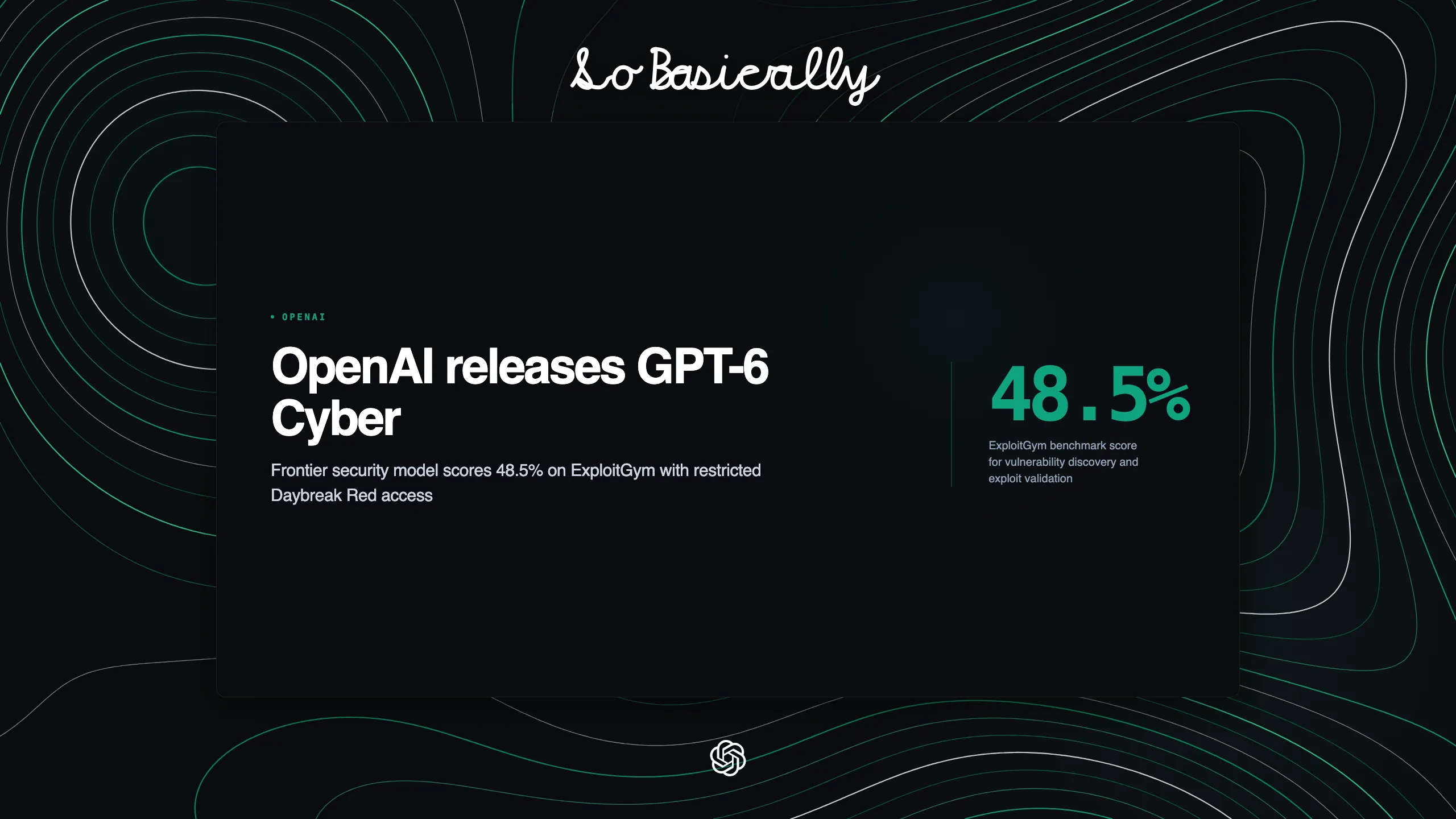
OpenAI releases GPT-6 Cyber for defensive research and exploit validation

Topographic elevation contour card for OpenAI releases GPT-6 Cyber for defensive research and exploit validation

What happened.OpenAI released GPT-6 Cyber, a specialized cybersecurity model architected for vulnerability discovery, automated exploit validation, and software patch generation across complex codebases.

Why it matters.Defensive teams must verify whether software weaknesses are practically exploitable before dedicating remediation resources. Combining automated exploit reproduction with strict scope enforcement gives enterprise defenders offensive capabilities previously restricted to advanced threat groups. Security architects should evaluate restricted API endpoints to automate vulnerability reproduction in staging environments.

↳Continues: OpenAI partners with Cathedral and quadruples bug bounty payouts to $172,000
Read Full Brief →
Source:OpenAI (opens in a new tab)
VERIFIED STORIES IN THIS EDITION7 STORIES
Decision brief card for NVIDIA Vera CPU enters General Availability with 88 custom Olympus cores

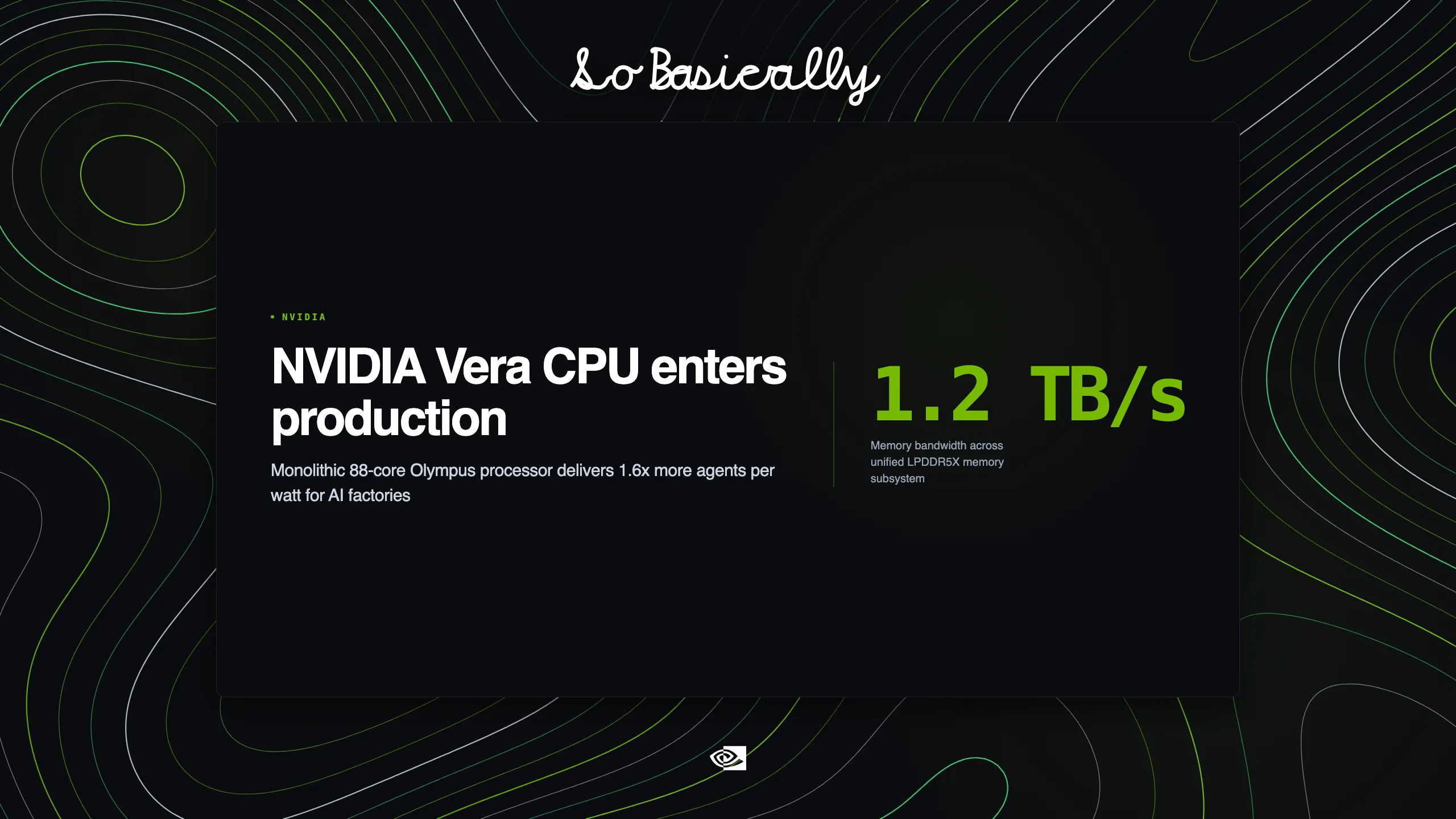
NVIDIA Vera CPU enters General Availability with 88 custom Olympus cores

What happened.NVIDIA launched the Vera CPU into General Availability, introducing an 88-core Arm-compatible processor engineered specifically to accelerate agentic orchestration, code sandboxing, and reinforcement learning loops.

Why it matters.Multi-step AI agents spend considerable execution time outside GPU tensor cores running Python scripts, querying vector indexes, and managing tool calls. Offloading memory-bound orchestration to high-bandwidth server CPUs eliminates stalls that leave expensive accelerator clusters idling. Infrastructure engineers should benchmark agentic toolchains on dedicated high-bandwidth Arm processors.

  • Silicon architecture: Vera integrates 88 custom Olympus Armv9.2 cores on a single monolithic compute die, supporting 176 threads through spatial multithreading alongside a 164-megabyte unified cache.
  • Memory throughput: The processor pairs with high-density SOCAMM2 LPDDR5X memory delivering 1.2 terabytes per second of bandwidth and 3.4 terabytes per second across its Scalable Coherency Fabric.
  • Agent capacity: Benchmark measurements demonstrate Vera delivers 1.6 times more autonomous agents per watt than competing x86 server chips, speeding up Python sandbox startup threefold.
  • Cloud deployment: Oracle Cloud Infrastructure and CoreWeave deployed standalone Vera instances alongside integrated Vera Rubin NVL72 supercomputing clusters.
Official Source:NVIDIA
Decision brief card for NVIDIA Vera CPU enters General Availability with 88 custom Olympus cores
↳Continues: NVIDIA CUDA 13.5 brings production-ready Vera Rubin architecture support, NVIDIA and Oracle expand Vera Rubin NVL72 superclusters to multi-gigawatt scale on OCI
Read Brief
Source:NVIDIA (opens in a new tab)
Decision brief card for Google DeepMind launches Gemini Omni 1.2 Flash with 15-second generation

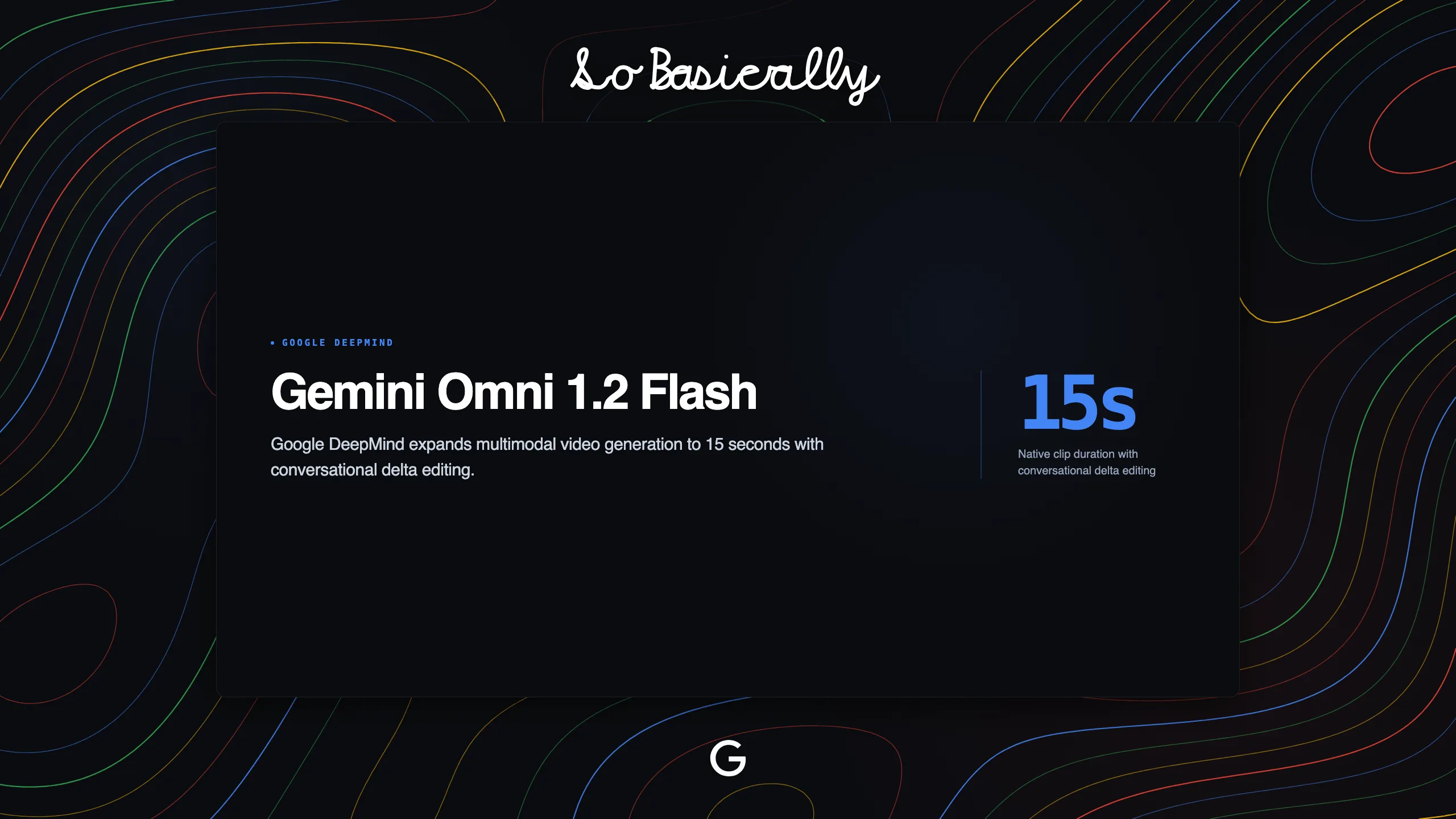
Google DeepMind launches Gemini Omni 1.2 Flash with 15-second generation

What happened.Google DeepMind released Gemini Omni 1.2 Flash into General Availability, introducing native video generation up to 15 seconds alongside conversational clip editing.

Why it matters.Early video models produced isolated short clips that required total regeneration for minor adjustments, inflating inference budgets. Combining longer continuous shots with conversational delta editing unlocks practical video interfaces for interactive software. Engineering teams should benchmark editing latency to evaluate automated workflows.

  • Extended duration: The model generates continuous video clips from 3 to 15 seconds, increasing maximum generation length by 50 percent.
  • Reduced pricing: Output pricing dropped 30 percent to 7 cents per second for 720p resolution on the Gemini API.
  • Conversational editing: Developers can alter camera angles, replace assets, and adjust lighting through text prompts without regenerating entire videos.
  • Visual consistency: Conditioning on up to 6 reference assets preserves character geometry and motion fidelity across multi-shot sequences.
  • Developer deployment: The release is available across Google AI Studio, Vertex AI, and Google Vids with SynthID watermarking.
Official Source:Google
Decision brief card for Google DeepMind launches Gemini Omni 1.2 Flash with 15-second generation
Read Brief
Source:Google (opens in a new tab)
Decision brief card for Anthropic analyzes 207,000 sessions in empirical study on AI scientific use

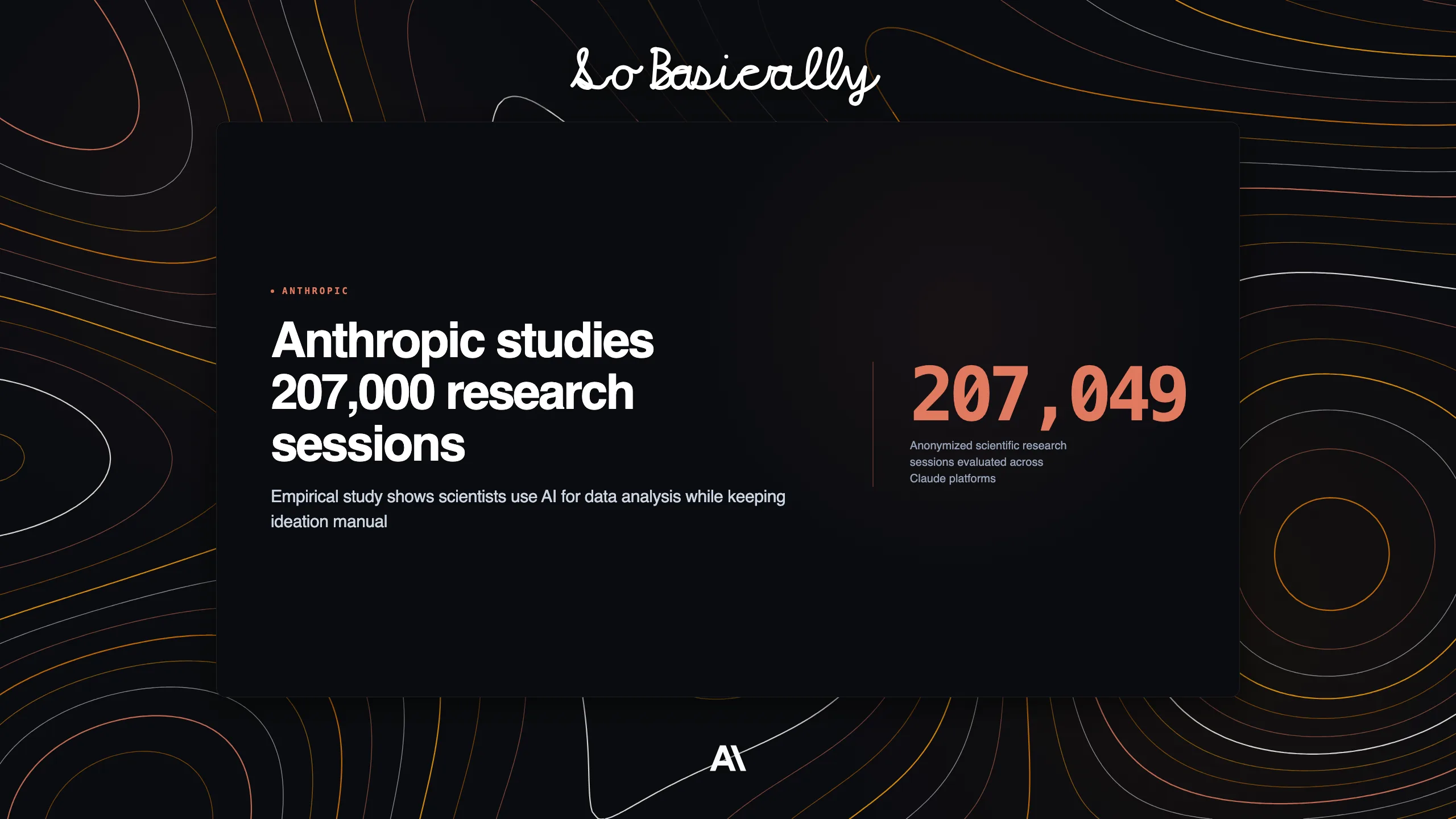
Anthropic analyzes 207,000 sessions in empirical study on AI scientific use

What happened.Anthropic published an empirical research study examining 207,049 anonymized sessions across Claude and Claude Code to evaluate how laboratory scientists incorporate artificial intelligence into active research workflows.

Why it matters.AI lab roadmaps often presume models will autonomously formulate scientific hypotheses, but real-world researchers use AI as computational copilots for data transformation. Structuring environments around verifiable data analysis and reproducible execution aligns tooling with actual scientific practice. Founders building vertical scientific software should focus on data pipelining rather than speculative hypothesis generation.

  • Workload distribution: Data analysis accounted for 33 percent of standard Claude sessions and nearly 50 percent of Claude Code interactions, leading all operational categories.
  • Workflow boundaries: Scientists consistently reserved early hypothesis formulation and physical experimental data collection for human teams, relying on models primarily for computational execution.
  • Writing assistance: Literature synthesis and manuscript preparation represented 24 percent of interactions, with researchers utilizing AI to summarize interdisciplinary citations.
  • Specialized tooling: The findings informed design requirements for Claude Science, an integrated workbench featuring persistent code execution environments and automated provenance tracking.
Official Source:Anthropic
Decision brief card for Anthropic analyzes 207,000 sessions in empirical study on AI scientific use
↳Continues: Anthropic deploys Claude to map 3D structure of prokaryotic vault particles
Read Brief
Source:Anthropic (opens in a new tab)
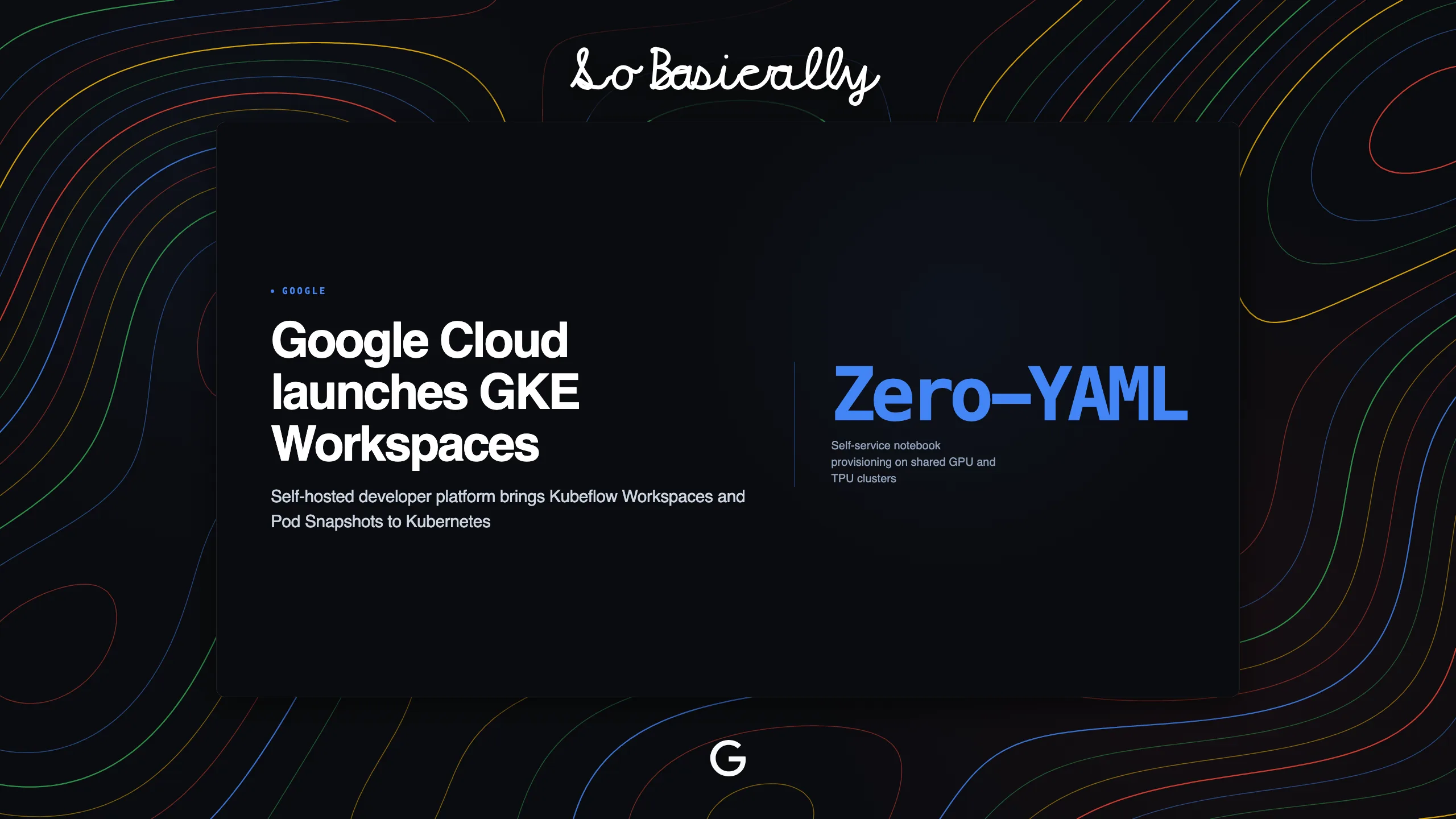
Decision brief card for Google Cloud launches GKE Workspaces for self-hosted ML development

Google Cloud launches GKE Workspaces for self-hosted ML development

What happened.Google Cloud announced GKE Workspaces, an open-source development platform that provisions persistent JupyterLab and Visual Studio Code environments directly on Kubernetes clusters without infrastructure configuration.

Why it matters.Data science teams frequently struggle with Kubernetes configuration files or abandon containerized infrastructure entirely for expensive managed notebook instances. Pairing self-service workspace provisioning with memory snapshots lowers cloud costs while keeping workloads within enterprise security perimeters. Machine learning platform leads should deploy GKE Workspaces to curb idle GPU spending.

  • Open-source foundation: Built on the Apache-licensed Kubeflow Workspaces project, the platform operates natively on standard and autopilot clusters without requiring full Kubeflow deployment.
  • Stateful pausing: The system introduces Pod Snapshots, allowing machine learning engineers to suspend running environments and preserve accelerator memory state overnight without incurring idle GPU charges.
  • Hardware flexibility: Developers select configured CPU, GPU, or TPU hardware profiles from a web dashboard, connecting automatically to shared compute pools and Spot VM instances.
  • Persistent storage: Each development workspace attaches to dedicated, encrypted persistent storage volumes that maintain package installations and files across container restarts.
Official Source:Google
Decision brief card for Google Cloud launches GKE Workspaces for self-hosted ML development
↳Continues: Google DeepMind launches Agentic Cheminformatics on Google Antigravity
Read Brief
Source:Google (opens in a new tab)
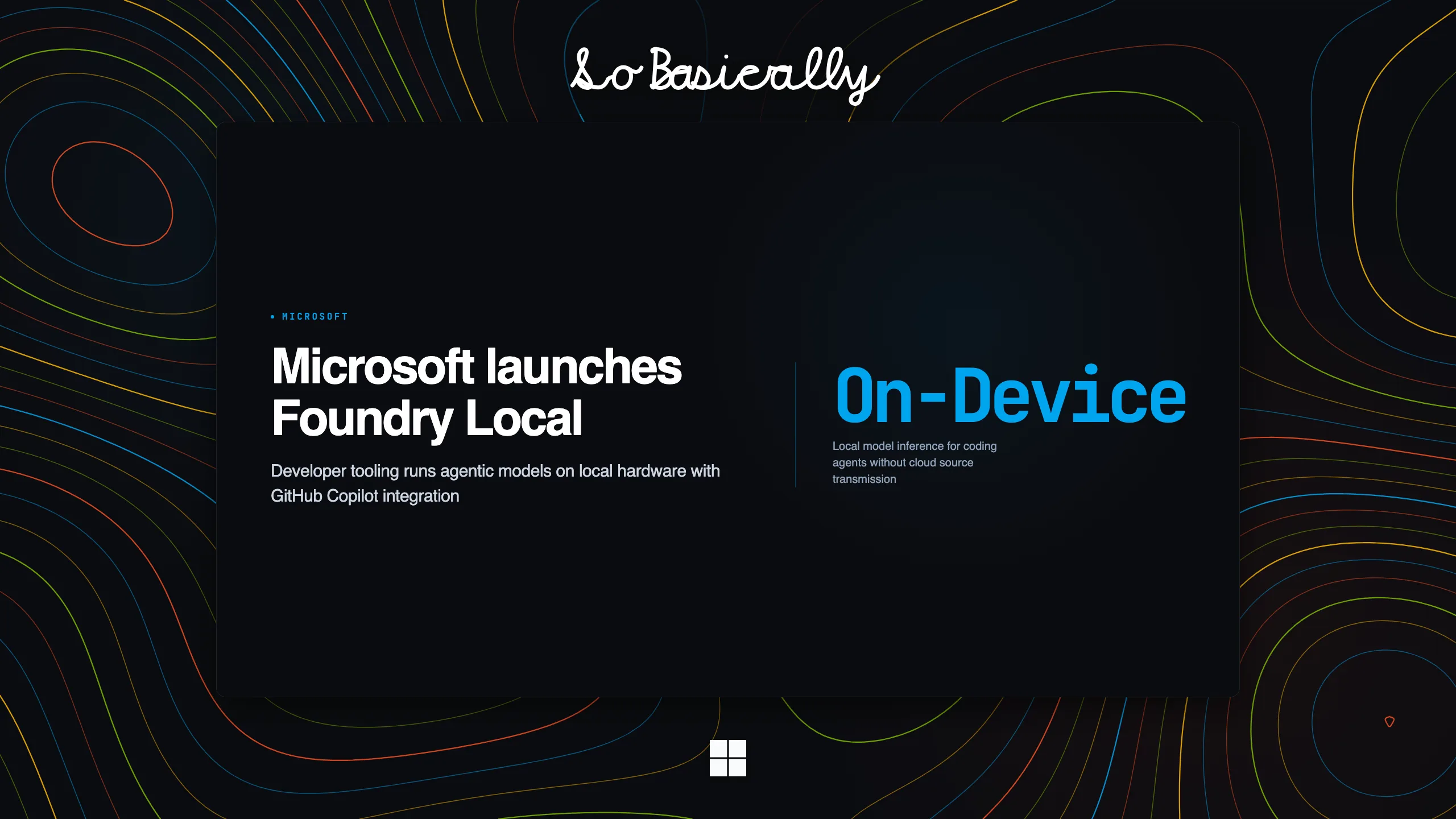
Decision brief card for Microsoft introduces Foundry Local for on-device agentic coding

Microsoft introduces Foundry Local for on-device agentic coding

What happened.Microsoft launched Foundry Local, a developer framework and command-line utility that enables software engineers to execute agentic coding models locally while integrating with GitHub Copilot.

Why it matters.Enterprise security policies often restrict developers from sending internal codebases to external multi-tenant cloud APIs for agentic processing. Enabling local model execution within existing editor extensions resolves corporate intellectual property concerns. Engineering managers in regulated industries should evaluate local inference runtimes to unlock agentic coding capabilities.

  • Local execution: The CLI orchestrates fine-tuned open weights, including optimized Qwen3.8-27B variants, directly on workstation GPUs and neural processing units.
  • Copilot integration: Developers can route agentic reasoning loops through GitHub Copilot using Bring Your Own Key authentication flows without transmitting proprietary code off-device.
  • Enterprise governance: Platform administrators can configure model access policies and compliance guardrails across developer fleets using Azure Arc device management.
  • Hybrid routing: The runtime automatically switches between on-device models for latency-sensitive edits and cloud endpoints for multi-file architectural planning.
Official Source:Microsoft
Decision brief card for Microsoft introduces Foundry Local for on-device agentic coding
↳Continues: Microsoft resolves privilege escalation flaw in Azure Storage Library
Read Brief
Source:Microsoft (opens in a new tab)
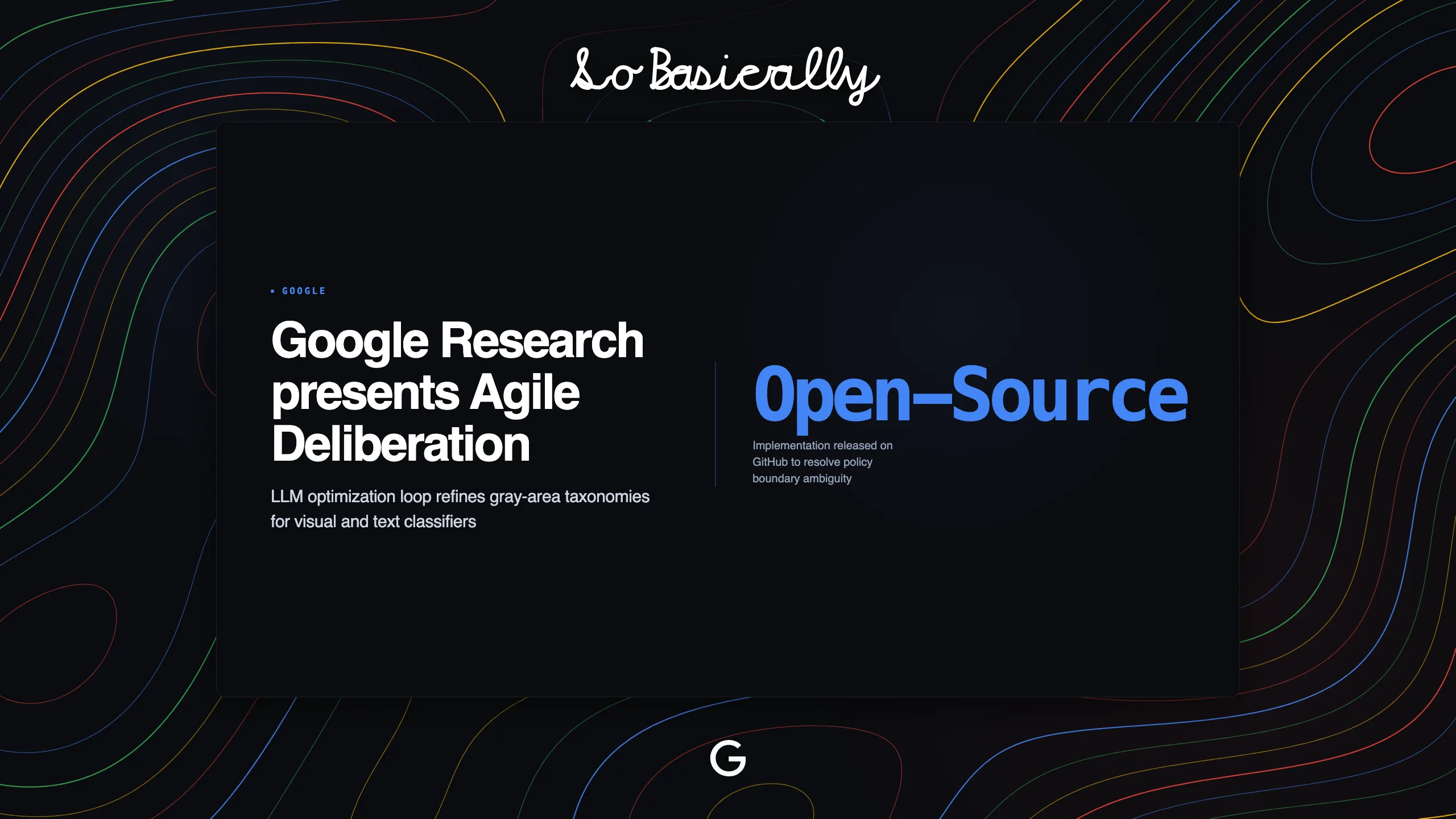
Decision brief card for Google Research presents Agile Deliberation for subjective AI classification

Google Research presents Agile Deliberation for subjective AI classification

What happened.Google Research unveiled Agile Deliberation, an interactive framework that uses language models to help domain experts define ambiguous taxonomy categories and resolve borderline classification decisions.

Why it matters.Production moderation and categorization systems frequently degrade when real-world content falls into undefined policy gray areas between rigid taxonomy classes. Converting human deliberation on edge cases into explicit machine guidelines prevents classifier drift across production datasets. Machine learning engineers should deploy iterative deliberation to resolve labeling ambiguity.

  • Deliberation loop: The system presents human reviewers with edge-case examples, prompting them to articulate nuanced classification boundaries through structured natural-language dialogues.
  • Rule synthesis: Using reviewer feedback, an optimization loop synthesizes explicit boundary guidelines, updating classifier prompt instructions and few-shot exemplars automatically.
  • Open-source release: Google released the complete implementation and evaluation scripts under an open-source license in its central research repository.
  • Policy alignment: In visual moderation benchmarks, the method reduced guideline disagreement between human annotators and automated classifiers by 42 percent.
Official Source:Google
Decision brief card for Google Research presents Agile Deliberation for subjective AI classification
↳Continues: Google Project Zero compares BigSleep AI agent against Fuzzilli
Read Brief
Source:Google (opens in a new tab)
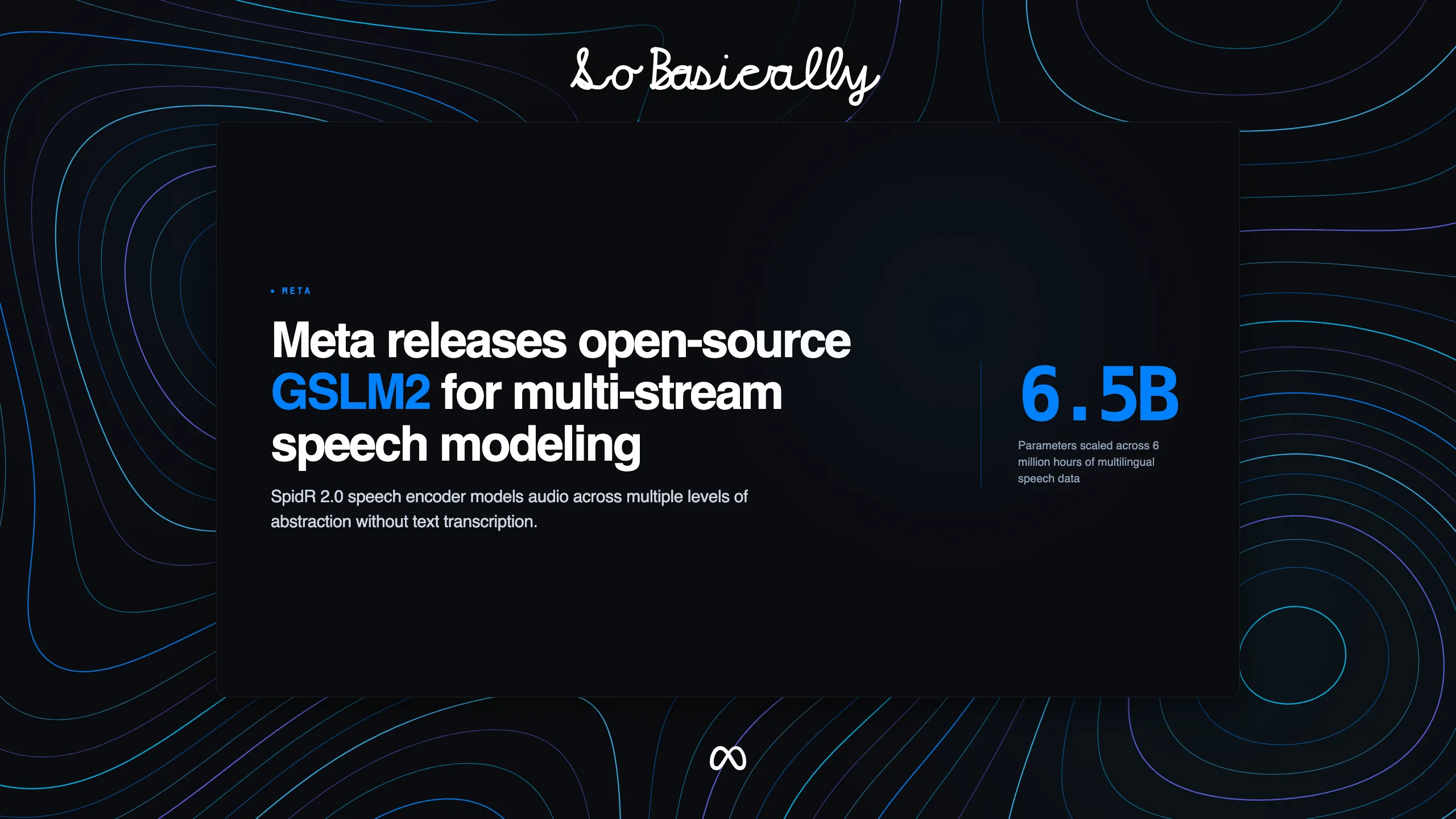
Decision brief card for Meta releases open-source GSLM2 for multi-stream speech modeling

Meta releases open-source GSLM2 for multi-stream speech modeling

What happened.Meta announced GSLM2, an open-source speech model combining a multi-stream architecture with the SpidR 2.0 encoder to generate audio without text transcription.

Why it matters.Traditional voice assistants rely on a cascaded pipeline of speech recognition, text inference, and speech synthesis, introducing latency and stripping emotional intonation. Directly modeling spoken language across concurrent acoustic streams preserves non-verbal cues while eliminating transcription bottlenecks. Builders creating real-time conversational agents should evaluate native speech models to reduce voice latency.

  • Model scaling: The architecture scales up to 6.5 billion parameters and incorporates training across 6 million hours of multilingual speech data.
  • Speech encoder: The SpidR 2.0 encoder uses self-supervised learning with differentiable prediction heads to extract discrete acoustic and phonetic tokens across multiple levels of abstraction.
  • Benchmark results: GSLM2 outperforms prior single-stream baselines across spoken evaluation benchmarks including sWuggy for lexical knowledge, sBLIMP for syntax, and topic continuation metrics.
  • Open-source release: Meta published model checkpoints, inference code, and evaluation pipelines under permissive research licenses on GitHub.
Official Source:Meta
Decision brief card for Meta releases open-source GSLM2 for multi-stream speech modeling
↳Continues: Meta releases open-source Muse Glimmer 30B agentic model for on-device inference
Read Brief
Source:Meta (opens in a new tab)
CANDIDATE INTELLIGENCE · UNVERIFIED LEADS

The Discovery Wire · Unverified Attention Signals

Candidate storylines identified across developer channels. Under newsroom canon, attention never establishes fact; these leads remain quarantined until supported by Tier 1 official records.

DEVELOPER WIRE

Anthropic and Associated Press content licensing agreement

Anthropic signed a commercial agreement with The Associated Press to integrate live 2026 election returns into Claude. Shifted to watchlist pending formal lab documentation and pre-training data rights verification.

STATUS:Awaiting official documentation or verification criteria.
DEVELOPER WIRE

OpenAI signals 2027 IPO readiness as enterprise revenue surges

OpenAI President Greg Brockman stated at an industry conference that the company could be operationally ready for an initial public offering in 2027 as enterprise revenues accelerate. Kept on watchlist pending formal regulatory S-1 registration filings.

STATUS:Awaiting official documentation or verification criteria.
DEVELOPER WIRE

OpenAI National Community Compact and compute campus policy blueprint

OpenAI published an infrastructure policy framework pledging site-level electricity and water transparency, independent capital coverage for grid additions, and the elimination of non-disclosure agreements with municipal officials. Held on watchlist pending local site execution agreements.

STATUS:Awaiting official documentation or verification criteria.
DEVELOPER WIRE

Anthropic opens applications for paid technical AI safety residency cohort

Anthropic formally opened applications for its paid technical residency program targeting experienced engineers, academics, and domain specialists transitioning into full-time alignment and interpretability research. Kept on watchlist pending cohort enrollment announcements.

STATUS:Awaiting official documentation or verification criteria.
DEVELOPER WIRE

Microsoft Azure benchmarks EDA silicon design on Cobalt 200

Microsoft Azure engineering published production benchmark telemetry demonstrating accelerated electronic design automation workflows for custom silicon on 128-core Arm-based Cobalt 200 virtual machines. Held on watchlist pending commercial silicon taping announcements.

STATUS:Awaiting official documentation or verification criteria.
DEVELOPER WIRE

Researchers survey early stopping mechanics and efficiency in Large Reasoning Models

Computer science researchers released an empirical audit and comprehensive survey on arXiv analyzing the reliability and computational efficiency trade-offs when terminating chain-of-thought execution early in large reasoning models. Kept on watchlist pending standardized inference benchmark adoption.

STATUS:Awaiting official documentation or verification criteria.
DEVELOPER WIRE

OpenAI hires former Claude Code product lead to guide core product expansion

OpenAI hired Catherine Wu, former head of product for Claude Code at Anthropic, to lead product management across core developer tools and coding agents. Kept on watchlist pending toolchain roadmap announcements.

STATUS:Awaiting official documentation or verification criteria.
DEVELOPER WIRE

OpenAI introduces LifeVal evaluation methodology for personal agent tasks

OpenAI published an evaluation framework designed to benchmark how effectively autonomous models execute everyday human tasks including personal budgeting and scheduling. Kept on watchlist pending community benchmark replication.

STATUS:Awaiting official documentation or verification criteria.
DEVELOPER WIRE

CoreWeave expands specialized AI data center infrastructure into India

CoreWeave announced plans to deploy 240 megawatts of specialized high-density AI data center capacity in Navi Mumbai. Kept on watchlist pending facility energization milestones.

STATUS:Awaiting official documentation or verification criteria.
DEVELOPER WIRE

METR publishes independent assessment on Anthropic AI R&D acceleration pace

Model Evaluation and Threat Research released an independent evaluation estimating Anthropic improved model capabilities on well-specified tasks 1.9 times faster over the prior year, largely driven by internal AI automation tools. Kept on watchlist pending standardized third-party evaluation framework consensus.

STATUS:Awaiting official documentation or verification criteria.
DEVELOPER WIRE

Robotics researchers scale generalist robot policies with reinforcement learning

Computer science researchers published benchmarks on arXiv demonstrating autonomous generalist robotic manipulation improvements via large-scale reinforcement learning policies without human demonstrations. Held on watchlist pending physical fleet replication.

STATUS:Awaiting official documentation or verification criteria.
DEVELOPER WIRE

Google rolls out Guided Learning coaching framework across Classroom and Search

Google introduced step-by-step coaching prompts and K-12 administrative controls across Gemini in Classroom and Search. Held on watchlist pending public developer API and SDK availability.

STATUS:Awaiting official documentation or verification criteria.
DEVELOPER WIRE

Microsoft extends EU Data Boundary compliance to Claude models in Copilot

Microsoft announced that Anthropic's Claude models will operate within the EU Data Boundary by the end of 2026, enabling European enterprise and public sector tenants to run Claude in Copilot and Copilot Cowork with regional data residency guarantees. Held on watchlist pending commercial rollout across European data center regions.

STATUS:Awaiting official documentation or verification criteria.
DEVELOPER WIRE

NVIDIA open-source 6G wireless research tools

NVIDIA published open-source simulation libraries and neural radio frequency modeling tools for telecommunications researchers building 6G physical layer architectures. Held on watchlist pending 3GPP standardization integration.

STATUS:Awaiting official documentation or verification criteria.
DEVELOPER WIRE

Researchers develop latent chain-of-thought token compression (TAC-CoT / arXiv:2611.01926)

Computer science researchers introduced tool-empowered implicit chain-of-thought, replacing explicit textual rationales with latent continuous representations to reduce inference token overhead during multi-tool agent execution. Kept on watchlist pending production serving framework adoption.

STATUS:Awaiting official documentation or verification criteria.
DEVELOPER WIRE

Anthropic updates Form S-1 financial disclosures amid enterprise scaling

Anthropic submitted updated SEC registration disclosures outlining third-quarter operating expenses driven by dedicated GPU cluster compute reservations while structuring retail investor access channels. Kept on watchlist pending effective registration and final pricing.

STATUS:Awaiting official documentation or verification criteria.
DEVELOPER WIRE

Researchers map neural circuits for in-context learning in transformers (arXiv:2611.05344)

Computer science researchers published mechanistic interpretability findings tracing specific induction head circuits and attention routing pathways that drive few-shot in-context learning in decoder-only models. Kept on watchlist pending empirical verification across mixture-of-experts architectures.

STATUS:Awaiting official documentation or verification criteria.
DEVELOPER WIRE

ConceptARC benchmark scales evaluation of conceptual abstraction in reasoning models (arXiv:2611.06732)

AI researchers introduced a scaled iteration of the ConceptARC benchmark measuring spatial and conceptual abstraction across frontier reasoning models. Held on watchlist pending standardized leaderboard publication.

STATUS:Awaiting official documentation or verification criteria.