 GoogleAnalysis
Google Project Zero compares BigSleep AI agent against Fuzzilli

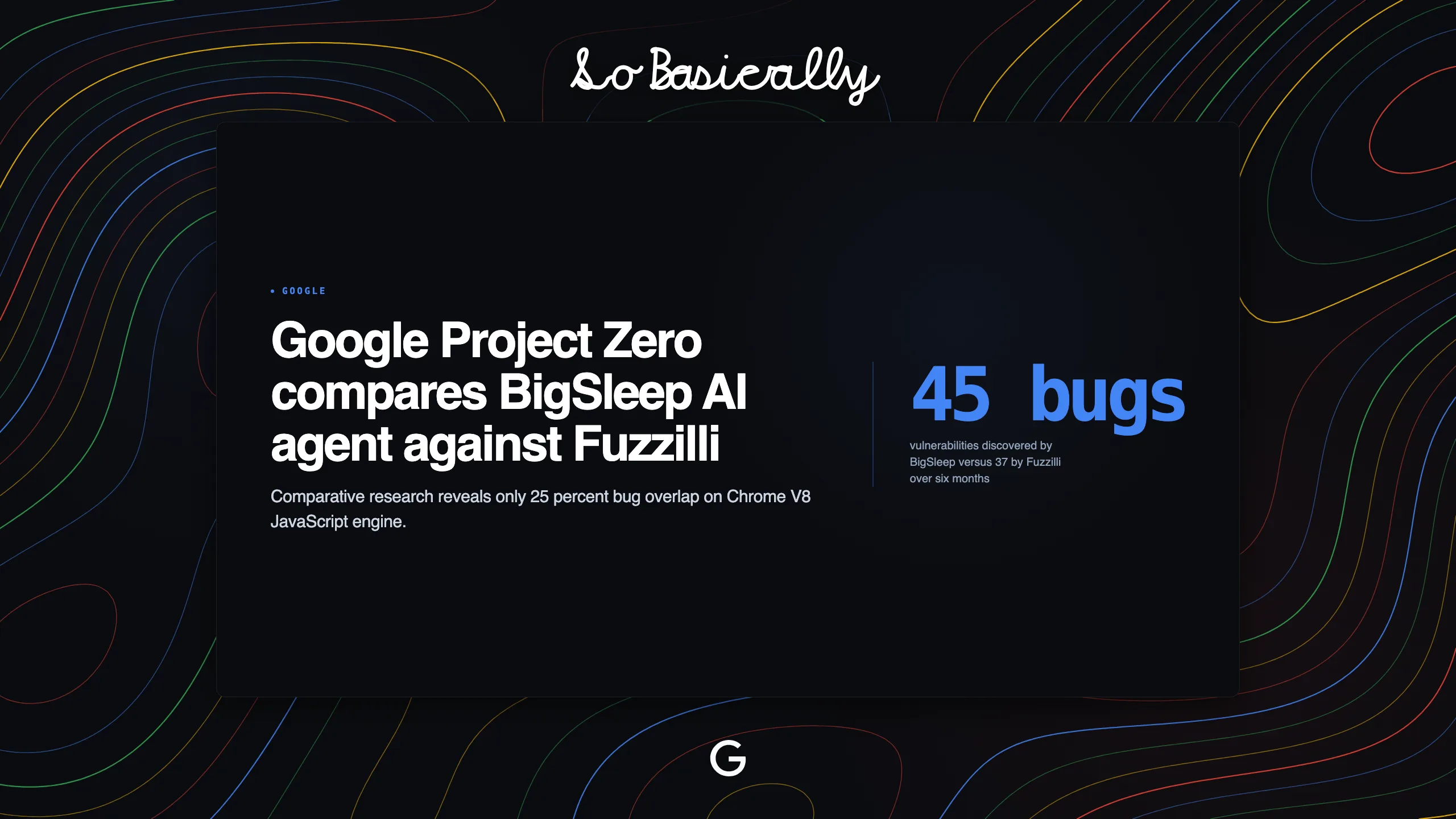
What happened.Google Project Zero published comparative research evaluating the BigSleep artificial intelligence bug-hunting agent against the Fuzzilli generative fuzzer on the Chrome V8 JavaScript engine.
Why it matters.Automated vulnerability research underpins modern browser security, yet coverage-guided fuzzing struggles with deep semantic states and complex compiler logic. Because AI agent workflows reason over structural code dependencies, they identify memory corruption bugs that traditional mutations miss entirely. Engineering leaders should integrate language model security agents into existing automated continuous fuzzing pipelines. Application teams must treat generative testing as an essential defense layer.
The technical specifications:
- Evaluation metrics: Over a six-month production study, BigSleep discovered 45 actionable vulnerabilities compared to 37 identified by Fuzzilli across identical JavaScript target surfaces.
- Surface divergence: The two systems exhibited only a 25 percent bug overlap in live tracking, while historical regression tests revealed roughly 60 percent theoretical overlap.
- Architectural synthesis: Project Zero concluded that autonomous language model agents and coverage-guided fuzzers uncover distinct vulnerability classes, recommending dual deployment across production codebases.
TOPICS: