Skip to content
INTELLIGENCE BEAT2 Briefs

Supercomputing

2 Briefs

Verified technical decision briefs tracking supercomputing developments

Filter:

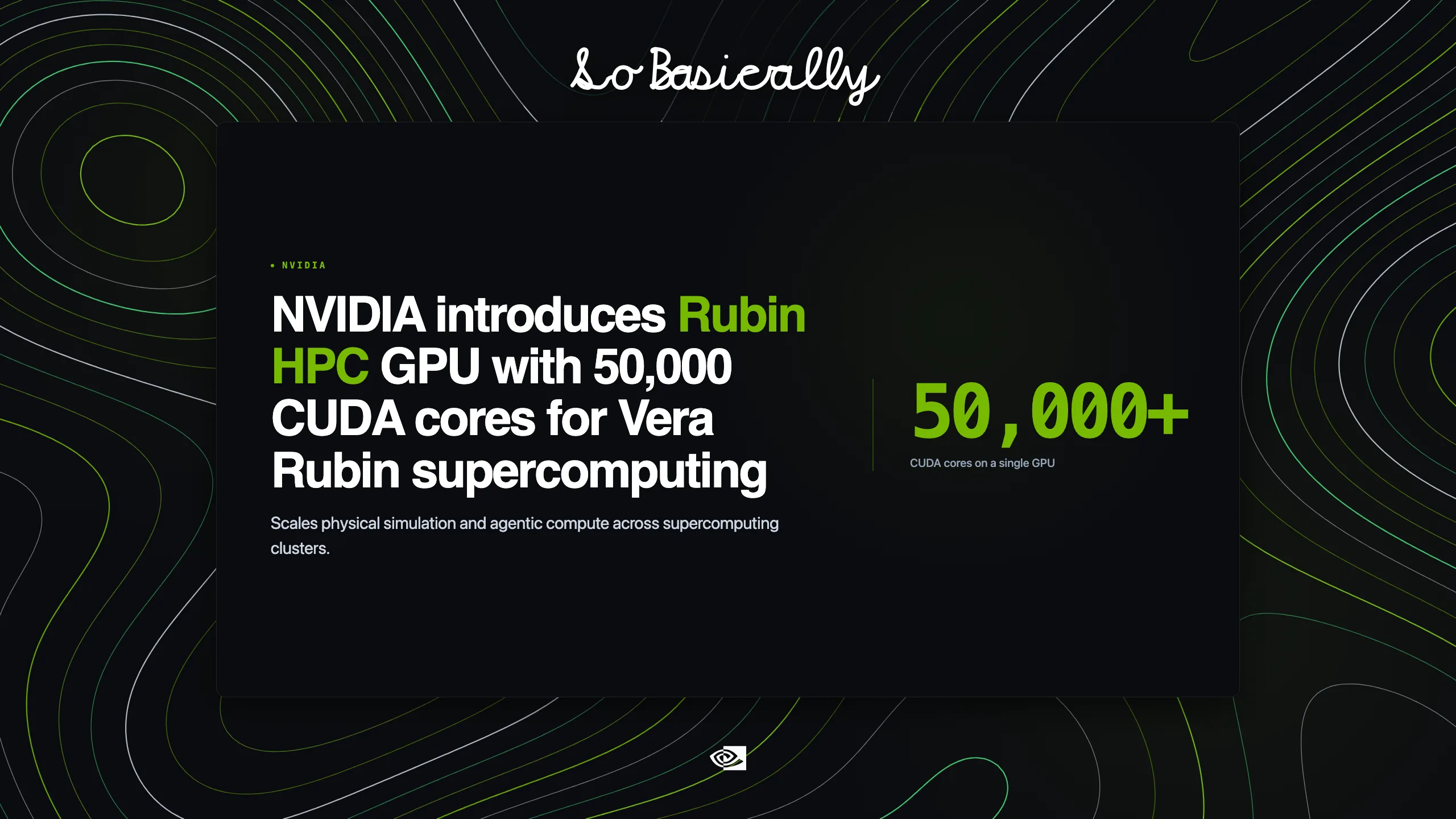
NVIDIA introduces Rubin HPC GPU with 50,000 CUDA cores for Vera Rubin supercomputing

Topographic elevation contour card for NVIDIA introduces Rubin HPC GPU with 50,000 CUDA cores for Vera Rubin supercomputing

What happened.NVIDIA unveiled Rubin HPC, a specialized graphics processing unit within the Vera Rubin architecture designed for computational science, physical simulation, and autonomous agent loops, featuring more than 50,000 CUDA cores on a single package.

Why it matters.Frontier reasoning models and multi-agent physics simulations require extreme arithmetic density combined with rapid memory traversal. Scaling past 50,000 cores while hardware-accelerating sparse memory patterns allows researchers to simulate complex molecular dynamics and climate models without encountering data starvation.

↳Continues: NVIDIA CUDA 13.5 brings production-ready Vera Rubin architecture support
Read Full Brief →
Source:NVIDIA (opens in a new tab)
All Stories1 story
Decision brief card for NVIDIA, IBM, and Fermilab deploy quantum-classical codesign platform with 13,000x error-correction speedup

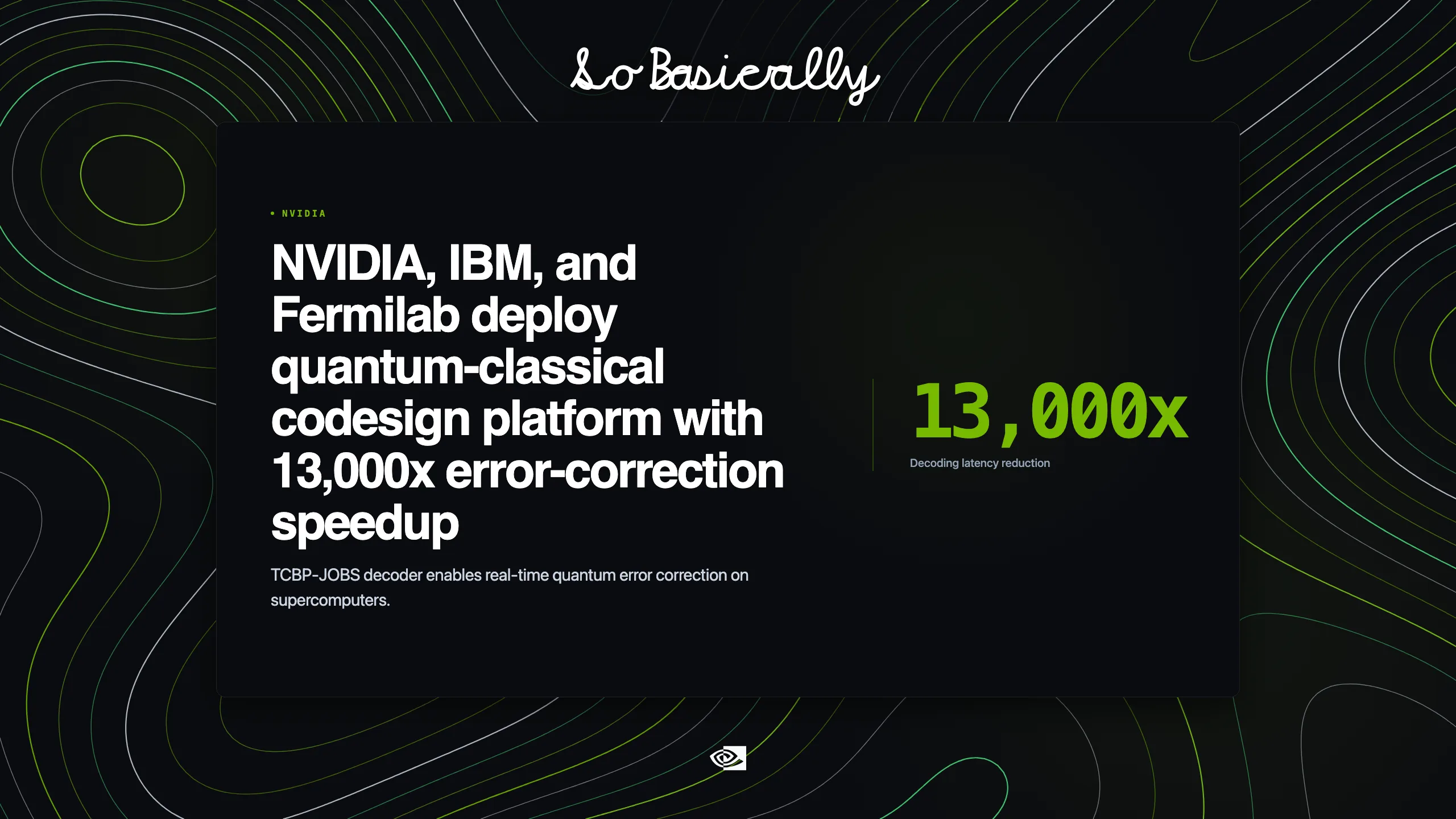
NVIDIA, IBM, and Fermilab deploy quantum-classical codesign platform with 13,000x error-correction speedup

What happened.NVIDIA announced a collaboration with IBM and the Fermi National Accelerator Laboratory to launch a hybrid quantum-classical codesign platform alongside the TCBP-JOBS decoding algorithm, achieving up to 13,000-fold speedups for quantum error correction.

Why it matters.Fault-tolerant quantum computing requires correcting qubit drift before quantum coherence collapses, demanding sub-millisecond decoding of high-rate syndrome data. Accelerating error correction by four orders of magnitude on GPU clusters brings practical hybrid quantum-classical computing significantly closer to production execution.

  • Hybrid codesign: Integrates GPU supercomputing clusters with superconducting quantum processors through NVIDIA CUDA-Q and IBM quantum hardware architectures.
  • Algorithmic speedup: Implements the TCBP-JOBS decoder on GPU tensor cores, achieving up to 13,000-times latency reduction compared to conventional syndrome decoding algorithms.
  • Real-time correction: Extracts and processes error syndromes within tight physical qubit coherence time windows to enable fault-tolerant quantum computing.
  • Workload orchestration: Expands Slurm workload scheduler integrations to schedule quantum processing units as first-class allocatable compute resources in supercomputing clusters.
  • Laboratory validation: Validates hybrid workflows across experimental quantum physics testbeds hosted at Fermilab and national scientific facilities.
Official Source:NVIDIA
Decision brief card for NVIDIA, IBM, and Fermilab deploy quantum-classical codesign platform with 13,000x error-correction speedup
Read Brief
Source:NVIDIA (opens in a new tab)