Skip to content
INTELLIGENCE BEAT4 Briefs

Llm

4 Briefs

Verified technical decision briefs tracking llm developments

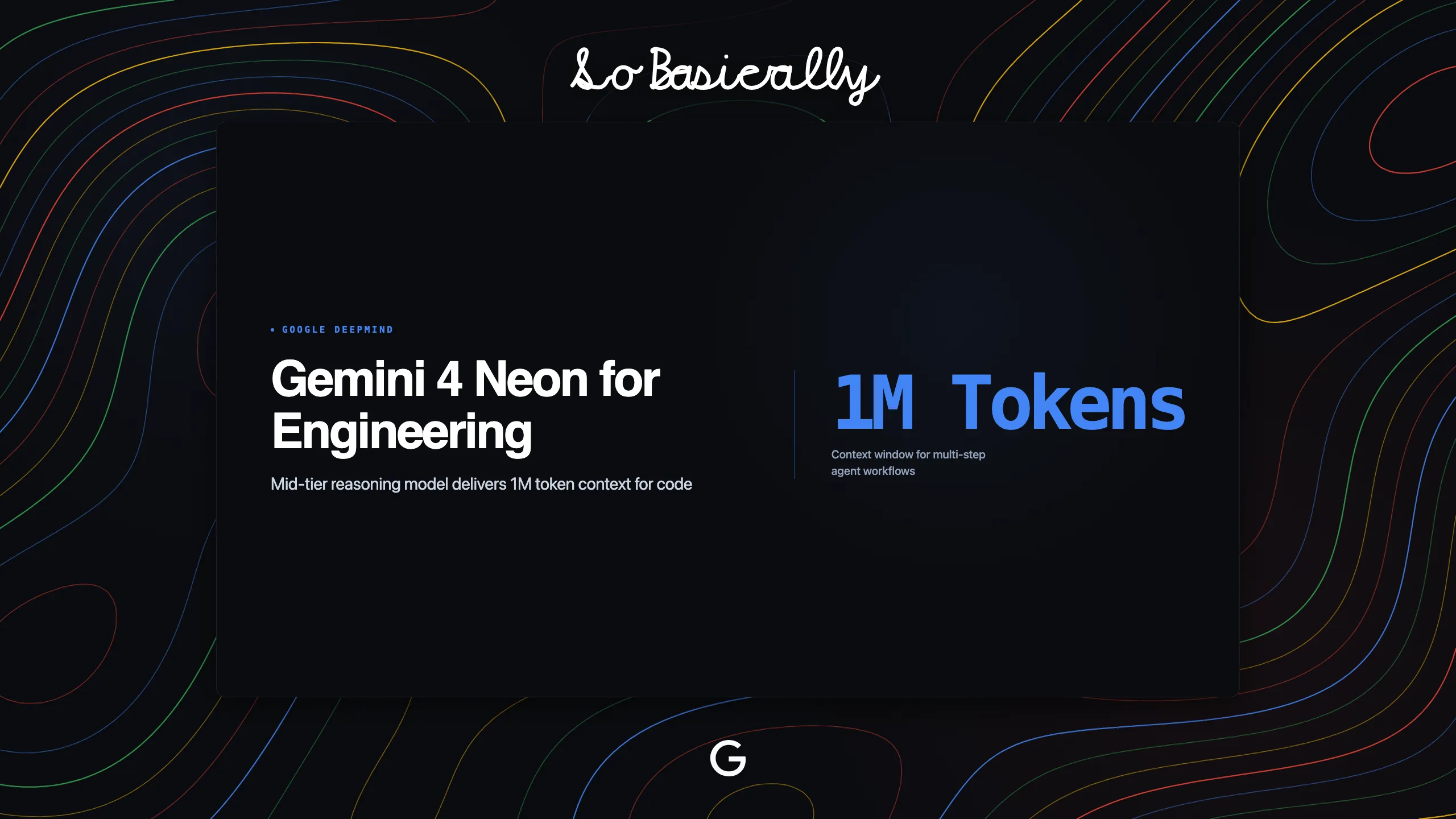
Google DeepMind releases Gemini 4 Neon for engineering
Topographic elevation contour card for Google DeepMind releases Gemini 4 Neon for engineering

What happened.Google DeepMind introduced Gemini 4 Neon, deploying a mid-tier frontier reasoning model for engineering tasks. It delivers a 1-million-token context window tailored for multi-step software development and scientific discovery.

Why it matters.Deploying frontier reasoning models across complex multi-step software tasks previously required choosing between slow, expensive flagship models or fast but inaccurate compact variants. Providing high reasoning density at mid-tier pricing allows engineering teams to automate multi-repository refactoring loops continuously.
↳Continues: Google introduces Gemini 4 Hydrogen for agentic workflows, Google DeepMind releases Gemini 4 Argon with restricted cybersecurity distribution
Read Full Brief →
Source:Google DeepMind (opens in a new tab)
All Stories3 stories
Decision brief card for Researchers introduce Self-Improvement Memory for agentic tuning

Researchers introduce Self-Improvement Memory for agentic tuning

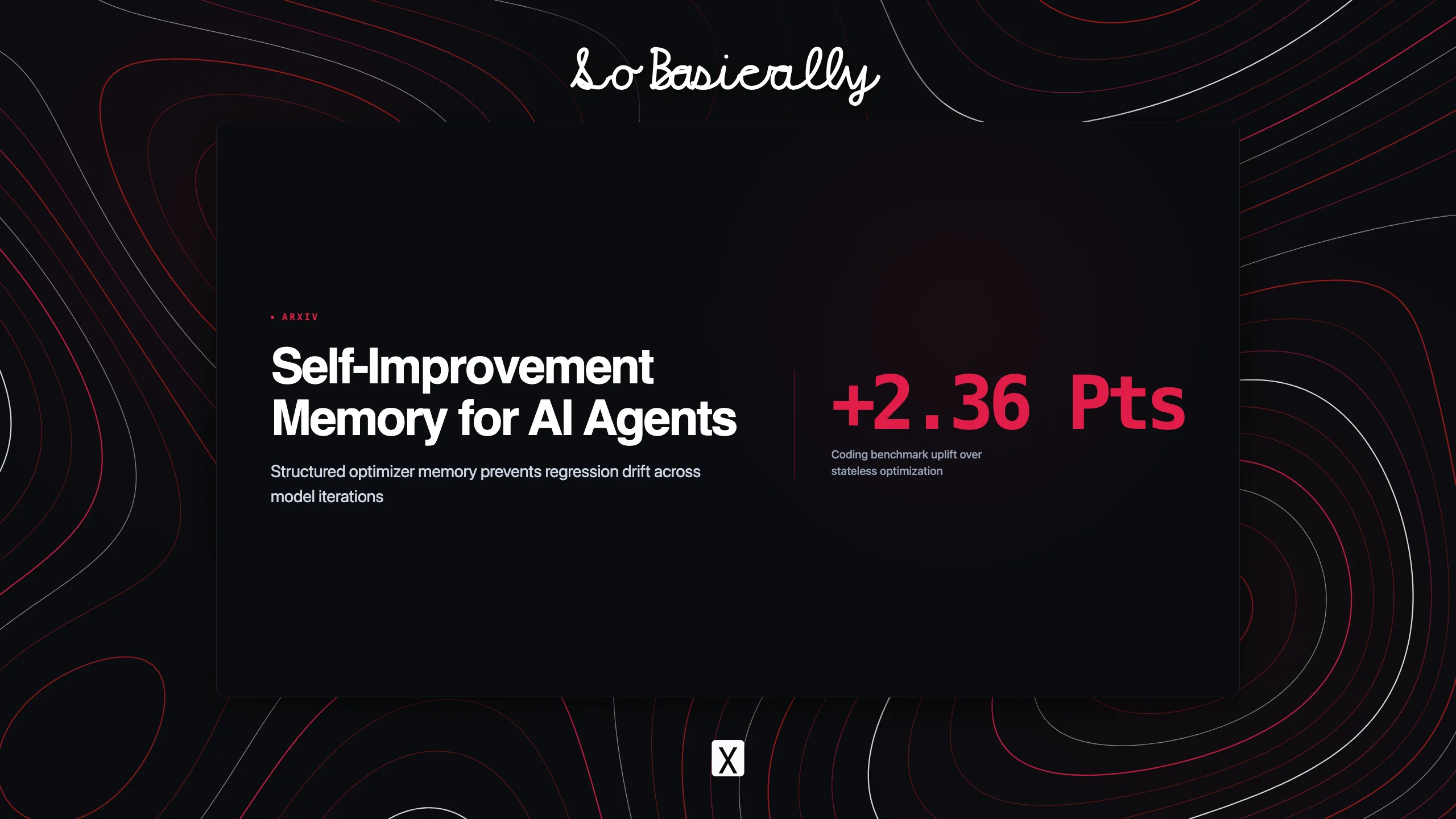
What happened.Researchers from Google Cloud AI and Google DeepMind introduced Self-Improvement Memory. The optimization framework equips recursive agent harnesses with audit trails to prevent performance regressions across model upgrades.

Why it matters.Iterative agent harnesses frequently suffer performance regressions when foundation models are updated beneath them. Equipping the meta-optimizer with persistent memory and empirical rollback criteria prevents optimization drift and stabilizes long-horizon agent maintenance.

  • Structured logging: Stores edit rationales, expected behavioral changes, and empirical test outcomes within dedicated optimizer memory.
  • Regression mitigation: Enables automated rollbacks when proposed prompt or tool configuration adjustments degrade downstream agent accuracy.
  • Cross-model transfer: Preserves cumulative optimization gains when migrating agent systems across underlying foundation model iterations.
  • Coding performance: Delivers an average improvement of 2.36 benchmark points over conventional stateless optimization routines.
Official Source:arXiv
Decision brief card for Researchers introduce Self-Improvement Memory for agentic tuning
Read Brief
Source:arXiv (opens in a new tab)
Decision brief card for OpenAI releases GPT-6.2 Astra and Sol frontier models

OpenAI releases GPT-6.2 Astra and Sol frontier models

What happened.OpenAI introduced GPT-6.2 Astra and GPT-6.2 Sol, releasing frontier reasoning models across ChatGPT, Codex, and API endpoints with lower output token volume and reduced inference costs.

Why it matters.High token costs and verbosity previously made deploying frontier reasoning models in iterative agent loops economically prohibitive. Slashing cached token fees to forty cents per million while improving reasoning accuracy allows teams to run continuous test-and-repair agent cycles at scalable margins.

  • Benchmark leadership: Astra scores 5.2 points higher than GPT-6 Astra on Agents' Last Exam and gains 9 points on Terminal-Bench-Science 0.1.
  • Token economics: Cuts Astra input pricing by 20 percent to $8.00 per million and cached inputs by 60 percent to $0.40 per million tokens.
  • Workhorse tier: Pairs Astra with GPT-6.2 Sol, keeping $2.00 input and $10.00 output pricing per million tokens for high-volume agent tasks.
  • Multistep reasoning: Produces cleaner code, complex spreadsheets, and structured documents that follow exacting enterprise templates.
  • Safety thresholds: Clears critical cybersecurity and high autonomous self-improvement evaluations under OpenAI's Preparedness Framework.
Official Source:OpenAI
Decision brief card for OpenAI releases GPT-6.2 Astra and Sol frontier models
Read Brief
Source:OpenAI (opens in a new tab)
Decision brief card for Microsoft launches MAI-Code-2 and Flash models in GitHub Copilot

Microsoft launches MAI-Code-2 and Flash models in GitHub Copilot

What happened.Microsoft AI and GitHub released MAI-Code-2 and MAI-Code-2-Flash generally available across GitHub Copilot, introducing agentic coding models specialized for multi-file repository refactoring.

Why it matters.Early developer assistants operated on isolated functions within active editor buffers. Moving to dedicated multi-file reasoning architectures enables autonomous agents to plan repository refactors and resolve dependency conflicts without losing cross-file context.

  • Model specialization: MAI-Code-2 targets deep architectural debugging and long-horizon multi-file changes across large software codebases.
  • Latency optimization: MAI-Code-2-Flash provides rapid execution for targeted file edits, automated test generation, and instant code explanations.
  • Multimodal reasoning: Both models process system screenshots and architectural diagrams alongside source text to diagnose user interface regressions.
  • Ecosystem rollout: Available immediately across VS Code, Visual Studio, JetBrains environments, and the Copilot command line interface.
Official Source:GitHub
Decision brief card for Microsoft launches MAI-Code-2 and Flash models in GitHub Copilot
Read Brief
Source:GitHub (opens in a new tab)