Skip to content
INTELLIGENCE BEAT6 Briefs

Cisa

6 Briefs

Verified technical decision briefs tracking cisa developments

Filter:

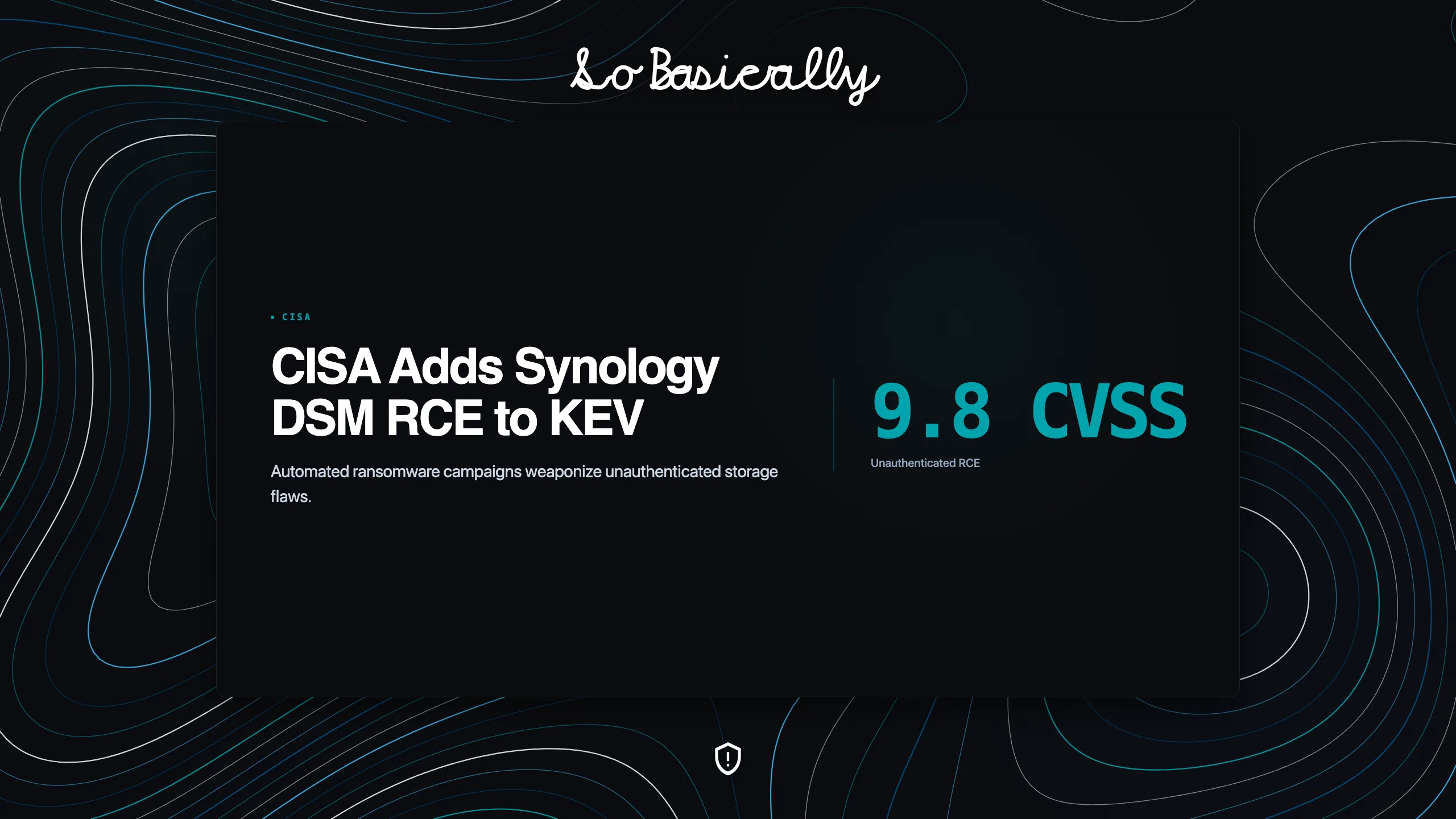
CISA adds Synology DiskStation Manager remote code execution flaw to KEV catalog
Topographic elevation contour card for CISA adds Synology DiskStation Manager remote code execution flaw to KEV catalog

What happened.The Cybersecurity and Infrastructure Security Agency added vulnerability CVE-2024-10441 in Synology DiskStation Manager to its Known Exploited Vulnerabilities catalog. Threat actors weaponize the defect in automated ransomware campaigns targeting network storage.

Why it matters.Network attached storage devices house production database backups and developer shared drives across startup offices. When storage appliances expose unauthenticated command execution flaws, ransomware operators encrypt local backups before alerting system administrators. Infrastructure operators must isolate storage devices behind private virtual networks.
Read Full Brief →
Source:NIST NVD (opens in a new tab)
All Stories5 stories
Decision brief card for CISA mandates emergency patching for Vanderbilt REDCap unauthenticated code injection

CISA mandates emergency patching for Vanderbilt REDCap unauthenticated code injection

What happened.The Cybersecurity and Infrastructure Security Agency added vulnerability CVE-2026-90817 in Vanderbilt University REDCap software to its Known Exploited Vulnerabilities catalog. Attackers exploit public survey portals to execute code on backend research servers.

Why it matters.Public data collection forms often connect directly to internal data processing pipelines. If forms permit file stream injection into runtimes, attackers easily compromise survey servers. Engineering teams must sanitize routing parameters and restrict survey server egress traffic.

  • Survey routing injection: Tracked as CVE-2026-90817 with a 9.8 CVSS score, the defect abuses passthrough routing via double-URL encoding.
  • Unauthenticated arbitrary execution: Malicious file streams trigger arbitrary PHP code execution during data import routines.
  • Active cryptomining intrusions: Threat groups leverage survey hashes to deploy persistent web shells and fileless cryptocurrency mining tools.
  • Upstream patch requirements: Vanderbilt released urgent remediation patches across supported long term and standard branches.
Official Source:NIST NVD
Decision brief card for CISA mandates emergency patching for Vanderbilt REDCap unauthenticated code injection
Read Brief
Source:NIST NVD (opens in a new tab)
Decision brief card for CISA mandates federal remediation for actively exploited Apache Axis RCE

CISA mandates federal remediation for actively exploited Apache Axis RCE

What happened.The Cybersecurity and Infrastructure Security Agency added vulnerability CVE-2026-90436 in Apache Axis to its Known Exploited Vulnerabilities catalog on November 18, 2026. Federal agencies must remediate instances by November 21, 2026.

Why it matters.Enterprise software stacks frequently embed deprecated SOAP serialization libraries inside administrative remote interfaces. Because Axis instantiates attacker-specified classes before authentication filters run, unauthenticated attackers gain immediate remote execution. Infrastructure teams must audit dependencies for legacy Axis libraries and disable unneeded XML-RPC endpoints.

  • Insecure deserialization flaw: Tracked as CVE-2026-90436 with a 9.8 CVSS score, the defect triggers during SOAP fault parsing before service authentication executes.
  • Unauthenticated class instantiation: Supplying crafted exception payloads tricks Axis into loading and initializing arbitrary Java classes with string constructors.
  • Downstream enterprise impact: Legacy Axis 1.x instances embedded in platforms like Atlassian Confluence Data Center and N-able N-central face active automated attacks.
  • No official upstream release: Because Axis 1.x reached end-of-life, the Apache Software Foundation provides source patches rather than updated binaries.
Official Source:CISA
Decision brief card for CISA mandates federal remediation for actively exploited Apache Axis RCE
Read Brief
Source:CISA (opens in a new tab)
Decision brief card for CISA adds Puppet Enterprise deserialization flaw to KEV catalog

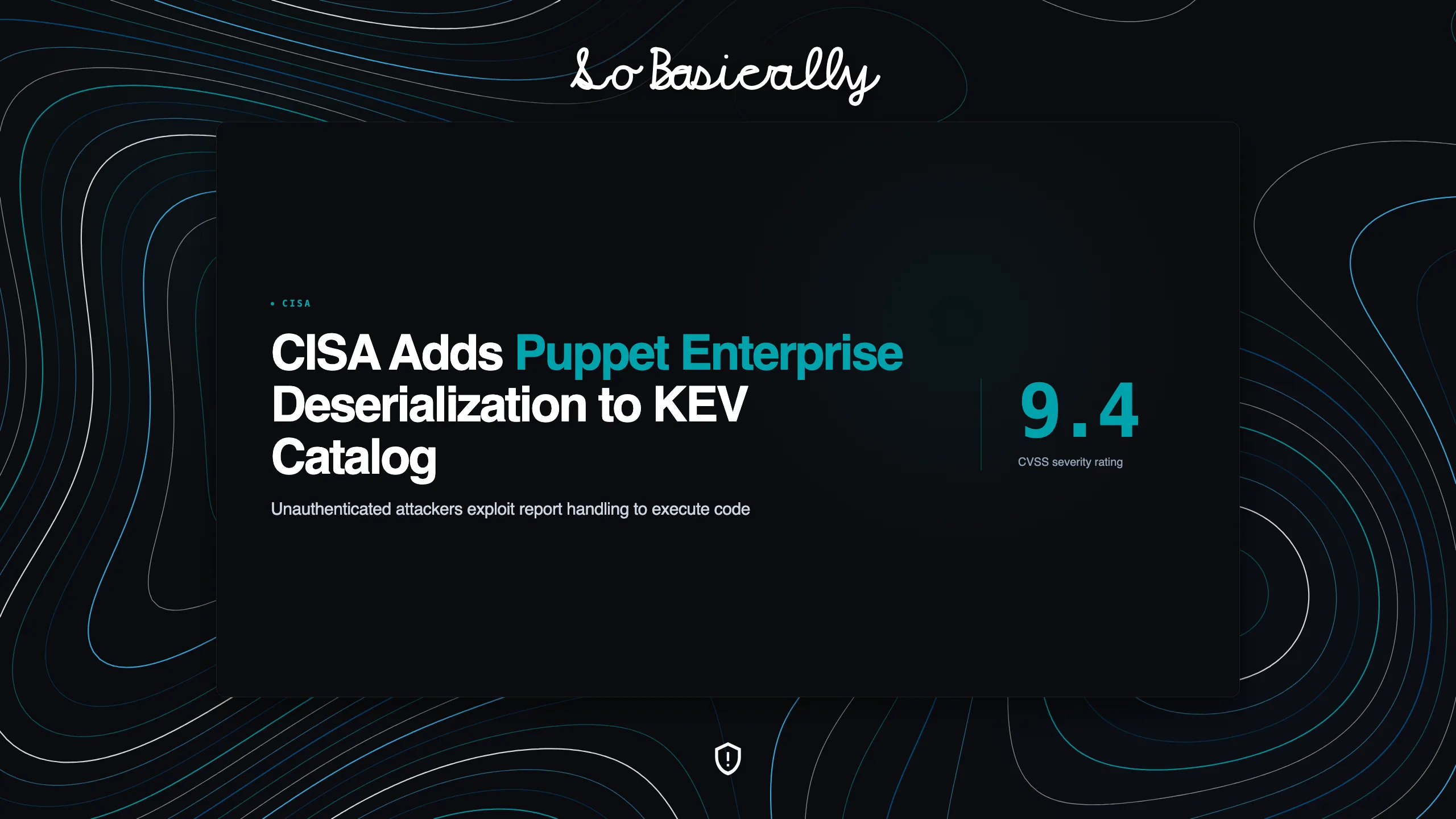
CISA adds Puppet Enterprise deserialization flaw to KEV catalog

What happened.The Cybersecurity and Infrastructure Security Agency added vulnerability CVE-2026-115731 affecting Perforce Puppet Enterprise to its Known Exploited Vulnerabilities catalog on November 17, 2026. Threat actors actively exploit the deserialization defect to execute code across centralized infrastructure servers.

Why it matters.Centralized configuration management servers maintain administrative root access across entire server fleets. Exploiting deserialization flaws in report processing lets adversaries compromise infrastructure orchestrators and pivot across production clusters. DevOps and security engineers must patch Puppet Servers immediately and restrict certificate autosigning.

  • Report deserialization flaw: Tracked as CVE-2026-115731 with a 9.4 CVSS score, the flaw resides in Puppet Server report-processing logic for rich-data types.
  • Certificate client execution: Any client presenting a CA-signed agent certificate can execute arbitrary code on the Puppet Server as the service user.
  • Autosigning exposure: Environments configured with automatic certificate signing allow unauthenticated network attackers to obtain valid certificates and achieve remote execution.
  • Vendor patch releases: Perforce published fixed versions 2023.8.13, 2025.12.1, and 2026.0.1 while requiring server restarts after updating.
Official Source:NIST NVD
Decision brief card for CISA adds Puppet Enterprise deserialization flaw to KEV catalog
Read Brief
Source:NIST NVD (opens in a new tab)
Decision brief card for CISA and Siemens issue industrial advisory on Node2Shell memory corruption in Brotli decoders

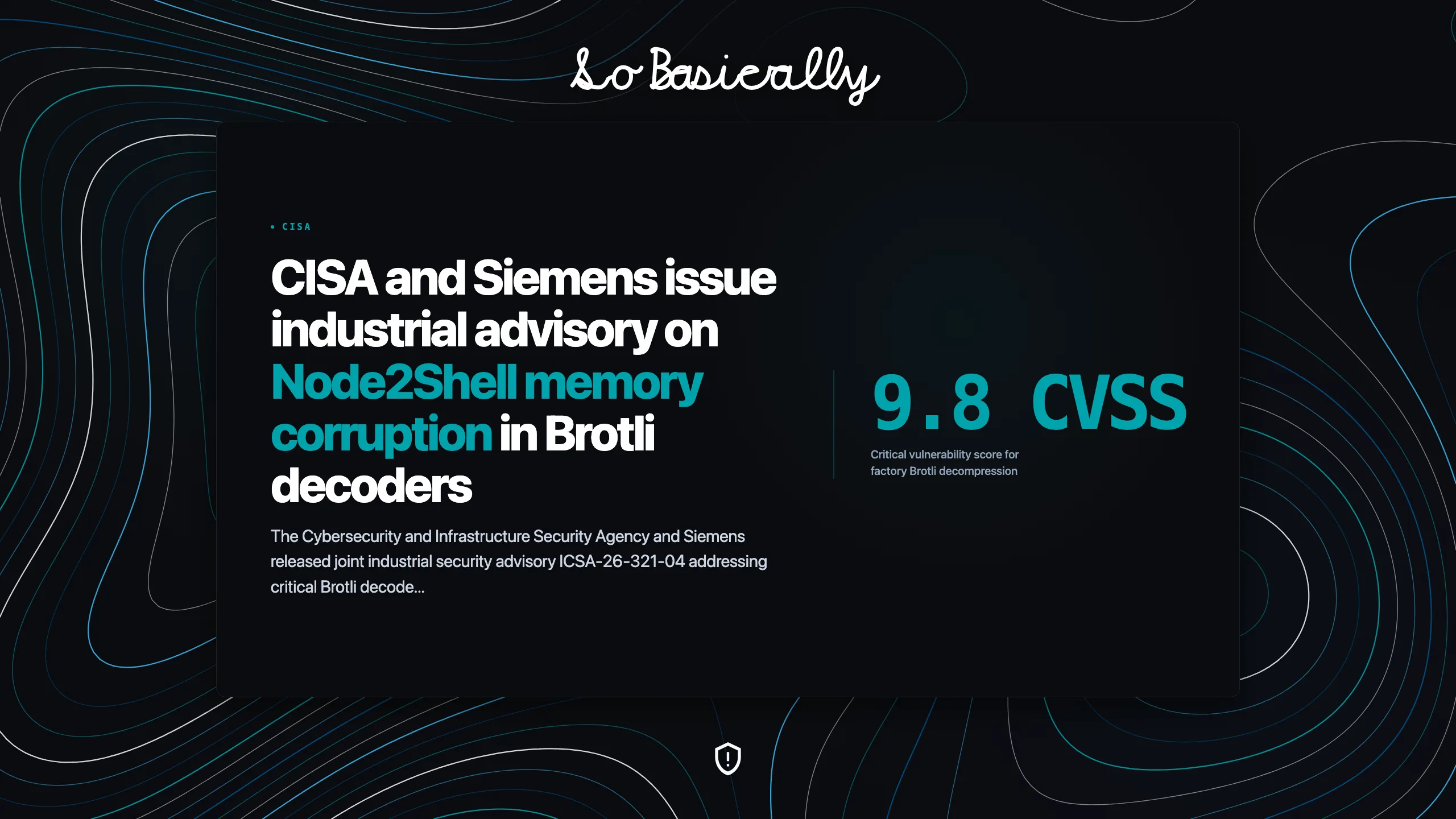
CISA and Siemens issue industrial advisory on Node2Shell memory corruption in Brotli decoders

What happened.The Cybersecurity and Infrastructure Security Agency and Siemens released joint industrial security advisory ICSA-26-321-04 addressing critical Brotli decoder memory corruption across multiple factory operations platforms.

Why it matters.Manufacturing execution platforms connect operational factory networks with enterprise resource planning data feeds. Exploiting memory safety flaws in bundled web components allows adversaries to bridge operational technology air gaps and disrupt automated manufacturing. Plant engineers must implement vendor mitigations immediately.

  • Out-of-bounds write: Tracked as CVE-2026-111497 with a 9.8 CVSS score, the vulnerability stems from buffer handling errors inside the bundled Node.js Brotli decompression component.
  • Industrial suite exposure: Impacted systems include Siemens Opcenter manufacturing execution tools, Insights Hub, and HyperLynx industrial design packages.
  • Remote code execution: Network attackers delivering compressed data packets to industrial web interfaces can corrupt heap memory to run arbitrary code.
  • Patch status: Siemens published firmware updates and configuration mitigations while scheduling dedicated maintenance rollouts for affected product lines.
Official Source:CISA
Decision brief card for CISA and Siemens issue industrial advisory on Node2Shell memory corruption in Brotli decoders
Read Brief
Source:CISA (opens in a new tab)
Decision brief card for CISA warns of credential disclosure vulnerabilities in Dorsett Controls InfoScan SCADA systems

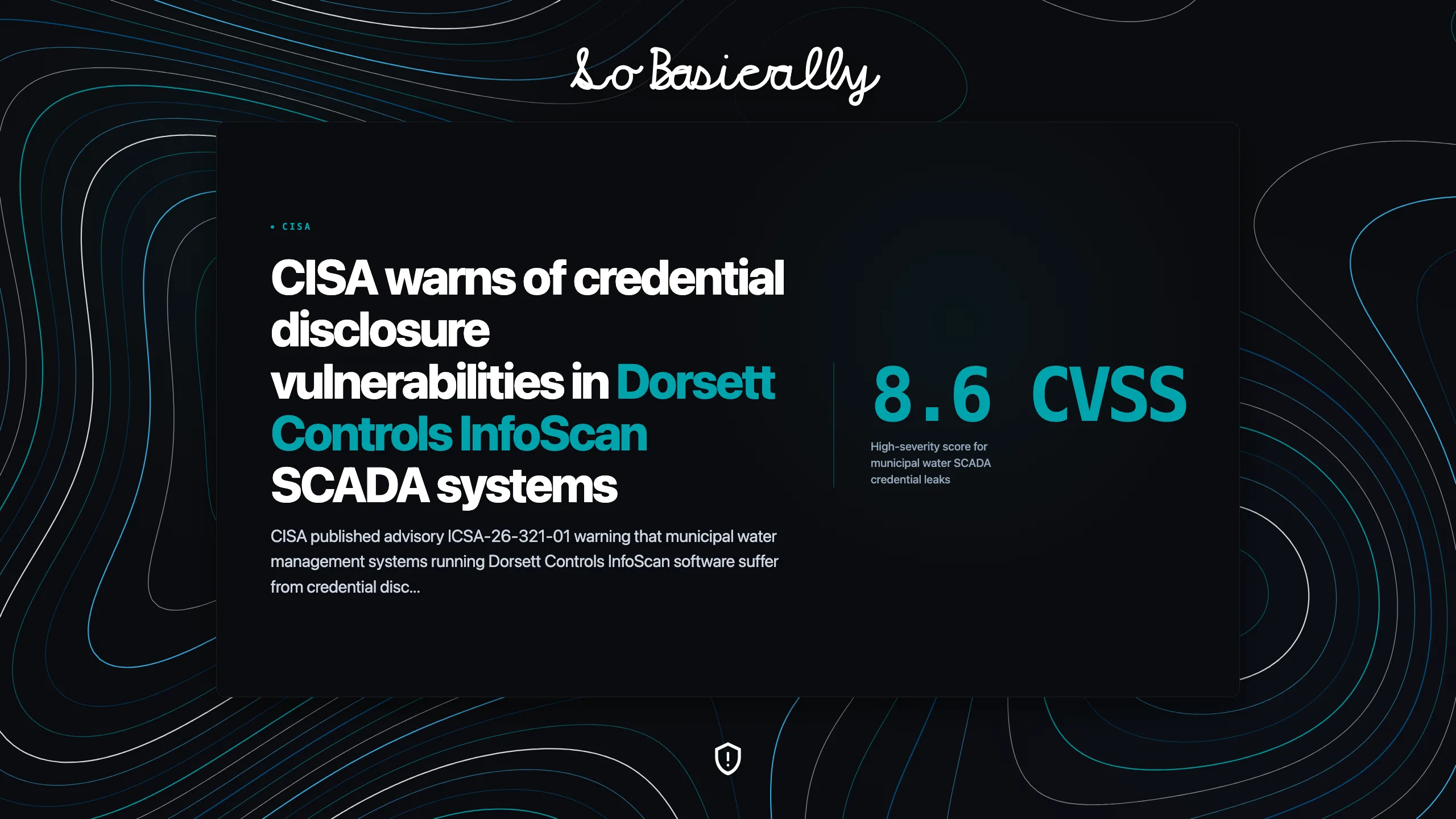
CISA warns of credential disclosure vulnerabilities in Dorsett Controls InfoScan SCADA systems

What happened.CISA published advisory ICSA-26-321-01 warning that municipal water management systems running Dorsett Controls InfoScan software suffer from credential disclosure flaws on web authentication endpoints.

Why it matters.Municipal utilities frequently manage remote pumping stations through internet-accessible supervisory control interfaces. When authentication endpoints leak administrative credentials, attackers gain direct physical control over community water distribution valves. Municipal infrastructure operators must restrict external access and install the 1.46 software update.

  • Verbose debugging output: Tracked as CVE-2026-120298 with an 8.6 CVSS score, application interfaces leak database credentials and password reset tokens in error responses.
  • Unauthenticated extraction: Remote actors query exposed login handlers to harvest operational credentials without prior authentication.
  • Critical utility impact: InfoScan software monitors and manages physical pumps, water tanks, and filtration equipment for municipal utility districts.
  • Remediation release: Dorsett Controls released version 1.46 resolving the debugging leaks, with CISA urging immediate utility perimeter audits.
Official Source:CISA
Decision brief card for CISA warns of credential disclosure vulnerabilities in Dorsett Controls InfoScan SCADA systems
Read Brief
Source:CISA (opens in a new tab)