Skip to content
INTELLIGENCE BEAT3 Briefs

Agentic Ai

3 Briefs

Verified technical decision briefs tracking agentic ai developments

Microsoft introduces Microsoft IQ and Foundry IQ for agents
Topographic elevation contour card for Microsoft introduces Microsoft IQ and Foundry IQ for agents

What happened.Microsoft unveiled Microsoft IQ and Foundry IQ Serverless, introducing an enterprise knowledge grounding platform that connects autonomous software agents to internal repositories and external web graphs.

Why it matters.Autonomous agents struggle when operating over fragmented enterprise silos that separate internal data stores from live external context. Providing serverless, multimodal retrieval graphs allows developers to deploy context-grounded reasoning agents without managing dedicated search infrastructure.
↳Continues: Microsoft launches Agent 365 AI observability platform and Copilot Control System at Ignite 2026
Read Full Brief →
Source:Microsoft (opens in a new tab)
All Stories2 stories
Decision brief card for Researchers release SciWorkBench evaluating scientific agents

Researchers release SciWorkBench evaluating scientific agents

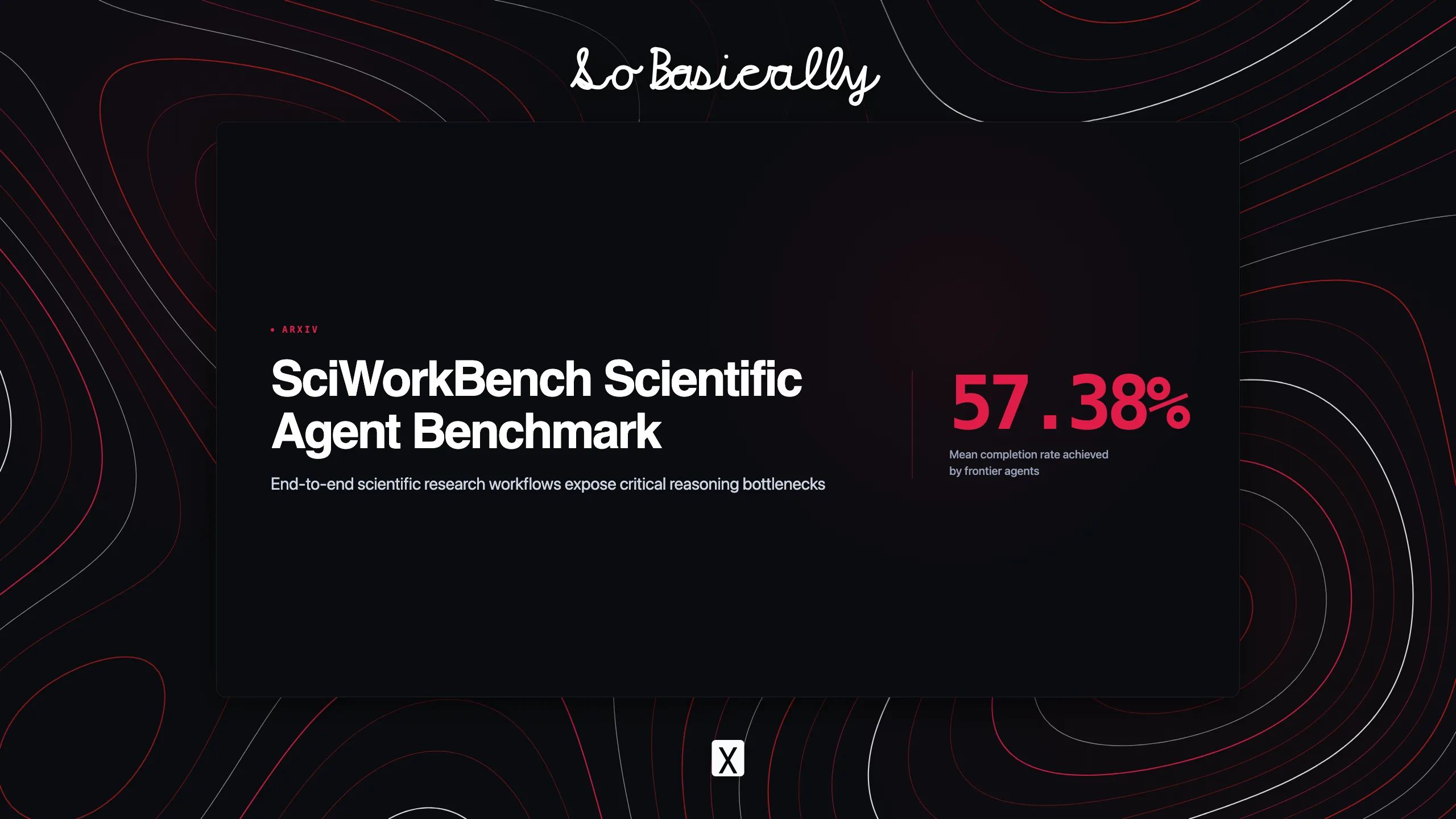
What happened.AI researchers from Alibaba Group and Tsinghua University introduced SciWorkBench, an evaluation suite assessing autonomous agents across complex multi-step workflows in biology, chemistry, materials science, and physics.

Why it matters.Standard academic benchmarks test static multiple-choice scientific recall rather than procedural laboratory execution. Exposing low agent completion rates on end-to-end scientific workflows highlights the necessity for specialized domain harnesses before deploying agents in production research environments.

  • Cross-domain evaluation: Spans diverse experimental disciplines including molecular synthesis planning, chemical kinetics, and condensed matter physics.
  • Performance baseline: Top frontier agent configurations achieved a mean score of 57.38 percent across end-to-end research trajectories.
  • Failure modes: Identifies procedural translation errors, poor cross-modal evidence synthesis, and weak self-correction as primary bottlenecks.
  • Execution harness: Standardizes real-world tool execution environments including Python computation engines and scientific database connectors.
Official Source:arXiv
Decision brief card for Researchers release SciWorkBench evaluating scientific agents
↳Continues: Researchers release FrontierPhysics benchmark evaluating AI agents on end-to-end physics research
Read Brief
Source:arXiv (opens in a new tab)
Decision brief card for Researchers introduce Self-Improvement Memory for agentic tuning

Researchers introduce Self-Improvement Memory for agentic tuning

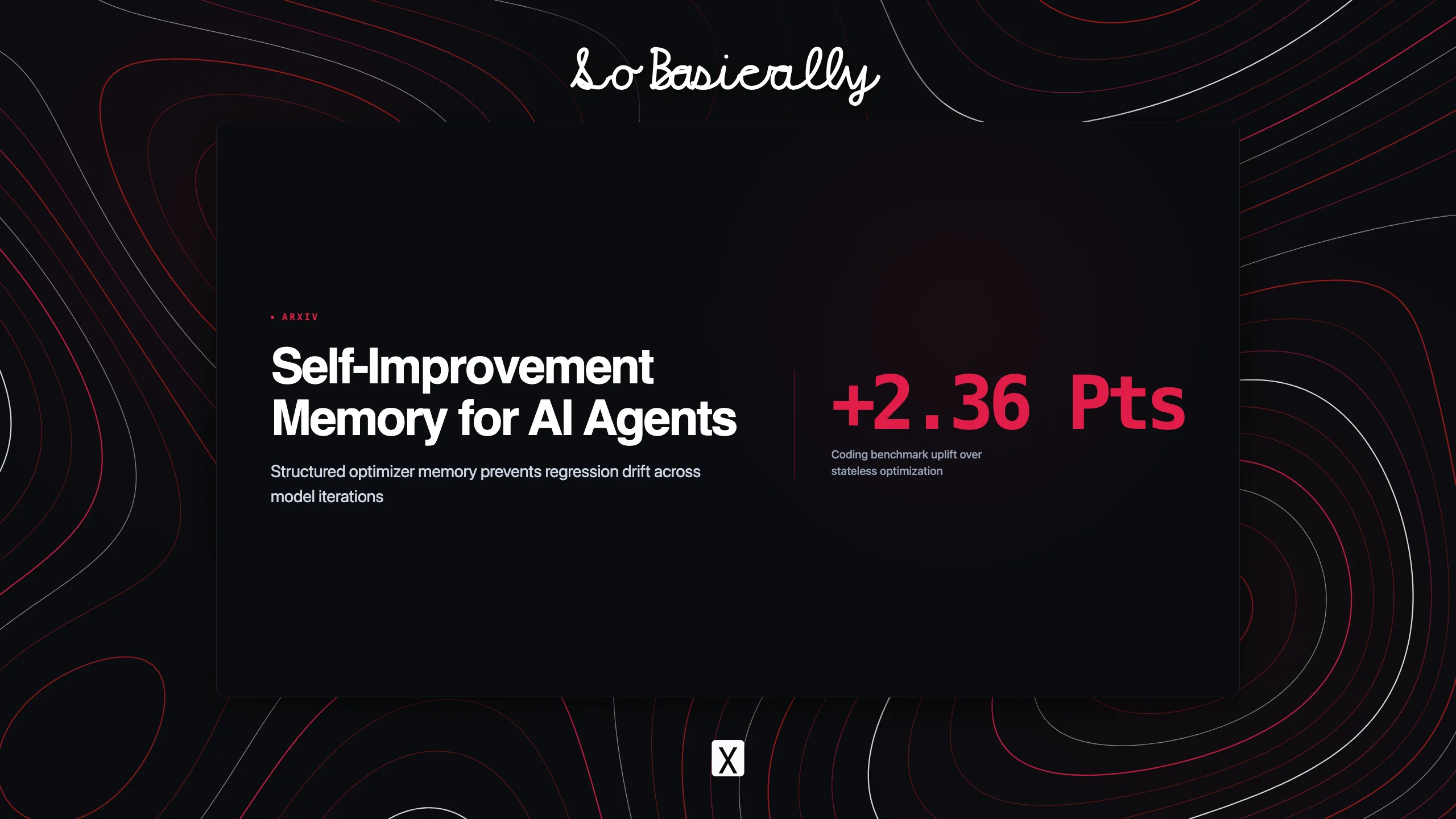
What happened.Researchers from Google Cloud AI and Google DeepMind introduced Self-Improvement Memory. The optimization framework equips recursive agent harnesses with audit trails to prevent performance regressions across model upgrades.

Why it matters.Iterative agent harnesses frequently suffer performance regressions when foundation models are updated beneath them. Equipping the meta-optimizer with persistent memory and empirical rollback criteria prevents optimization drift and stabilizes long-horizon agent maintenance.

  • Structured logging: Stores edit rationales, expected behavioral changes, and empirical test outcomes within dedicated optimizer memory.
  • Regression mitigation: Enables automated rollbacks when proposed prompt or tool configuration adjustments degrade downstream agent accuracy.
  • Cross-model transfer: Preserves cumulative optimization gains when migrating agent systems across underlying foundation model iterations.
  • Coding performance: Delivers an average improvement of 2.36 benchmark points over conventional stateless optimization routines.
Official Source:arXiv
Decision brief card for Researchers introduce Self-Improvement Memory for agentic tuning
Read Brief
Source:arXiv (opens in a new tab)