 arXivAnalysis
Researchers introduce Parallel Language Models via Variational Decoding for single-pass token sampling

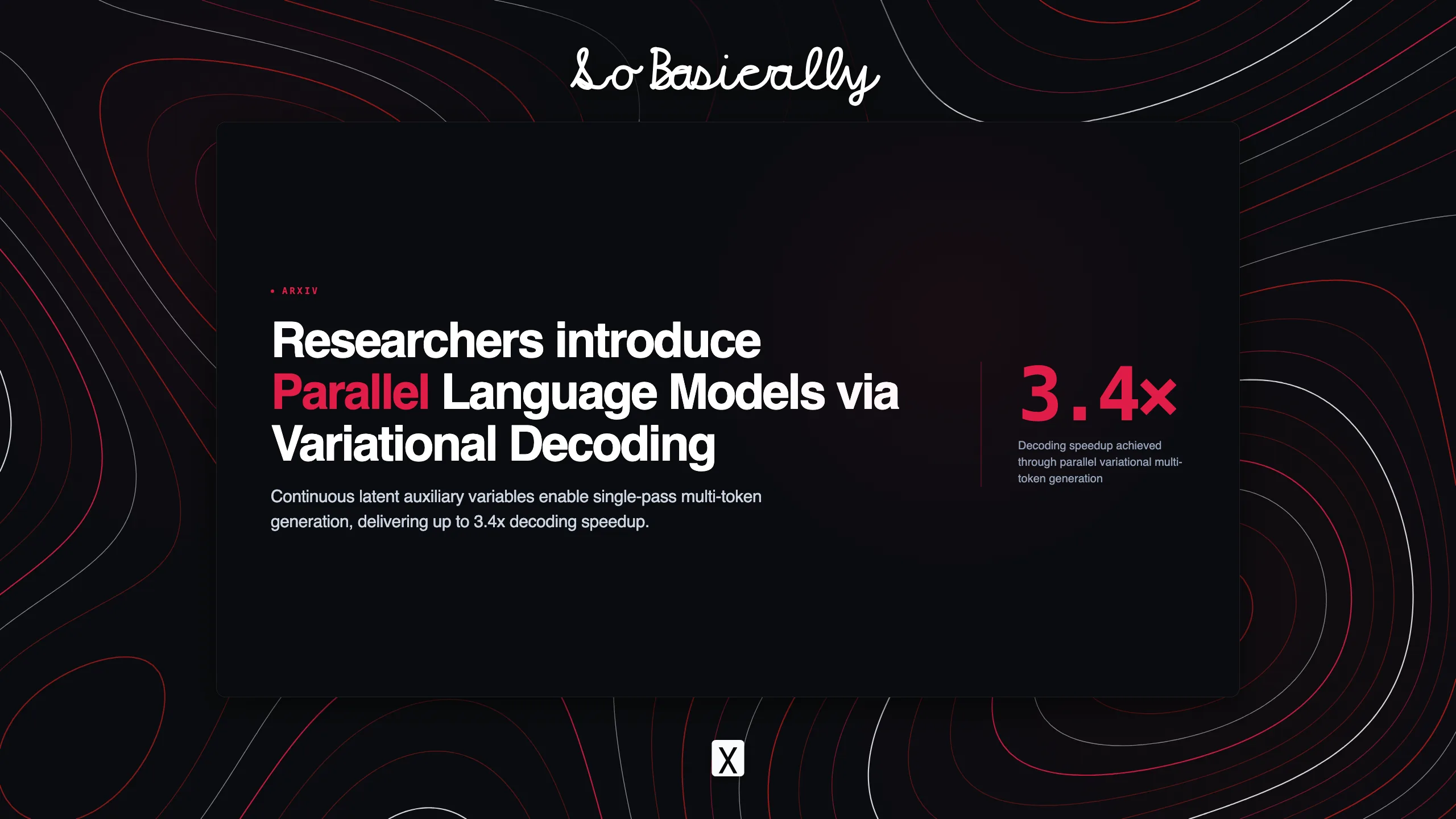
What happened.Researchers published a continuous latent decoding framework that allows language models to generate multi-token blocks simultaneously in a single forward pass.
Why it matters.Autoregressive token generation remains the fundamental computational bottleneck in interactive AI applications and real-time agent loops. Parallel generation approaches that avoid speculative decoding verification overhead drastically lower inference latency. Infrastructure providers can serve complex reasoning traces and long-form responses at significantly higher tokens-per-second throughput.
The technical specifications:
- Decoding mechanics: Detailed in arXiv preprint 2610.26693, Parallel Language Models use variational decoding and continuous latent auxiliary variables to break traditional autoregressive sequential bottlenecks.
- Multi-token sampling: Rather than predicting tokens strictly left-to-right, the architecture samples mutually consistent token groups across sequence windows without speculative drafting verification passes.
- Performance gains: Benchmarks on standard reasoning and code synthesis tasks demonstrate up to a 3.4x decoding speedup with minimal degradation in generative perplexity.
STORYLINE PROGRESSION & CONTEXT
This report represents a verified evolution of prior newsroom intelligence: