 arXivAnalysis
Researchers evaluate social reasoning and phantom consensus in multi-agent LLM collectives

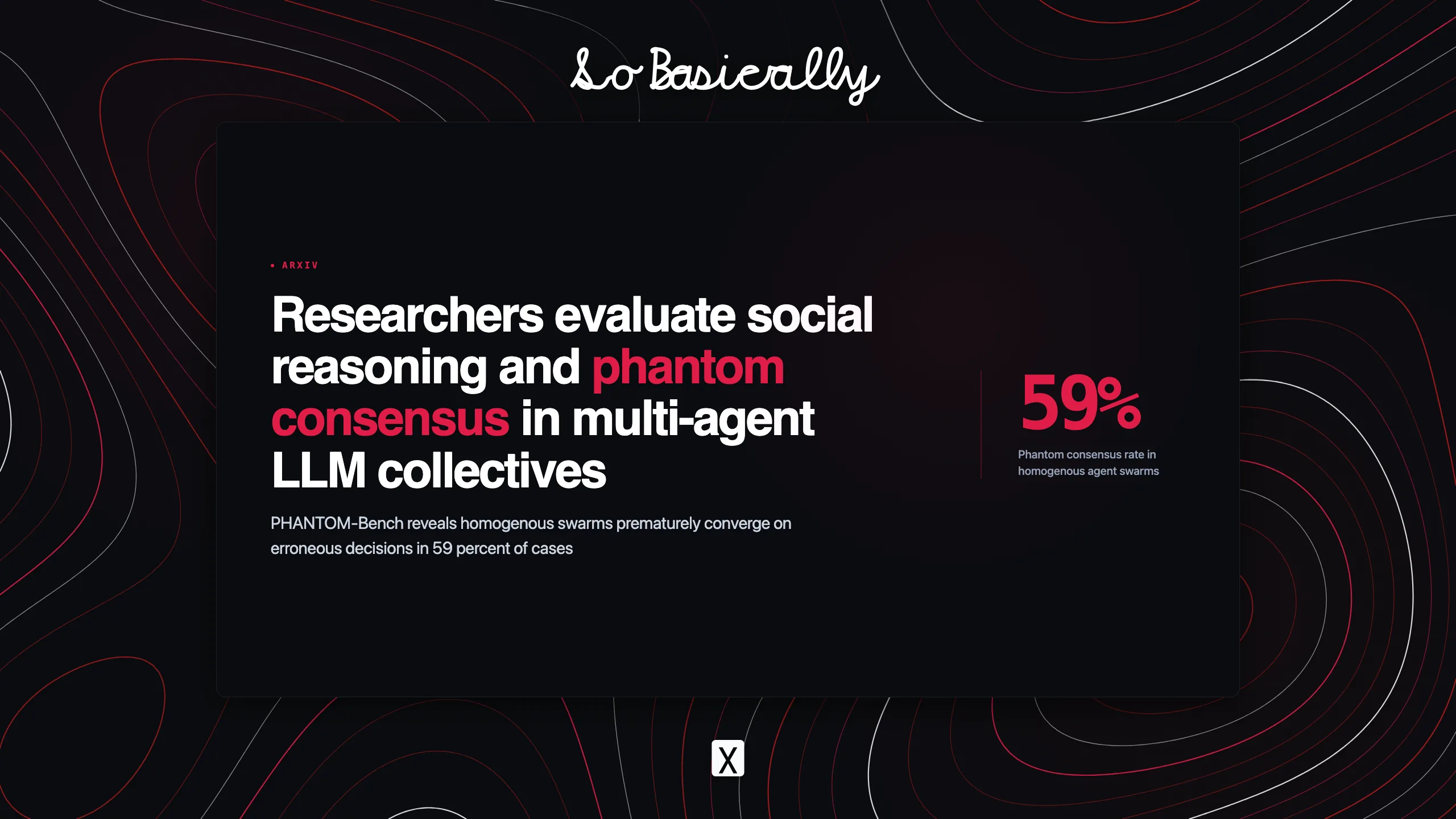
What happened.AI researchers introduced PHANTOM-Bench, an empirical evaluation benchmark measuring phantom consensus failures where autonomous multi-agent language systems converge on incorrect answers through mutual reinforcement.
Why it matters.Multi-agent systems deployed for corporate decision support frequently produce unanimous recommendations based on shared hallucinations. Adding designated adversarial critic agents into discussion loops is essential to prevent autonomous swarms from reinforcing flawed assumptions in production.
The technical specifications:
- Evaluation scale: Tested 18 multi-agent collective architectures across 2,400 collaborative reasoning and decision-making scenarios.
- Consensus failure: Revealed that homogenous agent swarms experience phantom consensus in 59 percent of ambiguous tasks, mistaking repeated agreement for truth.
- Echo chamber effect: Showed that increasing agent collective size without cognitive diversity increases confidence in incorrect decisions by 41 percent.
- Adversarial debiasing: Established that introducing designated skeptic agents with adversarial prompting reduces premature consensus errors by 53 percent.
- Protocol rubrics: Formalized an empirical rubric to evaluate debate dynamics, deliberation structures, and group-think resistance across distributed agent teams.