 GoogleAnalysis
Google debuts TPU 8tx and 8i Max accelerators for agentic workloads

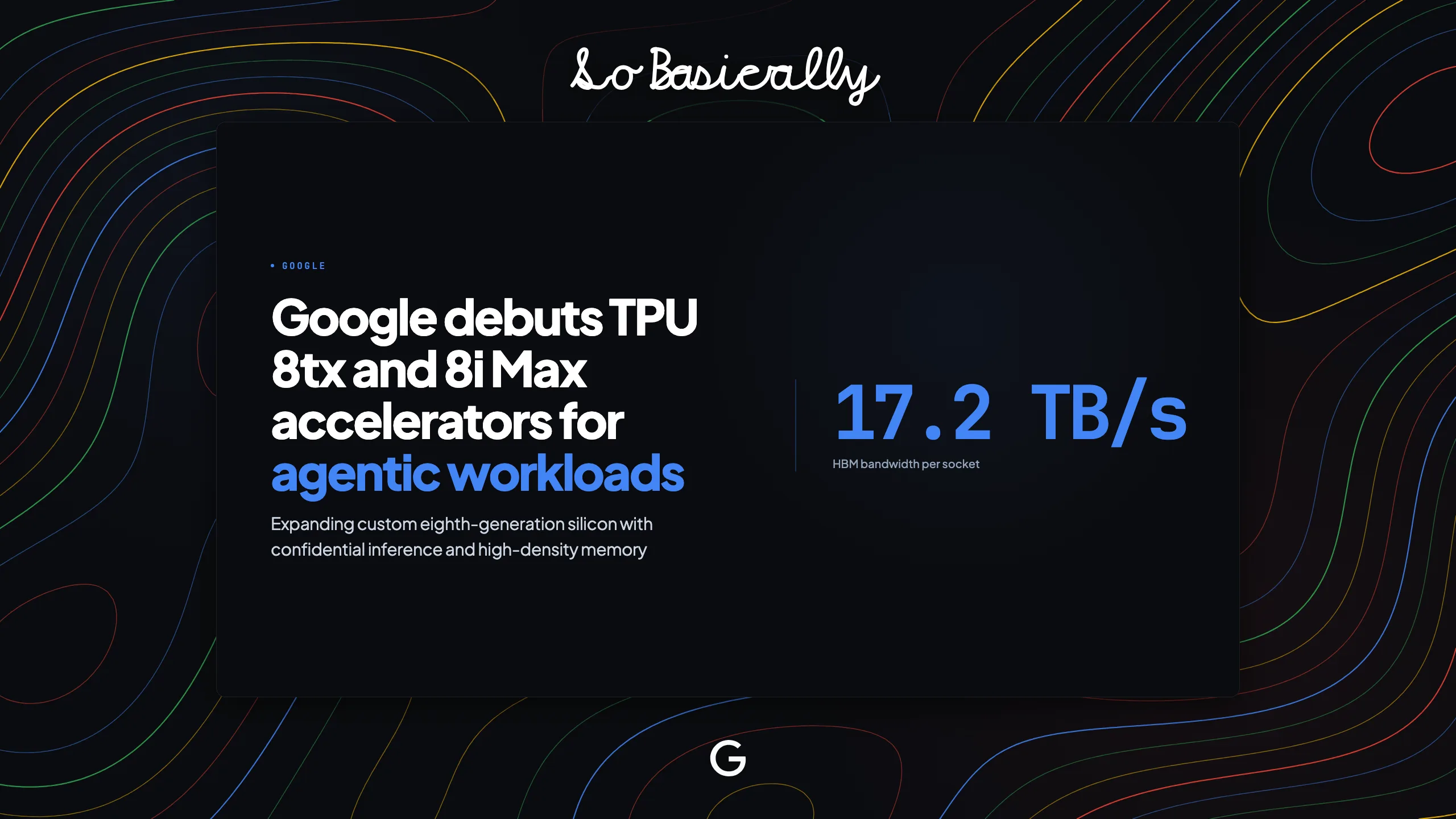
What happened.Google introduced the TPU 8tx and TPU 8i Max accelerators to expand its eighth-generation custom silicon family for long-running autonomous agent workloads.
Why it matters.Multi-step software agents require stateful execution, persistent context, and strict memory isolation across enterprise databases. Packaging higher memory bandwidth directly into server racks allows infrastructure engineers to serve agent swarms without hitting off-chip communication bottlenecks.
The technical specifications:
- Confidential compute: The TPU 8tx uses hardware encryption and secure enclaves paired with AMD EPYC processors to run agent workflows without exposing weights in memory.
- Context capacity: The TPU 8i Max combines two inference dies onto one socket to deliver double compute density, 768 megabytes of SRAM, and 17.2 terabytes per second of memory bandwidth.
- System latency: Benchmark results show the TPU 8tx reduces operational latency by up to two times compared to standard TPU 8t configurations while maintaining near-zero throughput penalties.
- Software ecosystem: Google released PyTorch integrations through TorchTPU alongside the open-source XLA Serving Engine under an Apache 2.0 license to standardize model deployment.