 AmazonAnalysis
AWS bulletin resolves pgactive replication buffer overflow defect

Listen to Briefing
0:00/2:03
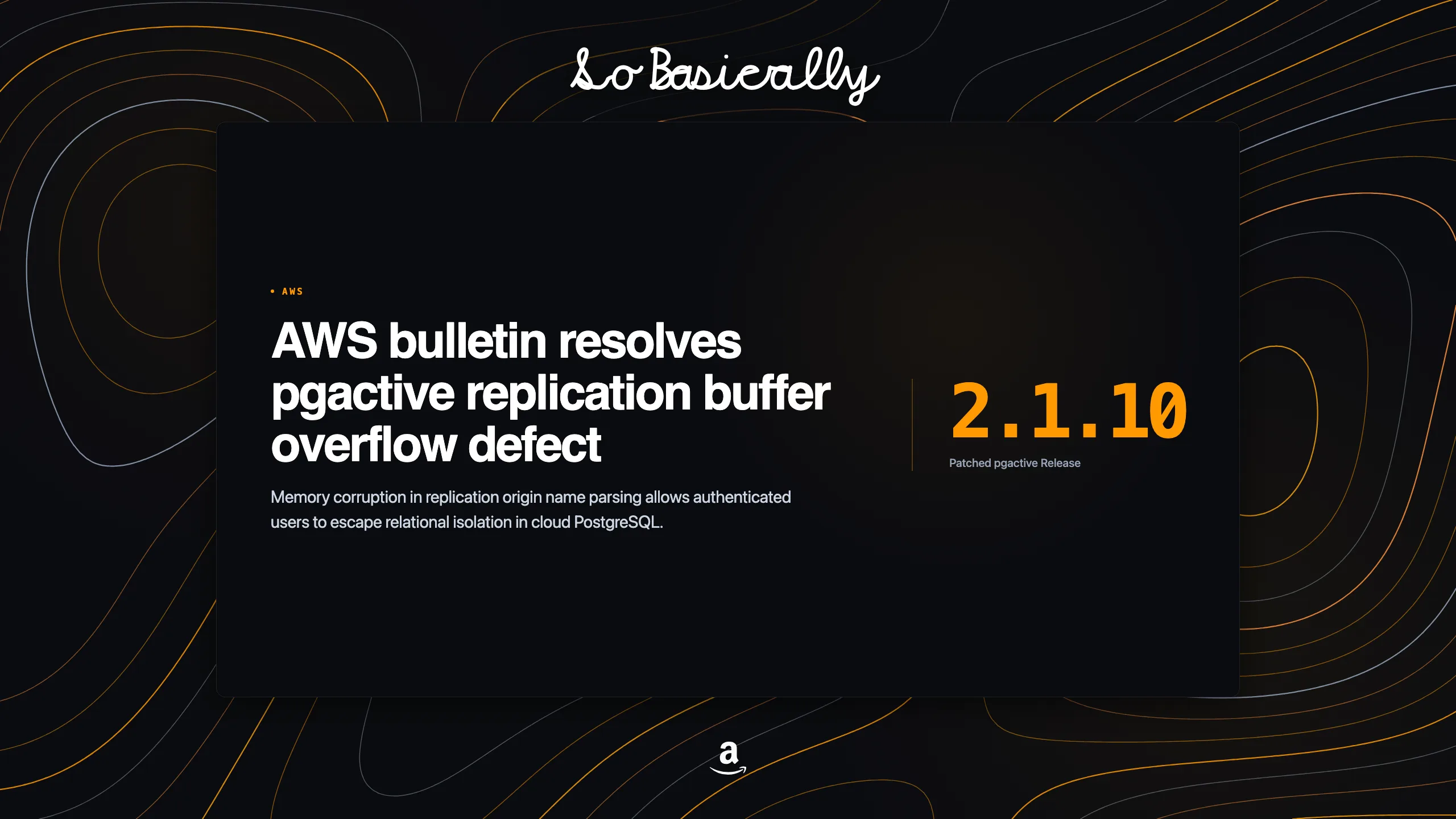
What happened.Amazon Web Services issued security bulletin 2026-198-AWS resolving a stack-based buffer overflow vulnerability in the pgactive multi-master replication extension for PostgreSQL.
Why it matters.Database replication extensions operate with elevated privileges within relational database kernels to synchronize transactions across multiple cloud regions. When replication parsers suffer memory corruption, authenticated database users can escape logical database isolation and compromise underlying host operating systems. Cloud database administrators should verify that managed clusters are running updated extension versions and restrict replication privileges strictly.
The technical specifications:
- Advisory scope: Tracked as CVE-2026-134068, the flaw affects database clusters utilizing pgactive extension versions prior to release 2.1.10.
- Memory overflow: The defect originates in replication origin name parsing routines, where malformed replication packet streams overwrite stack memory boundaries.
- Execution impact: Authenticated database users with replication privileges can exploit the memory corruption to crash PostgreSQL backends or achieve arbitrary code execution.
- Managed deployment: AWS deployed updated extension binaries across managed Amazon RDS and Aurora environments and published client package upgrades.