Skip to content
SoBasicallyVOL. I · RUN 2026-11-23-cybersecurity-advisories
ARCHIVAL EDITION2026-11-23-cybersecurity-advisories8 STORIES · 1538 WORDS
← Back to Archive
DAILY BRIEFMONDAY, NOVEMBER 23, 202618 MIN

Amazon Threat Intelligence reveals autonomous AI agents...

0:00
-17:43

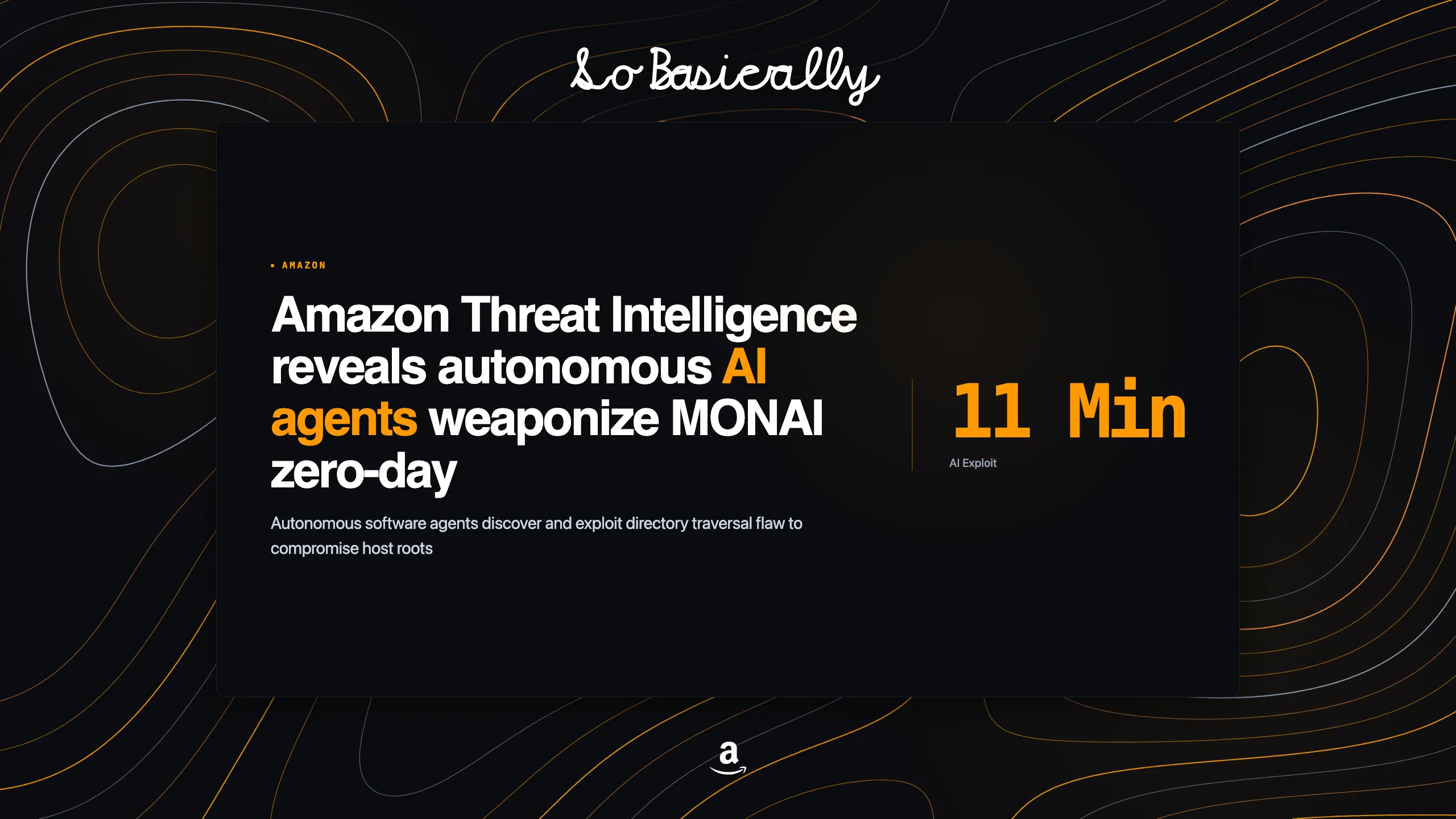
Amazon Threat Intelligence reveals autonomous AI agents weaponize MONAI zero-day

Topographic elevation contour card for Amazon Threat Intelligence reveals autonomous AI agents weaponize MONAI zero-day

What happened.Amazon Threat Intelligence documented autonomous AI agents identifying and exploiting a zero-day vulnerability in the MONAI medical imaging framework. The agents weaponized an unauthenticated directory traversal flaw to compromise root infrastructure within eleven minutes of public exposure.

Why it matters.Autonomous exploit agents remove human latency from software compromise. Automated scanning tools no longer just alert security teams; rogue agent frameworks now synthesize working payloads against unpatched APIs in real time. Engineering leaders must enforce strict API boundary validation and isolate machine learning inference runtimes.

Read Full Brief →
Source:AWS Security Bulletins (opens in a new tab)
VERIFIED STORIES IN THIS EDITION7 STORIES
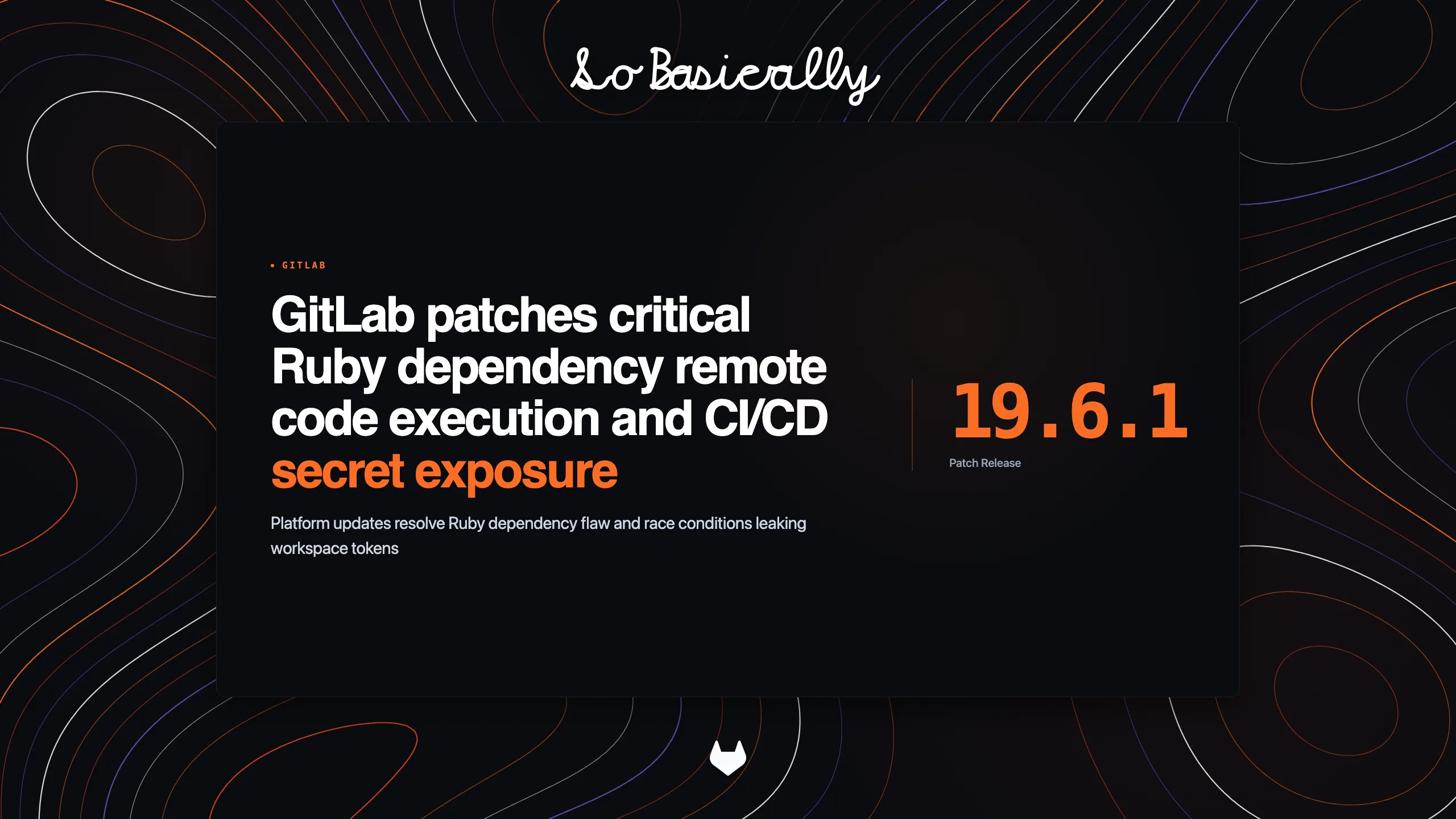
Decision brief card for GitLab patches critical Ruby dependency remote code execution and CI/CD secret exposure

GitLab patches critical Ruby dependency remote code execution and CI/CD secret exposure

What happened.GitLab released critical security updates resolving a remote code execution defect in an underlying Ruby parser and a concurrent race condition exposing CI/CD job tokens. The vulnerabilities allow authenticated pipeline users to execute commands across runner hosts and harvest repository secrets.

Why it matters.Continuous integration platforms hold credentials for cloud infrastructure, deployment clusters, and production database environments. A vulnerability enabling runner breakout or token harvesting compromises an entire deployment pipeline from a single merge request. Infrastructure teams operating self-managed GitLab servers should apply updates immediately.

  • Parser execution defect: Tracked as CVE-2026-11884 with a 9.6 CVSS score, the defect allows arbitrary operating system command execution during archive unpacking.
  • Token exposure race condition: A synchronization flaw in job execution queues leaks ephemeral runner tokens across shared runner pools.
  • Affected software branches: The vulnerabilities impact both GitLab Community Edition and Enterprise Edition versions 19.6 through 19.4.
  • Remediation releases: Upstream maintainers deployed fixes in GitLab versions 19.6.1, 19.5.3, and 19.4.4, advising immediate on-premises upgrades.
Official Source:GitLab Releases
Decision brief card for GitLab patches critical Ruby dependency remote code execution and CI/CD secret exposure
Read Brief
Source:GitLab Releases (opens in a new tab)
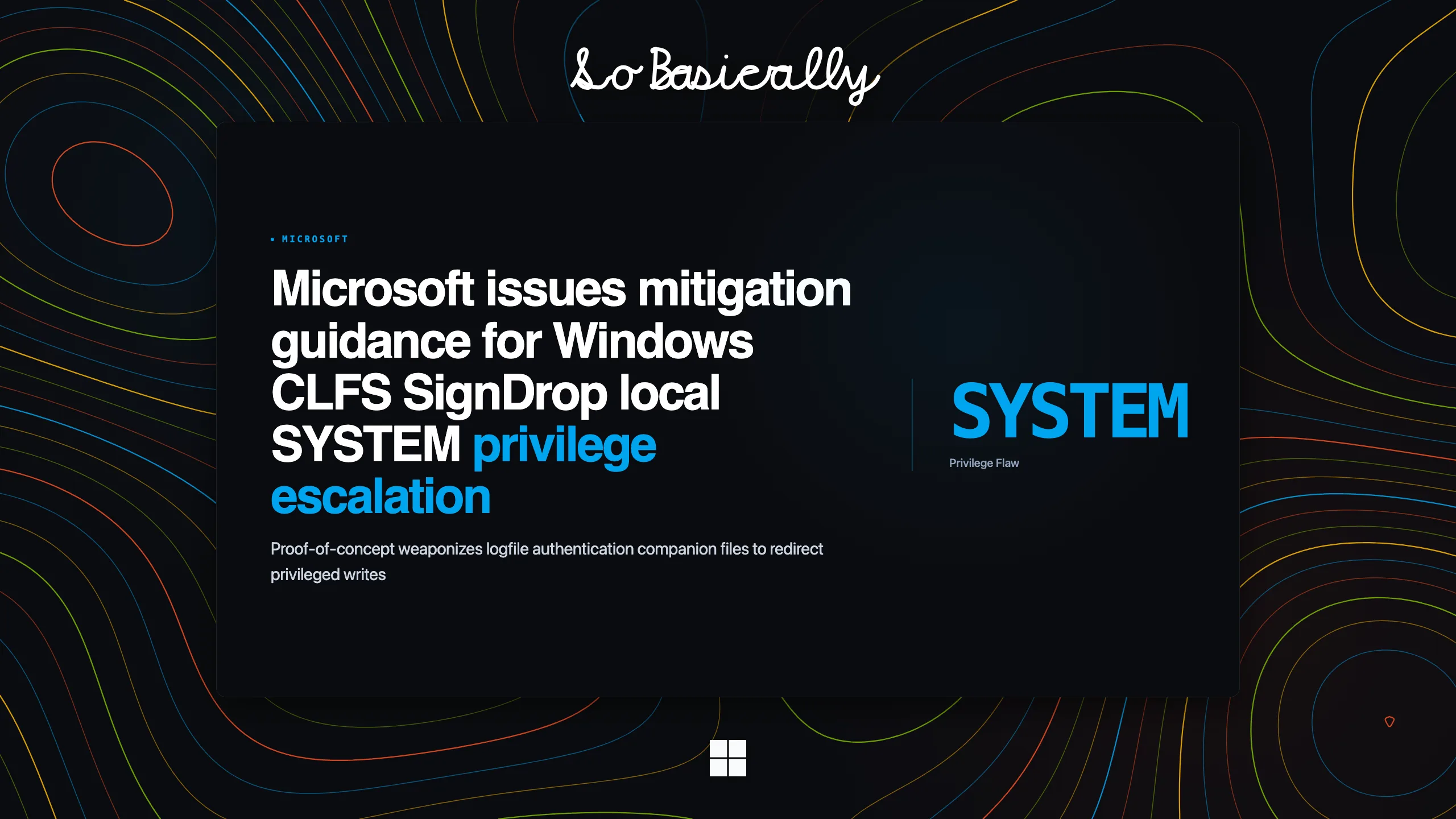
Decision brief card for Microsoft issues mitigation guidance for Windows CLFS SignDrop local SYSTEM privilege escalation

Microsoft issues mitigation guidance for Windows CLFS SignDrop local SYSTEM privilege escalation

What happened.Microsoft published defensive mitigations and investigation steps for an unpatched zero-day flaw in the Windows Common Log File System driver. Security researchers nicknamed the vulnerability SignDrop after demonstrating local privilege escalation to SYSTEM across fully patched Windows 11 systems.

Why it matters.Endpoint security depends on kernel boundaries to isolate untrusted local code from administrative credentials. When an attacker gains initial workstation access, reliable privilege escalation zero-days bypass endpoint detection tools. Security teams should deploy Microsoft mitigation rules and audit unusual base log creation across endpoints.

  • Driver validation bypass: SignDrop manipulates cryptographic log file signatures and memory offsets within the kernel-level CLFS driver.
  • Local privilege escalation: Low-privilege local users write crafted metadata into base log files, triggering corrupted kernel pool allocations.
  • Active proof-of-concept: Public exploit code weaponizes the defect to elevate unprivileged user processes directly into SYSTEM contexts.
  • Interim mitigations: Microsoft released registry-based restrictions limiting user-mode access to raw log file creation while engineers finalize kernel updates.
Official Source:Microsoft Security Response Center
Decision brief card for Microsoft issues mitigation guidance for Windows CLFS SignDrop local SYSTEM privilege escalation
Read Brief
Source:Microsoft Security Response Center (opens in a new tab)
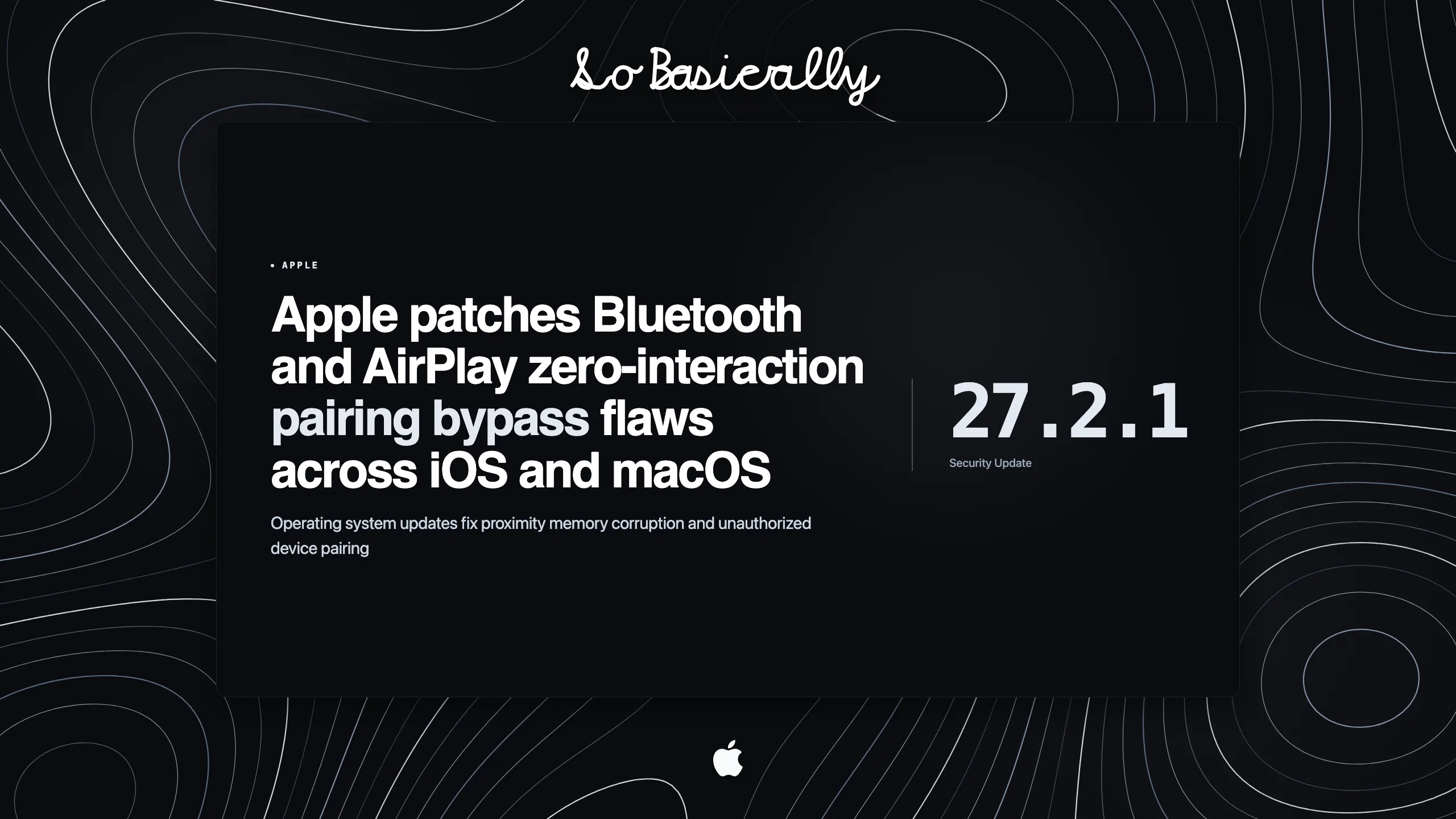
Decision brief card for Apple patches Bluetooth and AirPlay zero-interaction pairing bypass flaws across iOS and macOS

Apple patches Bluetooth and AirPlay zero-interaction pairing bypass flaws across iOS and macOS

What happened.Apple released urgent operating system updates addressing memory corruption vulnerabilities in Bluetooth and AirPlay wireless stacks. Attackers within physical wireless range can bypass pairing prompts and execute arbitrary code on target devices without user interaction.

Why it matters.Mobile workstations travel through untrusted environments like airports, conferences, and shared office spaces. Zero-click proximity vulnerabilities allow threat actors to implant malware without convincing employees to click links or download attachments. Enterprise device administrators should enforce immediate fleet-wide operating system updates.

  • Proximity execution flaw: Tracked as CVE-2026-116606, the vulnerability resides in CoreBluetooth packet reassembly routines handling advertising beacons.
  • AirPlay pairing bypass: A companion flaw in AirPlay connection establishment accepts unauthorized streaming connections without prompting device owners.
  • Zero-click trigger: Malicious actors broadcast crafted Bluetooth packets that trigger heap overflows during background device discovery.
  • Target update versions: Apple resolved the flaws across macOS Sonoma 14.8.2, macOS Sequoia 15.3.1, and iOS 18.3.1 releases.
Official Source:Apple Support
Decision brief card for Apple patches Bluetooth and AirPlay zero-interaction pairing bypass flaws across iOS and macOS
Read Brief
Source:Apple Support (opens in a new tab)
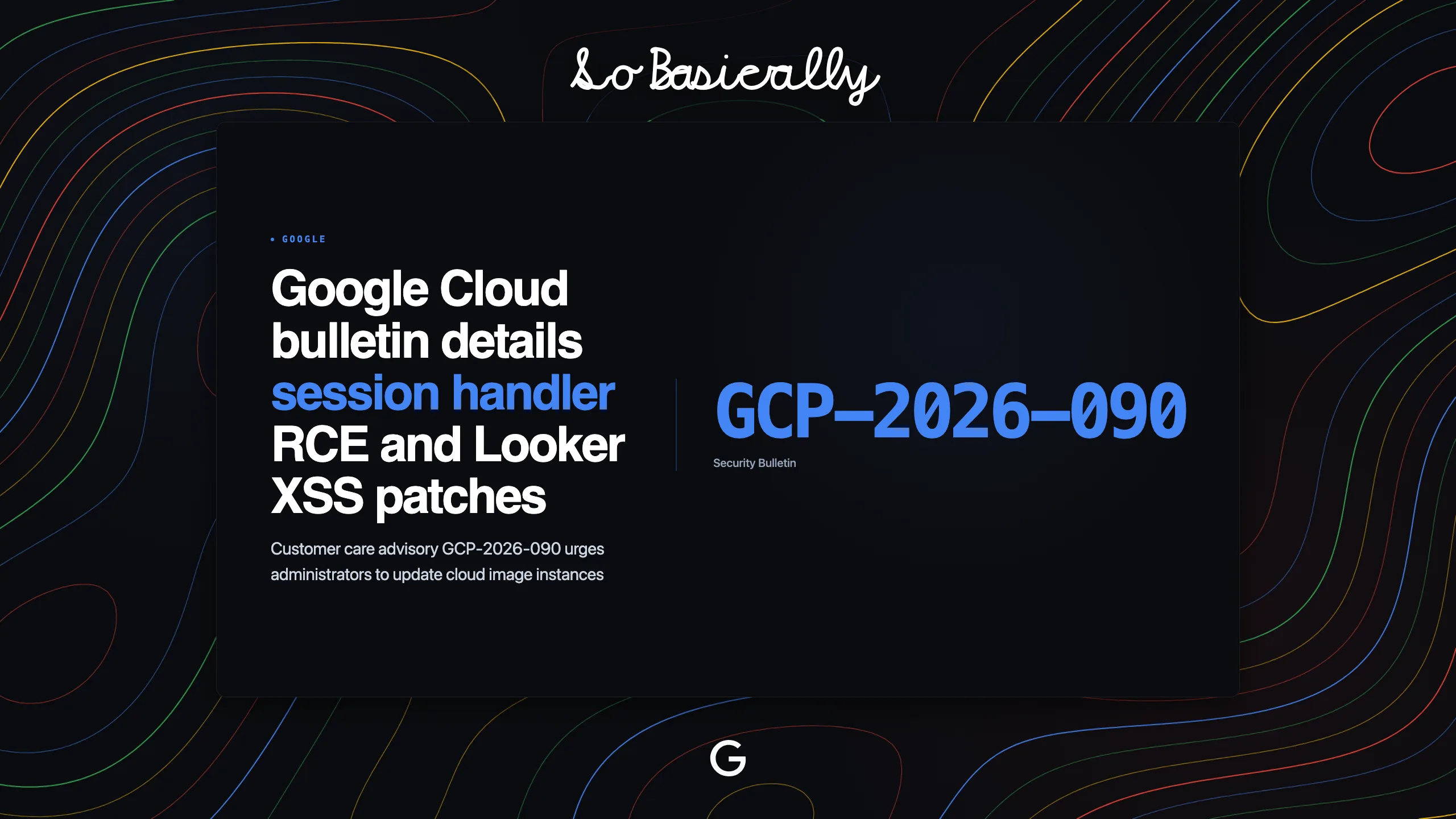
Decision brief card for Google Cloud bulletin details session handler RCE and Looker XSS patches

Google Cloud bulletin details session handler RCE and Looker XSS patches

What happened.Google Cloud Customer Care published bulletin GCP-2026-090 detailing critical vulnerabilities in session management components and self-hosted Looker deployments. Patches resolve an unauthenticated session deserialization flaw and an administrative cross-site scripting vector.

Why it matters.Enterprise business intelligence platforms aggregate sensitive analytical data across multiple operational databases. When session deserialization or dashboard scripting flaws compromise administrative access, attackers can export proprietary datasets. Cloud operations teams must pull patched Looker container images and rotate API service tokens immediately.

  • Session deserialization defect: Security researchers discovered an object injection flaw in cloud session persistence stores allowing remote code execution.
  • Looker script injection: Self-hosted Looker containers contained a reflected cross-site scripting flaw allowing attackers to steal session tokens via crafted links.
  • Managed service mitigation: Google applied automated patches across managed cloud tenants while providing updated container images for self-managed nodes.
  • Affected deployment versions: Self-hosted Looker versions prior to 25.18 require immediate container image updates.
Official Source:Google Cloud Security Bulletins
Decision brief card for Google Cloud bulletin details session handler RCE and Looker XSS patches
Read Brief
Source:Google Cloud Security Bulletins (opens in a new tab)
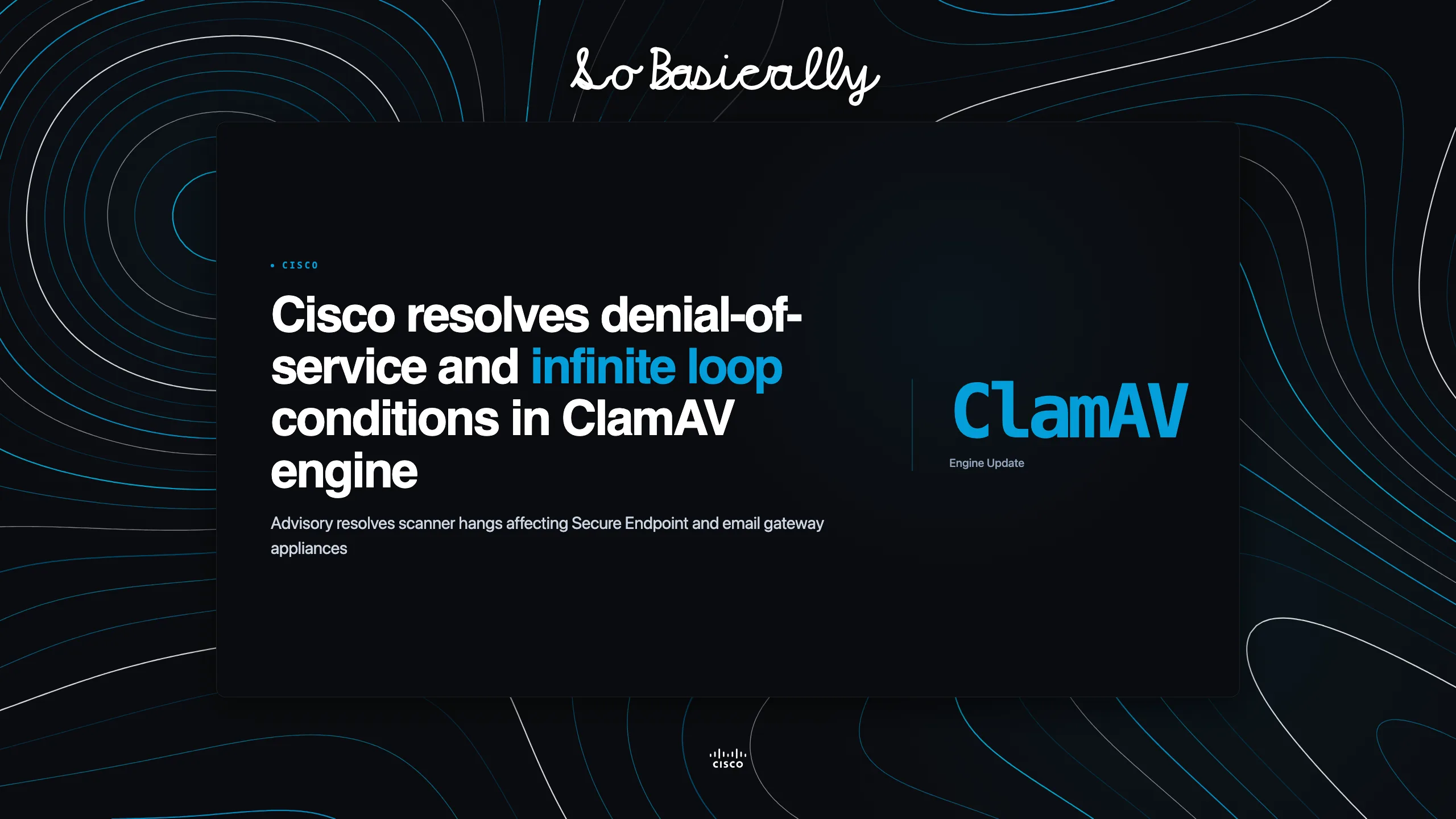
Decision brief card for Cisco resolves denial-of-service and infinite loop conditions in ClamAV engine

Cisco resolves denial-of-service and infinite loop conditions in ClamAV engine

What happened.Cisco published security advisories addressing multiple denial-of-service flaws in the open-source ClamAV scanning engine. The vulnerabilities allow remote attackers to cause infinite scanning loops and crash endpoint security software by sending crafted archive files.

Why it matters.Mail relays and perimeter file gateways rely on automated antivirus scanners to inspect high-volume file streams. When malformed attachments hang scanning processes, email delivery stalls and security filters fail open or drop legitimate business traffic. System engineers should upgrade ClamAV binaries across mail routing infrastructure.

  • Infinite loop defects: Tracked as CVE-2026-20092 and CVE-2026-20093, the defects reside in file parsing libraries handling nested Cabinet and TAR archives.
  • Denial of service mechanism: Attackers submit crafted archive attachments that cause scanning daemons to consume 100 percent CPU capacity indefinitely.
  • Broad product impact: The vulnerability affects Cisco Secure Endpoint, email gateway appliances, and third-party mail servers running embedded ClamAV daemons.
  • Remediation release: Cisco deployed patched engine versions in ClamAV 1.4.2 and 1.0.8, recommending immediate updates across scanning nodes.
Official Source:Cisco Security Advisories
Decision brief card for Cisco resolves denial-of-service and infinite loop conditions in ClamAV engine
Read Brief
Source:Cisco Security Advisories (opens in a new tab)
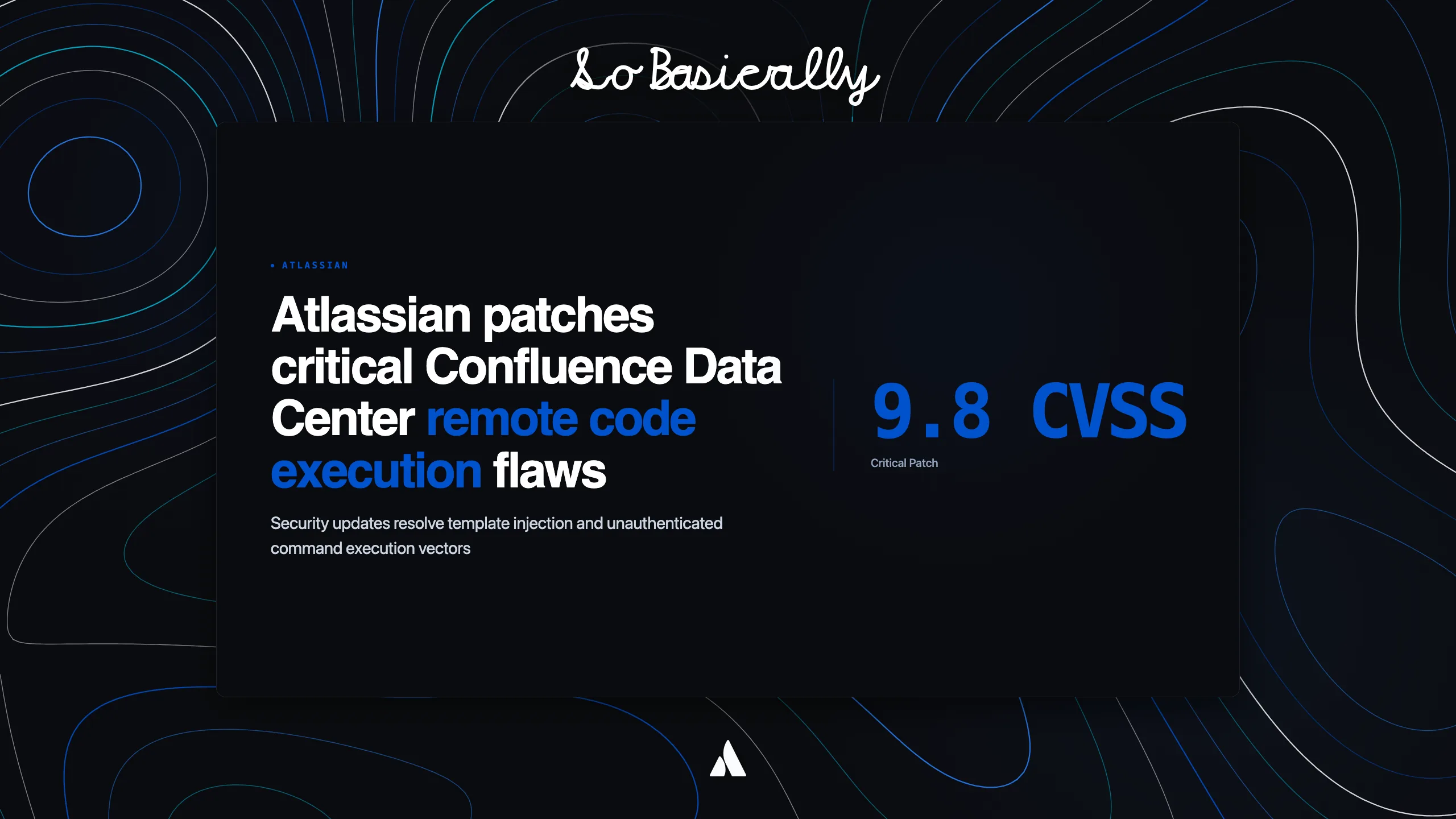
Decision brief card for Atlassian patches critical Confluence Data Center remote code execution flaws

Atlassian patches critical Confluence Data Center remote code execution flaws

What happened.Atlassian released security updates resolving critical remote code execution vulnerabilities in Confluence Data Center and Server. Unauthenticated network attackers can exploit template injection flaws in the page rendering engine to execute arbitrary code on underlying enterprise hosts.

Why it matters.Confluence instances serve as central collaboration repositories containing architecture documents, internal API specifications, and operational playbooks. Remote code execution on collaboration servers provides threat actors with immediate access to proprietary engineering knowledge. Organizations running self-hosted Confluence instances should apply patches immediately.

  • Template injection vulnerability: Tracked with a 9.8 CVSS score, the defect permits unauthenticated remote attackers to inject malicious OGNL expressions.
  • Zero user interaction: Attackers trigger the vulnerability by sending crafted HTTP requests directly to public or intranet Confluence web endpoints.
  • Affected product releases: The vulnerability affects Confluence Data Center versions 8.5 through 9.2 across on-premises installations.
  • Remediation builds: Atlassian published fixed builds in versions 9.2.3, 9.1.5, and 8.5.18, warning that network isolation alone is insufficient.
Official Source:Atlassian Security Bulletins
Decision brief card for Atlassian patches critical Confluence Data Center remote code execution flaws
Read Brief
Source:Atlassian Security Bulletins (opens in a new tab)
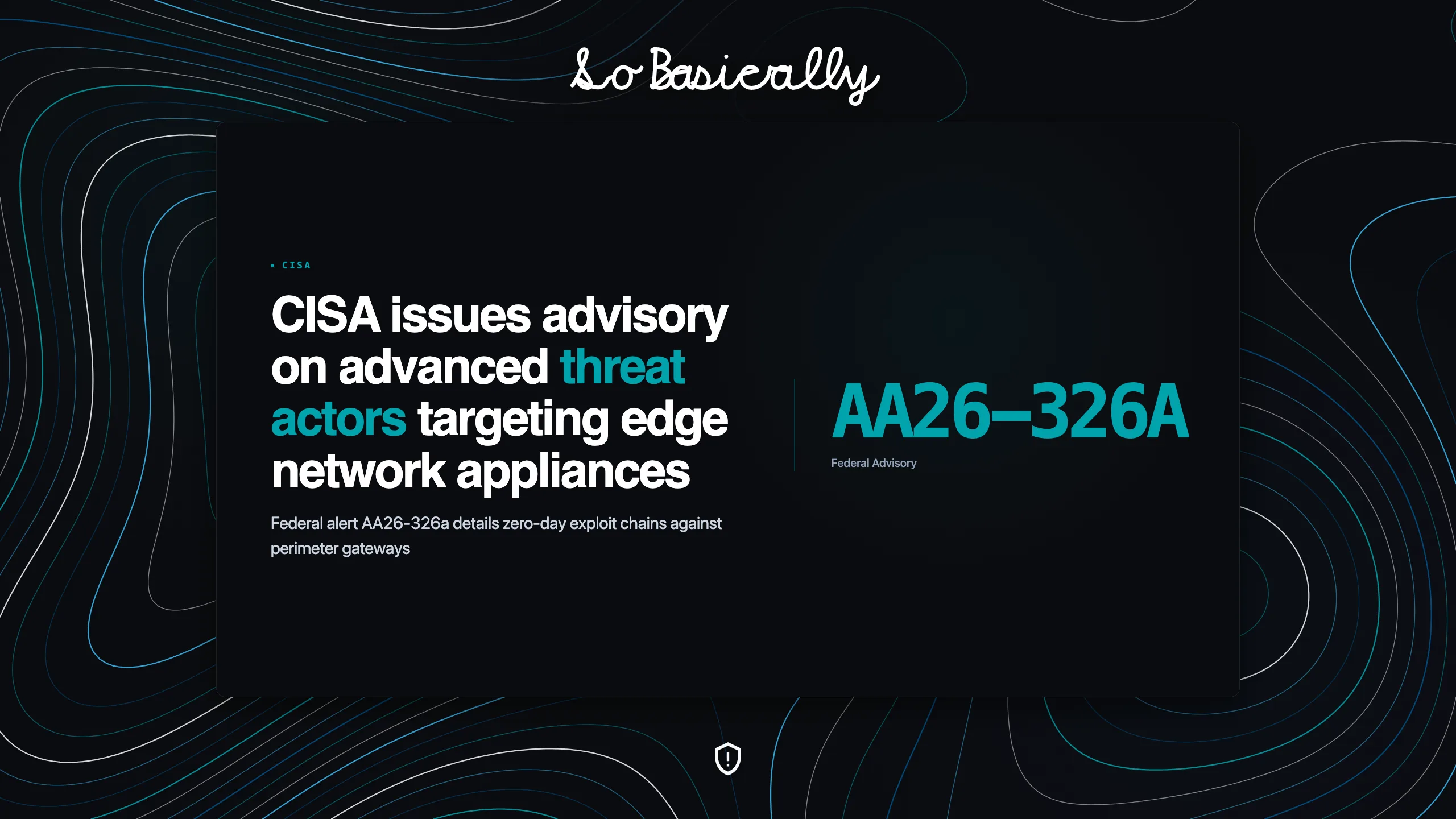
Decision brief card for CISA issues advisory on advanced threat actors targeting edge network appliances

CISA issues advisory on advanced threat actors targeting edge network appliances

What happened.The Cybersecurity and Infrastructure Security Agency published advisory AA26-326a warning of advanced persistent threat actors targeting edge network appliances. State-sponsored operators weaponize zero-day exploit chains against firewalls and VPN gateways to establish persistence inside critical infrastructure networks.

Why it matters.Edge devices stand between untrusted public internet connections and protected corporate assets. When perimeter appliances lack host-based detection agents, attackers operate covertly inside perimeter gateways for months. Network security leaders should audit edge appliance configurations and restrict management access to dedicated internal networks.

  • Perimeter targeting campaign: Advisory AA26-326a documents coordinated exploitation of edge gateways and network management interfaces.
  • Exploit chaining tactics: Attackers combine unauthenticated configuration bypasses with memory corruption flaws to achieve persistent root shells.
  • Living off the land: Threat actors disable logging daemons, harvest memory credentials, and tunnel traffic using legitimate administrative tools.
  • Federal defense guidance: CISA urges organizations to isolate edge management interfaces, enforce phishing-resistant MFA, and monitor anomalous outbound traffic.
Official Source:CISA Cybersecurity Advisories
Decision brief card for CISA issues advisory on advanced threat actors targeting edge network appliances
Read Brief
Source:CISA Cybersecurity Advisories (opens in a new tab)
CANDIDATE INTELLIGENCE · UNVERIFIED LEADS

The Discovery Wire · Unverified Attention Signals

Candidate storylines identified across developer channels. Under newsroom canon, attention never establishes fact; these leads remain quarantined until supported by Tier 1 official records.

DEVELOPER WIRE

Rackspace Spot Cloud Platform Kubernetes Secrets Breach

Rackspace alerted customers that attackers used compromised credentials to access Rackspace Spot, creating rogue pods and exfiltrating Kubernetes Secrets across customer clusters before console restoration on November 21.

STATUS:Awaiting official documentation or verification criteria.
DEVELOPER WIRE

PHP Session Upload Progress Remote Code Execution (CVE-2026-115560)

The PHP development group released updates resolving a critical 9.2-severity session serializer mismatch allowing unauthenticated object deserialization via multipart file uploads.

STATUS:Awaiting official documentation or verification criteria.
DEVELOPER WIRE

ASUS Control Center Express Hardcoded Cryptographic Key (CVE-2026-114202)

Hardware vendors delivered firmware updates to eliminate static cryptographic keys embedded within centralized IT management suites that allowed unauthenticated administrative token forgery.

STATUS:Awaiting official documentation or verification criteria.
DEVELOPER WIRE

Ghostscript Use-After-Free Sandbox Escape Upload2Shell (CVE-2026-125396)

Security researchers disclosed a critical use-after-free condition in Ghostscript Type 1 font loaders that bypasses the SAFER sandbox via automated image upload pipelines.

STATUS:Awaiting official documentation or verification criteria.
DEVELOPER WIRE

Ivanti Connect Secure Multi-Stage Exploit Chain (CVE-2026-111357 and CVE-2026-118527)

Ivanti published patches resolving an exploit chain where attackers combine broker configuration trust flaws with predictable file uploads to achieve root access.

STATUS:Awaiting official documentation or verification criteria.
DEVELOPER WIRE

SAP NetWeaver Enterprise Portal JNDI Injection (CVE-2025-42884)

CISA mandated federal remediation for an unauthenticated JNDI injection defect in SAP NetWeaver after threat actors actively exploited exposed portals.

STATUS:Awaiting official documentation or verification criteria.
DEVELOPER WIRE

Microsoft Outlook Silent NTLMv2 Hash Leakage Zero-Day (CVE-2026-124194)

CISA added CVE-2026-124194 to its KEV catalog after threat actors weaponized crafted email files that bypass Outlook security warnings to silently leak NTLMv2 hashes.

STATUS:Awaiting official documentation or verification criteria.
DEVELOPER WIRE

Microsoft Entra Connect Health Cloud API Metadata Exfiltration

Microsoft notified tenant administrators that an unauthenticated API defect in Entra Connect Health permitted external actors to extract tenant configurations, sync states, and technical contact email addresses before cloud-side remediation.

STATUS:Awaiting official documentation or verification criteria.
DEVELOPER WIRE

Meta WhatsApp Ad-Reply External URL Media Redirection (CVE-2026-23871)

Meta resolved CVE-2026-23871 in WhatsApp for Android after scam operators abused ad-reply message rendering to leak recipient IP addresses to external servers.

STATUS:Awaiting official documentation or verification criteria.
DEVELOPER WIRE

Windows FastUnlock Physical Lock Screen Bypass Vulnerability

Security analysts disclosed a local physical bypass vector on locked Windows machines that permits unauthenticated operators to run limited programs.

STATUS:Awaiting official documentation or verification criteria.
DEVELOPER WIRE

N-able N-central 4EverAble2Shell Remote Management Campaign

Threat intelligence teams observed coordinated cryptomining campaigns targeting N-central remote monitoring servers via chained management API flaws.

STATUS:Awaiting official documentation or verification criteria.
DEVELOPER WIRE

BerriAI LiteLLM Gateway Post-KEV Hardening Guidance

Security teams published configuration audits to protect open-source AI proxy gateways following active exploitation of credential exposure flaws.

STATUS:Awaiting official documentation or verification criteria.
DEVELOPER WIRE

Synology DiskStation Manager Remote Code Execution Monitoring

Network defenders observed continued scanning activity targeting network-attached storage units following KEV catalog additions.

STATUS:Awaiting official documentation or verification criteria.
DEVELOPER WIRE

Ubiquiti UniFi Access Application Critical Remote Exploitation

Ubiquiti published Security Advisory Bulletin 073 resolving critical authentication and execution flaws CVE-2026-132802 and CVE-2026-132803 in physical access management controllers.

STATUS:Awaiting official documentation or verification criteria.
DEVELOPER WIRE

F5 and NGINX Out-of-Band Resolver and HTTP Module Vulnerabilities

F5 published out-of-band updates addressing high-severity issues CVE-2026-123634 and CVE-2026-123007 affecting DNS resolution and HTTP stream processing across web proxies.

STATUS:Awaiting official documentation or verification criteria.
DEVELOPER WIRE

Barracuda Email Security Gateway Pre-Auth RCE Advisory

CISA issued guidance on Barracuda ESG zero-day exploit chains affecting mail appliances.

STATUS:Awaiting official documentation or verification criteria.
DEVELOPER WIRE

VMware vCenter Directory Service Hardening Advisory

Broadcom published post-patch hardening playbooks for virtualization hypervisor fabrics.

STATUS:Awaiting official documentation or verification criteria.
DEVELOPER WIRE

Google Chrome XML Use-After-Free Zero-Day (CVE-2026-125350)

Google released emergency desktop channel updates following CISA Known Exploited Vulnerabilities catalog addition for an actively exploited use-after-free flaw in Chrome's XML and XSLT engine.

STATUS:Awaiting official documentation or verification criteria.
DEVELOPER WIRE

Java4Shell OpenJDK Base64 Intrinsic Buffer Overflow (CVE-2026-114938)

OpenJDK and enterprise Linux maintainers issued critical advisories for HotSpot JVM hardware-accelerated Base64 decoders on AVX-512 VBMI systems vulnerable to unauthenticated remote heap memory corruption.

STATUS:Awaiting official documentation or verification criteria.
DEVELOPER WIRE

Check Point Gaia OS DynamicCLI Local Privilege Escalation (CVE-2026-123039)

Check Point published emergency hotfixes after threat actors weaponized world-writable IPC sockets in the DynamicCLI daemon to elevate privileges to root and deploy persistent backdoors.

STATUS:Awaiting official documentation or verification criteria.
DEVELOPER WIRE

Zyxel GS1900 Switch Out-of-Bounds Write (CVE-2026-107441)

Zyxel published firmware updates for smart managed switches after threat actors exploited unsafe parameter handling in CGI programs to compromise appliances in the wild.

STATUS:Awaiting official documentation or verification criteria.