Skip to content
SoBasicallyVOL. I · RUN 2026-11-22-cybersecurity-advisories
ARCHIVAL EDITION2026-11-22-cybersecurity-advisories8 STORIES · 1652 WORDS
← Back to Archive

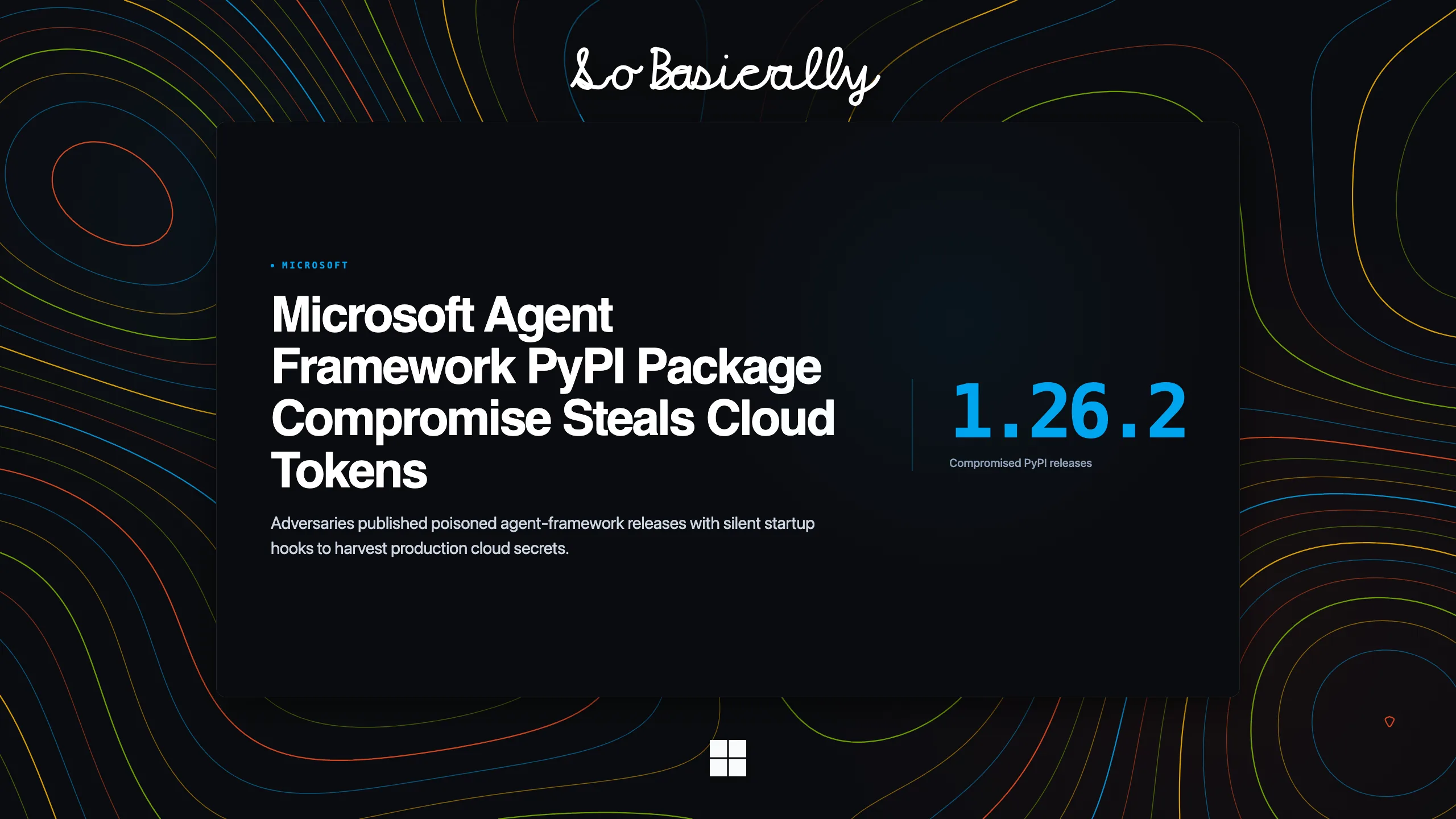
Microsoft Agent Framework PyPI package compromise exfiltrates cloud credentials

Topographic elevation contour card for Microsoft Agent Framework PyPI package compromise exfiltrates cloud credentials

What happened.Microsoft and PyPI administrators removed malicious versions of the official agent-framework Python package. Attackers compromised credentials to distribute packages that stole cloud tokens from developer machines and automated pipelines.

Why it matters.Language package registries are primary supply chain distribution vectors into enterprise build pipelines. When attacker payloads trigger automatically through interpreter startup hooks, standard code reviews miss the intrusion. Engineering leaders must enforce strict package hash pinning and audit environment variable access across build runners.

Read Full Brief →
Source:GitHub Security Advisories (opens in a new tab)
VERIFIED STORIES IN THIS EDITION7 STORIES
Decision brief card for Linux kernel developers patch AMD nested virtualization KVM host escape

Linux kernel developers patch AMD nested virtualization KVM host escape

What happened.Linux kernel maintainers patched a high-severity hypervisor breakout vulnerability in the Kernel-based Virtual Machine subsystem. The flaw allowed guest virtual machines to escape hardware virtualization boundaries and access physical host memory on AMD processors.

Why it matters.Multi-tenant cloud hypervisors rely entirely on processor-enforced isolation boundaries to keep neighboring workloads separate. A memory pointer desynchronization flaw that leaks host RAM compromises multi-tenant cloud security models at the hardware layer. Cloud infrastructure operators must apply updated kernel builds or disable nested virtualization on AMD compute nodes.

  • Memory desynchronization: Tracked as CVE-2026-99312 with an 8.8 CVSS score, the defect resides in nested Secure Virtual Machine logic for AMD x86 processors.
  • Stale MMU pointer reuse: When a virtual CPU received an INIT signal during nested guest execution with paging disabled, KVM failed to refresh memory management contexts.
  • Bare-metal memory exposure: Security researchers demonstrated reading 127 GB of host RAM, including secrets belonging to neighboring multi-tenant cloud instances.
  • Kernel patch integration: Upstream commit c7c288d178cb introduced unconditional MMU context resets across Linux kernel versions 7.3.5, 6.18.64, and 6.12.118.
Official Source:NIST NVD
Decision brief card for Linux kernel developers patch AMD nested virtualization KVM host escape
Read Brief
Source:NIST NVD (opens in a new tab)
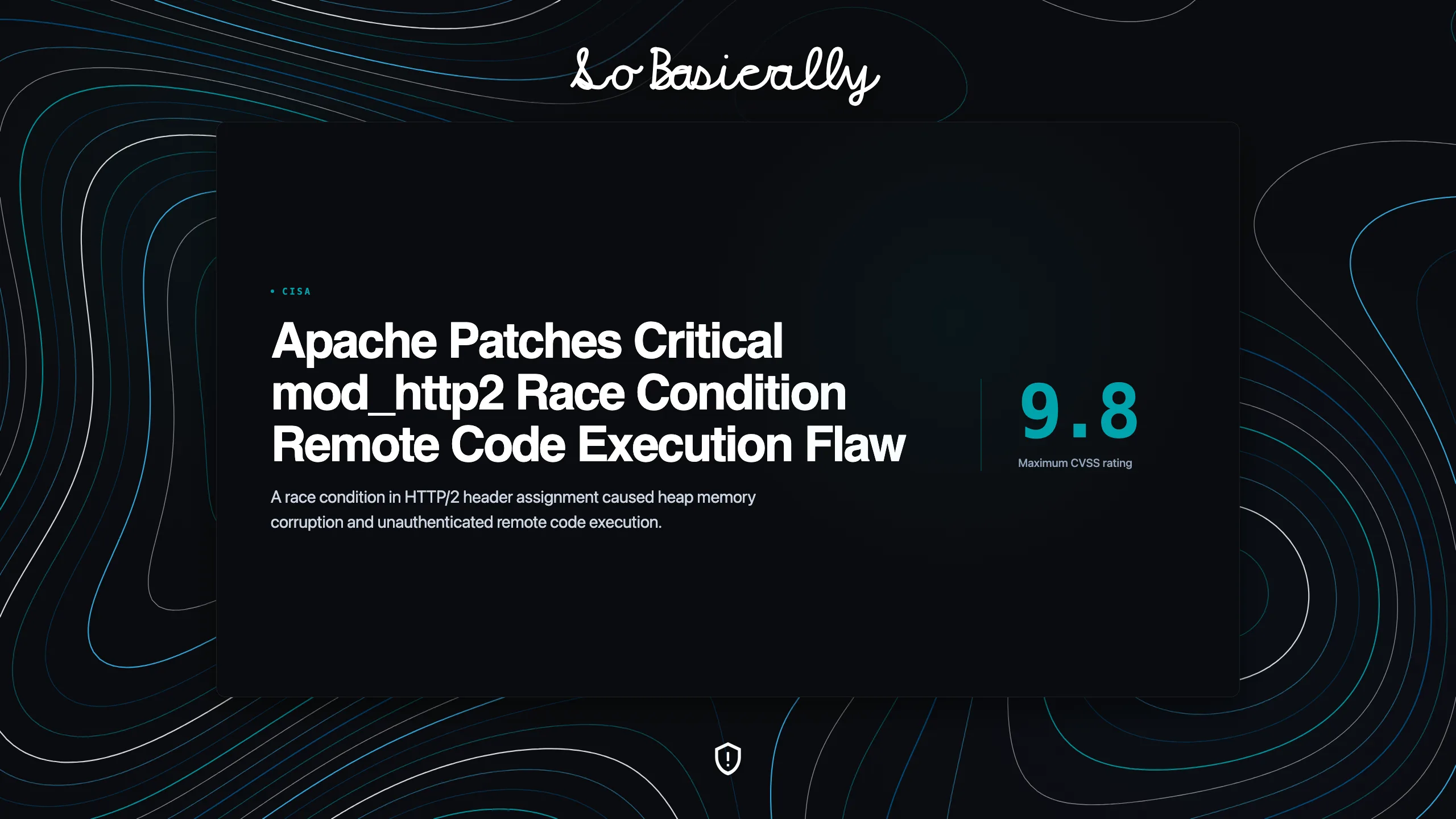
Decision brief card for Apache patches critical mod_http2 race condition remote code execution flaw

Apache patches critical mod_http2 race condition remote code execution flaw

What happened.The Apache HTTP Server project released security updates resolving a critical race condition in the mod_http2 protocol module. Unauthenticated network attackers can corrupt worker heap memory and execute arbitrary code on web servers with HTTP/2 enabled.

Why it matters.Front-end web servers process untrusted ingress traffic at the outermost edge of enterprise architectures. When high-performance protocol modules suffer synchronization flaws that permit memory corruption, attackers can achieve remote execution without valid credentials. Web operations teams should deploy Apache 2.4.71 updates and restart listening daemons.

  • Synchronization race defect: Tracked as CVE-2026-119618 with a 9.8 CVSS score, the defect occurs during header assignment routines within mod_http2.
  • Heap memory corruption: Concurrent threads handling stream requests access shared connection structures without synchronization, writing synthetic headers over adjacent memory boundaries.
  • Affected server versions: The vulnerability impacts Apache HTTP Server versions 2.4.55 through 2.4.70 and mod_h2 standalone releases 2.0.8 through 2.0.42.
  • Remediation release path: Upstream maintainers resolved the flaw in Apache HTTP Server 2.4.71, recommending that administrators disable mod_http2 if maintenance is delayed.
Official Source:NIST NVD
Decision brief card for Apache patches critical mod_http2 race condition remote code execution flaw
Read Brief
Source:NIST NVD (opens in a new tab)
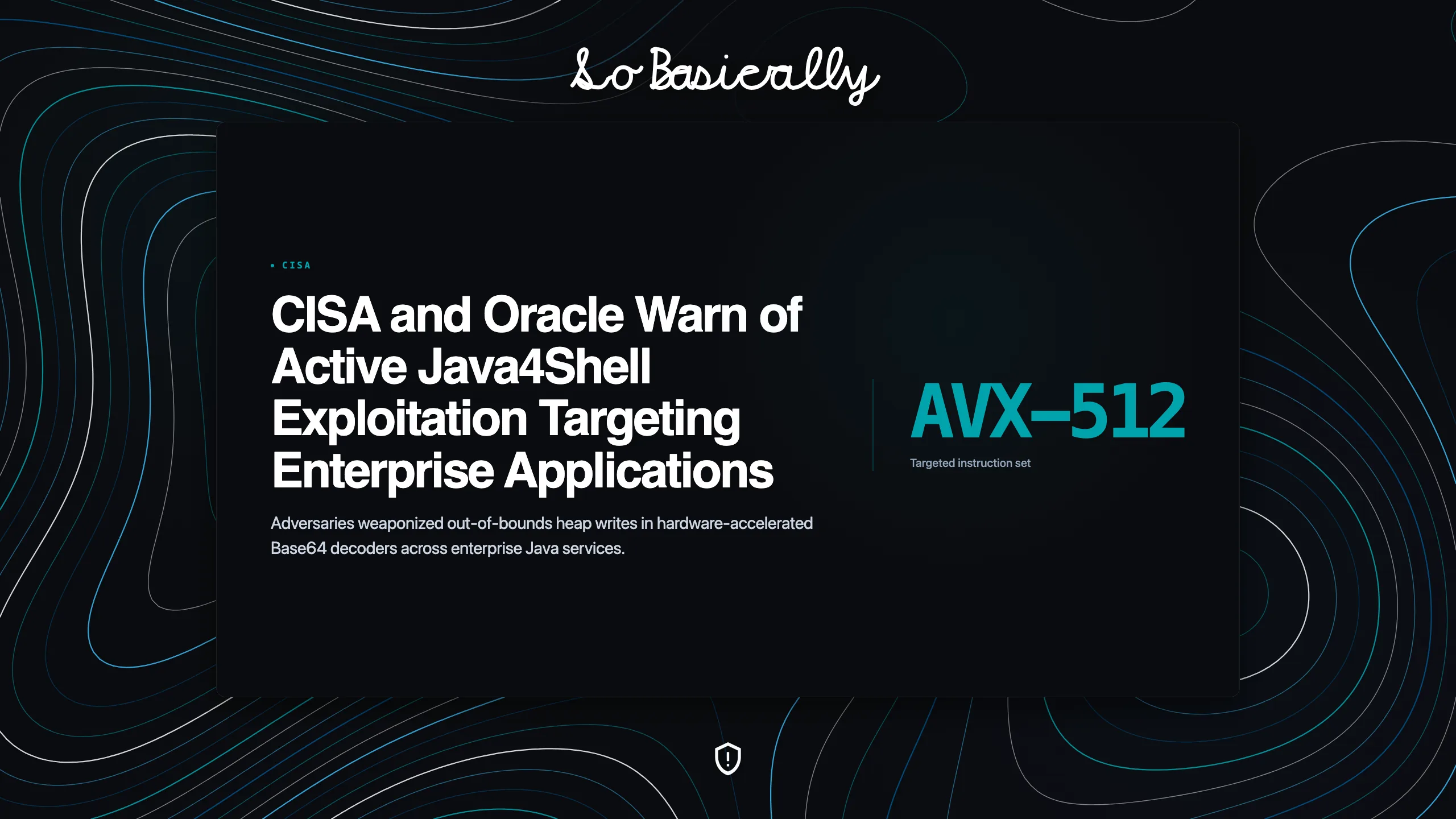
Decision brief card for CISA and Oracle warn of active Java4Shell exploitation targeting enterprise applications

CISA and Oracle warn of active Java4Shell exploitation targeting enterprise applications

What happened.CISA issued an urgent cybersecurity advisory following active in-the-wild exploitation of the critical Java4Shell vulnerability. Threat actors are weaponizing heap corruption flaws in the Java Virtual Machine compiler against exposed enterprise applications.

Why it matters.Core programming runtimes form the foundation of internal collaboration platforms, identity providers, and data processing services. When standard library decoders fail on specific CPU architectures, software stacks inherit remote execution vulnerabilities regardless of application code quality. Security teams must inventory Java deployments and apply latest runtime revisions across production infrastructure.

  • Instruction set flaw: Tracked as CVE-2026-114938 with a 9.8 CVSS score, the flaw resides in the HotSpot Base64 decoder on CPUs with AVX-512 VBMI instructions.
  • Out-of-bounds heap write: Processing malformed Base64 strings triggers memory corruption, enabling unauthenticated remote actors to achieve remote code execution.
  • Targeted software ecosystem: Observed attacks target internet-facing instances of Jira, Confluence, Jenkins, and Keycloak running unpatched Java runtimes.
  • Remediation directive: CISA urged immediate patching across all environments, highlighting that web application firewalls provide incomplete protection against polymorphic payloads.
Official Source:NIST NVD
Decision brief card for CISA and Oracle warn of active Java4Shell exploitation targeting enterprise applications
↳Continues: OpenJDK patches critical Java4Shell remote code execution in AVX-512 Base64 decoders
Read Brief
Source:NIST NVD (opens in a new tab)
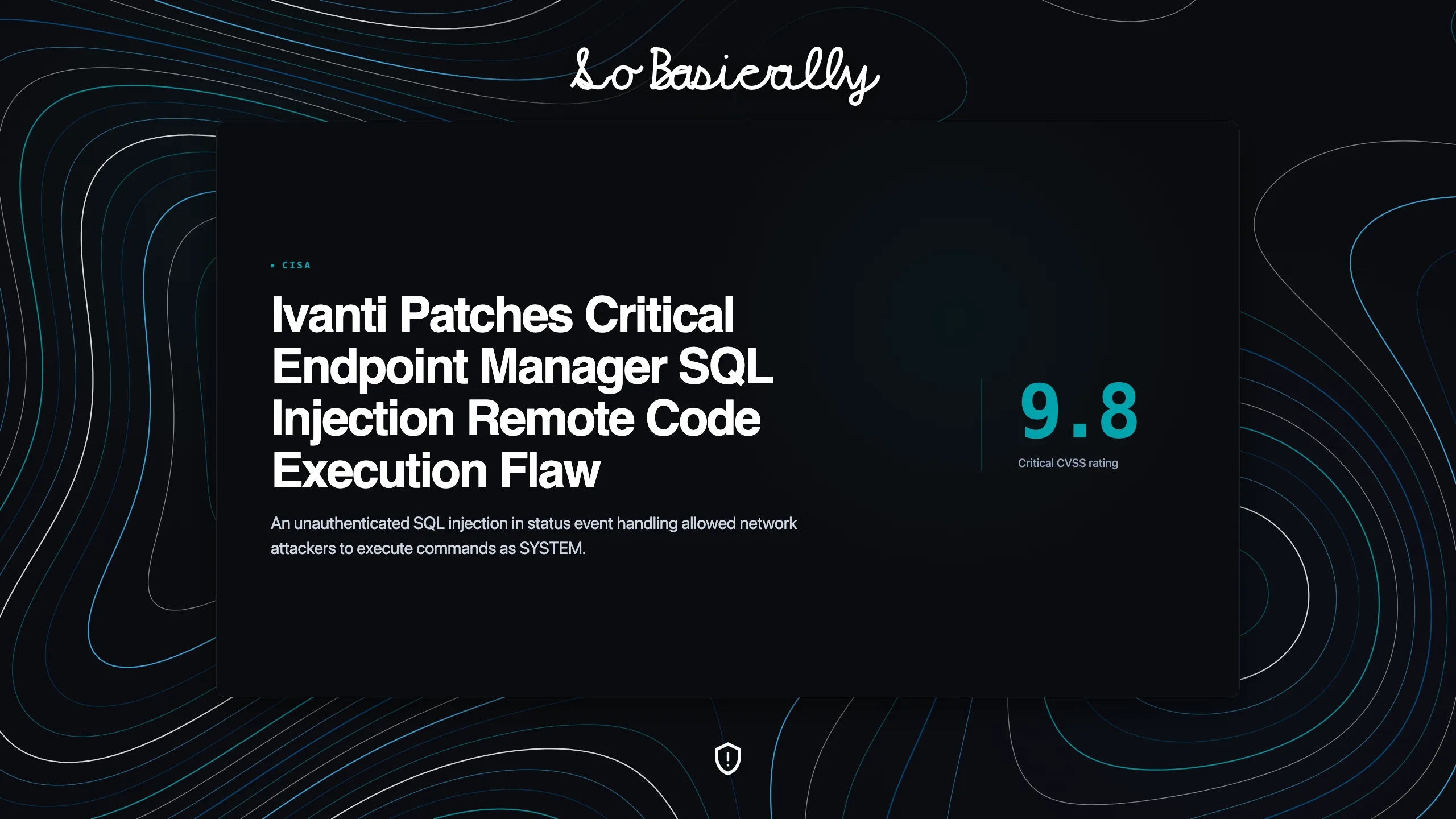
Decision brief card for Ivanti patches critical Endpoint Manager SQL injection remote code execution flaw

Ivanti patches critical Endpoint Manager SQL injection remote code execution flaw

What happened.Ivanti published out-of-band security updates resolving a critical SQL injection vulnerability in Endpoint Manager. Unauthenticated remote attackers can execute arbitrary SQL commands on the backend database and obtain root privileges on the core management server.

Why it matters.Centralized endpoint management platforms maintain privileged agents and administrative credentials across all corporate laptops and servers. A remote code execution flaw in the management console gives adversaries an immediate mechanism to compromise managed endpoints across the organization. IT infrastructure teams must update Ivanti Core servers to 2024 SU8 immediately.

  • Database injection flaw: Tracked as CVE-2026-121653 with a 9.8 CVSS score, the defect involves improper neutralization of special elements in database queries.
  • Unauthenticated status handler: The vulnerability resides within the WSStatusEvents service on the Core server, accepting unauthenticated network requests over corporate networks.
  • Affected platform matrix: The vulnerability impacts Ivanti Endpoint Manager 2024 SU7 and prior releases deployed across enterprise device management networks.
  • Resolved software release: Ivanti released Endpoint Manager 2024 SU8, advising administrators to restrict network access to core server management endpoints.
Official Source:NIST NVD
Decision brief card for Ivanti patches critical Endpoint Manager SQL injection remote code execution flaw
Read Brief
Source:NIST NVD (opens in a new tab)
Decision brief card for Check Point patches actively exploited Gaia OS DynamicCLI root privilege escalation

Check Point patches actively exploited Gaia OS DynamicCLI root privilege escalation

What happened.Check Point released emergency hotfixes after security researchers and CISA confirmed active exploitation of a local privilege escalation flaw in Gaia OS. Attackers chained the socket permission flaw with perimeter web vulnerabilities to take over enterprise security gateways.

Why it matters.Perimeter security gateways protect internal networks from external intrusion, making gateway persistence a top priority for advanced threat groups. When local daemon sockets lack authorization controls, low-privilege web exploits turn into full root compromise. Network engineers should deploy Jumbo Hotfix packages and review gateway audit logs for unauthorized socket interaction.

  • World-writable socket access: Tracked as CVE-2026-123039 with a 7.8 CVSS score, the defect resides in the Dynamic CLI background service.
  • Missing authorization checks: The dynamic_server process created a local Unix domain socket with 0777 permissions and accepted unauthenticated commands to execute as root.
  • Affected appliance scope: The vulnerability impacts Quantum Security Gateways, Security Management servers, and Maestro platforms running Gaia OS R81 and R82.
  • Hotfix and workaround: Check Point published Jumbo Hotfix sk1000362 and provided a CLI command to disable the dynamic_server process until patched.
Official Source:NIST NVD
Decision brief card for Check Point patches actively exploited Gaia OS DynamicCLI root privilege escalation
Read Brief
Source:NIST NVD (opens in a new tab)
Decision brief card for Palo Alto Networks resolves PAN-OS firewall dataplane information disclosure

Palo Alto Networks resolves PAN-OS firewall dataplane information disclosure

What happened.Palo Alto Networks published security advisories resolving an unauthenticated sensitive information disclosure vulnerability in PAN-OS. Remote network attackers can extract internal firewall telemetry and active connection session state by directing crafted packets to dataplane interfaces.

Why it matters.Next-generation firewalls inspect application traffic and maintain real-time session state for sensitive enterprise perimeters. Information disclosure vulnerabilities in dataplane packet processing give adversaries valuable intelligence regarding internal network topologies and active sessions. Network security teams should upgrade affected PAN-OS instances and audit perimeter firewall rule configurations.

  • Dataplane state leakage: Tracked as CVE-2026-0331 with a high severity rating, the vulnerability affects firewall data interfaces handling production traffic.
  • Unauthenticated packet extraction: Attackers sending specially structured network packets can access session memory tables and internal routing configurations without credentials.
  • Affected firewall versions: The defect impacts specific releases of PAN-OS software deployed on physical appliances and software virtual firewalls.
  • Remediation release path: Palo Alto Networks published maintenance software updates, recommending that security teams restrict dataplane access and enforce interface zone filtering.
Official Source:Palo Alto Networks Security Advisories
Decision brief card for Palo Alto Networks resolves PAN-OS firewall dataplane information disclosure
Read Brief
Source:Palo Alto Networks Security Advisories (opens in a new tab)
Decision brief card for CISA adds Apache Roller deserialization remote code execution to KEV catalog

CISA adds Apache Roller deserialization remote code execution to KEV catalog

What happened.CISA added Apache Roller deserialization to its Known Exploited Vulnerabilities catalog. The federal directive mandates that civilian agencies remediate the flaw after threat actors actively exploited unpatched web installations in the wild.

Why it matters.Web applications and content platforms frequently maintain legacy serialization endpoints that accept untrusted network input. When threat actors automate exploitation against public servers, unpatched instances become entry points for network pivoting. IT leaders must cross-reference public assets against the CISA catalog and remove legacy web endpoints from external exposure.

  • Untrusted data deserialization: Tracked as CVE-2026-129448 with a 9.8 CVSS score, the defect involves Java deserialization within the web application framework.
  • Unauthenticated execution path: Remote actors sending crafted serialized objects to web endpoints trigger arbitrary operating system commands with application server privileges.
  • Federal directive action: CISA issued Binding Operational Directive 26-04 requirements, mandating that federal agencies apply vendor mitigations or isolate exposed systems.
  • Ecosystem exploitation pattern: The addition follows recent catalog actions targeting deserialization defects in open-source blog and content engines.
  • Vendor patch availability: Project maintainers published updated application archives to eliminate vulnerable serialization endpoints and restrict reflection calls.
Official Source:CISA Known Exploited Vulnerabilities
Decision brief card for CISA adds Apache Roller deserialization remote code execution to KEV catalog
↳Continues: CISA adds Puppet Enterprise deserialization flaw to KEV catalog
Read Brief
Source:CISA Known Exploited Vulnerabilities (opens in a new tab)
CANDIDATE INTELLIGENCE · UNVERIFIED LEADS

The Discovery Wire · Unverified Attention Signals

Candidate storylines identified across developer channels. Under newsroom canon, attention never establishes fact; these leads remain quarantined until supported by Tier 1 official records.

DEVELOPER WIRE

Microsoft Entra Connect Health Cloud API Metadata Exfiltration

Microsoft notified tenant administrators that an unauthenticated API defect in Entra Connect Health permitted external actors to extract tenant configurations, sync states, and technical contact email addresses before cloud-side remediation.

STATUS:Awaiting official documentation or verification criteria.
DEVELOPER WIRE

Meta WhatsApp Ad-Reply External URL Media Redirection

Meta resolved CVE-2026-23871 in WhatsApp for Android after scam operators abused ad-reply message rendering to leak recipient IP addresses to external servers.

STATUS:Awaiting official documentation or verification criteria.
DEVELOPER WIRE

Windows CLFS SignDrop Unpatched Local SYSTEM Privilege Escalation Zero-Day

Security researchers released technical details demonstrating that unpatched Windows Common Log File System drivers permit local users to elevate privileges to SYSTEM.

STATUS:Awaiting official documentation or verification criteria.

DEVELOPER WIRE

Windows FastUnlock Physical Lock Screen Bypass Vulnerability

Security analysts disclosed a local physical bypass vector on locked Windows machines that permits unauthenticated operators to run limited programs.

STATUS:Awaiting official documentation or verification criteria.
DEVELOPER WIRE

N-able N-central 4EverAble2Shell Remote Management Campaign

Threat intelligence teams observed coordinated cryptomining campaigns targeting N-central remote monitoring servers via chained management API flaws.

STATUS:Awaiting official documentation or verification criteria.
DEVELOPER WIRE

Cisco ClamAV Engine Denial-of-Service Fixes in Secure Endpoint

Cisco published security updates resolving multiple infinite loop conditions in ClamAV file scanning engines used across endpoint security products.

STATUS:Awaiting official documentation or verification criteria.
DEVELOPER WIRE

BerriAI LiteLLM Gateway Post-KEV Hardening Guidance

Security teams published configuration audits to protect open-source AI proxy gateways following active exploitation of credential exposure flaws.

STATUS:Awaiting official documentation or verification criteria.
DEVELOPER WIRE

Vanderbilt University REDCap Code Injection Remediation

Healthcare data infrastructure operators deployed patches after CISA mandated federal remediation for actively exploited code injection flaws in medical survey engines.

STATUS:Awaiting official documentation or verification criteria.
DEVELOPER WIRE

Synology DiskStation Manager Remote Code Execution Monitoring

Network defenders observed continued scanning activity targeting network-attached storage units following KEV catalog additions.

STATUS:Awaiting official documentation or verification criteria.
DEVELOPER WIRE

Google Chrome V8 Type Confusion Zero-Day Patch Verification

Browser engineering teams validated rapid security release deployments following zero-day type confusion discoveries in JavaScript compilation engines.

STATUS:Awaiting official documentation or verification criteria.
DEVELOPER WIRE

ASUS Control Center Express Hardcoded Cryptographic Key Advisory

Hardware vendors delivered firmware updates to replace static cryptographic certificates embedded within centralized IT management suites.

STATUS:Awaiting official documentation or verification criteria.
DEVELOPER WIRE

AWS S3 Encryption Client AES-GCM Tag Downgrade Remediation

Amazon Web Services released client library revisions to prevent cryptographic tag truncation during object decryption routines.

STATUS:Awaiting official documentation or verification criteria.
DEVELOPER WIRE

GitLab Workspace Secrets and CI/CD Pipeline Race Condition Fixes

DevOps platform engineers deployed security patches preventing concurrent pipeline jobs from accessing ephemeral workspace tokens.

STATUS:Awaiting official documentation or verification criteria.
DEVELOPER WIRE

Fortinet FortiClient Local API Remote Code Execution

Fortinet disclosed advisory FG-IR-26-194 for CVE-2026-121529, a critical CORS misconfiguration in the local client daemon allowing malicious websites to execute commands.

STATUS:Awaiting official documentation or verification criteria.
DEVELOPER WIRE

Ubiquiti UniFi Access Application Critical Remote Exploitation

Ubiquiti published Security Advisory Bulletin 073 resolving critical authentication and execution flaws CVE-2026-132802 and CVE-2026-132803 in physical access management controllers.

STATUS:Awaiting official documentation or verification criteria.
DEVELOPER WIRE

F5 and NGINX Out-of-Band Resolver and HTTP Module Vulnerabilities

F5 published out-of-band updates addressing high-severity issues CVE-2026-123634 and CVE-2026-123007 affecting DNS resolution and HTTP stream processing across web proxies.

STATUS:Awaiting official documentation or verification criteria.