Skip to content
SoBasicallyVOL. I · RUN 2026-11-20-cybersecurity-advisories
ARCHIVAL EDITION2026-11-20-cybersecurity-advisories8 STORIES · 1519 WORDS
← Back to Archive

Cisco warns of active in-the-wild exploitation of Expressway root RCE

Topographic elevation contour card for Cisco warns of active in-the-wild exploitation of Expressway root RCE

What happened.Cisco and threat intelligence teams reported active exploitation of a critical remote code execution flaw in Cisco Expressway appliances. Attackers leverage public proof-of-concept exploits to take over internet-exposed communication gateways.

Why it matters.Expressway appliances sit at network perimeters to bridge external calls into internal enterprise networks. A root-level compromise of edge gateways enables immediate lateral movement into core corporate communications and directory infrastructure. Security teams must upgrade exposed appliances immediately.

Read Full Brief →
Source:Cisco Security Advisories (opens in a new tab)
VERIFIED STORIES IN THIS EDITION7 STORIES
Decision brief card for CISA adds Synology DiskStation Manager remote code execution flaw to KEV catalog

CISA adds Synology DiskStation Manager remote code execution flaw to KEV catalog

What happened.The Cybersecurity and Infrastructure Security Agency added vulnerability CVE-2024-10441 in Synology DiskStation Manager to its Known Exploited Vulnerabilities catalog. Threat actors weaponize the defect in automated ransomware campaigns targeting network storage.

Why it matters.Network attached storage devices house production database backups and developer shared drives across startup offices. When storage appliances expose unauthenticated command execution flaws, ransomware operators encrypt local backups before alerting system administrators. Infrastructure operators must isolate storage devices behind private virtual networks.

  • Improper output encoding: Tracked as CVE-2024-10441 with a 9.8 CVSS score, the flaw allows unauthenticated remote code execution in system plugin daemons.
  • Active ransomware campaigns: Adversaries deploy C3RB3R ransomware payloads against internet-exposed storage appliances to encrypt enterprise backups.
  • Broad hardware exposure: The defect affects DiskStation Manager versions prior to 7.2.2-72806-1 and BeeStation OS versions before 1.1-65374.
  • Federal remediation deadline: Federal Civilian Executive Branch agencies must apply vendor firmware updates or disconnect vulnerable units by December 9, 2026.
Official Source:NIST NVD
Decision brief card for CISA adds Synology DiskStation Manager remote code execution flaw to KEV catalog
Read Brief
Source:NIST NVD (opens in a new tab)
Decision brief card for CISA mandates emergency patching for Vanderbilt REDCap unauthenticated code injection

CISA mandates emergency patching for Vanderbilt REDCap unauthenticated code injection

What happened.The Cybersecurity and Infrastructure Security Agency added vulnerability CVE-2026-90817 in Vanderbilt University REDCap software to its Known Exploited Vulnerabilities catalog. Attackers exploit public survey portals to execute code on backend research servers.

Why it matters.Public data collection forms often connect directly to internal data processing pipelines. If forms permit file stream injection into runtimes, attackers easily compromise survey servers. Engineering teams must sanitize routing parameters and restrict survey server egress traffic.

  • Survey routing injection: Tracked as CVE-2026-90817 with a 9.8 CVSS score, the defect abuses passthrough routing via double-URL encoding.
  • Unauthenticated arbitrary execution: Malicious file streams trigger arbitrary PHP code execution during data import routines.
  • Active cryptomining intrusions: Threat groups leverage survey hashes to deploy persistent web shells and fileless cryptocurrency mining tools.
  • Upstream patch requirements: Vanderbilt released urgent remediation patches across supported long term and standard branches.
Official Source:NIST NVD
Decision brief card for CISA mandates emergency patching for Vanderbilt REDCap unauthenticated code injection
Read Brief
Source:NIST NVD (opens in a new tab)
Decision brief card for AWS issues security updates for seventeen PHP vulnerabilities across Amazon Linux

AWS issues security updates for seventeen PHP vulnerabilities across Amazon Linux

What happened.Amazon Web Services published security bulletin 2026-190-AWS providing urgent updates for seventeen vulnerabilities in PHP across Amazon Linux environments. The patch wave addresses core engine bugs and memory corruption risks.

Why it matters.PHP powers significant enterprise web backends, content management frameworks, and internal administration tools. Operating unpatched runtime interpreters leaves web endpoints vulnerable to unexpected memory crashes and potential command execution. Cloud engineers should trigger package updates across all active web server images.

  • Multi-branch package rollout: The bulletin delivers security updates for PHP branches 8.2.36, 8.3.37, 8.4.28, and 8.5.13 on Amazon Linux 2023 and Amazon Linux 2.
  • Vulnerability surface area: The addressed defects span the PHP core engine, FastCGI process manager, stream wrappers, and cryptographic extension libraries.
  • Denial of service and execution: Multiple integer parsing errors and memory corruption flaws could allow untrusted input to crash worker processes or execute arbitrary code.
  • Automated package deployment: System operators can apply the security fixes across server fleets using standard package management commands without full operating system reboots.
Official Source:AWS Security Bulletins
Decision brief card for AWS issues security updates for seventeen PHP vulnerabilities across Amazon Linux
Read Brief
Source:AWS Security Bulletins (opens in a new tab)
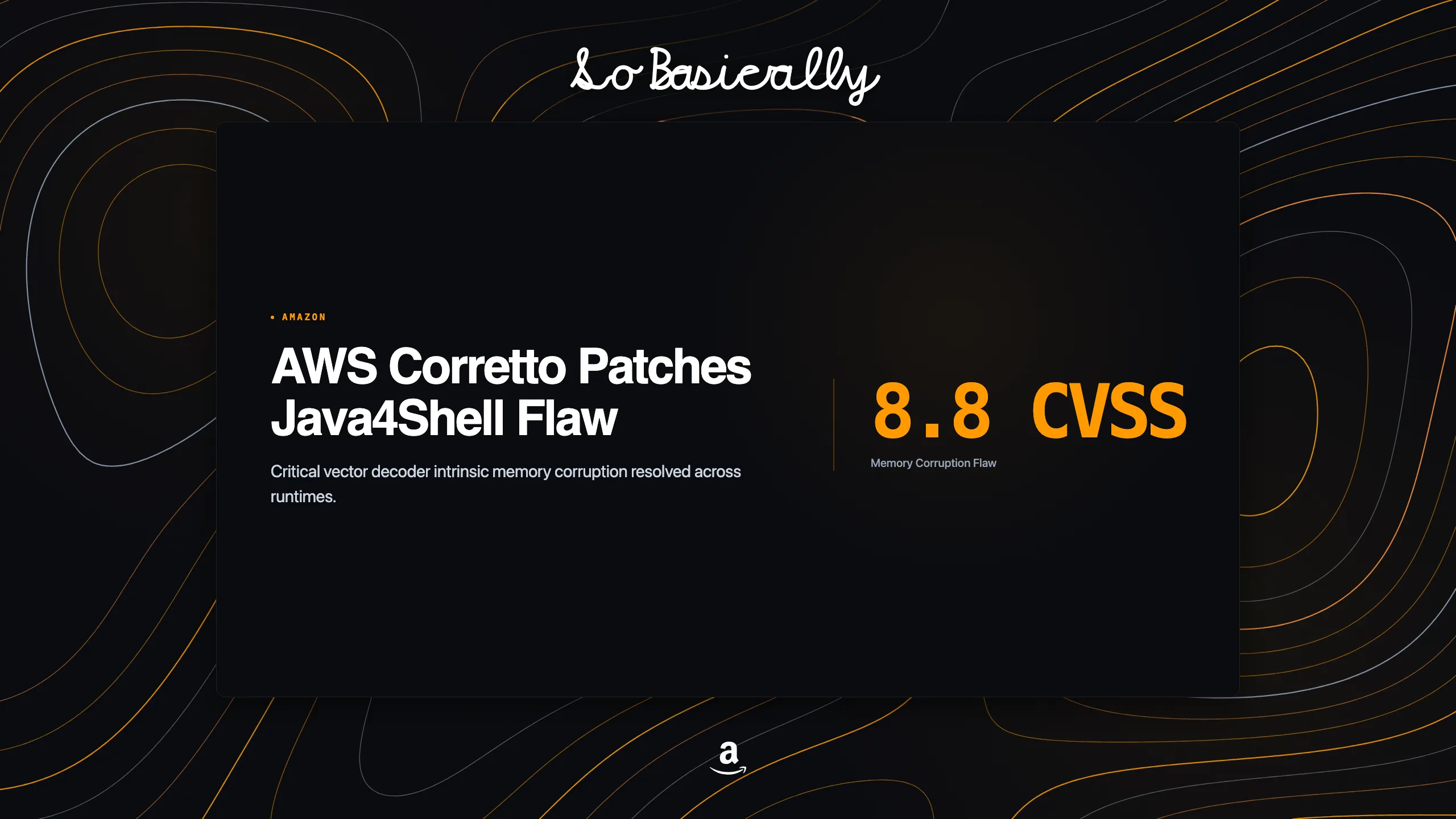
Decision brief card for Amazon updates Corretto runtimes for critical Java4Shell remote code execution flaw

Amazon updates Corretto runtimes for critical Java4Shell remote code execution flaw

What happened.Amazon Web Services published security bulletin 2026-189-AWS releasing Critical Security Patch Updates for Amazon Corretto to fix the Java4Shell vulnerability. The flaw allows memory corruption in hardware-accelerated Base64 decoders.

Why it matters.Java microservices frequently decode incoming Base64 tokens and data payloads on modern cloud instances equipped with vector acceleration. Memory corruption in core decoding intrinsics allows unauthenticated payloads to execute code inside backend JVM processes. DevOps teams should redeploy container bases with patched Corretto builds.

  • Intrinsic out-of-bounds write: Tracked as CVE-2026-114938 with an 8.8 CVSS score, the defect resides in the vector-accelerated Base64 decoding routine.
  • Hardware dependency: Exploitation requires x86-64 server processors running AVX-512 vector byte manipulation instructions during Base64 payload decoding.
  • Broad Corretto distribution: AWS delivered updated runtimes across Corretto versions 27.0.1.1.4, 25.0.5.1.2, 21.0.13.1.2, 17.0.21.1.2, 11.0.33.1.1, and 8u514.
  • Operational mitigation flag: Organizations unable to patch immediately can disable hardware vector acceleration by passing the flag minus XX colon UseAVX equals 2 to the runtime.
Official Source:AWS Security Bulletins
Decision brief card for Amazon updates Corretto runtimes for critical Java4Shell remote code execution flaw
↳Continues: OpenJDK patches critical Java4Shell remote code execution in AVX-512 Base64 decoders
Read Brief
Source:AWS Security Bulletins (opens in a new tab)
Decision brief card for Apple releases security updates for iOS, macOS, and visionOS across nine vulnerabilities

Apple releases security updates for iOS, macOS, and visionOS across nine vulnerabilities

What happened.Apple published coordinated security updates across iOS 27.2.1, macOS Golden Gate 27.2.1, and visionOS 27.2.1 resolving nine security vulnerabilities. The updates fix local pairing bypasses and memory corruption defects.

Why it matters.Mobile and desktop workstations form the primary operational endpoints for software engineers handling production keys and cloud credentials. Local network pairing bypasses and parser flaws expose developer hardware to nearby wireless compromises. IT managers should enforce client updates across all corporate Apple devices.

  • Wireless pairing bypasses: Tracked as CVE-2026-113968 and CVE-2026-113970, logic flaws allowed adjacent devices to bypass Bluetooth pairing rate limits.
  • Compression memory corruption: Vulnerability CVE-2026-111497 addresses an out-of-bounds write defect in Brotli data decompression during malformed file processing.
  • Application permission controls: Defect CVE-2026-113963 resolves an authorization flaw in App Intents that previously exposed sensitive user data through voice shortcuts.
  • Agent permission boundaries: The updates introduce granular disk access boundaries to prevent autonomous background AI tools from modifying critical system settings.
Official Source:Apple Security Releases
Decision brief card for Apple releases security updates for iOS, macOS, and visionOS across nine vulnerabilities
Read Brief
Source:Apple Security Releases (opens in a new tab)
Decision brief card for Google Cloud revokes compromised subordinate certificate authority in Confidential Space

Google Cloud revokes compromised subordinate certificate authority in Confidential Space

What happened.Google Cloud published security bulletin GCP-2026-084 notifying customers of compromised private keys from a third-party certificate authority. Google updated Container-Optimized OS trust stores and revoked older attestation tokens.

Why it matters.Confidential computing enclaves protect proprietary machine learning models and sensitive customer datasets during active processing. Compromised certificate authority keys could allow unauthorized intermediaries to spoof enclave identities and intercept decrypted memory. Cloud architects must verify that enclave images meet current attestation baselines.

  • Compromised authority keys: Compromised subordinate certificate authority keys from eMudhra were identified inside default operating system root stores.
  • Mandatory image update: Customers running Confidential Space workloads must update images to version 261001 or newer to purge the invalid certificates.
  • Attestation token cutoffs: Google Cloud Attestation and Intel Trust Authority ceased issuing verification tokens to outdated Confidential Space workloads.
  • Untrusted workload isolation: Outdated confidential computing instances failing attestation cannot receive production cryptographic keys from key management services.
Official Source:Google Cloud Security Bulletins
Decision brief card for Google Cloud revokes compromised subordinate certificate authority in Confidential Space
Read Brief
Source:Google Cloud Security Bulletins (opens in a new tab)
Decision brief card for AWS patches path traversal vulnerability in AutoGluon MultiModal machine learning toolkit

AWS patches path traversal vulnerability in AutoGluon MultiModal machine learning toolkit

What happened.Amazon Web Services published security bulletin 2026-188-AWS resolving a path traversal vulnerability in the AutoGluon MultiModal machine learning library. The flaw allowed malicious datasets to overwrite files on host systems.

Why it matters.Automated machine learning pipelines routinely download external datasets and multimodal bundles from public repositories. Path traversal defects in preprocessing tools turn automated model training jobs into entry points for host system compromise. Machine learning engineers must validate dataset origins and update AutoGluon dependencies.

  • Path traversal flaw: Tracked as CVE-2026-130638 with a 7.5 CVSS score, the defect resides in the object detection dataset preparation utility.
  • Arbitrary file manipulation: Ingesting untrusted image datasets containing manipulated path segments allows external data to escape target working directories.
  • Pipeline compromise risk: Attackers exploiting the vulnerability can overwrite system binaries or inject arbitrary code into automated training pipelines.
  • Library remediation: AWS Labs released patched library packages and advised users to update their Python dependencies across data science environments.
Official Source:AWS Security Bulletins
Decision brief card for AWS patches path traversal vulnerability in AutoGluon MultiModal machine learning toolkit
Read Brief
Source:AWS Security Bulletins (opens in a new tab)
CANDIDATE INTELLIGENCE · UNVERIFIED LEADS

The Discovery Wire · Unverified Attention Signals

Candidate storylines identified across developer channels. Under newsroom canon, attention never establishes fact; these leads remain quarantined until supported by Tier 1 official records.

DEVELOPER WIRE

CISA Adds LiteLLM AI Gateway Sandbox Escape to KEV Catalog

CISA added CVE-2026-40217 to the Known Exploited Vulnerabilities catalog following active in-the-wild exploitation of unauthenticated alternate channel defects in BerriAI LiteLLM proxy deployments.

STATUS:Awaiting official documentation or verification criteria.
DEVELOPER WIRE

Check Point Gaia OS DynamicCLI Local Privilege Escalation

Check Point tracked CVE-2026-123039, an incorrect permission assignment in the DynamicCLI daemon permitting local users to elevate privileges to root on security gateways.

STATUS:Awaiting official documentation or verification criteria.
DEVELOPER WIRE

SonicWall SonicOS SSL-VPN SAML Bypass Remediation Deadline

CISA mandated federal agencies remediate CVE-2026-19868 across SonicWall Gen 7 and Gen 8 firewalls to prevent attackers from bypassing multi-factor authentication.

STATUS:Awaiting official documentation or verification criteria.
DEVELOPER WIRE

Palo Alto Networks Panorama Authenticated Remote Code Execution

Palo Alto Networks published PAN-OS security advisory CVE-2026-0330 resolving an authenticated root execution vulnerability on central Panorama management servers.

STATUS:Awaiting official documentation or verification criteria.
DEVELOPER WIRE

Google Cloud Apigee Security Update on Flow Control

Google Cloud published security advisory GCP-2026-082 for Apigee version 1-18-0-apigee-10 resolving proxy flow routing and authorization bypass risks.

STATUS:Awaiting official documentation or verification criteria.
DEVELOPER WIRE

AWS Private CA Connector for Kubernetes Authorization Flaw

AWS published security bulletin 2026-187-AWS addressing CVE-2026-130622 and CVE-2026-130623 covering credential scoping flaws in namespace certificate issuers.

STATUS:Awaiting official documentation or verification criteria.

DEVELOPER WIRE

UnrealIRCd Delimiter Neutralization Command Injection

CISA and security researchers tracked CVE-2026-114713, an improper delimiter neutralization vulnerability affecting network communication routing daemons.

STATUS:Awaiting official documentation or verification criteria.
DEVELOPER WIRE

GitLab Security Updates for Workspace Secrets and CI/CD Pipeline Races

GitLab released patch versions 19.5.6, 19.4.8, and 19.3.9 resolving cross-site scripting and timing authorization flaws across DevOps environments.

STATUS:Awaiting official documentation or verification criteria.
DEVELOPER WIRE

Cisco Secure Endpoint Connector ClamAV Infinite Loop Denial of Service

Cisco tracked advisory cisco-sa-clamav-multi-e93M3vdA resolving scanning engine parser flaws causing endpoint agent freezes during file inspection.

STATUS:Awaiting official documentation or verification criteria.

DEVELOPER WIRE

Apache Axis Unsafe Reflection Unauthenticated Remote Code Execution

Federal agencies completed mandatory remediation for CVE-2026-90436 across legacy SOAP enterprise endpoints.

STATUS:Awaiting official documentation or verification criteria.