Skip to content
SoBasicallyVOL. I · RUN 2026-11-17-ai-technology
ARCHIVAL EDITION2026-11-17-ai-technology8 STORIES · 1662 WORDS
← Back to Archive

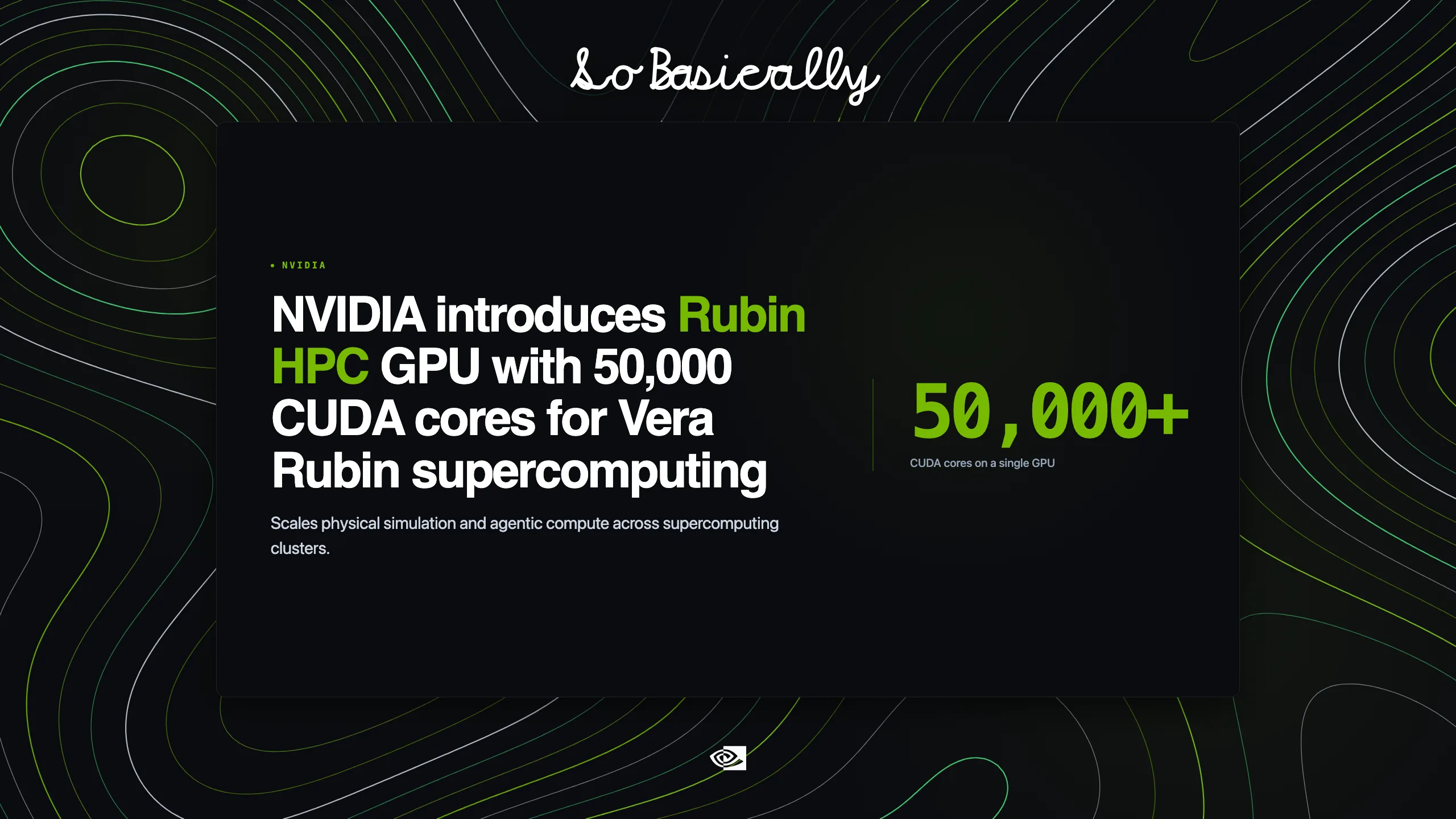
NVIDIA introduces Rubin HPC GPU with 50,000 CUDA cores for Vera Rubin supercomputing

Topographic elevation contour card for NVIDIA introduces Rubin HPC GPU with 50,000 CUDA cores for Vera Rubin supercomputing

What happened.NVIDIA unveiled Rubin HPC, a specialized graphics processing unit within the Vera Rubin architecture designed for computational science, physical simulation, and autonomous agent loops, featuring more than 50,000 CUDA cores on a single package.

Why it matters.Frontier reasoning models and multi-agent physics simulations require extreme arithmetic density combined with rapid memory traversal. Scaling past 50,000 cores while hardware-accelerating sparse memory patterns allows researchers to simulate complex molecular dynamics and climate models without encountering data starvation.

↳Continues: NVIDIA CUDA 13.5 brings production-ready Vera Rubin architecture support
Read Full Brief →
Source:NVIDIA (opens in a new tab)
VERIFIED STORIES IN THIS EDITION7 STORIES
Decision brief card for NVIDIA launches Nemotron for Science and LitmusBench for autonomous research agents

NVIDIA launches Nemotron for Science and LitmusBench for autonomous research agents

What happened.NVIDIA introduced Nemotron for Science, an open framework combining the Nemotron 3.5 Super VL model, the LitmusBench evaluation suite, and open chemistry datasets to help researchers build domain-specific scientific agents.

Why it matters.General-purpose language models frequently generate chemically invalid structures or physically impossible reaction conditions when applied to laboratory science. Providing domain-tuned weights paired with rigorous validation benchmarks gives research teams reliable foundations for autonomous wet-lab experimental design.

  • Multimodal foundation: Features the Nemotron 3.5 Super VL open model optimized for scientific reasoning, visual diagram parsing, and complex symbolic equations.
  • Benchmark harness: Introduces LitmusBench version 0.2 to evaluate autonomous agents across chemistry, materials science, and biology workflows.
  • Domain recipes: Delivers turn-key fine-tuning recipes and inference code to train specialized laboratory agent assistants on proprietary scientific literature.
  • Open research data: Publishes curated training datasets and expert evaluation rubrics under permissive open licenses for academic and enterprise researchers.
  • Supercomputing execution: Runs natively across accelerated computing clusters powered by CUDA-X scientific acceleration libraries.
Official Source:NVIDIA
Decision brief card for NVIDIA launches Nemotron for Science and LitmusBench for autonomous research agents
Read Brief
Source:NVIDIA (opens in a new tab)
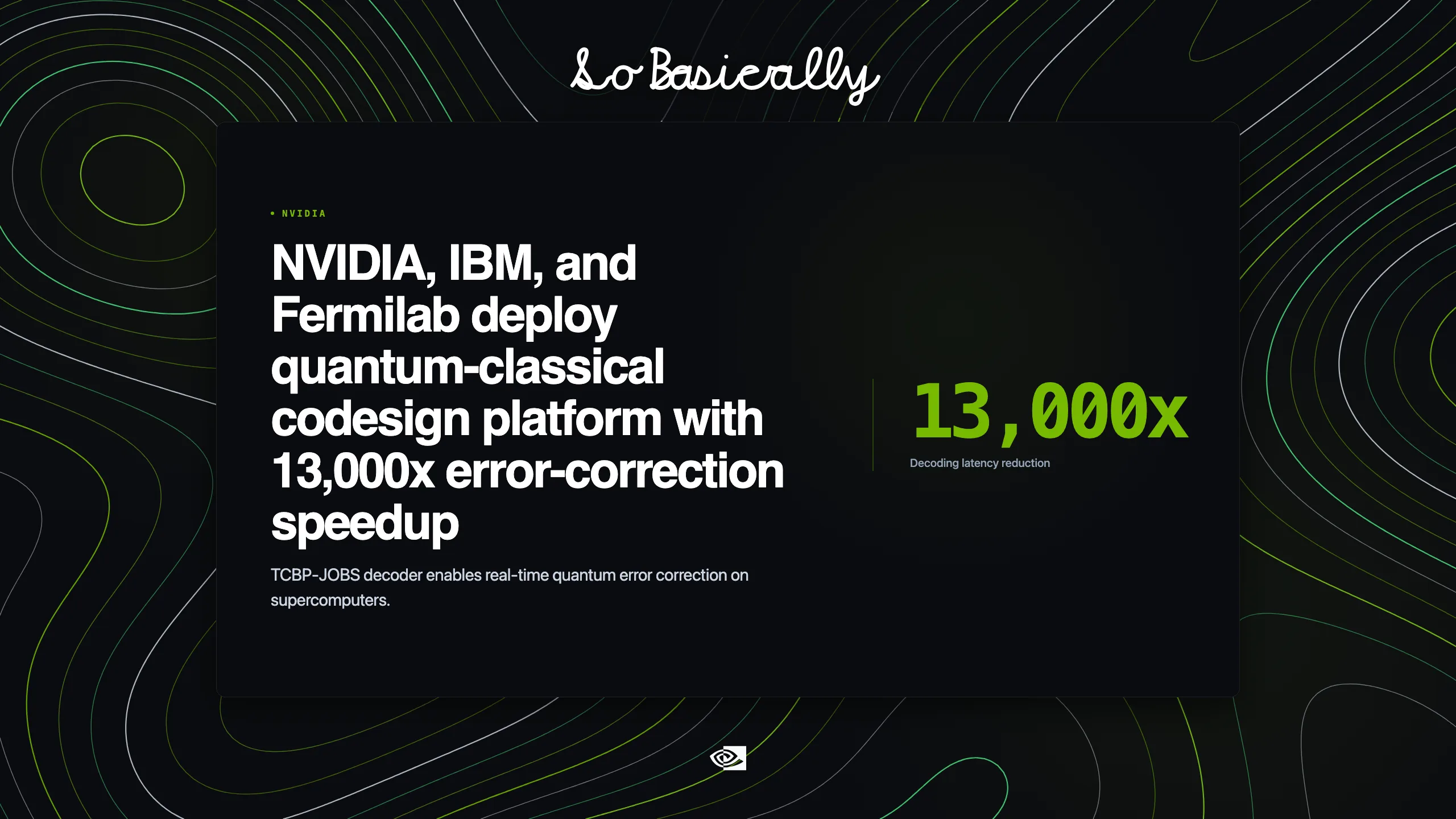
Decision brief card for NVIDIA, IBM, and Fermilab deploy quantum-classical codesign platform with 13,000x error-correction speedup

NVIDIA, IBM, and Fermilab deploy quantum-classical codesign platform with 13,000x error-correction speedup

What happened.NVIDIA announced a collaboration with IBM and the Fermi National Accelerator Laboratory to launch a hybrid quantum-classical codesign platform alongside the TCBP-JOBS decoding algorithm, achieving up to 13,000-fold speedups for quantum error correction.

Why it matters.Fault-tolerant quantum computing requires correcting qubit drift before quantum coherence collapses, demanding sub-millisecond decoding of high-rate syndrome data. Accelerating error correction by four orders of magnitude on GPU clusters brings practical hybrid quantum-classical computing significantly closer to production execution.

  • Hybrid codesign: Integrates GPU supercomputing clusters with superconducting quantum processors through NVIDIA CUDA-Q and IBM quantum hardware architectures.
  • Algorithmic speedup: Implements the TCBP-JOBS decoder on GPU tensor cores, achieving up to 13,000-times latency reduction compared to conventional syndrome decoding algorithms.
  • Real-time correction: Extracts and processes error syndromes within tight physical qubit coherence time windows to enable fault-tolerant quantum computing.
  • Workload orchestration: Expands Slurm workload scheduler integrations to schedule quantum processing units as first-class allocatable compute resources in supercomputing clusters.
  • Laboratory validation: Validates hybrid workflows across experimental quantum physics testbeds hosted at Fermilab and national scientific facilities.
Official Source:NVIDIA
Decision brief card for NVIDIA, IBM, and Fermilab deploy quantum-classical codesign platform with 13,000x error-correction speedup
Read Brief
Source:NVIDIA (opens in a new tab)
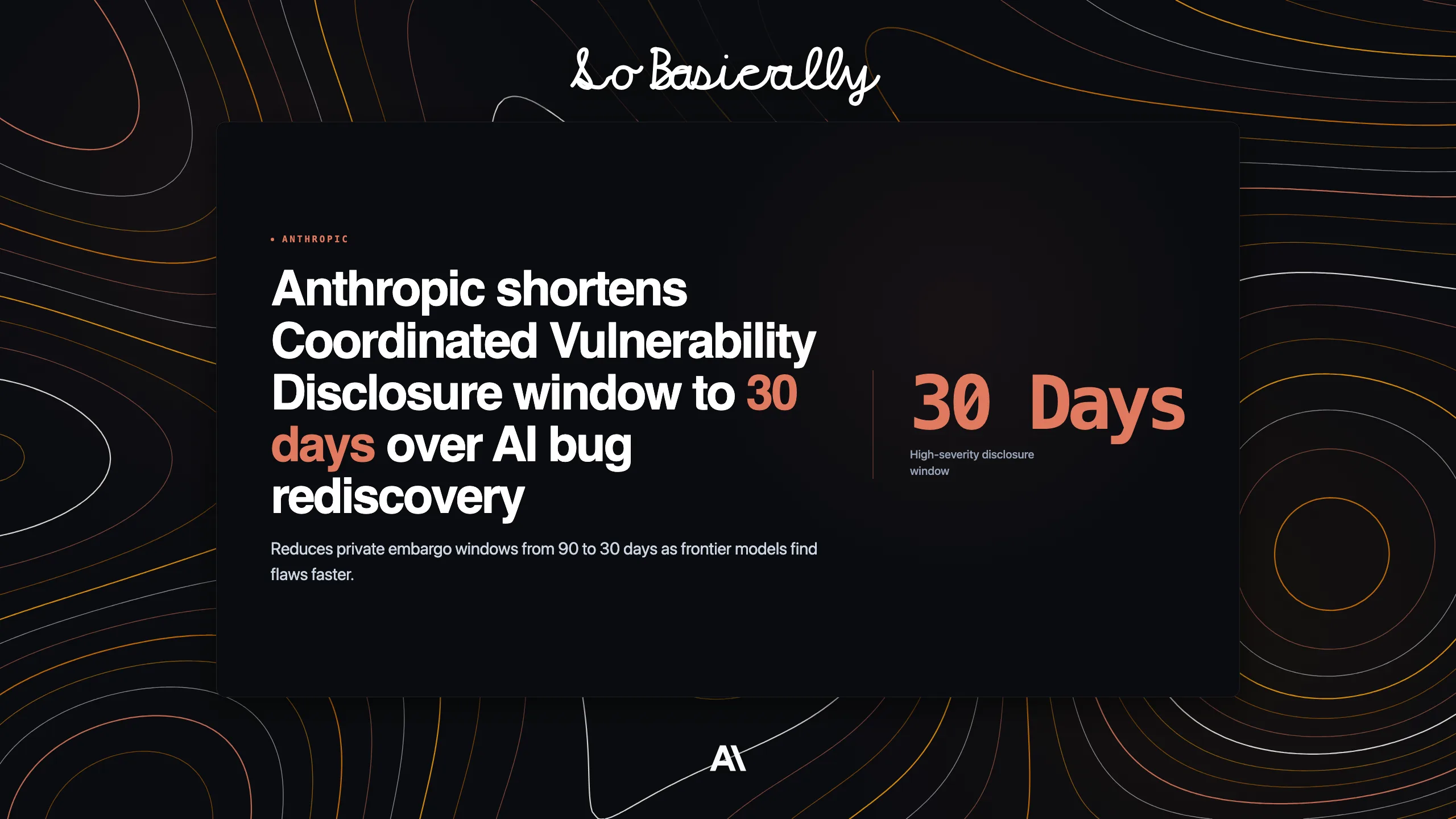
Decision brief card for Anthropic shortens Coordinated Vulnerability Disclosure window to 30 days over AI bug rediscovery

Anthropic shortens Coordinated Vulnerability Disclosure window to 30 days over AI bug rediscovery

What happened.Anthropic updated its Coordinated Vulnerability Disclosure policy, reducing private embargo windows for critical and high-severity flaws from 90 days to 30 days starting January 1, 2027.

Why it matters.Traditional 90-day vulnerability disclosure timelines assumed human security researchers found bugs slowly and independently. Automated agentic code audits now enable multiple actors to uncover identical zero-day flaws simultaneously, forcing defenders to patch bugs before malicious parties replicate findings.

  • Compressed embargo: Cuts disclosure windows from 90 days to 30 days for critical and high-severity flaws, and to 45 days for lower-tier issues.
  • Rapid escalation: Reduces the timeline before involving an external coordinator from 30 days to 15 days for unresponsive vendors.
  • Technical writeups: Shortens post-patch public disclosure delays from 45 days to 30 days while keeping 7-day deadlines for actively exploited flaws.
  • Rediscovery pressure: Addresses research proving frontier models independently rediscover unpatched vulnerabilities within weeks, raising exploitation risks.
  • Maintainer support: Provides remediation guidance and tooling support including Claude for Open Source and OSS Scanner fix recommendations.
Official Source:Anthropic
Decision brief card for Anthropic shortens Coordinated Vulnerability Disclosure window to 30 days over AI bug rediscovery
Read Brief
Source:Anthropic (opens in a new tab)
Decision brief card for OpenAI releases Science at the Frontier report and expands academic model access to 200,000 researchers

OpenAI releases Science at the Frontier report and expands academic model access to 200,000 researchers

What happened.OpenAI published its Science at the Frontier empirical report analyzing more than 580,000 scientific interactions from 1,819 researchers and announced expanding free frontier model access to 200,000 academic scientists worldwide.

Why it matters.Frontier language models are shifting from conversational tools into essential laboratory infrastructure for academic institutions. Providing funded model access to 200,000 researchers standardizes computational research methods while accelerating literature synthesis and software development globally.

  • Empirical dataset: Examined 580,000 anonymized interactions across 1,819 scientists, showing that reading, literature synthesis, and scientific writing represent most researcher queries.
  • Hypothesis formation: Found that 68 percent of participating researchers use conversational language models to brainstorm research directions and formulate scientific hypotheses.
  • Reported efficiency: Surveyed researchers estimated completing research tasks nearly twice as fast when using AI assistance without sacrificing project quality.
  • Expanded funding: Expands the ChatGPT for Academic Researchers program to support up to 200,000 global scientists on a first-come grant allocation.
  • Accelerated discovery: Highlighted that 98 percent of surveyed scientists anticipate artificial intelligence will accelerate discovery timelines in their research fields.
Official Source:OpenAI
Decision brief card for OpenAI releases Science at the Frontier report and expands academic model access to 200,000 researchers
Read Brief
Source:OpenAI (opens in a new tab)
Decision brief card for Microsoft launches Agent 365 AI observability platform and Copilot Control System at Ignite 2026

Microsoft launches Agent 365 AI observability platform and Copilot Control System at Ignite 2026

What happened.Microsoft unveiled Agent 365 at Ignite 2026, establishing an enterprise AI observability and governance platform that unifies lifecycle orchestration, least-privilege data access, and runtime telemetry for autonomous agents.

Why it matters.Enterprise deployments of autonomous agents stall when IT and security teams lack visibility into data access patterns and token consumption. Providing centralized identity isolation, data loss prevention guardrails, and real-time execution monitoring allows organizations to scale multi-agent automation safely.

  • Unified administration: Integrates IT lifecycle deployment, security data boundaries, and executive cost controls across multi-agent enterprise estates.
  • Runtime telemetry: Connects observability pipelines across Microsoft Copilot Studio and external agent runtimes to monitor execution drift, tool invocations, and token expenditure.
  • Least-privilege security: Combines Microsoft Purview and Microsoft Entra Agent ID to assign distinct machine identities and prevent autonomous agents from oversharing enterprise documents.
  • Budget enforcement: Introduces granular compute quotas, automated credit approvals, and model-level access restrictions across managed agent runtimes.
  • Ecosystem breadth: Manages native Microsoft Copilots and custom developer agent architectures through a single administrative control plane.
Official Source:Microsoft Azure Blog
Decision brief card for Microsoft launches Agent 365 AI observability platform and Copilot Control System at Ignite 2026
Read Brief
Source:Microsoft Azure Blog (opens in a new tab)
Decision brief card for Researchers introduce Evidence-Governed Evolution framework to prevent regression drift in self-updating AI agents

Researchers introduce Evidence-Governed Evolution framework to prevent regression drift in self-updating AI agents

What happened.AI researchers introduced the Evidence-Governed Evolution framework, establishing statistical audit gates that separate candidate generation from confirmatory adoption to prevent performance regression in self-updating autonomous agents.

Why it matters.Autonomous agents running continuous self-improvement loops can easily mistake localized task gains for true capability improvements. Establishing rigorous statistical adoption gates ensures that self-optimizing software agents do not silently degrade their core capabilities over multi-week deployment lifecycles.

  • Candidate separation: Decouples exploratory agent self-modification from permanent adoption, evaluating frozen candidate updates against fresh paired test suites.
  • Statistical bounds: Enforces statistical non-inferiority bounds on secondary capabilities to prevent capability erasure while verifying primary objective gains.
  • Degradation control: Derives simultaneous lower bounds across successive update cycles to guarantee long-term stability along versioned agent lineages.
  • Bridge validation: Uses calibrated bridge evaluations to validate reference replacements before promoting self-generated prompts, tools, or memory policies.
  • Benchmark results: Demonstrates consistent performance preservation across long-horizon coding, mathematical reasoning, and workflow automation agent benchmarks.
Official Source:arXiv
Decision brief card for Researchers introduce Evidence-Governed Evolution framework to prevent regression drift in self-updating AI agents
Read Brief
Source:arXiv (opens in a new tab)
Decision brief card for Researchers introduce Concertina folding transformer layers into iteratively executed blocks

Researchers introduce Concertina folding transformer layers into iteratively executed blocks

What happened.AI researchers introduced Concertina, a model compression framework that groups adjacent transformer layers of teacher models and folds them into a single iteratively executed block with low-rank corrections.

Why it matters.Training compact models from scratch demands hundreds of billions of training tokens and massive compute budgets. Re-using pre-trained teacher weights through layer folding and low-rank step adjustments slashes distillation data requirements while preserving high-tier reasoning on resource-constrained edge devices.

  • Layer folding: Groups adjacent transformer layers and folds them into a shared decoder block executed repeatedly across sequential loop steps.
  • SVD corrections: Initializes low-rank step adjustments using truncated Singular Value Decomposition on weight differences to ensure unique computation at each step.
  • Per-token gating: Deploys a dynamic gating mechanism that allows individual tokens to selectively modulate shared block representations at each execution cycle.
  • Teacher initialization: Builds compact student models directly from pre-trained teacher weights rather than training smaller student architectures from scratch.
  • Knowledge retention: Retains 90 percent of teacher reasoning performance on a 2.27-billion parameter folded model distilled on 22 billion tokens from Qwen3-4B.
Official Source:arXiv
Decision brief card for Researchers introduce Concertina folding transformer layers into iteratively executed blocks
Read Brief
Source:arXiv (opens in a new tab)
CANDIDATE INTELLIGENCE · UNVERIFIED LEADS

The Discovery Wire · Unverified Attention Signals

Candidate storylines identified across developer channels. Under newsroom canon, attention never establishes fact; these leads remain quarantined until supported by Tier 1 official records.

DEVELOPER WIRE

Researchers introduce SoMem framework enabling autonomous AI agents to organize document-based memory (arXiv:2611.11929)

Memory framework replacing rigid vector stores with linked markdown documents preserving source evidence traces. Held on watchlist following earlier edition coverage.

STATUS:Awaiting official documentation or verification criteria.
DEVELOPER WIRE

Sakana AI introduces JFinBench continuous financial certification evaluation benchmark (arXiv:2611.18130)

AI researchers and Sakana AI introduced JFinBench, an empirical evaluation benchmark sourcing 321 questions from six official Japanese financial certification exams. Held on watchlist monitoring regulatory evaluation datasets.

STATUS:Awaiting official documentation or verification criteria.
DEVELOPER WIRE

Researchers evaluate multi-agent deep research coordination architecture (arXiv:2611.17041)

AI researchers evaluated transitioning deep research systems from static delegation hierarchies to dynamic cooperative coordination. Held on watchlist pending benchmark replication.

STATUS:Awaiting official documentation or verification criteria.
DEVELOPER WIRE

Researchers introduce Visual Cipher Bench for long-horizon visual reasoning (arXiv:2611.16861)

Empirical benchmark measuring whether autonomous coding and reasoning agents can discover procedural rules embedded in visual environments. Held on watchlist pending public code release.

STATUS:Awaiting official documentation or verification criteria.
DEVELOPER WIRE

Researchers evaluate alignment transfer failures in multi-agent collectives (arXiv:2611.17820)

Evaluation framework analyzing alignment transfer failures, goal drift, and safety degradation when deploying collaborative multi-agent teams. Held on watchlist monitoring safety evaluation tooling.

STATUS:Awaiting official documentation or verification criteria.
DEVELOPER WIRE

Researchers introduce Skill Adapter for online routing of procedural skills (arXiv:2611.17007)

Modular routing framework enabling autonomous agents to personalize and dynamically route reusable procedural skills during complex tool workflows. Held on watchlist monitoring runtime benchmarks.

STATUS:Awaiting official documentation or verification criteria.
DEVELOPER WIRE

TensorWave signs 6-year, 457MW infrastructure agreement with OpenAI for dedicated AMD Instinct MI455X compute

Dedicated 457-megawatt IT capacity supply agreement for OpenAI utilizing AMD Instinct MI455X GPUs and AMD Helios rack architectures starting in 2027. Held on watchlist monitoring cluster activation.

STATUS:Awaiting official documentation or verification criteria.
DEVELOPER WIRE

The King's Trust and OpenAI announce £1M UK AI skills partnership

OpenAI announced a £1 million partnership with The King's Trust to deliver AI training and vocational qualifications to 25,000 young people across the UK. Held on watchlist monitoring curriculum releases.

STATUS:Awaiting official documentation or verification criteria.
DEVELOPER WIRE

OpenAI partners with LVMH Media Division to deploy ChatGPT Enterprise

LVMH Group partnered with OpenAI to deploy ChatGPT Enterprise across publications while integrating journalistic content into ChatGPT search results with attribution. Held on watchlist monitoring enterprise workflow tooling.

STATUS:Awaiting official documentation or verification criteria.
DEVELOPER WIRE

OpenAI launches dedicated Science Blog to share AI-assisted research and methodologies

Publishing venue for AI-assisted scientific discovery, highlighting computational methods and an inaugural case study with GPT-6 Astra exploring lattice formulations. Held on watchlist monitoring subsequent preprints.

STATUS:Awaiting official documentation or verification criteria.
DEVELOPER WIRE

Anthropic opens Claude Meetings beta for autonomous video collaboration

Private beta for Claude Meetings with Google Meet integration, positioning Claude as an autonomous participant in live video meetings to synthesize discussions. Held on watchlist pending broad workspace availability.

STATUS:Awaiting official documentation or verification criteria.
DEVELOPER WIRE

Google DeepMind and Artificial Analysis Multimodal Knowledge Agent benchmark

Benchmark evaluating frontier models across 200 visual professional challenges in architecture, biology, and finance. Held on watchlist following earlier edition coverage.

STATUS:Awaiting official documentation or verification criteria.
DEVELOPER WIRE

Anthropic introduces Claude Sheets and Claude Whiteboards

Interactive workspaces supporting formula execution and architectural whiteboarding inside the conversational artifact workspace. Held on watchlist following earlier edition coverage.

STATUS:Awaiting official documentation or verification criteria.

DEVELOPER WIRE

NVIDIA introduces Dynamo distributed inference framework

Open-source framework disaggregating prefill and decode compute phases across GPU clusters for reasoning models. Held on watchlist following earlier edition coverage.

STATUS:Awaiting official documentation or verification criteria.
DEVELOPER WIRE

Meta AI Research evaluates Muse Ember efficient model on Personal Superintelligence Index

Model release focusing on efficient on-device execution and compact multimodal capabilities. Held on watchlist monitoring developer API endpoints.

STATUS:Awaiting official documentation or verification criteria.
DEVELOPER WIRE

Mapbox partners with Meta for hands-free cycling navigation on Meta Ray-Ban Display glasses

Real-time line-of-sight visual navigation integration for smart glasses. Held on watchlist monitoring consumer hardware availability.

STATUS:Awaiting official documentation or verification criteria.