Skip to content
SoBasicallyVOL. I · RUN 2026-11-11-cybersecurity-advisories
ARCHIVAL EDITION2026-11-11-cybersecurity-advisories8 STORIES · 1639 WORDS
← Back to Archive

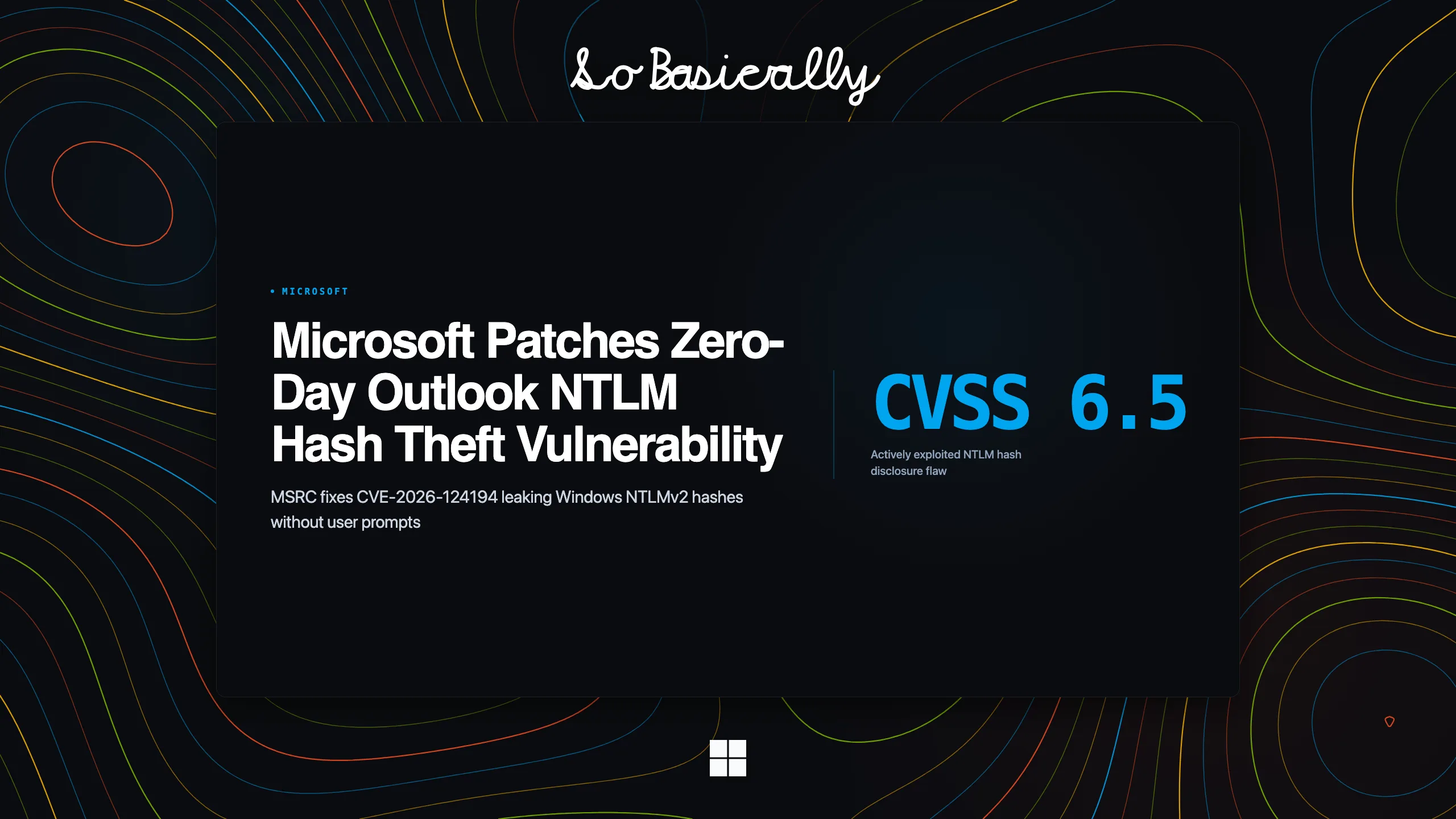
Microsoft patches actively exploited zero-day Outlook NTLM hash theft vulnerability

Topographic elevation contour card for Microsoft patches actively exploited zero-day Outlook NTLM hash theft vulnerability

What happened.Microsoft addressed an actively exploited zero-day spoofing vulnerability in Outlook during its monthly security update cycle.

Why it matters.Desktop email clients serve as standard workspace hubs across corporate environments. When opening a file triggers silent background authentication without user consent, attackers harvest password hashes to access internal corporate networks. System administrators must deploy monthly Office patches across all enterprise endpoints. Security operations teams should block outbound SMB port 445 traffic at the network perimeter.

Read Full Brief →
Source:CISA (opens in a new tab)
VERIFIED STORIES IN THIS EDITION7 STORIES
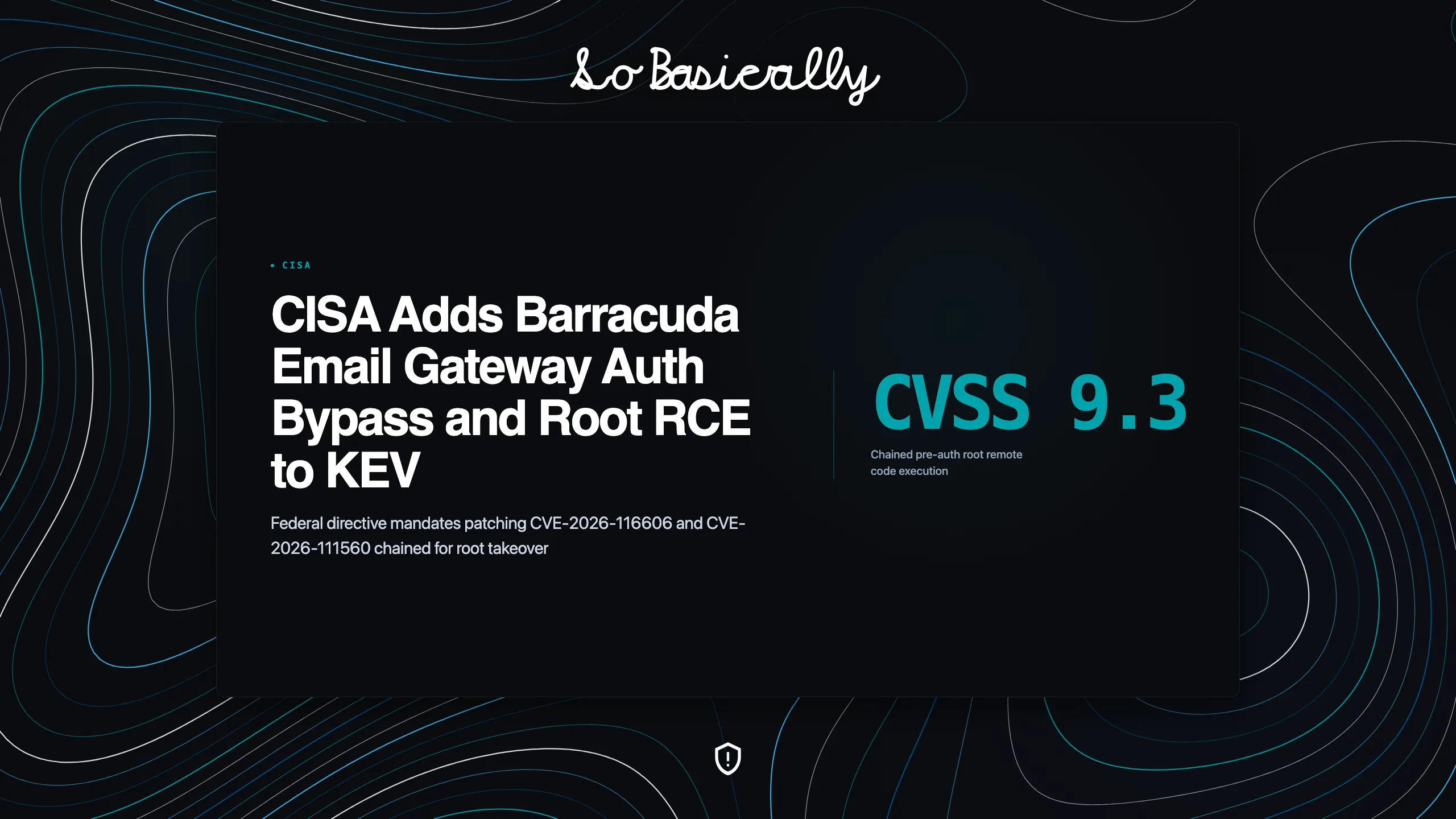
Decision brief card for CISA adds chained Barracuda Email Gateway auth bypass and root RCE flaws to KEV catalog

CISA adds chained Barracuda Email Gateway auth bypass and root RCE flaws to KEV catalog

What happened.CISA ordered federal agencies to patch chained authentication bypass and command injection vulnerabilities in Barracuda Email Security Gateway appliances.

Why it matters.Edge email gateways inspect inbound traffic at corporate perimeters. When chained flaws yield root execution, attackers decrypt traffic and establish persistent footholds. Infrastructure teams must apply firmware updates immediately and restrict management access from public routing.

  • Vulnerability mechanics: Tracked as CVE-2026-116606 and CVE-2026-111560, the flaws affect appliance backup restoration and timezone configuration parsing.
  • Exploit chain: Remote attackers exploit the alternate path authorization bypass on administrative interfaces to restore crafted backups without credentials.
  • Root execution: Intruders subsequently pass shell metacharacters into timezone fields to execute arbitrary commands with root privileges.
  • Appliance impact: While authorization bypass affects email gateways, the command injection flaw spans Barracuda load balancers, firewalls, and archivers.
  • Remediation releases: Barracuda released firmware update 9.4.0.030 alongside hotfixes BNSF-40425 and BNSF-40430, advising teams to restrict management access.
Official Source:NIST NVD
Decision brief card for CISA adds chained Barracuda Email Gateway auth bypass and root RCE flaws to KEV catalog
Read Brief
Source:NIST NVD (opens in a new tab)
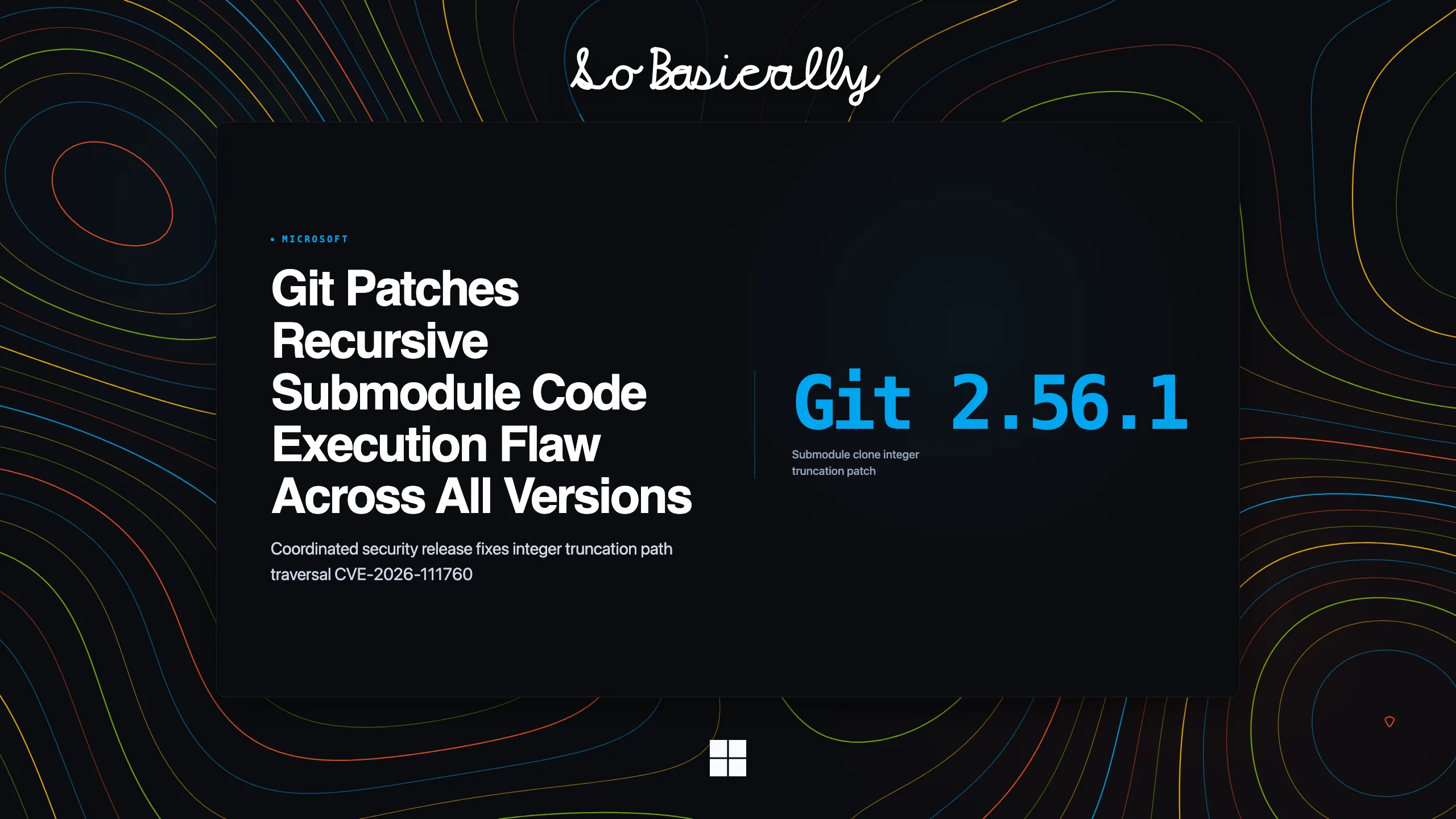
Decision brief card for Git patches recursive submodule arbitrary code execution flaw across all versions

Git patches recursive submodule arbitrary code execution flaw across all versions

What happened.The Git project and GitHub released coordinated maintenance updates fixing six vulnerabilities headed by an integer truncation code execution flaw.

Why it matters.Engineering teams clone external repositories daily during normal development and automated builds. When recursive submodule checkout triggers arbitrary code execution, attackers compromise developer workstations and build runners. Engineering teams must upgrade local Git tools and continuous integration container images immediately.

  • Vulnerability mechanics: Tracked as CVE-2026-111760, an integer truncation bug in index path handling lets deeply nested paths bypass sanitization checks.
  • Submodule exploitation: Attackers substitute a submodule git directory file with a symbolic link pointing to a malicious directory containing hook scripts.
  • Execution vector: When developers recursively clone an untrusted repository, Git follows the link and executes arbitrary commands during checkout.
  • Protocol vulnerabilities: The release also fixes CVE-2026-113408, a path traversal defect triggered through advertised symbolic references over Git protocol v2.
  • Remediation releases: Patches shipped in Git 2.56.1 and backported across maintenance branches 2.55.1, 2.54.1, 2.53.1, 2.52.1, 2.51.3, and 2.50.2.
Official Source:GitHub Blog
Decision brief card for Git patches recursive submodule arbitrary code execution flaw across all versions
Read Brief
Source:GitHub Blog (opens in a new tab)
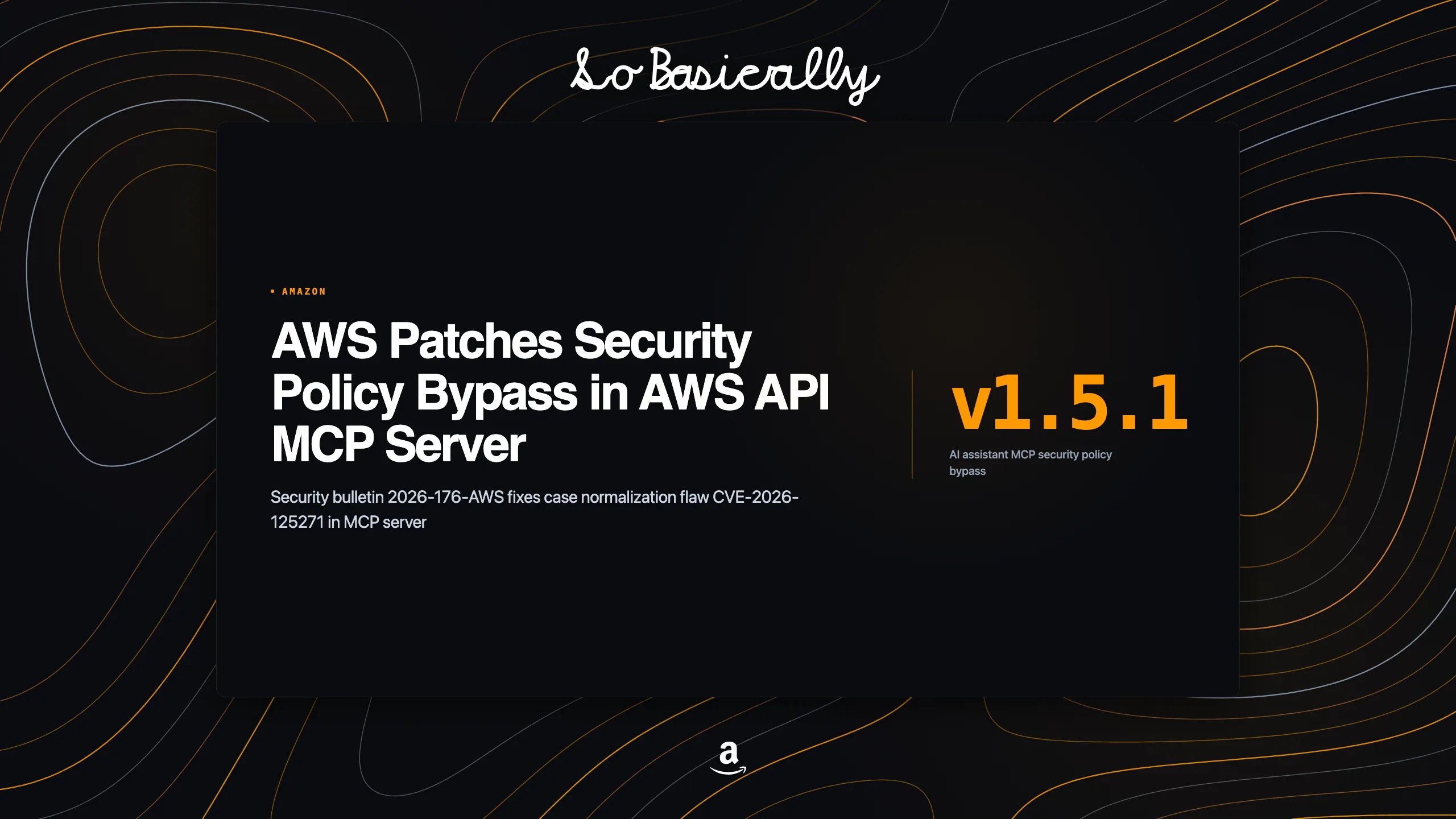
Decision brief card for AWS patches security policy bypass in AWS API MCP Server allowing unauthorized tool calls

AWS patches security policy bypass in AWS API MCP Server allowing unauthorized tool calls

What happened.Amazon Web Services published security bulletin 2026-176-AWS detailing a policy bypass vulnerability in its open-source Model Context Protocol server.

Why it matters.Model Context Protocol servers give artificial intelligence assistants programmatic access to cloud APIs. When case normalization errors let API calls bypass deny lists, autonomous agents execute destructive actions without required approvals. Cloud engineers must upgrade AWS API MCP servers to version 1.5.1 immediately.

  • Vulnerability mechanics: Tracked as CVE-2026-125271 and GHSA-4wq9-grf3-qg2p, the defect affects security policy enforcement in awslabs.aws-api-mcp-server versions 0.2.13 through 1.5.0.
  • Normalization failure: The server normalizes operation names incorrectly when evaluating API calls containing consecutive capital letters against configured policies.
  • Policy evasion: Affected operations fail to match operator denyList rules, allowing artificial intelligence assistants to execute prohibited API actions without approval.
  • Remediation release: AWS resolved the issue in version 1.5.1 by correcting operation name casing conversion before policy evaluation.
  • Operational guidance: AWS confirmed no workaround exists, advising all teams running containerized or local MCP servers to upgrade immediately.
Official Source:AWS Security Bulletins
Decision brief card for AWS patches security policy bypass in AWS API MCP Server allowing unauthorized tool calls
Read Brief
Source:AWS Security Bulletins (opens in a new tab)
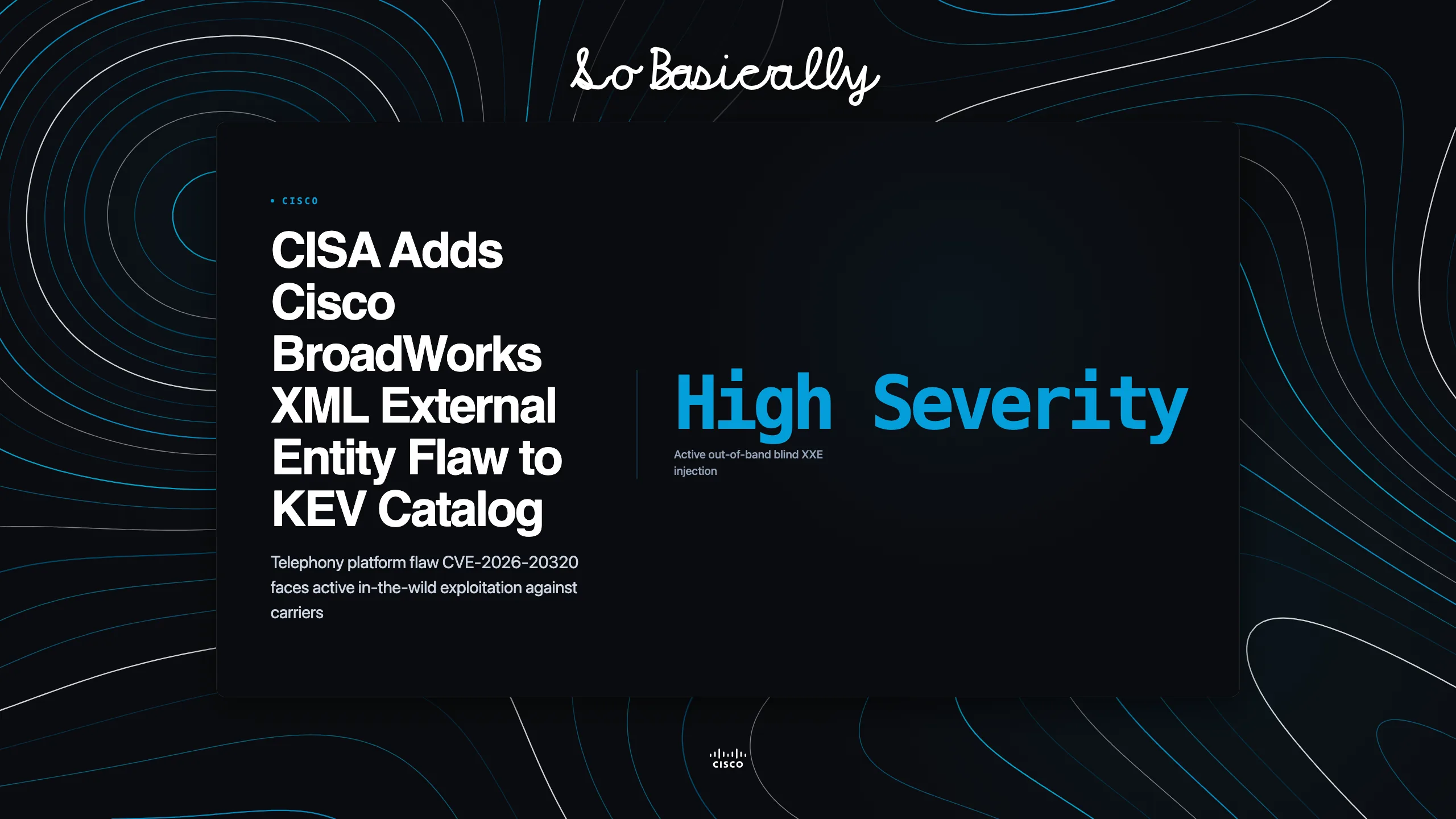
Decision brief card for CISA adds Cisco BroadWorks XML external entity flaw to KEV catalog amid active attacks

CISA adds Cisco BroadWorks XML external entity flaw to KEV catalog amid active attacks

What happened.CISA added an out-of-band blind XML external entity injection vulnerability in Cisco BroadWorks to its Known Exploited Vulnerabilities catalog.

Why it matters.Cisco BroadWorks provides session control backbones for telecommunications carriers and large enterprise phone networks. When unauthenticated XML payloads force servers to leak configuration files, threat actors intercept carrier communications. Telecommunications engineers must apply Cisco BroadWorks maintenance patches immediately and restrict management port access.

  • Vulnerability mechanics: Tracked as CVE-2026-20320, the defect resides in the Open Client Interface XML parser of Cisco BroadWorks application delivery platforms.
  • Exploit method: Unauthenticated remote attackers send crafted XML messages to network ports, forcing the server to read files and open outbound channels.
  • Data exfiltration: Threat actors leverage out-of-band responses to extract sensitive configuration data, cryptographic tokens, and subscriber records.
  • Exploitation confirmation: CISA confirmed active in-the-wild exploitation against telecommunications providers, setting a federal remediation deadline under BOD 26-04.
  • Remediation releases: Cisco released software maintenance fixes across BroadWorks Release 23.0 and Release 24.0, noting access control lists can limit port exposure.
Official Source:NIST NVD
Decision brief card for CISA adds Cisco BroadWorks XML external entity flaw to KEV catalog amid active attacks
Read Brief
Source:NIST NVD (opens in a new tab)
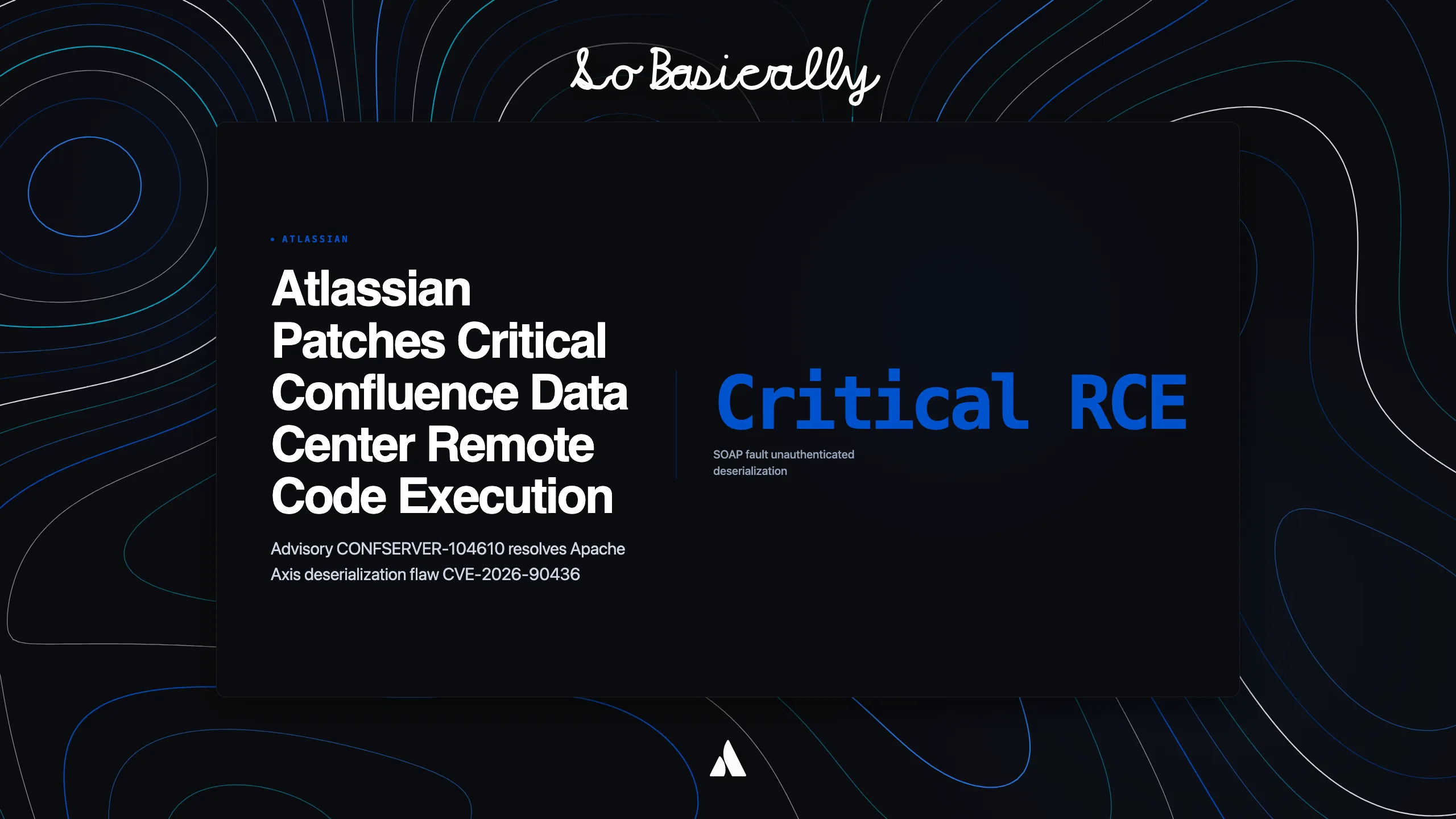
Decision brief card for Atlassian patches critical Confluence Data Center remote code execution vulnerability

Atlassian patches critical Confluence Data Center remote code execution vulnerability

What happened.Atlassian published security advisory CONFSERVER-104610 resolving an unauthenticated remote code execution vulnerability affecting Confluence Data Center deployments.

Why it matters.Confluence Data Center hosts proprietary design documents and internal engineering wikis for enterprise teams. When unauthenticated SOAP requests trigger class deserialization and remote code execution, attackers compromise application servers. Infrastructure engineers should upgrade Confluence Data Center instances immediately and disable legacy XML-RPC endpoints.

  • Vulnerability mechanics: Tracked as CVE-2026-90436, the defect stems from unsafe deserialization in the Apache Axis library inside Confluence SOAP and XML-RPC interfaces.
  • Attack vector: Remote unauthenticated attackers send crafted SOAP fault requests to the Remote API endpoint, instantiating arbitrary Java classes before authentication checks.
  • Configuration dependency: Systems remain vulnerable when administrators enable the Remote API setting, which legacy integrations frequently activate for scripting.
  • Remediation releases: Atlassian delivered fixes in Confluence Data Center versions 9.2.28, 10.2.21, and subsequent maintenance releases.
  • Workaround guidance: Administrators unable to upgrade immediately can mitigate exposure by disabling the Remote API setting through the general configuration console.
Official Source:Atlassian Security Advisories
Decision brief card for Atlassian patches critical Confluence Data Center remote code execution vulnerability
Read Brief
Source:Atlassian Security Advisories (opens in a new tab)
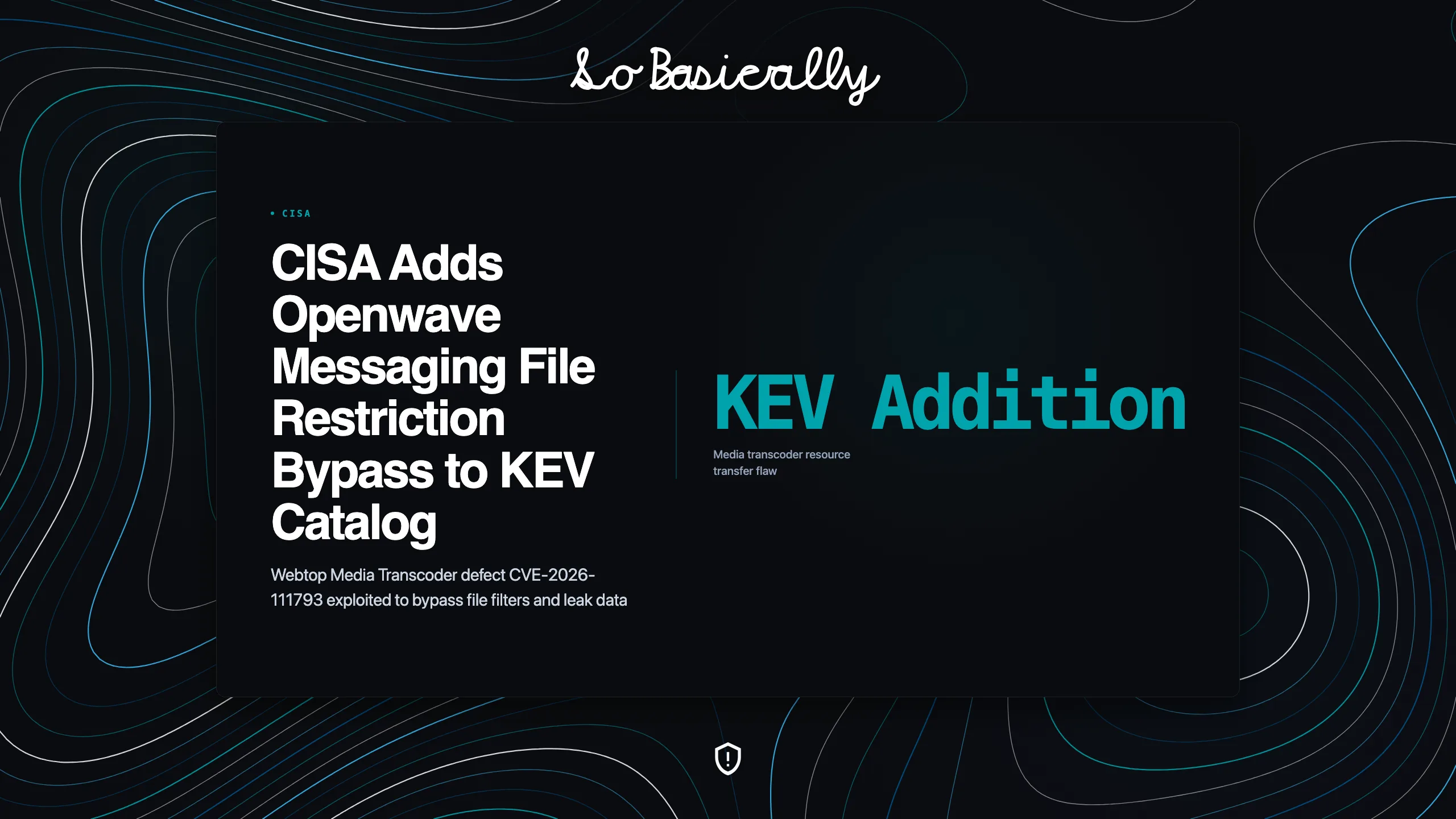
Decision brief card for CISA adds Openwave Messaging file restriction bypass flaw to KEV catalog after active attacks

CISA adds Openwave Messaging file restriction bypass flaw to KEV catalog after active attacks

What happened.CISA added an actively exploited document handling flaw in Openwave Messaging Webtop Media Transcoder to its Known Exploited Vulnerabilities catalog.

Why it matters.Enterprise messaging platforms rely on media transcoders to convert attachments into browser-safe formats for webmail users. When direct API submissions bypass administrative file filters, attackers force transcoders to process forbidden formats and expose sensitive message metadata. Messaging engineers must deploy Openwave version 1.1.22.0 immediately and isolate transcoder ports.

  • Vulnerability mechanics: Tracked as CVE-2026-111793 with a 4.3 CVSS score, the defect represents an incorrect resource transfer flaw during file conversion operations.
  • Restriction bypass: Attackers bypass webmail interface filters and upload crafted document structures directly to the media transcoder service component.
  • Information disclosure: The transcoder processes disallowed document types, exposing internal server memory buffers and message metadata during conversion cycles.
  • Exploitation status: International coordination authorities reported active in-the-wild exploitation campaigns targeting enterprise webmail environments.
  • Remediation releases: Openwave Messaging released software updates in version 1.1.22.0, while CISA established a federal remediation deadline under BOD 26-04.
Official Source:NIST NVD
Decision brief card for CISA adds Openwave Messaging file restriction bypass flaw to KEV catalog after active attacks
Read Brief
Source:NIST NVD (opens in a new tab)
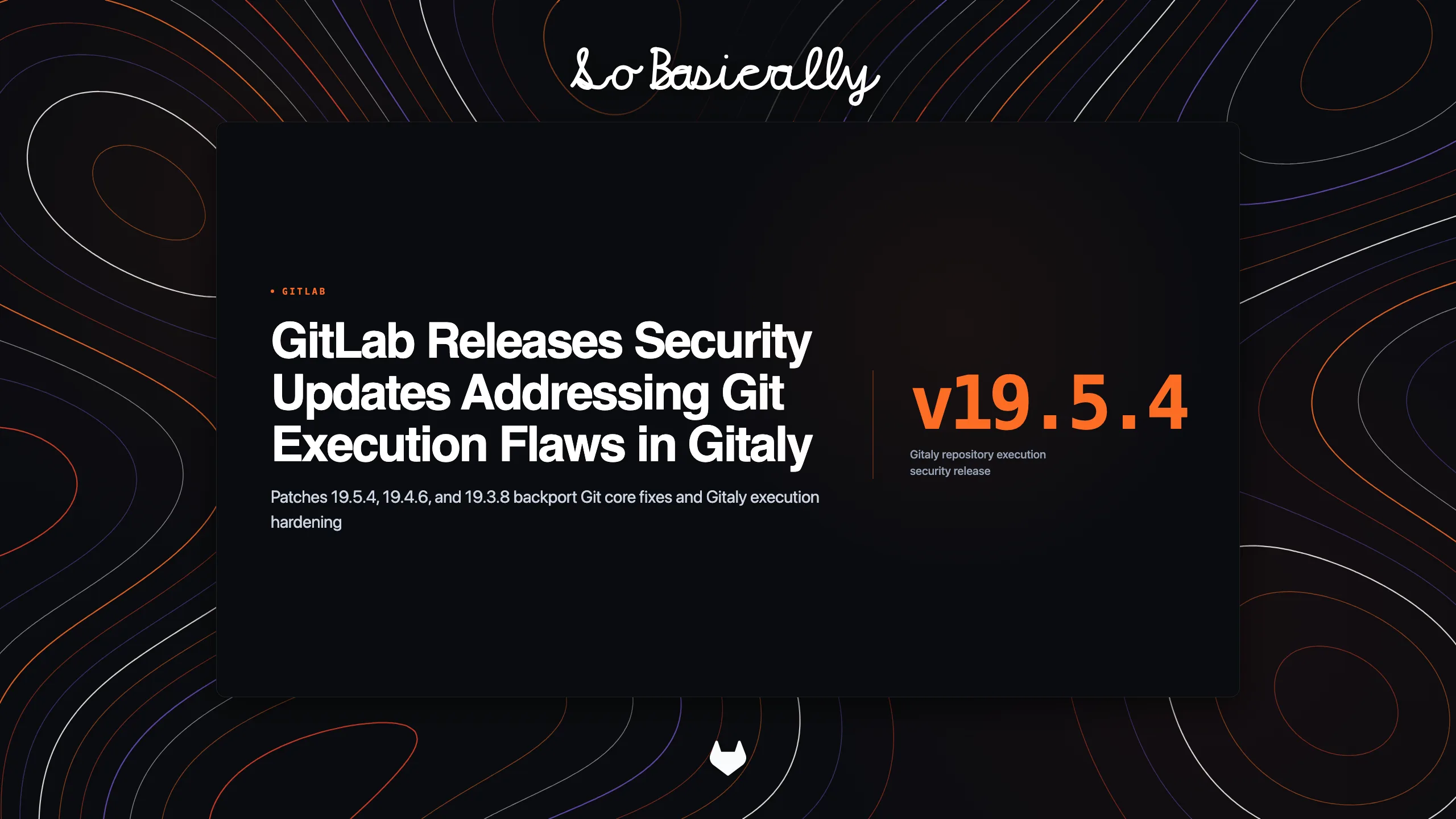
Decision brief card for GitLab releases security updates addressing Git execution flaws in Gitaly engine

GitLab releases security updates addressing Git execution flaws in Gitaly engine

What happened.GitLab published security maintenance releases for Community Edition and Enterprise Edition addressing Git execution flaws in the Gitaly service engine.

Why it matters.Self-managed GitLab instances serve as central source code repositories and deployment automation platforms. When repository service engines inherit Git execution flaws, malicious repository imports compromise host infrastructure and expose proprietary source code. DevOps teams must upgrade self-managed GitLab instances to versions 19.5.4, 19.4.6, or 19.3.8 immediately.

  • Remediation versions: Updates shipped in versions 19.5.4, 19.4.6, and 19.3.8 for both self-managed Community Edition and Enterprise Edition deployments.
  • Gitaly integration: The updates patch the underlying Gitaly service engine, incorporating upstream Git fixes for recursive clone integer truncation defect CVE-2026-111760.
  • Execution hardening: The release resolves CVE-2026-105437, an issue where malformed repository configurations could trigger unexpected process execution paths during repository synchronization.
  • Continuous integration updates: The builds deliver bundled security hardening for continuous integration runner execution environments and external repository mirroring tasks.
  • Upgrade priority: GitLab designated the releases as strongly recommended for all self-managed instances to prevent remote attackers from abusing repository import routines.
Official Source:GitLab Security
Decision brief card for GitLab releases security updates addressing Git execution flaws in Gitaly engine
Read Brief
Source:GitLab Security (opens in a new tab)
CANDIDATE INTELLIGENCE · UNVERIFIED LEADS

The Discovery Wire · Unverified Attention Signals

Candidate storylines identified across developer channels. Under newsroom canon, attention never establishes fact; these leads remain quarantined until supported by Tier 1 official records.

DEVELOPER WIRE

Palo Alto Networks PAN-OS GlobalProtect user impersonation (CVE-2026-0328)

Security teams update PAN-OS instances after vendor warned unauthenticated attackers can impersonate users and establish unauthorized VPN connections when third-party VPN clients are enabled.

STATUS:Awaiting official documentation or verification criteria.
DEVELOPER WIRE

Palo Alto Networks Panorama authenticated root RCE (CVE-2026-0330)

Network infrastructure engineers restrict Panorama management interfaces following disclosure of authenticated remote code execution with root privileges.

STATUS:Awaiting official documentation or verification criteria.
DEVELOPER WIRE

SAP Security Patch Day four CVSS 10.0 vulnerabilities

Enterprise administrators prioritize urgent kernel and Web Dispatcher updates after SAP patched critical remote code execution flaws across NetWeaver ICM, Web Dispatcher, and SAML2 service providers.

STATUS:Awaiting official documentation or verification criteria.
DEVELOPER WIRE

AWS ParallelCluster CLI relative path traversal flaw (CVE-2026-124033)

DevOps engineers update aws-parallelcluster CLI to 3.16.0 to prevent crafted S3 bucket object keys from overwriting local filesystem binaries during log export.

STATUS:Awaiting official documentation or verification criteria.
DEVELOPER WIRE

Microsoft Paint out-of-bounds read remote code execution flaw (CVE-2026-83844)

Enterprise administrators verify Windows Paint updates to version 11.2609.401.0 via Microsoft Store after MSRC updated guidance on decoupled utility servicing.

STATUS:Awaiting official documentation or verification criteria.
DEVELOPER WIRE

SignalWire FreeSWITCH inbound SIP message command injection flaw (CVE-2026-116779)

Telephony infrastructure operators update to FreeSWITCH 1.11.3 or disable chat API protocols following active exploitation and CISA KEV listing.

STATUS:Awaiting official documentation or verification criteria.
DEVELOPER WIRE

WordPress Contact Form 7 unauthenticated arbitrary file upload flaw (CVE-2026-114432)

Web application engineers update to Contact Form 7 version 6.2.4 to eliminate unauthenticated file upload and remote code execution vulnerabilities in file form fields.

STATUS:Awaiting official documentation or verification criteria.
DEVELOPER WIRE

Progress WS_FTP Server insecure credential storage and XFT transport flaws (CVE-2026-115340, CVE-2026-115338)

Windows infrastructure administrators update to WS_FTP Server version 2025.0.5 to prevent plaintext credential harvesting from temporary files and unencrypted data transmission.

STATUS:Awaiting official documentation or verification criteria.
DEVELOPER WIRE

Cisco UCS Central Software authenticated path traversal remote code execution (CVE-2026-76506)

Data center administrators upgrade Cisco UCS Central Software installations following disclosure of high-severity arbitrary file upload and code execution flaws.

STATUS:Awaiting official documentation or verification criteria.
DEVELOPER WIRE

OpenSSH sshole authentication bypass exploitation across musl libc environments (CVE-2026-123158)

Threat intelligence teams monitor automated vulnerability scanning targeting Alpine Linux containers running OpenSSH builds without PAM against musl libc.

STATUS:Awaiting official documentation or verification criteria.
DEVELOPER WIRE

WordPress Core TOCTOU race condition flaw active scanning (CVE-2026-119977)

Security operations teams monitor internet-facing sites for automated exploit scripts probing predictable upgrade staging paths under wp-content/upgrade during core updates.

STATUS:Awaiting official documentation or verification criteria.
DEVELOPER WIRE

Ethersphere bee-js release workflow supply chain compromise (GHSA-hh7j-5m3j-23pf)

Node operators and Web3 developers purge version 13.3.0 and roll back to 13.2.0 after attackers hijacked GitHub release workflows to distribute the SleepyDuck credential exfiltration backdoor.

STATUS:Awaiting official documentation or verification criteria.
DEVELOPER WIRE

Qubole AWS cross-account IAM credential compromise

Cloud security teams audit AWS CloudTrail logs for unauthorized AssumeRole activity after attackers abused third-party platform trust relationships to exfiltrate customer cloud data.

STATUS:Awaiting official documentation or verification criteria.
DEVELOPER WIRE

AWS Amplify MapLibre popup component stored cross-site scripting (CVE-2026-121652)

Frontend engineering teams update to maplibre-gl-js-amplify 4.0.3 to prevent client-side JavaScript execution via unsanitized GeoJSON marker properties.

STATUS:Awaiting official documentation or verification criteria.
DEVELOPER WIRE

Ruby on Rails Active Storage ImageMagick arbitrary file read/write (GHSA-f3w6-w445-fwh9 / CVE-2026-122006)

Web application engineers update to Rails 8.1.4.1 and 8.0.5.2 to eliminate unauthenticated file write and secret extraction flaws in mini_magick variant processing.

STATUS:Awaiting official documentation or verification criteria.
DEVELOPER WIRE

OpsShield cPGuard Update Supply Chain Compromise

Hosting providers audit servers running cPGuard v5.88.12 through v5.88.19 after attackers breached the update CDN to exfiltrate passwords and SSH keys.

STATUS:Awaiting official documentation or verification criteria.