Skip to content
SoBasicallyVOL. I · RUN 2026-11-10-cybersecurity-advisories
ARCHIVAL EDITION2026-11-10-cybersecurity-advisories8 STORIES · 1720 WORDS
← Back to Archive

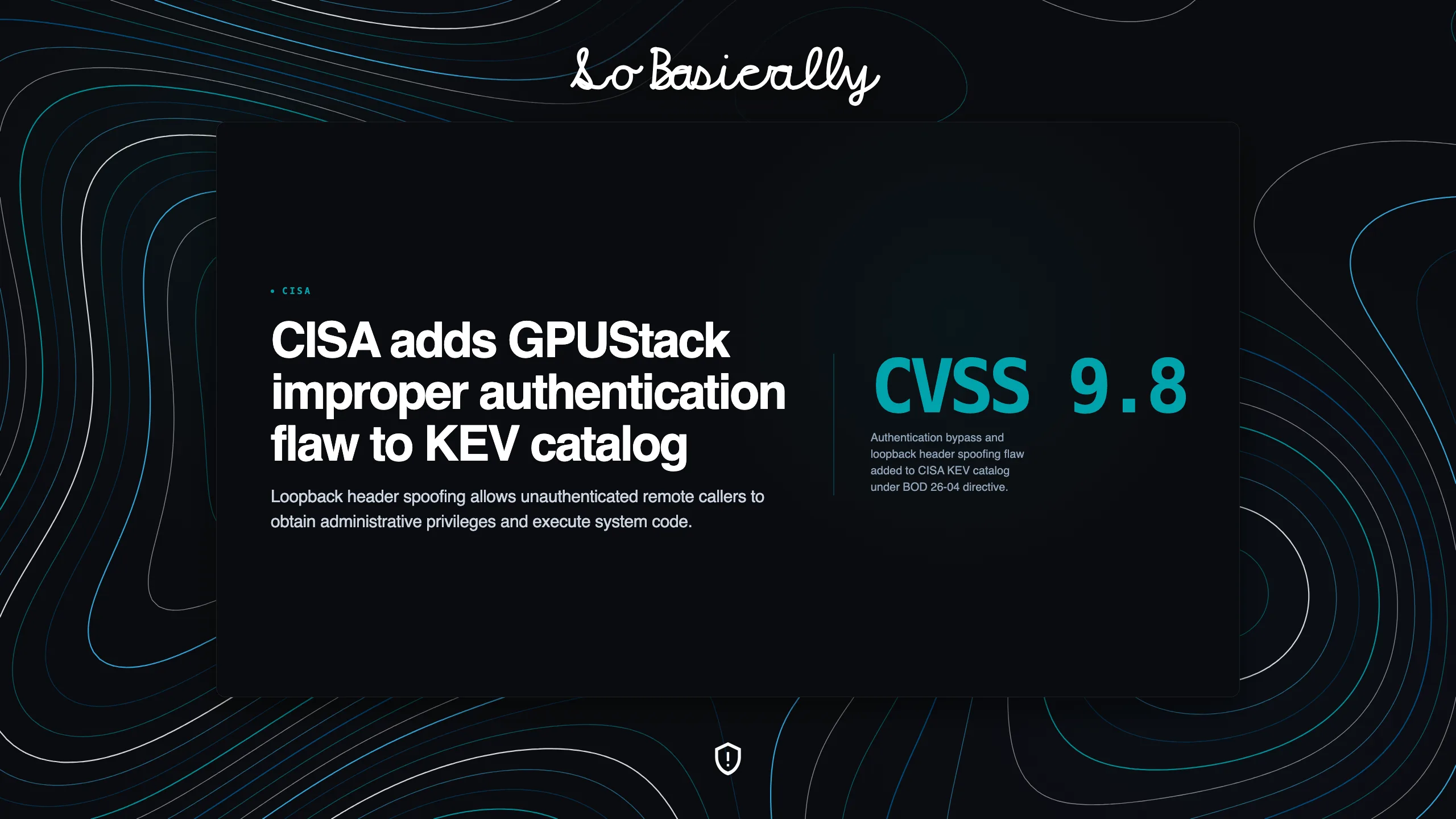
CISA adds GPUStack improper authentication flaw to KEV catalog

Topographic elevation contour card for CISA adds GPUStack improper authentication flaw to KEV catalog

What happened.The Cybersecurity and Infrastructure Security Agency added an actively exploited authentication bypass vulnerability in GPUStack to its Known Exploited Vulnerabilities catalog.

Why it matters.GPUStack orchestrates graphics processing clusters for large language model inference workloads. When reverse-proxy header spoofing grants administrative control, attackers hijack compute infrastructure and steal proprietary model weights. Platform engineers must upgrade GPUStack deployments to version 2.2.0 immediately. Administrators should ensure loopback proxy authentication is strictly enforced across internal load balancers.

Read Full Brief →
Source:NIST NVD (opens in a new tab)
VERIFIED STORIES IN THIS EDITION7 STORIES
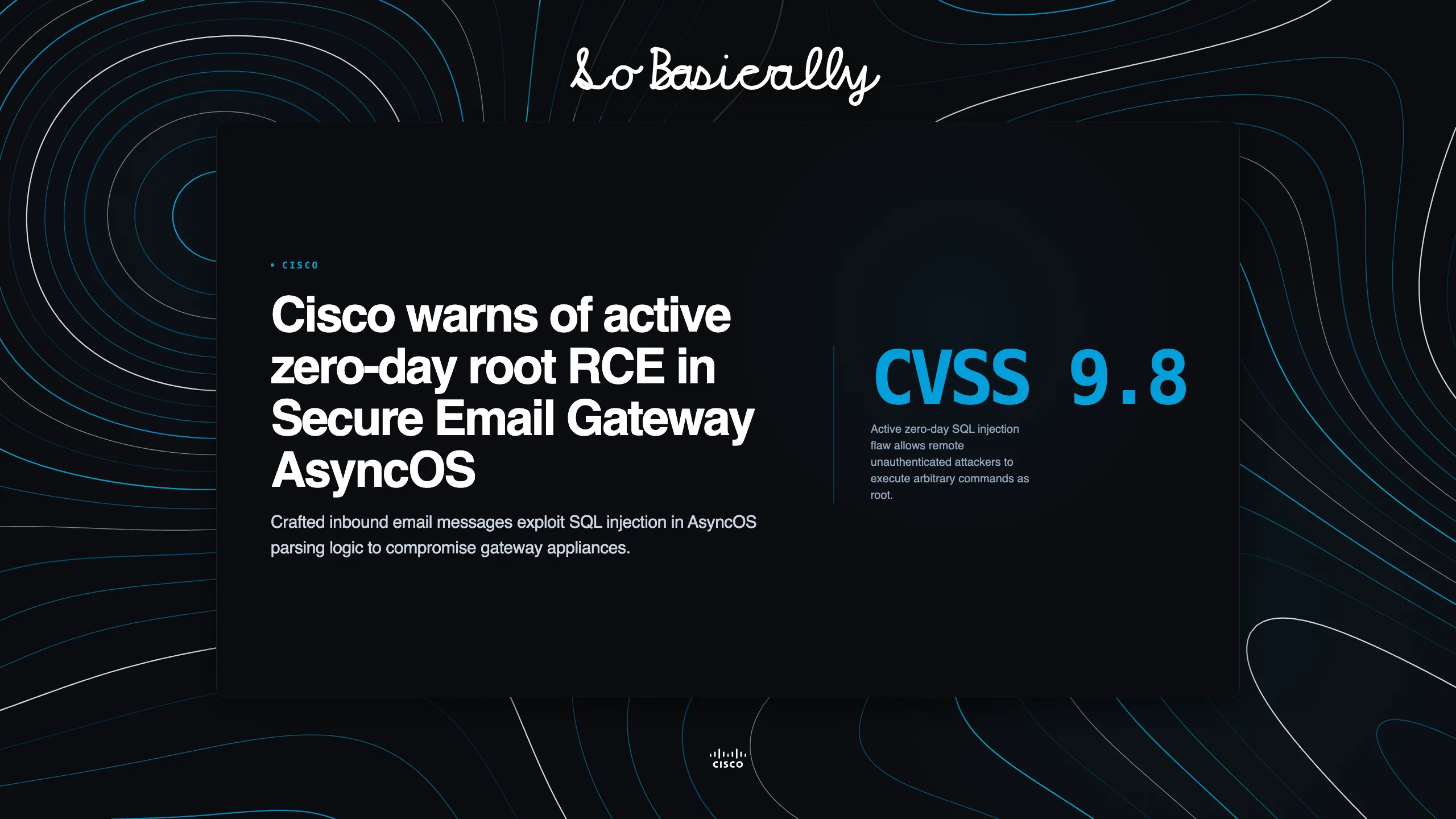
Decision brief card for Cisco warns of active zero-day root RCE in Secure Email Gateway AsyncOS

Cisco warns of active zero-day root RCE in Secure Email Gateway AsyncOS

What happened.Cisco published an emergency advisory warning of an actively exploited zero-day command injection flaw affecting Cisco Secure Email Gateway appliances.

Why it matters.Secure Email Gateway appliances filter inbound and outbound email traffic for enterprise communications. When incoming email parsing triggers root remote code execution, unauthenticated attackers compromise corporate email infrastructure and pivot into enterprise networks. Infrastructure teams must apply Cisco AsyncOS maintenance releases immediately. Security operations engineers should inspect mail logs for unauthorized command patterns.

  • Vulnerability mechanics: Tracked as CVE-2026-76461 with a 9.8 CVSS score, the defect stems from improper input validation during email message parsing in AsyncOS.
  • Attack vector: Remote unauthenticated attackers send crafted email messages containing malicious database commands directly through targeted appliances.
  • Root execution: The injected SQL commands execute with root privileges on the underlying operating system without requiring administrative authentication.
  • Exploitation detection: Administrators can audit text mail logs for suspicious COPY TO PROGRAM entries to detect active exploitation attempts.
  • Remediation releases: Cisco released AsyncOS maintenance builds 15.5.5-014, 16.0.4-302, and 16.5.0-780, confirming no workarounds exist.
Official Source:Cisco
Decision brief card for Cisco warns of active zero-day root RCE in Secure Email Gateway AsyncOS
Read Brief
Source:Cisco (opens in a new tab)
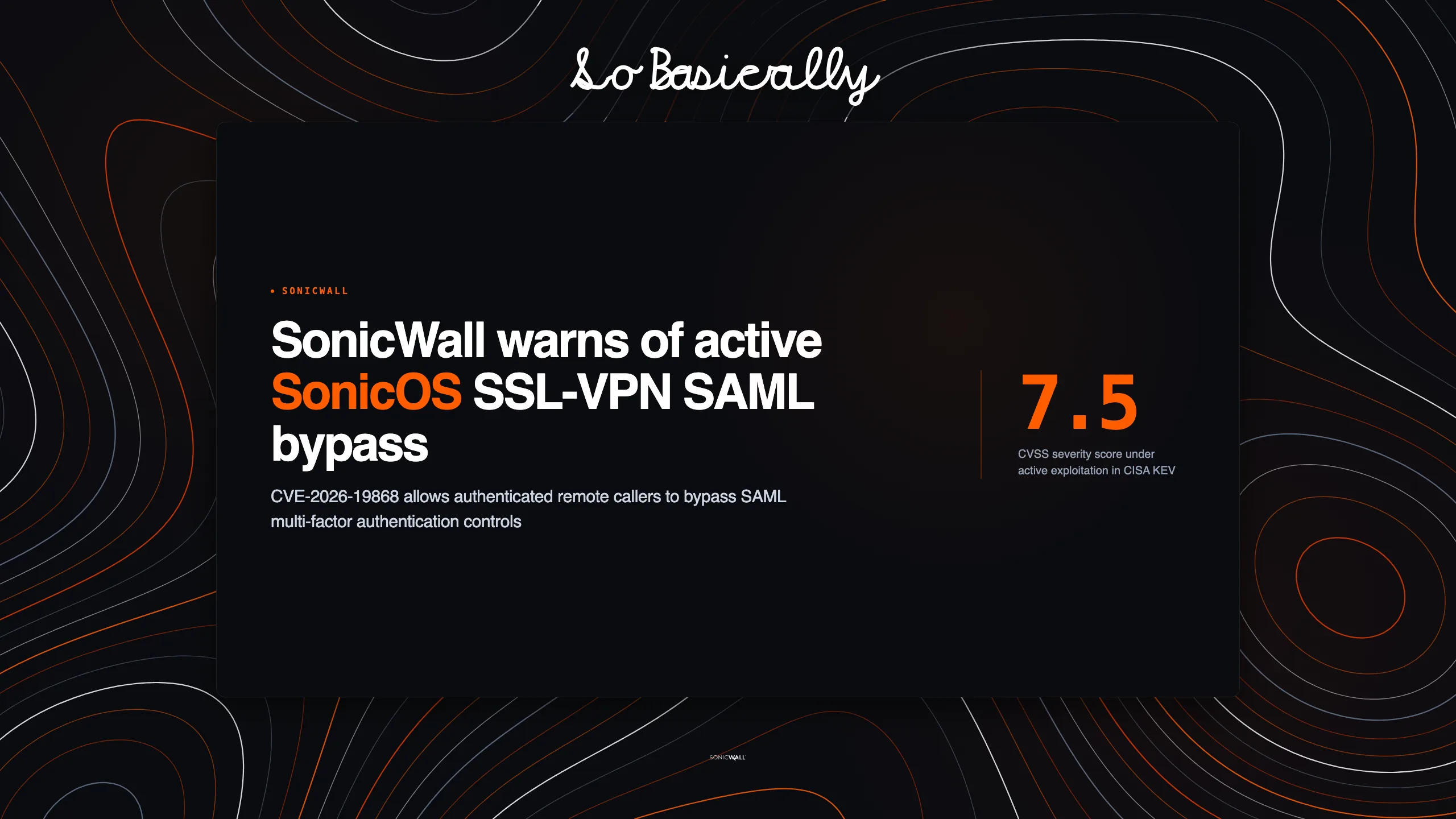
Decision brief card for SonicWall warns of active SonicOS SSL-VPN SAML bypass

SonicWall warns of active SonicOS SSL-VPN SAML bypass

What happened.SonicWall released emergency security advisory SNWLID-2026-0014 warning of an actively exploited authentication bypass defect in SonicOS SSL-VPN.

Why it matters.Enterprise security perimeters rely on firewall SSL-VPN portals to shield corporate internal networks from unauthorized access. When alternate credential paths bypass SAML authentication checks, external attackers compromise private cloud resources and pivot into enterprise databases. Network security engineers must apply SonicOS maintenance firmware releases immediately. IT administrators should verify that WAN management interfaces remain restricted to trusted administrative IP addresses.

  • Vulnerability mechanics: Tracked as CVE-2026-19868 with a 7.5 CVSS score, the defect allows attackers to bypass security assertion markup language authentication.
  • Trigger conditions: The vulnerability occurs when administrators configure the SonicOS SSL-VPN gateway service with external SAML authentication enabled.
  • Multi-factor evasion: Authenticated network callers using alternate credential paths skip secondary identity challenges to access internal network assets directly.
  • Federal directive: The Cybersecurity and Infrastructure Security Agency added the vulnerability to its Known Exploited Vulnerabilities catalog under Binding Operational Directive 26-04.
  • Remediation releases: SonicWall published maintenance firmware hotfixes across affected appliance lines, advising operators to restrict public management access until completing patch deployment.
Official Source:SonicWall
Decision brief card for SonicWall warns of active SonicOS SSL-VPN SAML bypass
Read Brief
Source:SonicWall (opens in a new tab)
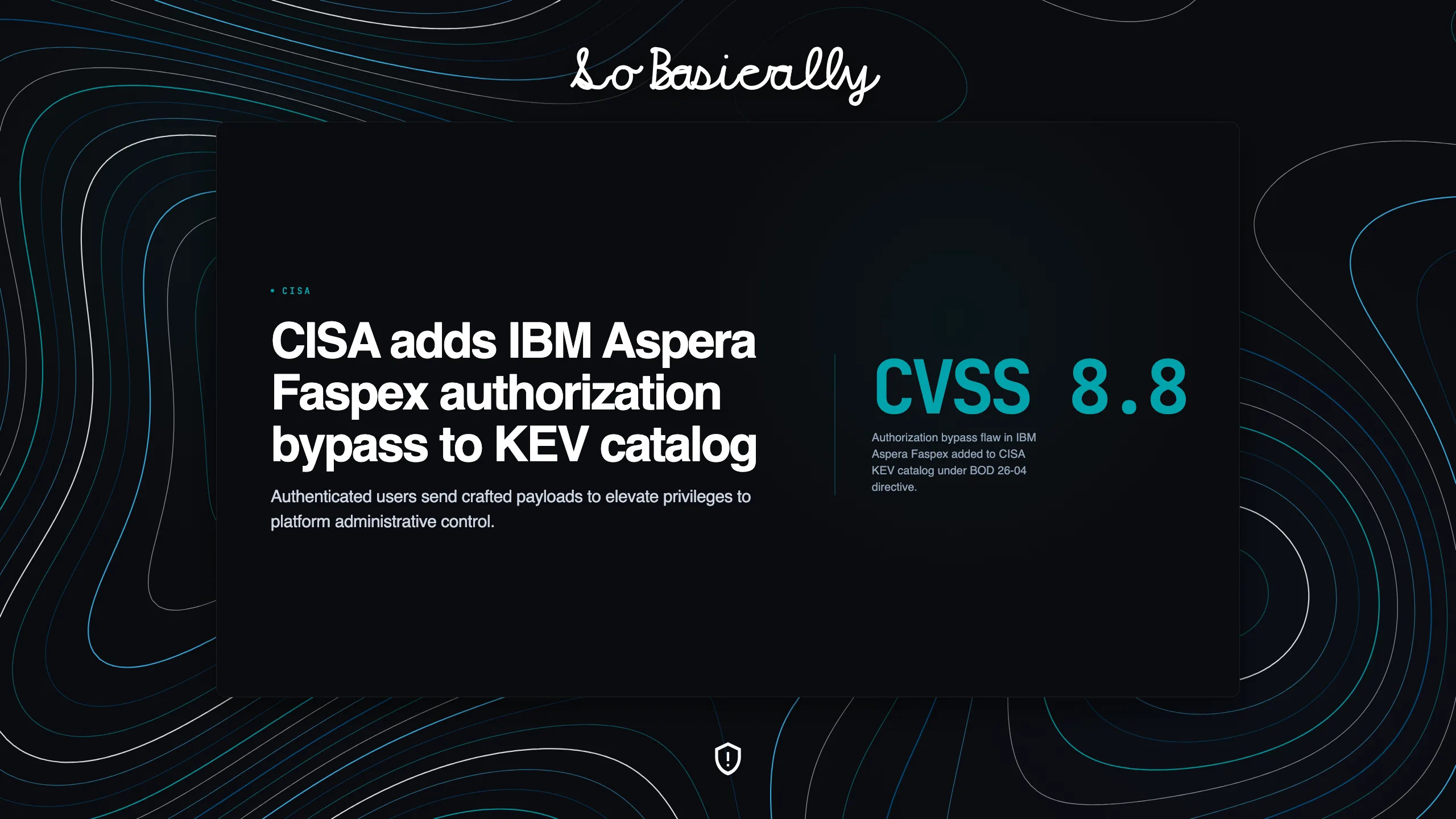
Decision brief card for CISA adds IBM Aspera Faspex authorization bypass to KEV catalog

CISA adds IBM Aspera Faspex authorization bypass to KEV catalog

What happened.The Cybersecurity and Infrastructure Security Agency added an actively exploited incorrect authorization vulnerability in IBM Aspera Faspex to its Known Exploited Vulnerabilities catalog.

Why it matters.IBM Aspera Faspex transfers large data packages and media archives across corporate hybrid cloud topologies. When authenticated users elevate privileges to platform administrators, attackers exfiltrate proprietary enterprise datasets and manipulate package delivery workflows. Infrastructure engineering leads should upgrade Aspera Faspex servers to version 5.0.20 or later. Security teams should audit user role assignments across transfer clusters.

  • Vulnerability mechanics: Tracked as CVE-2026-123218 with an 8.8 CVSS score, an incorrect authorization defect allows authenticated users to bypass permission boundaries.
  • Exploitation impact: Authenticated attackers send crafted API payloads to escalate privileges to full administrative control across the file exchange platform.
  • Affected deployments: The defect impacts IBM Aspera Faspex versions 5.0.0 through 5.0.19 running across enterprise data transfer environments.
  • Federal directive: CISA mandated that Federal Civilian Executive Branch agencies remediate the flaw under Binding Operational Directive 26-04.
  • Remediation update: IBM released maintenance updates addressing the authorization check, urging administrators to upgrade past version 5.0.19.
Official Source:NIST NVD
Decision brief card for CISA adds IBM Aspera Faspex authorization bypass to KEV catalog
Read Brief
Source:NIST NVD (opens in a new tab)
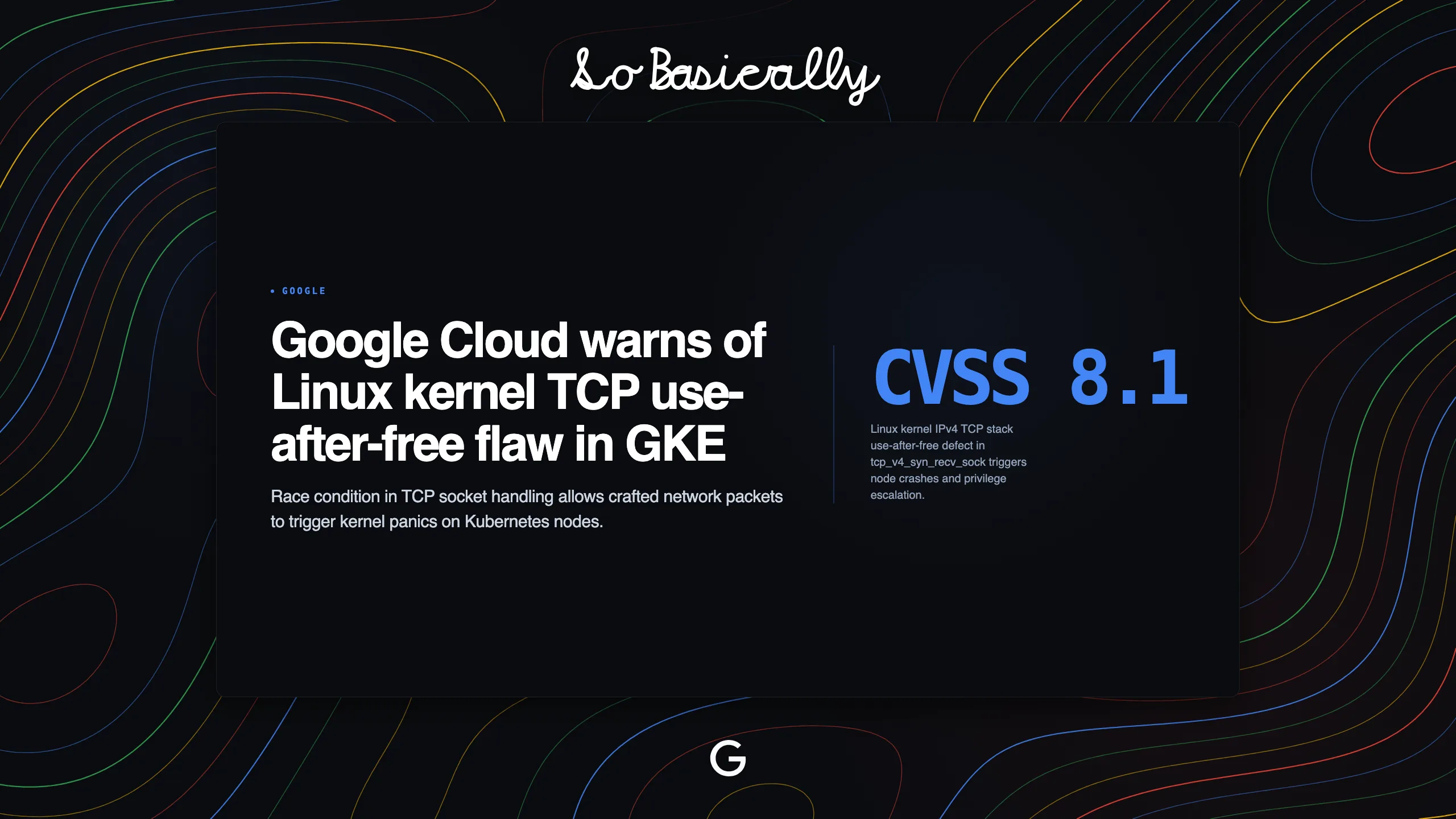
Decision brief card for Google Cloud warns of Linux kernel TCP use-after-free flaw in GKE

Google Cloud warns of Linux kernel TCP use-after-free flaw in GKE

What happened.Google Cloud published security bulletin GCP-2026-077 detailing a Linux kernel networking use-after-free vulnerability affecting Google Kubernetes Engine clusters.

Why it matters.Kubernetes worker nodes run shared container workloads across cloud environments. When external TCP handshakes corrupt kernel socket structures, attackers crash worker nodes or escape container boundaries to gain host root privileges. Cloud platform teams must upgrade GKE node images immediately. Infrastructure operators should audit VPC firewalls to block public ingress to node IP ranges.

  • Vulnerability mechanics: Tracked as CVE-2026-98432 with an 8.1 CVSS score, the defect involves a race condition in the IPv4 TCP stack receive socket function.
  • Trigger conditions: Remote network attackers send crafted IPv4 TCP packets containing custom IP options to open network listeners on Kubernetes worker nodes.
  • Impact scope: The memory corruption triggers kernel crashes or node-level privilege escalation, impacting GKE Standard and Autopilot clusters.
  • Cloud mitigations: Google Cloud began rolling out patched node images and recommended restricting external TCP access via VPC firewall rules.
  • Customer action: Cluster administrators must upgrade GKE node pools and block untrusted public traffic to node TCP listeners.
Official Source:Google Cloud
Decision brief card for Google Cloud warns of Linux kernel TCP use-after-free flaw in GKE
Read Brief
Source:Google Cloud (opens in a new tab)
Decision brief card for AWS patches relative path traversal flaw in ParallelCluster CLI

AWS patches relative path traversal flaw in ParallelCluster CLI

What happened.Amazon Web Services published security bulletin 2026-174-AWS resolving a relative path traversal vulnerability in the AWS ParallelCluster command-line interface.

Why it matters.AWS ParallelCluster deploys high-performance computing clusters for scientific simulation and engineering research. When log extraction commands permit arbitrary file writes, compromised S3 buckets allow attackers to overwrite local scripts and binaries on administrator workstations. DevOps engineers running ParallelCluster should update the CLI package to version 3.16.0 immediately. Cloud teams should audit write permissions on cluster log export buckets.

  • Vulnerability mechanics: Tracked as CVE-2026-124033 with a 7.5 CVSS score, the flaw resides in the log export routines of the CLI.
  • Affected commands: The defect affects the export-cluster-logs and export-image-logs subcommands in aws-parallelcluster versions 3.0.0 through 3.15.0.
  • Exploitation mechanics: Remote attackers with write access to the target Amazon S3 bucket craft object keys containing directory traversal sequences.
  • Filesystem risk: Unpacking the logs writes arbitrary files outside the target directory with the local privileges of the CLI operator.
  • Remediation release: AWS released ParallelCluster CLI version 3.16.0, adding path sanitization to reject S3 object keys with traversal patterns.
Official Source:AWS
Decision brief card for AWS patches relative path traversal flaw in ParallelCluster CLI
Read Brief
Source:AWS (opens in a new tab)
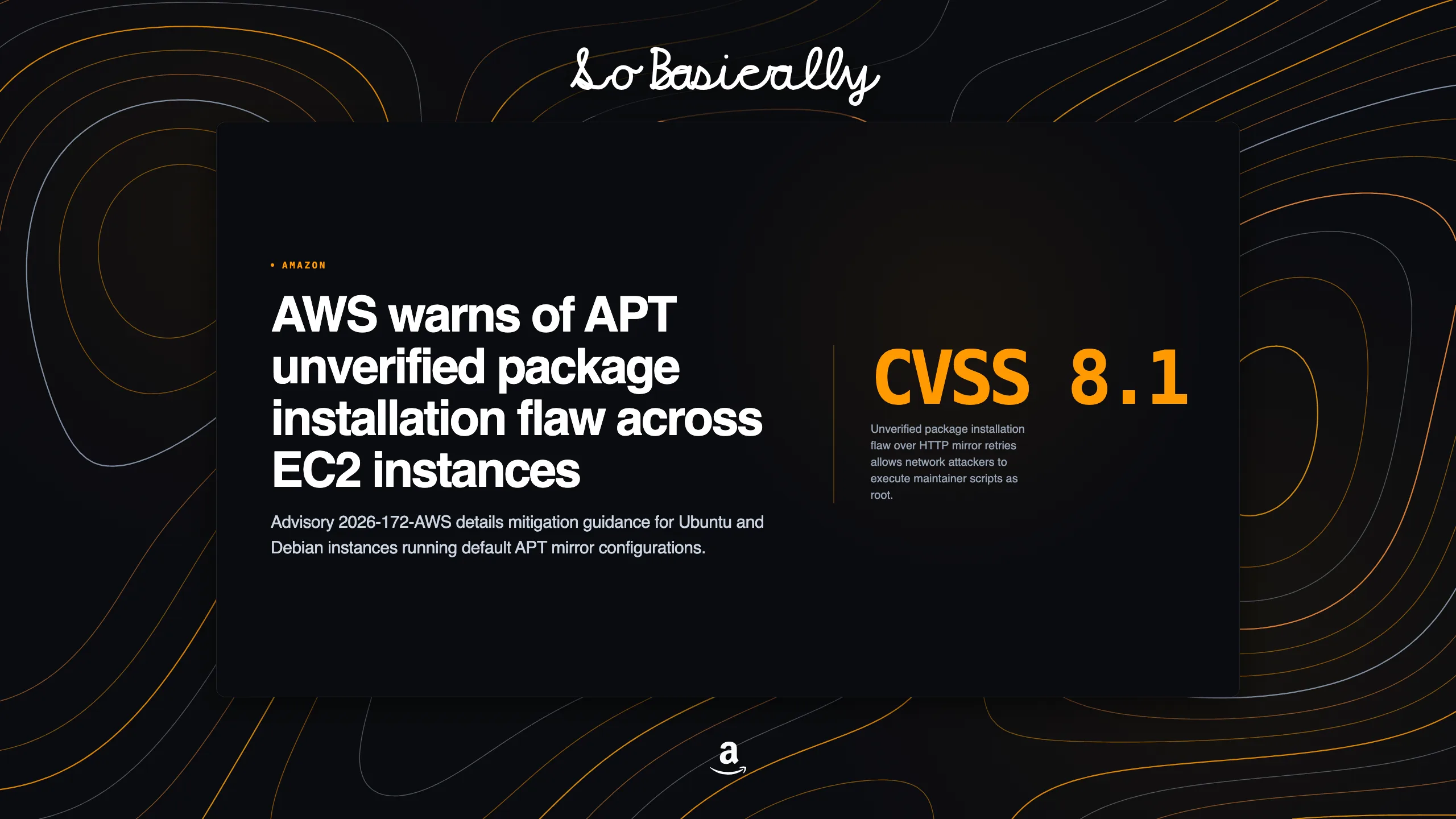
Decision brief card for AWS warns of APT unverified package installation flaw across EC2 instances

AWS warns of APT unverified package installation flaw across EC2 instances

What happened.Amazon Web Services published security bulletin 2026-172-AWS advising customers running Ubuntu and Debian on Amazon EC2 of an unverified package installation flaw in APT.

Why it matters.Linux virtual machines in cloud fleets frequently update dependencies during automated scaling cycles. When package managers accept unverified archives over plain HTTP connections, network-positioned attackers gain root administrative execution across production servers. System administrators should configure HTTPS repository endpoints across instance fleets immediately. Infrastructure engineers should apply security updates provided under Canonical USN-8996-1 and Debian DSA-6607-1.

  • Vulnerability mechanics: Tracked as CVE-2026-109518 with an 8.1 CVSS score, the defect allows network-adjacent attackers to force installation of unverified software.
  • Trigger conditions: The issue manifests when the APT package manager downloads packages over unencrypted HTTP mirrors with connection retries enabled.
  • Exploitation impact: In-path network attackers manipulate retry responses to inject unsigned packages, executing maintainer scripts with root privileges.
  • Affected platforms: The vulnerability impacts default installations of Ubuntu 22.04 LTS and later alongside Debian 12 and later.
  • Remediation guidance: AWS urged operators to apply upstream patches from Canonical and Debian or disable HTTP retries by setting Acquire::Retries=0.
Official Source:AWS
Decision brief card for AWS warns of APT unverified package installation flaw across EC2 instances
Read Brief
Source:AWS (opens in a new tab)
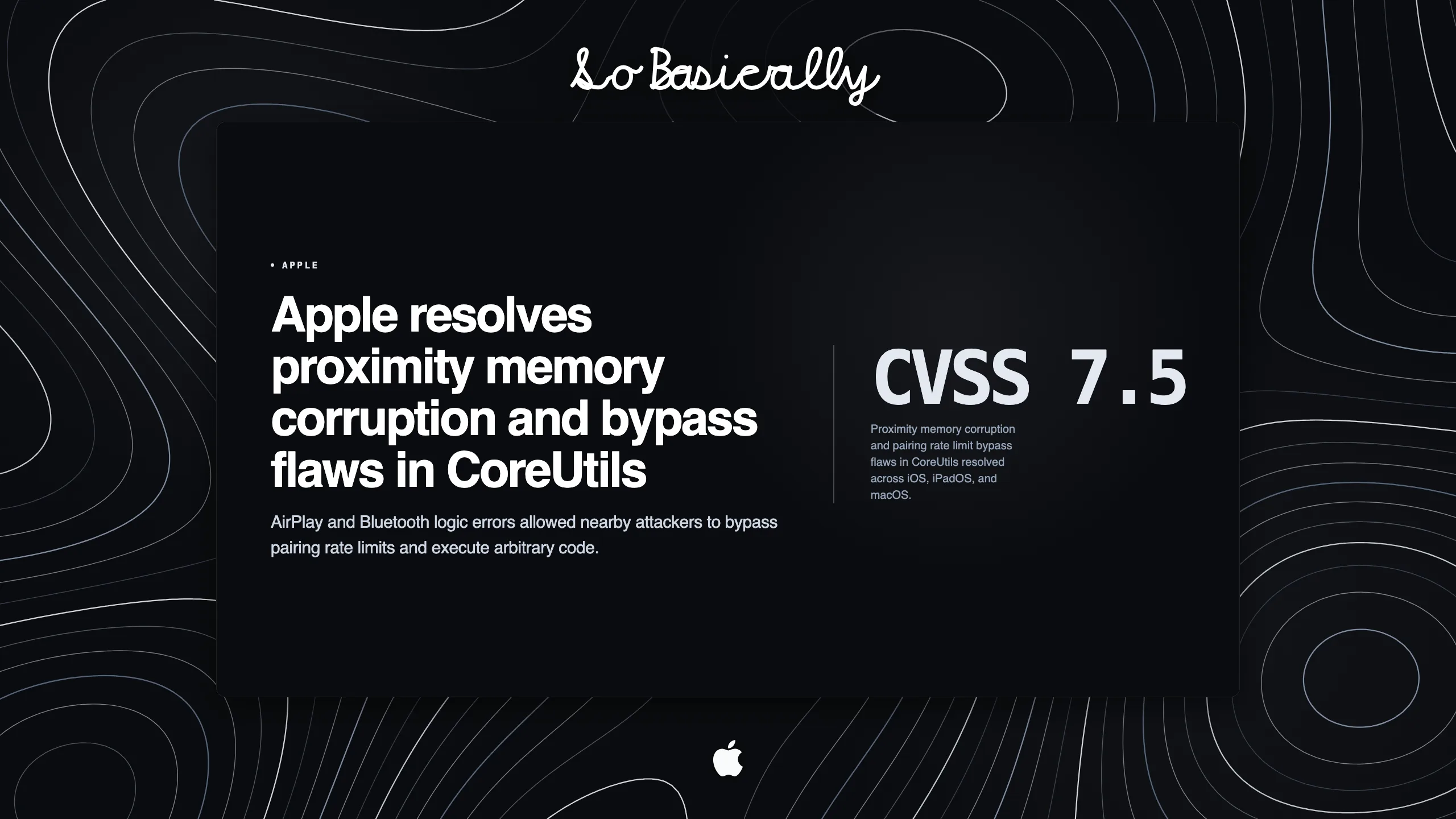
Decision brief card for Apple resolves proximity memory corruption and bypass flaws in CoreUtils

Apple resolves proximity memory corruption and bypass flaws in CoreUtils

What happened.Apple released security updates resolving multiple wireless memory corruption and pairing bypass vulnerabilities in the CoreUtils subsystem across its operating systems.

Why it matters.Enterprise employees use mobile devices and laptops in public and corporate spaces with active wireless radios. When proximity protocols fail to enforce pairing rate limits, nearby attackers connect without physical interaction and compromise local process memory. Enterprise fleet administrators should enforce immediate OS updates across employee hardware. Security teams should advise users to disable Bluetooth when operating in untrusted environments.

  • Vulnerability mechanics: Tracked under CVE-2026-113968 and CVE-2026-113970, the defects include logic errors and use-after-free flaws in AirPlay and Bluetooth pairing.
  • Proximity vector: Attackers within physical wireless range exploit flawed state machines to bypass pairing-code rate limits during device negotiation.
  • Memory corruption: Malicious connection sequences corrupt wireless daemon memory to execute arbitrary code with local service privileges.
  • System coverage: Apple deployed fixes across iOS 27.2.1, iPadOS 27.2.1, macOS Golden Gate 27.2.1, and maintenance builds for earlier operating systems.
  • Remediation updates: Apple resolved the flaws by tightening state management and improving boundary checks across CoreUtils wireless handlers.
Official Source:NIST NVD
Decision brief card for Apple resolves proximity memory corruption and bypass flaws in CoreUtils
Read Brief
Source:NIST NVD (opens in a new tab)
CANDIDATE INTELLIGENCE · UNVERIFIED LEADS

The Discovery Wire · Unverified Attention Signals

Candidate storylines identified across developer channels. Under newsroom canon, attention never establishes fact; these leads remain quarantined until supported by Tier 1 official records.

DEVELOPER WIRE

Microsoft Paint out-of-bounds read remote code execution flaw (CVE-2026-83844)

Enterprise administrators verify Windows Paint updates to version 11.2609.401.0 via Microsoft Store after MSRC updated guidance on decoupled utility servicing.

STATUS:Awaiting official documentation or verification criteria.
DEVELOPER WIRE

SignalWire FreeSWITCH inbound SIP message command injection flaw (CVE-2026-116779)

Telephony infrastructure operators update to FreeSWITCH 1.11.3 or disable chat API protocols following active exploitation and CISA KEV listing.

STATUS:Awaiting official documentation or verification criteria.
DEVELOPER WIRE

WordPress Contact Form 7 unauthenticated arbitrary file upload flaw (CVE-2026-114432)

Web application engineers update to Contact Form 7 version 6.2.4 to eliminate unauthenticated file upload and remote code execution vulnerabilities in file form fields.

STATUS:Awaiting official documentation or verification criteria.
DEVELOPER WIRE

Progress WS_FTP Server insecure credential storage and XFT transport flaws (CVE-2026-115340, CVE-2026-115338)

Windows infrastructure administrators update to WS_FTP Server version 2025.0.5 to prevent plaintext credential harvesting from temporary files and unencrypted data transmission.

STATUS:Awaiting official documentation or verification criteria.
DEVELOPER WIRE

Cisco UCS Central Software authenticated path traversal remote code execution (CVE-2026-76506)

Data center administrators upgrade Cisco UCS Central Software installations following disclosure of high-severity arbitrary file upload and code execution flaws.

STATUS:Awaiting official documentation or verification criteria.
DEVELOPER WIRE

Palo Alto Networks PAN-OS authenticated management interface code injection (CVE-2026-0322)

Security teams verify firewall management interfaces are restricted to trusted internal networks following confirmed in-the-wild exploitation of PAN-OS administrative interfaces.

STATUS:Awaiting official documentation or verification criteria.
DEVELOPER WIRE

OpenSSH sshole authentication bypass exploitation across musl libc environments (CVE-2026-123158)

Threat intelligence teams monitor automated vulnerability scanning targeting Alpine Linux containers running OpenSSH builds without PAM against musl libc.

STATUS:Awaiting official documentation or verification criteria.
DEVELOPER WIRE

WordPress Core TOCTOU race condition flaw active scanning (CVE-2026-119977)

Security operations teams monitor internet-facing sites for automated exploit scripts probing predictable upgrade staging paths under wp-content/upgrade during core updates.

STATUS:Awaiting official documentation or verification criteria.
DEVELOPER WIRE

Ethersphere bee-js release workflow supply chain compromise (GHSA-hh7j-5m3j-23pf)

Node operators and Web3 developers purge version 13.3.0 and roll back to 13.2.0 after attackers hijacked GitHub release workflows to distribute the SleepyDuck credential exfiltration backdoor.

STATUS:Awaiting official documentation or verification criteria.
DEVELOPER WIRE

Qubole AWS cross-account IAM credential compromise

Cloud security teams audit AWS CloudTrail logs for unauthorized AssumeRole activity after attackers abused third-party platform trust relationships to exfiltrate customer cloud data.

STATUS:Awaiting official documentation or verification criteria.

DEVELOPER WIRE

AWS Amplify MapLibre popup component stored cross-site scripting (CVE-2026-121652)

Frontend engineering teams update to maplibre-gl-js-amplify 4.0.3 to prevent client-side JavaScript execution via unsanitized GeoJSON marker properties.

STATUS:Awaiting official documentation or verification criteria.
DEVELOPER WIRE

Barracuda Email Security Gateway chained pre-auth root RCE (CVE-2026-116606 & CVE-2026-111560)

Infrastructure teams isolate admin interfaces following disclosure of pre-authentication backup restoration chained with root command injection in ESG firmware.

STATUS:Awaiting official documentation or verification criteria.
DEVELOPER WIRE

Ruby on Rails Active Storage ImageMagick arbitrary file read/write (GHSA-f3w6-w445-fwh9 / CVE-2026-122006)

Web application engineers update to Rails 8.1.4.1 and 8.0.5.2 to eliminate unauthenticated file write and secret extraction flaws in mini_magick variant processing.

STATUS:Awaiting official documentation or verification criteria.
DEVELOPER WIRE

OpsShield cPGuard Update Supply Chain Compromise

Hosting providers audit servers running cPGuard v5.88.12 through v5.88.19 after attackers breached the update CDN to exfiltrate passwords and SSH keys.

STATUS:Awaiting official documentation or verification criteria.
DEVELOPER WIRE

Anthropic Claude Code settings credential exposure

Cloud security engineers review CI/CD and repository scanning after Apiiro reported plaintext credentials committed via .claude/settings.local.json.

STATUS:Awaiting official documentation or verification criteria.