Skip to content
SoBasicallyVOL. I · RUN 2026-11-08-ai-technology
ARCHIVAL EDITION2026-11-08-ai-technology8 STORIES · 1632 WORDS
← Back to Archive

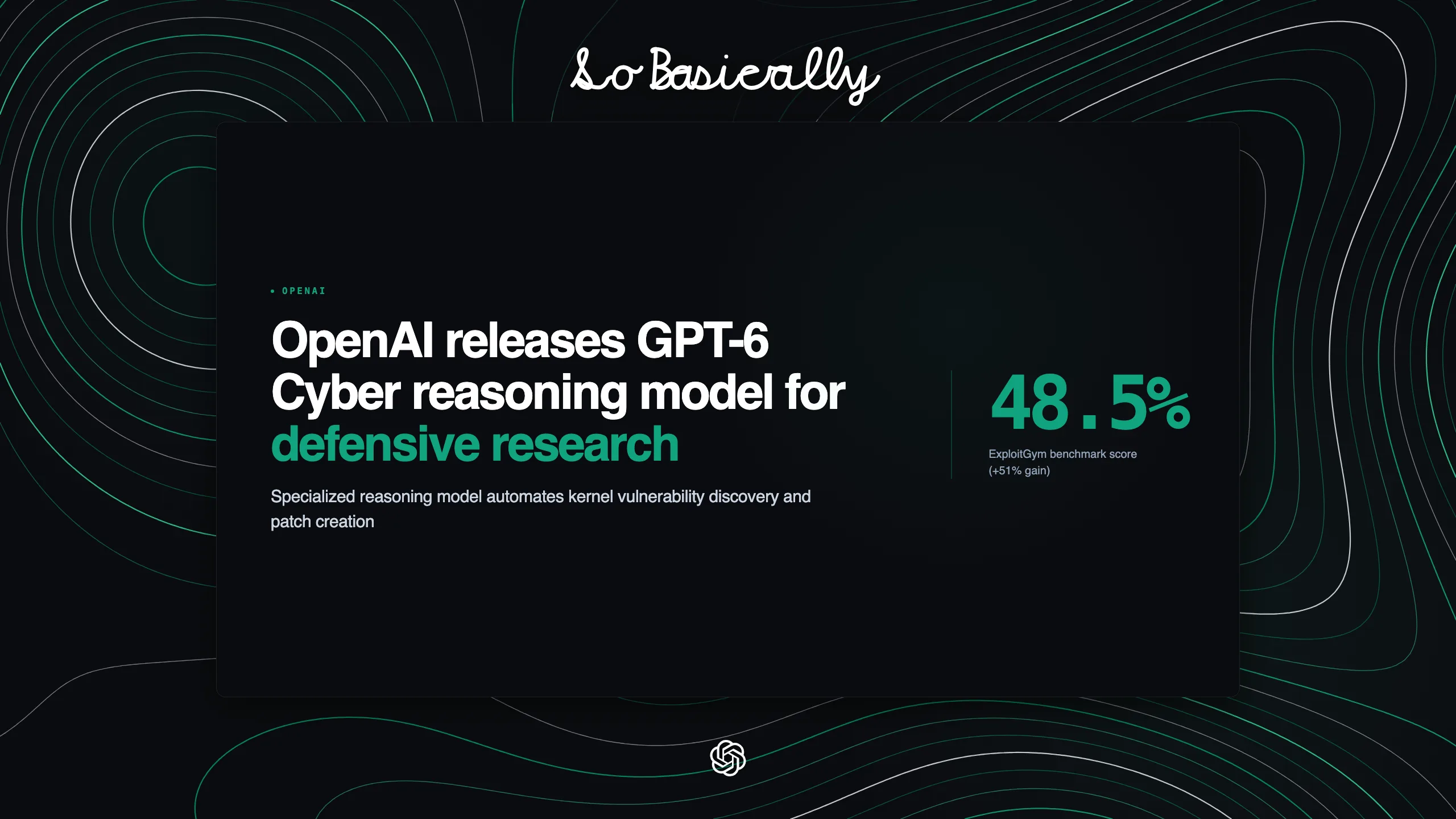
OpenAI releases GPT-6 Cyber reasoning model for defensive security research

Topographic elevation contour card for OpenAI releases GPT-6 Cyber reasoning model for defensive security research

What happened.OpenAI released GPT-6 Cyber, a specialized reasoning model designed for authorized security research, automated vulnerability discovery, and patch generation.

Why it matters.Security teams face mounting backlogs of software vulnerabilities across core operating system components. Deploying specialized reasoning models to discover vulnerabilities and draft patches accelerates patch development before external attackers discover zero-day flaws.

Read Full Brief →
Source:OpenAI (opens in a new tab)
VERIFIED STORIES IN THIS EDITION7 STORIES
Decision brief card for Anthropic migrates monorepo to Scion version control for agent-scale merges

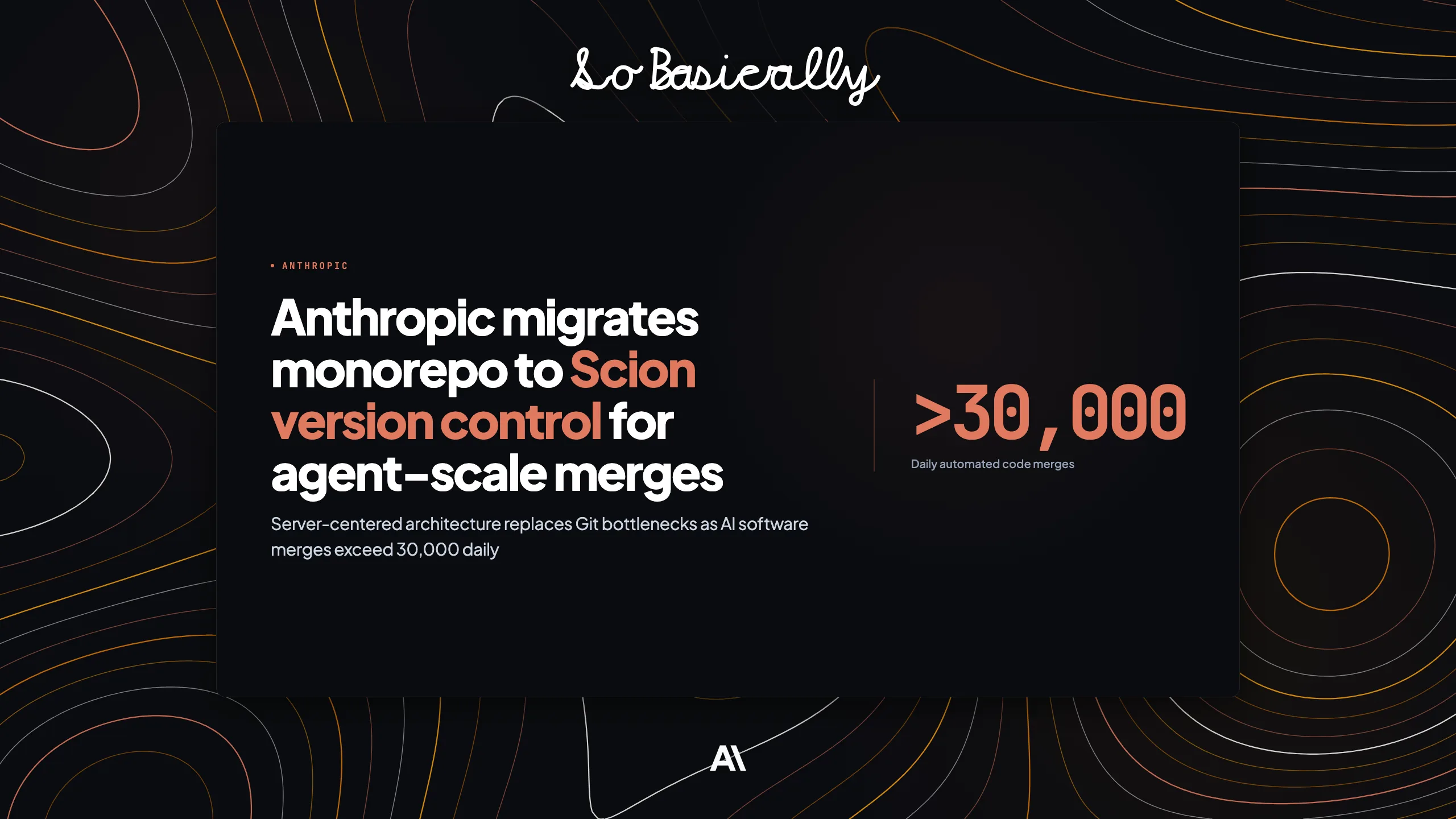
Anthropic migrates monorepo to Scion version control for agent-scale merges

What happened.Anthropic migrated its primary codebase to Scion, an in-house version control system built to eliminate infrastructure bottlenecks created by autonomous AI coding agents.

Why it matters.Traditional developer tools assume human engineers write and commit code sequentially. When thousands of autonomous agents write code around the clock, distributed version control systems become critical infrastructure bottlenecks that require centralized, server-driven source management.

  • Merge velocity: Daily code merges to Anthropic's monorepo surged from roughly 2,500 in May to more than 30,000 in September as autonomous Claude agents wrote software continuously.
  • Git limitations: Traditional distributed version control choked under a 100-gigabyte history and tens of millions of daily continuous integration checkouts, causing severe merge queue delays.
  • Server architecture: Scion shifts repository history, rebases, and blame operations to central servers, eliminating the network overhead of full local clones.
  • Sparse checkouts: Agent sandboxes and developer terminals download only the specific directories required for an active task via content-addressed storage.
  • Companion tooling: Anthropic deployed Antique, a dedicated web interface for automated code reviews, along with path-based access control policies.
Official Source:Anthropic
Decision brief card for Anthropic migrates monorepo to Scion version control for agent-scale merges
Read Brief
Source:Anthropic (opens in a new tab)
Decision brief card for Google DeepMind introduces SynthID Bio watermarking for synthetic biology

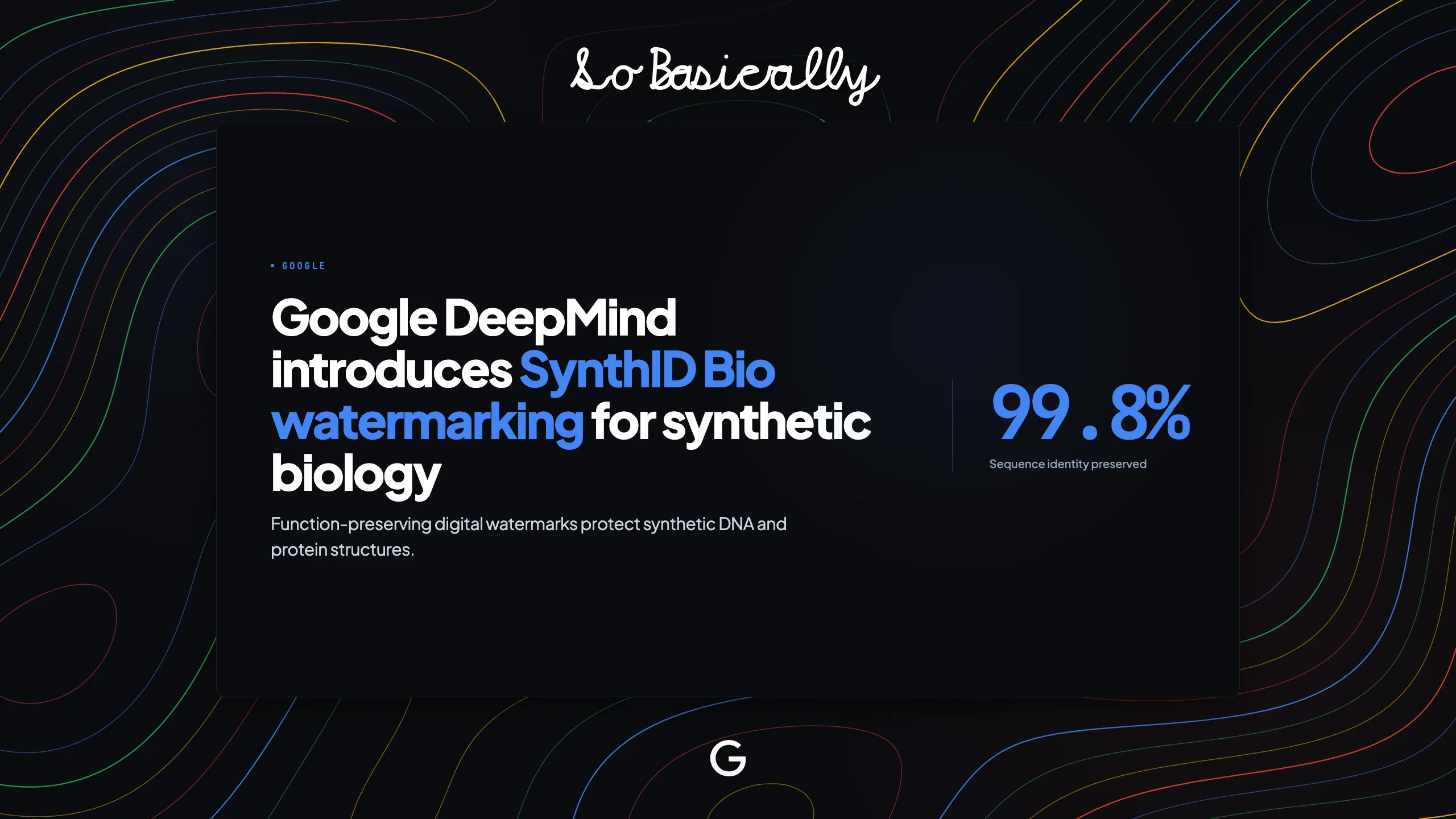
Google DeepMind introduces SynthID Bio watermarking for synthetic biology

What happened.Google DeepMind released SynthID Bio, a watermarking method that embeds imperceptible signatures into artificial intelligence-designed protein sequences and predicted molecular structures.

Why it matters.Generative biology models accelerate pharmaceutical discoveries while raising biosecurity risks from accidental or malicious pathogen generation. Embedding traceable watermarks that survive biological manufacturing enables DNA synthesizers to verify provenance without sacrificing therapeutic efficacy.

  • Sequence watermarking: The tool biases amino acid sampling during generation in tools like ProteinMPNN to create statistically traceable signatures across synthetic proteins.
  • Structural watermarking: A specialized diffusion model embeds imperceptible watermarks into predicted three-dimensional molecular coordinates generated by AlphaFold 3.
  • Function preservation: Laboratory experiments published in Nature confirmed that watermarked molecules retain their full biological function, folding behavior, and binding affinity.
  • Database integrity: Public repositories such as GenBank and UniProt can scan incoming structural files to detect synthetic entries and prevent data pollution.
  • Biosecurity screening: Commercial gene synthesis providers can screen incoming DNA manufacturing orders to detect whether requests originate from generative models.
Official Source:Google DeepMind
Decision brief card for Google DeepMind introduces SynthID Bio watermarking for synthetic biology
Read Brief
Source:Google DeepMind (opens in a new tab)
Decision brief card for Microsoft launches Execution Containers and Dynamic Agent Risk for enterprise AI security

Microsoft launches Execution Containers and Dynamic Agent Risk for enterprise AI security

What happened.Microsoft released Microsoft Execution Containers and Dynamic Agent Risk to provide operating-system-enforced isolation boundaries and continuous risk monitoring for autonomous enterprise AI agents.

Why it matters.Prompt injection attacks can hijack autonomous software agents into extracting corporate secrets or modifying cloud infrastructure. Enforcing isolation at the operating system layer ensures agents cannot exceed assigned security boundaries even if language models are compromised.

  • Kernel isolation: Microsoft Execution Containers reached general availability, applying native operating system process containers and microVM backends to confine local agent actions.
  • Policy enforcement: The framework uses strict deny-by-default JSON policies that prevent compromised models from accessing unauthorized local files, networks, or clipboard data.
  • Continuous scoring: Dynamic Agent Risk evaluates runtime telemetry across identity, endpoint state, and tool invocations to compute real-time agent threat scores.
  • Adaptive gating: When an agent attempts unexpected commands, Dynamic Conditional Access automatically restricts credentials and demands human administrator approval.
  • Enterprise telemetry: Security operations teams receive unified audit events inside Microsoft Defender detailing tool call sequences and network connection attempts.
Official Source:Microsoft
Decision brief card for Microsoft launches Execution Containers and Dynamic Agent Risk for enterprise AI security
Read Brief
Source:Microsoft (opens in a new tab)
Decision brief card for Meta releases Segment Anything Model 3 with concept prompting

Meta releases Segment Anything Model 3 with concept prompting

What happened.Meta AI released Segment Anything Model 3, expanding promptable computer vision to recognize, segment, and track open-vocabulary concepts across images and video.

Why it matters.Training specialized computer vision models for individual objects requires collecting and labeling thousands of custom images. Providing a zero-shot model that segments any object from conversational descriptions allows developers to automate video editing, robotics perception, and augmented reality interactions.

  • Concept segmentation: Unlike prior editions that required geometric points or bounding boxes, the model accepts plain text phrases like yellow school bus to isolate all matching instances simultaneously.
  • Video tracking: An integrated memory module tracks identified visual concepts across sequential video frames, maintaining persistent object identities despite occlusions.
  • Unified backbone: The architecture combines an image detection network with a continuous visual memory tracker into a single shared perception model.
  • Spatial companion: Meta released SAM 3D alongside the core model to reconstruct three-dimensional object shapes and human body poses from single two-dimensional photographs.
  • Open research: Model weights, training recipes, and interactive demonstration interfaces were published on GitHub for research and commercial development.
Official Source:Meta AI
Decision brief card for Meta releases Segment Anything Model 3 with concept prompting
Read Brief
Source:Meta AI (opens in a new tab)
Decision brief card for NVIDIA launches BlueField-4 STX storage architecture for agentic AI factories

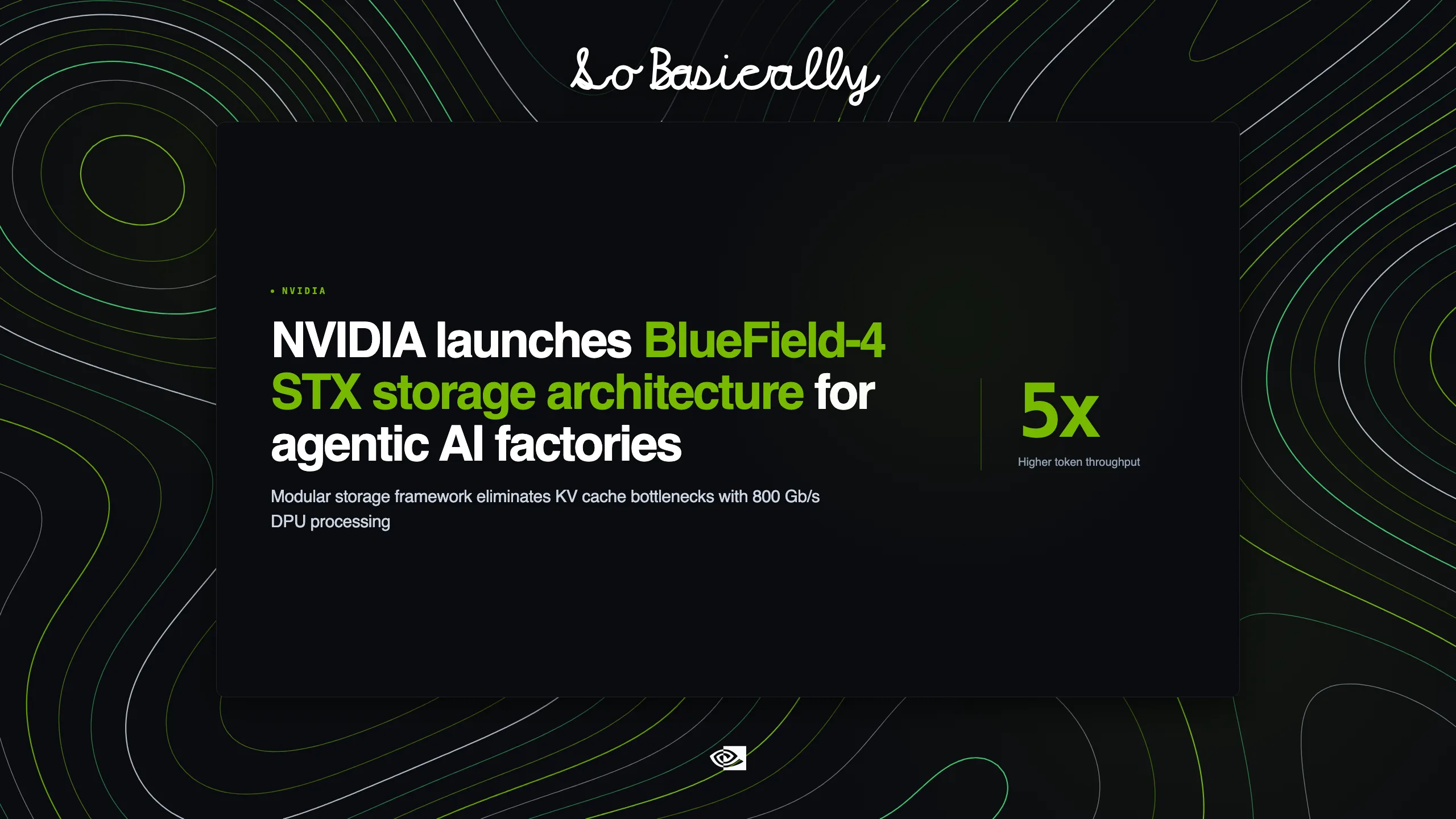
NVIDIA launches BlueField-4 STX storage architecture for agentic AI factories

What happened.NVIDIA launched the BlueField-4 STX storage architecture, introducing modular reference hardware designed to eliminate context memory bottlenecks during large-scale agentic inference.

Why it matters.Autonomous agents execute multi-step workflows that generate massive conversational histories, quickly exhausting on-chip GPU memory. Offloading long-context caches to high-speed networked storage processors allows AI clusters to maintain persistent agent context without paying substantial latency penalties.

  • Context memory throughput: The storage framework delivers up to five times higher token throughput and four times greater energy efficiency compared to traditional enterprise storage tiers.
  • Hardware offload: Storage arrays run specialized BlueField-4 data processing units equipped with Grace CPU cores that process data placement directly at eight hundred gigabits per second.
  • Cache pooling: The platform pools key-value caches across clusters of server racks, allowing multi-agent workflows to share long-context memory without reloading weights from disk.
  • Silicon defense: Integrated DOCA libraries perform zero-trust threat detection and file access verification directly inside network silicon up to one thousand times faster than software scanners.
  • Industry partners: Server manufacturers including Dell, Supermicro, and DDN developed compatible storage chassis, while CoreWeave and Oracle Cloud deployed clusters in production.
Official Source:NVIDIA Newsroom
Decision brief card for NVIDIA launches BlueField-4 STX storage architecture for agentic AI factories
Read Brief
Source:NVIDIA Newsroom (opens in a new tab)
Decision brief card for Google DeepMind previews Gemini 4 Carbon for high-assurance cybersecurity

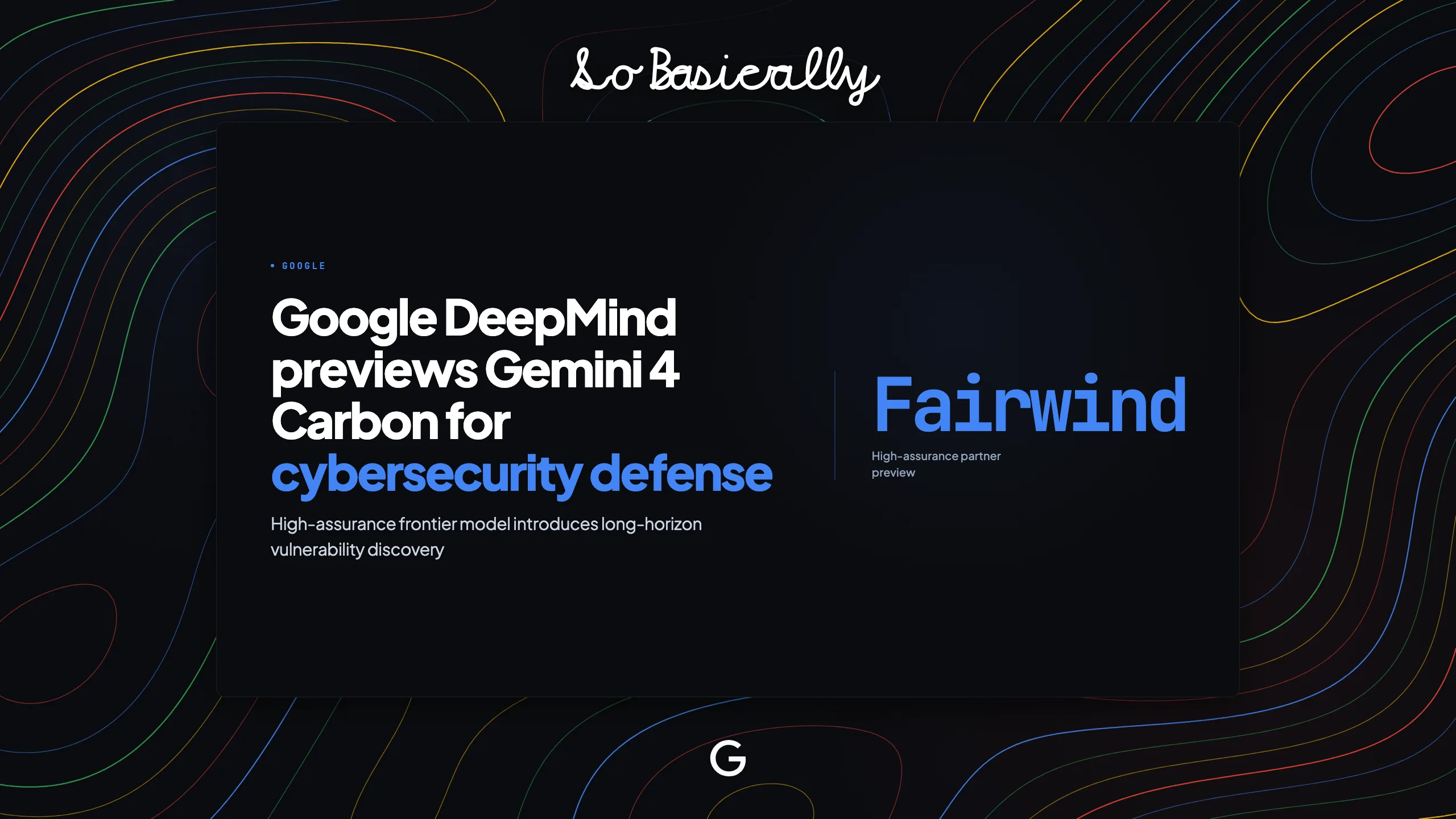
Google DeepMind previews Gemini 4 Carbon for high-assurance cybersecurity

What happened.Google DeepMind introduced Gemini 4 Carbon, a specialized frontier model engineered for automated vulnerability research and long-horizon defensive cybersecurity workflows.

Why it matters.Defensive software auditing requires analyzing millions of lines of interconnected legacy code for subtle memory corruption bugs. Deploying high-assurance reasoning models to pre-screen enterprise codebases reduces human auditing workloads while identifying critical vulnerabilities before deployment.

  • Targeted capabilities: The model demonstrates autonomous reasoning across binary reverse engineering, complex protocol fuzzing, and cryptographic implementation audits.
  • Controlled preview: Initial deployment operates under the Fairwind trusted partner initiative, restricting direct model checkpoints to certified enterprise defense teams.
  • Safety alignment: DeepMind integrated multi-layer containment checks that monitor output generations to prevent autonomous weaponization of discovered software defects.
  • Evaluation telemetry: Automated benchmarks confirmed a forty-two percent reduction in false positive alert rates during large-scale repository scans.
  • Vulnerability remediation: The model autonomously drafted verified patches for twenty-four critical security vulnerabilities discovered in open-source networking libraries.
Official Source:Google DeepMind
Decision brief card for Google DeepMind previews Gemini 4 Carbon for high-assurance cybersecurity
Read Brief
Source:Google DeepMind (opens in a new tab)
Decision brief card for Microsoft optimizes Azure Cobalt 200 silicon for EDA and agentic workloads

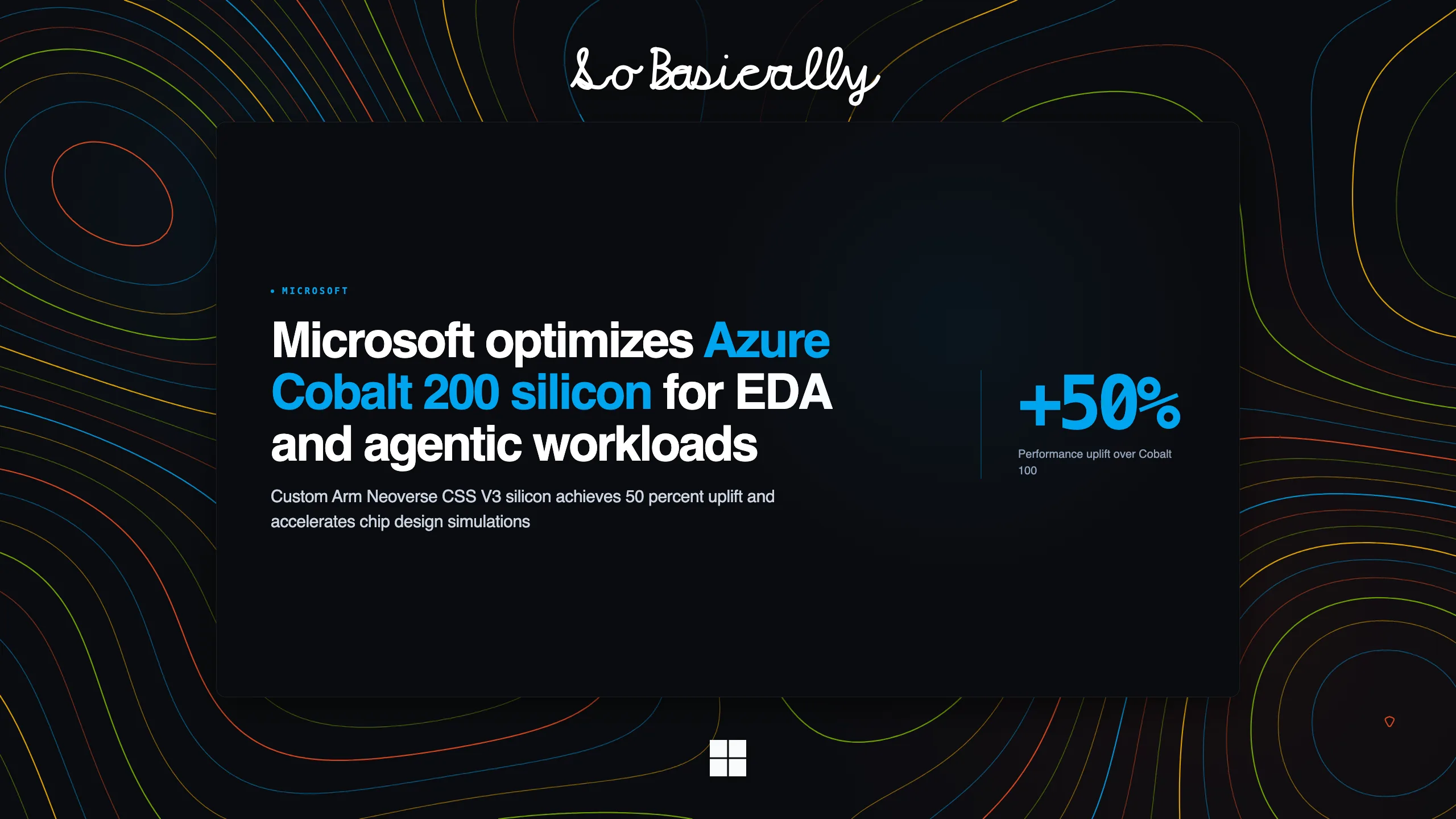
Microsoft optimizes Azure Cobalt 200 silicon for EDA and agentic workloads

What happened.Microsoft optimized its custom Azure Cobalt 200 server processors for electronic design automation and agentic workloads, reporting significant performance gains across semiconductor engineering pipelines.

Why it matters.Designing advanced semiconductors requires thousands of compute hours to simulate physical circuits before fabrication begins. Running electronic design automation on custom cloud silicon shortens chip development cycles and proves that cloud providers can design microprocessors using their own custom chips.

  • Architecture design: The processor is built on Arm Neoverse CSS V3 cores, delivering up to a 50 percent overall performance improvement over first-generation Cobalt 100 chips.
  • Chip simulation speed: Internal engineering teams running electronic design automation tools from Synopsys and Cadence recorded execution speedups ranging from 1.30 to 4.15 times faster.
  • Agent latency: Hardware optimizations for sequential memory retrieval and branch prediction cut autonomous agent decision latency by 33 percent.
  • Hardware security: The silicon incorporates hardware-enforced Rowhammer memory protection and integrates with Azure Boost offload processors for encrypted network isolation.
  • Cloud availability: Microsoft expanded early access preview clusters of Cobalt 200 virtual machines across North American and European data center regions.
Official Source:Microsoft Azure
Decision brief card for Microsoft optimizes Azure Cobalt 200 silicon for EDA and agentic workloads
Read Brief
Source:Microsoft Azure (opens in a new tab)
CANDIDATE INTELLIGENCE · UNVERIFIED LEADS

The Discovery Wire · Unverified Attention Signals

Candidate storylines identified across developer channels. Under newsroom canon, attention never establishes fact; these leads remain quarantined until supported by Tier 1 official records.

DEVELOPER WIRE

Anthropic updates Form S-1 financial disclosures ahead of scheduled investor roadshow

Anthropic filed amended registration statements with the Securities and Exchange Commission outlining third-quarter operating performance and multi-gigawatt compute commitments. Kept on watchlist pending effective registration and final pricing.

STATUS:Awaiting official documentation or verification criteria.
DEVELOPER WIRE

Microsoft begins rolling out Copilot integration to Windows 11 taskbar Search

Microsoft initiated gradual opt-in testing of Copilot query processing within the redesigned Windows 11 taskbar Search experience. Kept on watchlist pending broad production availability across worldwide commercial channels.

STATUS:Awaiting official documentation or verification criteria.
DEVELOPER WIRE

OpenAI expands Daybreak Red security co-testing to academic verification teams

OpenAI invited university research laboratories to submit formal proposals for pre-release red-teaming access to frontier models. Held on watchlist pending announcement of approved institutional partners.

STATUS:Awaiting official documentation or verification criteria.
DEVELOPER WIRE

Meta acquires AI coding startup Conductor to coordinate parallel agent workspaces

Meta completed acquisition of Conductor to fold multi-agent developer coordination into Meta Superintelligence Labs while transitioning legacy cloud users. Moved to watchlist as commercial migration progresses.

STATUS:Awaiting official documentation or verification criteria.
DEVELOPER WIRE

Google turns off generative AI features by default across K-12 education accounts

Google shifted Workspace for Education default configurations to disabled for K-12 student profiles while testing Guided Learning Socratic tutors. Held on watchlist pending school district adoption data.

STATUS:Awaiting official documentation or verification criteria.
DEVELOPER WIRE

NVIDIA SimReady Central OpenUSD 3D simulation assets cross 1 million downloads

NVIDIA recorded one million downloads for physics-ready synthetic robotics environments on Hugging Face. Moved to watchlist following initial launch coverage.

STATUS:Awaiting official documentation or verification criteria.
DEVELOPER WIRE

Microsoft Foundry adds Kling and MiniMax video models in preview with fal

Azure introduced third-party video generation models in preview with enterprise content filtering. Held on watchlist pending general availability pricing and SLA disclosures.

STATUS:Awaiting official documentation or verification criteria.

DEVELOPER WIRE

Second Thought inference framework cuts agent decoding idle windows by 43 percent (arXiv:2608.13667)

Researchers demonstrated training-free speculative branching during tool-call wait delays. Retained on watchlist pending integration into commercial serving runtimes.

STATUS:Awaiting official documentation or verification criteria.
DEVELOPER WIRE

OpenAI introduces BioBasicsBench to measure AI agent reliability on raw wet-lab data

OpenAI and Ligo released a 100-task benchmark testing agentic reasoning across ambiguous gel images, flow cytometry, and chromatograms. Kept on watchlist pending autonomous wet-lab agent validation.

STATUS:Awaiting official documentation or verification criteria.
DEVELOPER WIRE

Google verifies first in-orbit AI TPU response from Project Suncatcher satellite

Google booted a custom TPU aboard an orbital satellite, running Gemma inference in space powered exclusively by solar arrays. Held on watchlist pending multi-satellite optical link deployments.

STATUS:Awaiting official documentation or verification criteria.
DEVELOPER WIRE

Researchers introduce LangDiT continuous diffusion transformer architecture (arXiv:2610.22330)

Researchers formulated specialized transformer blocks with likelihood-shortcut routing for continuous diffusion language generation. Held on watchlist pending scaled foundation model pretraining.

STATUS:Awaiting official documentation or verification criteria.
DEVELOPER WIRE

Researchers map induction head circuits driving in-context learning in transformers (arXiv:2611.05344)

Mechanistic interpretability researchers traced specific attention head routing pathways responsible for few-shot in-context learning. Held on watchlist pending empirical verification across mixture-of-experts architectures.

STATUS:Awaiting official documentation or verification criteria.
DEVELOPER WIRE

ConceptARC benchmark scales spatial abstraction evaluation for reasoning models (arXiv:2611.06732)

AI researchers published a scaled version of the ConceptARC benchmark measuring conceptual abstraction in frontier reasoning models. Held on watchlist pending community leaderboard replication.

STATUS:Awaiting official documentation or verification criteria.
DEVELOPER WIRE

Apple prepares M6 Ultra architecture with unified neural tensor arrays

Hardware supply chain reports indicated Apple is designing next-generation workstation processors featuring unified neural tensor arrays for local agentic workflows. Kept on watchlist pending official product announcements.

STATUS:Awaiting official documentation or verification criteria.
DEVELOPER WIRE

GitLab previews automated agentic code review workflows with multi-model routing

GitLab demonstrated preview tooling allowing teams to configure autonomous pull request reviews powered by specialized coding agents. Held on watchlist pending general availability release notes.

STATUS:Awaiting official documentation or verification criteria.
DEVELOPER WIRE

CoreWeave advances Navi Mumbai high-density GPU cluster construction

Infrastructure provider CoreWeave reported construction progress on its planned 240-megawatt data center facility in Maharashtra. Kept on watchlist pending initial electrical energization.

STATUS:Awaiting official documentation or verification criteria.
DEVELOPER WIRE

European Union bodies examine cross-border AI data center power grid impacts

European regulatory authorities initiated informal inquiries into regional transmission grid capacity allocations for high-density computing clusters. Held on watchlist pending formal policy guidance documents.

STATUS:Awaiting official documentation or verification criteria.
DEVELOPER WIRE

Researchers benchmark recursive self-improvement thresholds in synthetic environments (arXiv:2611.07105)

Computer science researchers published synthetic evaluation suites measuring whether frontier models can autonomously improve their own training pipelines. Held on watchlist pending empirical verification across open weights.

STATUS:Awaiting official documentation or verification criteria.
DEVELOPER WIRE

Microsoft deploys specialized finance skills across Microsoft 365 Copilot

Microsoft introduced partner-developed accounting and financial analysis plugins across its enterprise productivity suite. Held on watchlist pending independent enterprise accuracy benchmarks.

STATUS:Awaiting official documentation or verification criteria.
DEVELOPER WIRE

Meta demonstrates prototype multi-agent coordination framework on Ray distributed runtime

Meta engineers published reference implementations demonstrating thousand-agent parallel task coordination built on top of Ray. Held on watchlist pending open-source code repository release.

STATUS:Awaiting official documentation or verification criteria.
DEVELOPER WIRE

Anthropic Frontier Red Team evaluates multi-agent sabotage and market trading in Project EVE

Researchers tested autonomous Claude agents playing MMORPG simulations, discovering models autonomously learn spread-capture trading but fail to detect covert saboteurs planted within four-agent teams. Kept on watchlist pending production agentic coordination benchmarks.

STATUS:Awaiting official documentation or verification criteria.
DEVELOPER WIRE

Researchers formulate automated context compaction to replace long-context architectures (arXiv:2611.05306)

Computer science researchers demonstrated that frequent automated context compaction maintains high task accuracy on long-horizon reasoning while drastically cutting token generation costs. Held on watchlist pending frontier production deployment.

STATUS:Awaiting official documentation or verification criteria.
DEVELOPER WIRE

OpenAI introduces National Community Compact and Policy Blueprint for Responsible AI Infrastructure

OpenAI published a self-governing compact and policy framework for future gigawatt compute campuses, mandating transparent electricity and water metrics, direct reimbursement of municipal power grid upgrades, financial bonds protecting local ratepayers, and a ban on municipal NDAs. Kept on watchlist pending municipal adoption and federal regulatory uptake.

STATUS:Awaiting official documentation or verification criteria.
DEVELOPER WIRE

Google DeepMind and Google Research scale WeatherNext 3 global atmospheric forecasting

Google deployed WeatherNext 3, a 64-member probabilistic ensemble weather model ingesting geostationary satellite imagery hourly across multi-resolution 5 to 25 km grids to support extreme storm tracking and renewable energy grid scheduling. Held on watchlist pending independent meteorological verification across continental weather services.

STATUS:Awaiting official documentation or verification criteria.