Skip to content
SoBasicallyVOL. I · RUN 2026-11-04-cybersecurity-advisories
ARCHIVAL EDITION2026-11-04-cybersecurity-advisories4 STORIES · 599 WORDS
← Back to Archive

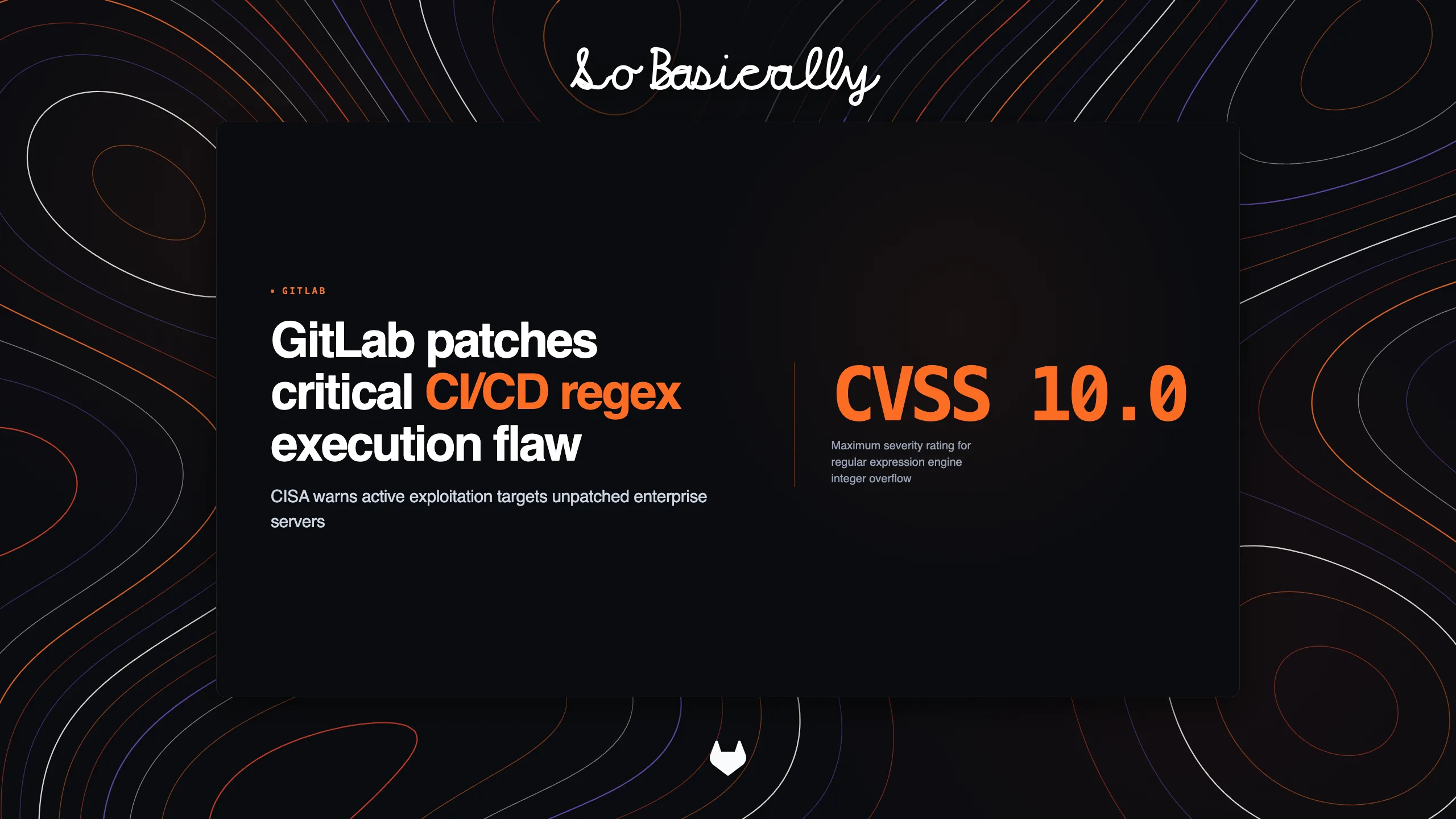
GitLab addresses critical CI/CD regular expression remote code execution flaw
Topographic elevation contour card for GitLab addresses critical CI/CD regular expression remote code execution flaw

What happened.GitLab released emergency security updates while CISA added CVE-2026-97229 to its Known Exploited Vulnerabilities catalog after discovering active exploitation against an integer overflow in the CI/CD pipeline compiler.

Why it matters.CI/CD automation systems maintain privileged access to cloud environments, production repositories, and container registries. When unauthenticated attackers execute code inside build runners, they can steal source code and poison deployment pipelines. Engineering teams running self-managed GitLab instances must update server packages immediately. DevOps operators using external Ruby runtimes must verify that host interpreter binaries receive matching library patches.
Read Full Brief →
Source:GitLab Security (opens in a new tab)
VERIFIED STORIES IN THIS EDITION3 STORIES
Decision brief card for Google Brotli decompression flaw triggers widespread downstream runtime patching

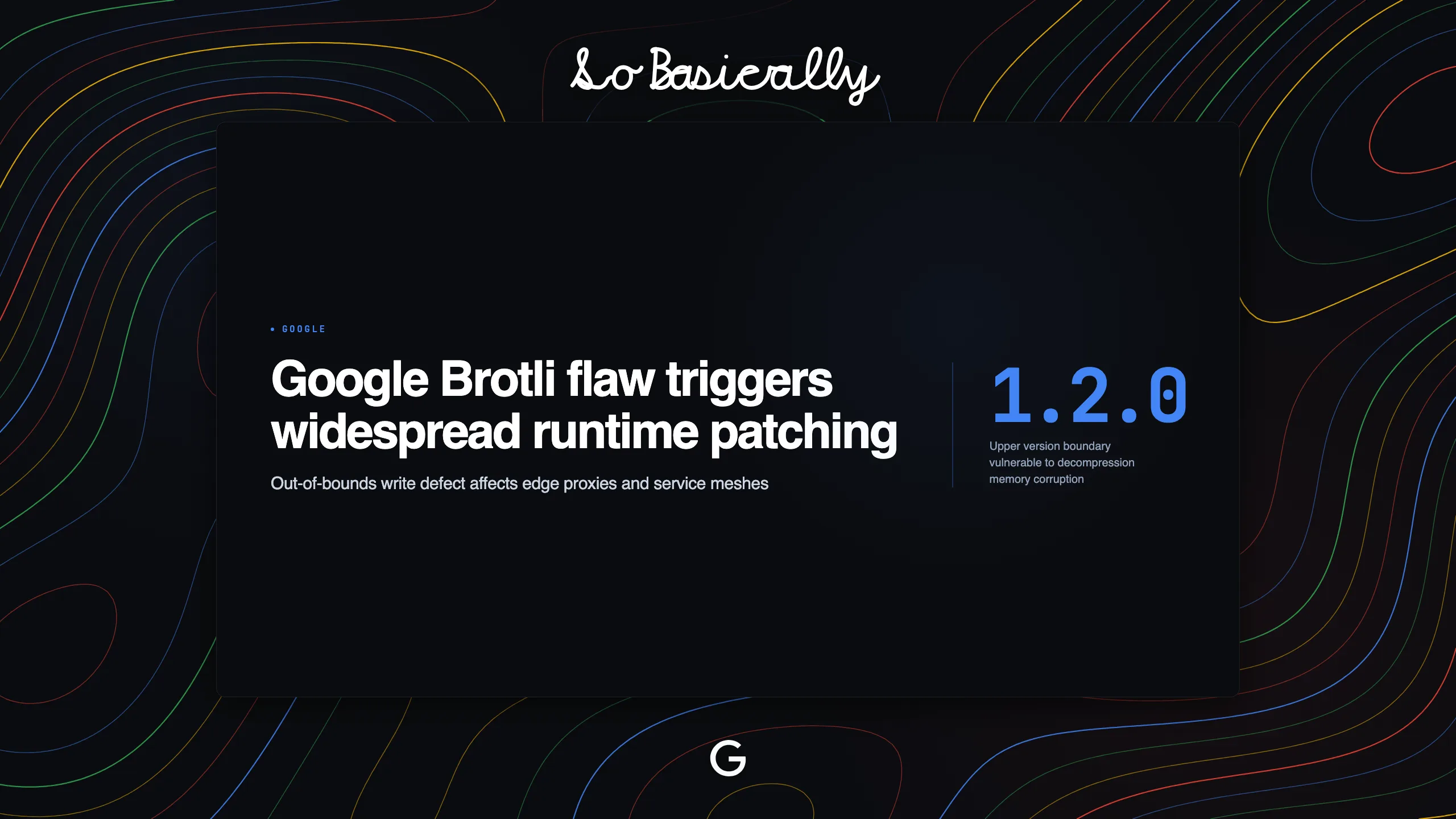
Google Brotli decompression flaw triggers widespread downstream runtime patching

What happened.CISA added Google Brotli buffer overflow vulnerability CVE-2026-111497 to its Known Exploited Vulnerabilities catalog as downstream runtime maintainers issued urgent updates.

Why it matters.Compression libraries operate transparently at network ingress points, exposing edge gateways and microservice sidecars to unauthenticated memory corruption. When core decompression utilities fail, entire clusters face destabilization and unauthorized host inspection. Infrastructure architects must inventory all edge proxies and container bases for vulnerable Brotli shared libraries. Platform security teams should apply runtime dependency updates across all internet-facing service mesh proxies.

  • Memory corruption: An out-of-bounds write flaw in Google Brotli versions 1.0.3 through 1.2.0 enables remote actors to corrupt decoder state buffers when processing crafted compressed payloads.
  • Downstream blast radius: The vulnerability directly impacts major developer ecosystems embedding Brotli decompression, including Node.js web services, Envoy edge proxies, and Istio service meshes.
  • Exploitation risk: Threat actors exploit decompression buffers to trigger denial of service crashes and execute arbitrary code on proxy endpoints handling untrusted inbound HTTP traffic.
Official Source:NIST NVD
Decision brief card for Google Brotli decompression flaw triggers widespread downstream runtime patching
Read Brief
Source:NIST NVD (opens in a new tab)
Decision brief card for AWS patches stored cross-site scripting flaw in Amplify MapLibre library

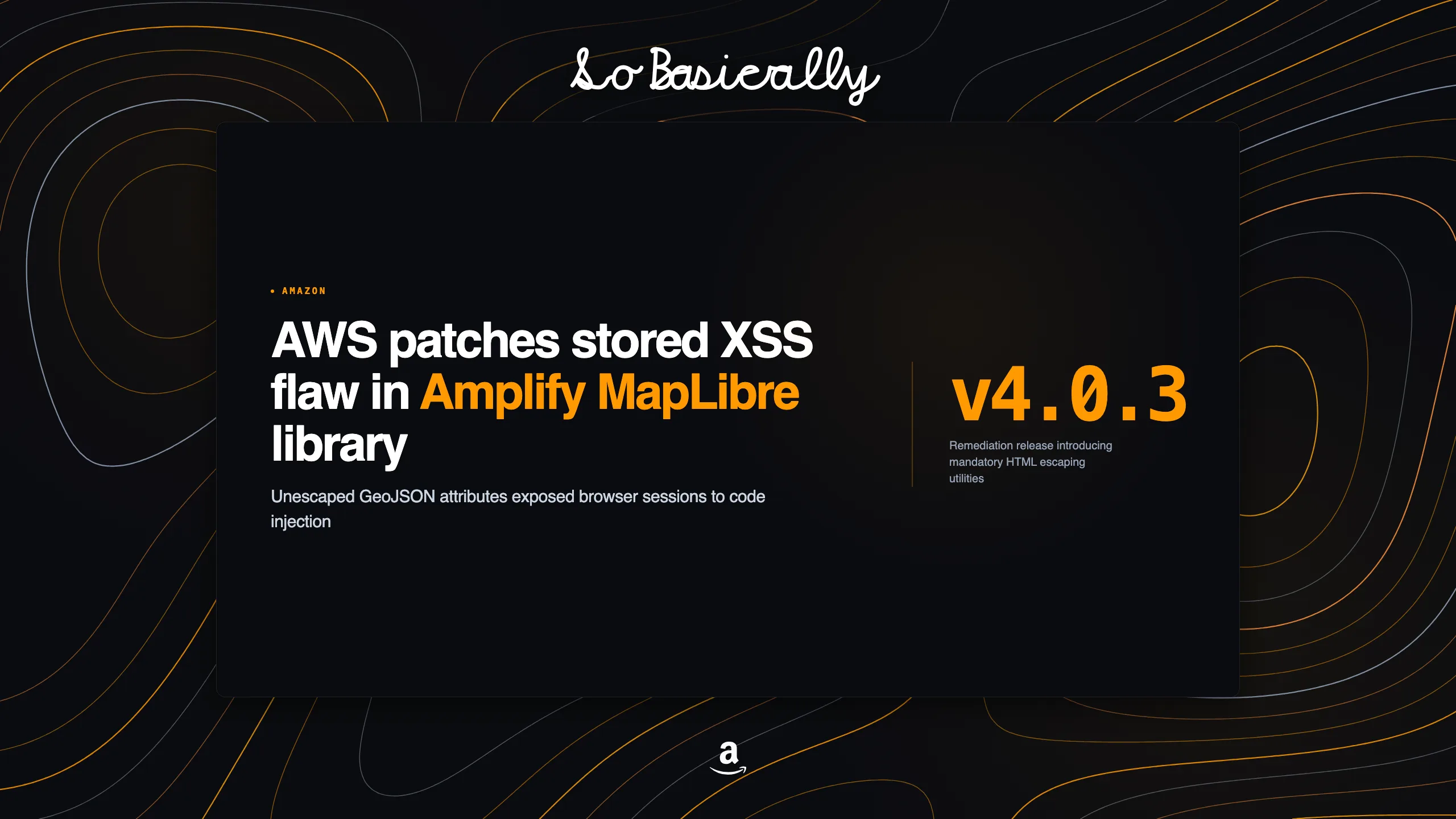
AWS patches stored cross-site scripting flaw in Amplify MapLibre library

What happened.Amazon Web Services published security bulletin 2026-167-AWS detailing a stored cross-site scripting vulnerability within the open-source AWS Amplify MapLibre location library.

Why it matters.Frontend mapping libraries frequently handle location telemetry and boundary data without secondary sanitization. When applications render user-supplied coordinates and metadata directly into browser sessions, attackers can harvest session tokens and compromise administrative dashboards. Software builders using AWS Amplify location components should upgrade dependencies to version 4.0.3 immediately. Application security engineers should audit custom popup templates to ensure HTML escaping covers all dynamic user attributes.

  • Vulnerability mechanics: Tracked as CVE-2026-121652, the maplibre-gl-js-amplify package interpolated user-supplied GeoJSON properties directly into application DOM elements using unescaped innerHTML calls.
  • Exploitation vector: An authenticated attacker storing malicious JavaScript within map point titles, address strings, or geofence markers could trigger script execution in victim browser sessions.
  • Remediation release: AWS issued version 4.0.3 of the package to introduce mandatory HTML encoding utilities across all map popup and location display handlers.
Official Source:AWS Security Bulletins
Decision brief card for AWS patches stored cross-site scripting flaw in Amplify MapLibre library
Read Brief
Source:AWS Security Bulletins (opens in a new tab)
Decision brief card for Microsoft resolves privilege escalation flaw in Azure Storage Library

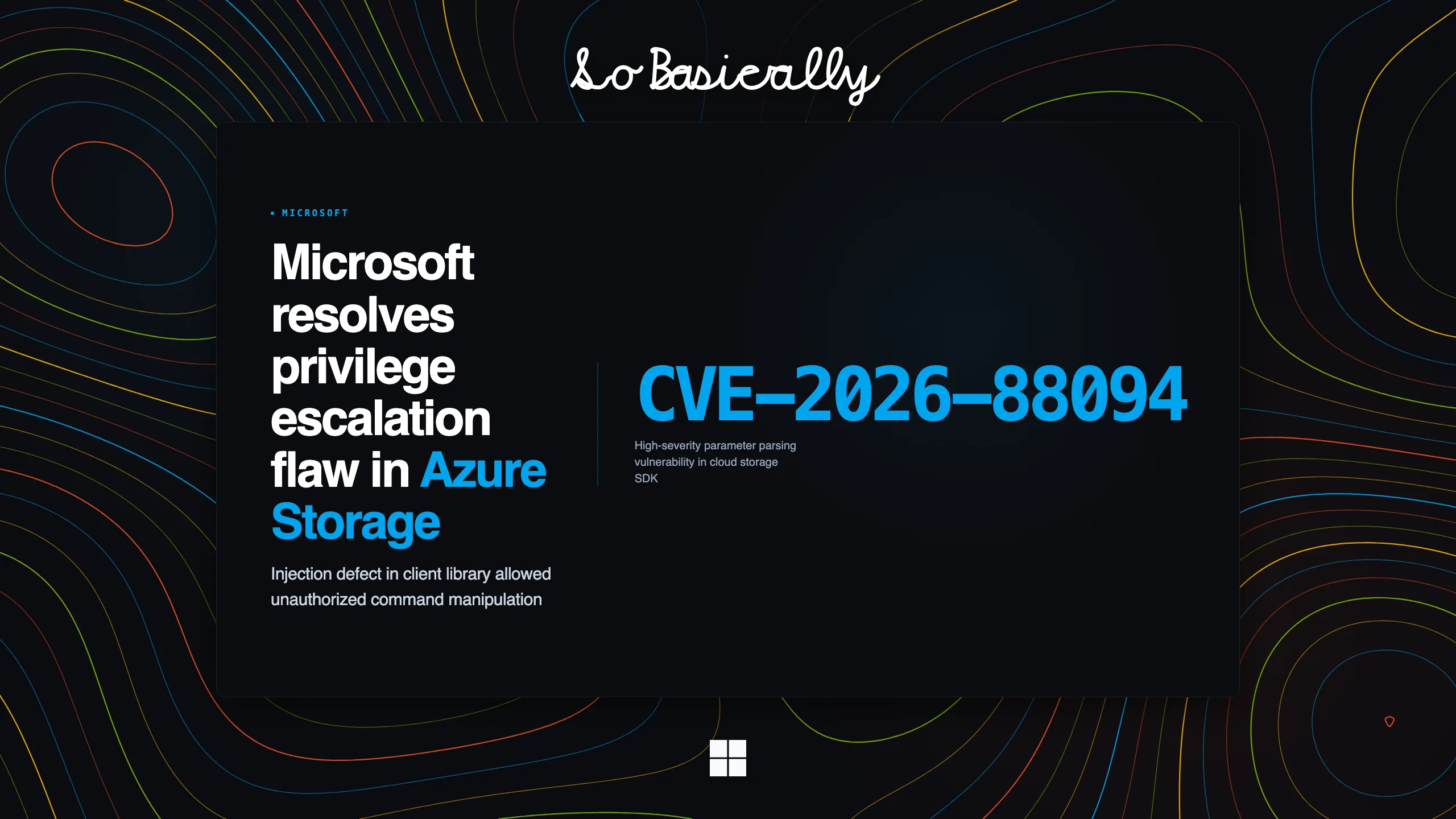
Microsoft resolves privilege escalation flaw in Azure Storage Library

What happened.Microsoft issued a security bulletin resolving a high-severity privilege escalation vulnerability discovered within the Azure Storage client library used across cloud applications.

Why it matters.Cloud storage client libraries handle sensitive data access and transactional operations between application tiers. When parameter handling defects permit command injection, tenant boundaries and storage access controls weaken significantly. Cloud architects should review dependent services to confirm that application runtimes incorporate patched Azure Storage SDK releases. Security engineers must enforce least-privilege role assignments on storage account keys to reduce blast radius risks.

  • Vulnerability mechanics: Tracked as CVE-2026-88094, an injection flaw in special character handling allows authenticated network actors to manipulate downstream storage commands.
  • Exploitation impact: Adversaries with restricted account permissions exploit flawed parameter parsing to modify storage transaction routing and alter backend data pipelines.
  • Remediation releases: Microsoft published patched client packages across NuGet and PyPI, advising cloud development teams to upgrade application dependencies to the latest release versions.
Official Source:Microsoft Security Response Center
Decision brief card for Microsoft resolves privilege escalation flaw in Azure Storage Library
Read Brief
Source:Microsoft Security Response Center (opens in a new tab)
CANDIDATE INTELLIGENCE · UNVERIFIED LEADS

The Discovery Wire · Unverified Attention Signals

Candidate storylines identified across developer channels. Under newsroom canon, attention never establishes fact; these leads remain quarantined until supported by Tier 1 official records.

DEVELOPER WIRE

Barracuda Networks appliance authorization bypass and command injection chain (CVE-2026-116606 & CVE-2026-111560)

Pre-authentication flaw chain yielding root privileges across Email Security Gateways and Web Application Firewalls. Held on watchlist pending public forensic bulletins on active exploitation volumes.

STATUS:Awaiting official documentation or verification criteria.
DEVELOPER WIRE

Canonical LXD and MicroCloud client certificate validation bypass (CVE-2026-112816)

Critical authentication logic flaw in HTTPS API allowing unauthorized client logins with trusted public certificates. Held on watchlist pending wider container distribution advisories.

STATUS:Awaiting official documentation or verification criteria.
DEVELOPER WIRE

Langflow OSS unauthenticated arbitrary code execution flaws (CVE-2026-93680 & CVE-2026-110186)

Flaws in open-source AI agent workflow platform allowing remote unauthenticated compromises. Held on watchlist pending upstream patch telemetry.

STATUS:Awaiting official documentation or verification criteria.