Skip to content
SoBasicallyVOL. I · RUN 2026-11-04-ai-technology
ARCHIVAL EDITION2026-11-04-ai-technology4 STORIES · 581 WORDS
← Back to Archive

Google DeepMind launches Agentic Cheminformatics on Google Antigravity
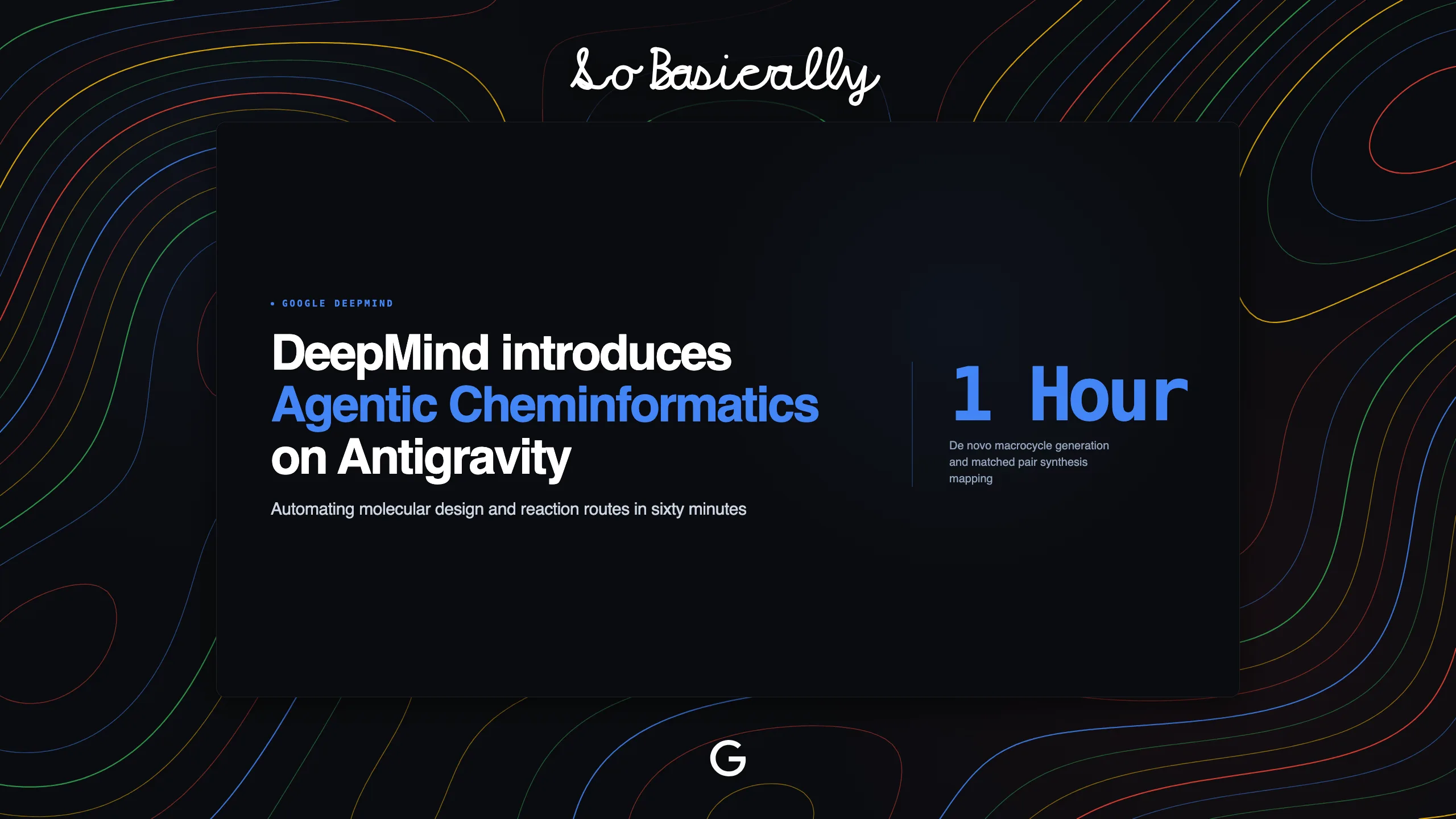
Topographic elevation contour card for Google DeepMind launches Agentic Cheminformatics on Google Antigravity

What happened.Google DeepMind introduced Agentic Cheminformatics within Google Antigravity, deploying specialized agent skills that automate molecular design, matched pair analysis, and multi-step synthesis planning for early-stage drug discovery.

Why it matters.Early-stage medicinal chemistry suffers from tedious manual data curation across fragmented patent libraries, vendor catalogs, and molecular modeling suites. Delegating iterative chemical querying and synthesis mapping to multi-agent pipelines with local execution verification eliminates weeks of pipeline overhead. Biotech founders can leverage agentic cheminformatics to rapidly iterate lead candidate analogs before committing lab capital to wet-lab synthesis.
↳Continues: Google DeepMind releases AlphaGenome Atlas mapping 9 billion human genetic variants
Read Full Brief →
Source:Google DeepMind (opens in a new tab)
VERIFIED STORIES IN THIS EDITION3 STORIES
Decision brief card for NVIDIA releases Cosmos open world models for physical AI simulation

NVIDIA releases Cosmos open world models for physical AI simulation

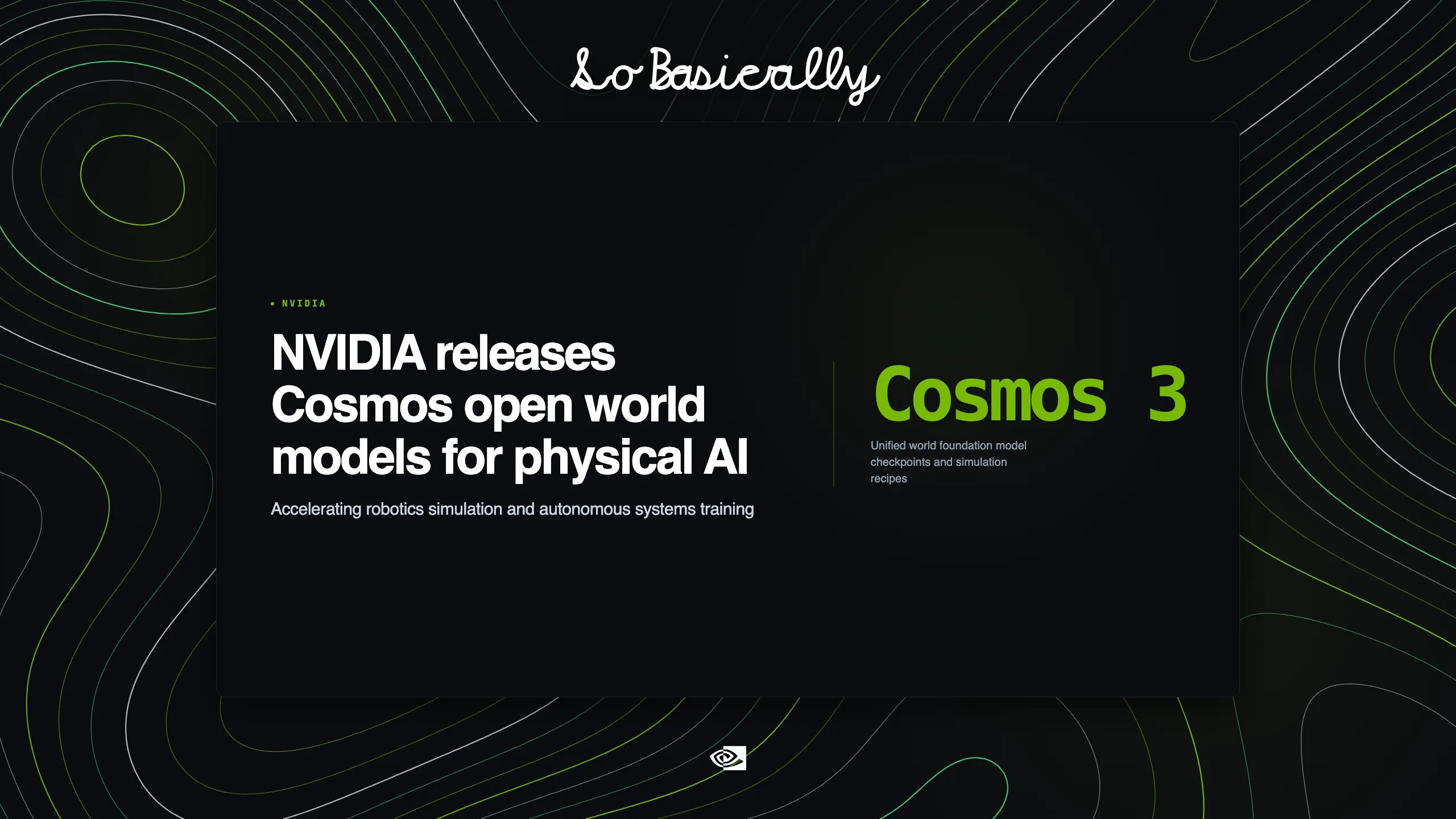
What happened.NVIDIA unveiled Cosmos, a family of open-weight world foundation models and training tools built to accelerate physical AI development and robotics simulation.

Why it matters.Training autonomous robots and self-driving vehicles requires billions of driving miles and edge-case scenarios that cannot be gathered safely in real physical environments. Open world foundation models provide high-fidelity physics-informed synthetic data pipelines that train perception and control policies entirely in simulation. Robotics founders should adopt standardized world simulation checkpoints to compress development timelines and reduce expensive hardware test fleets.

  • Multimodal world generation: Cosmos integrates visual tokenizers, diffusion world generators, and physics-predictive autoregressive models to simulate physical dynamics and camera viewpoints.
  • Data pipeline scaling: The platform introduces Cosmos Data Factory and GPU-accelerated Cosmos Curator tools to ingest, filter, and augment petabyte-scale robotics sensor feeds.
  • Open license checkpoints: NVIDIA published model checkpoints and developer recipes across Hugging Face and NVIDIA NIM microservices to run interactive simulations on DGX systems.
Official Source:NVIDIA Blog
Decision brief card for NVIDIA releases Cosmos open world models for physical AI simulation
↳Continues: NVIDIA and Oracle expand Vera Rubin NVL72 superclusters to multi-gigawatt scale on OCI
Read Brief
Source:NVIDIA Blog (opens in a new tab)
Decision brief card for OpenAI partners with Cathedral and quadruples bug bounty payouts to $172,000

OpenAI partners with Cathedral and quadruples bug bounty payouts to $172,000

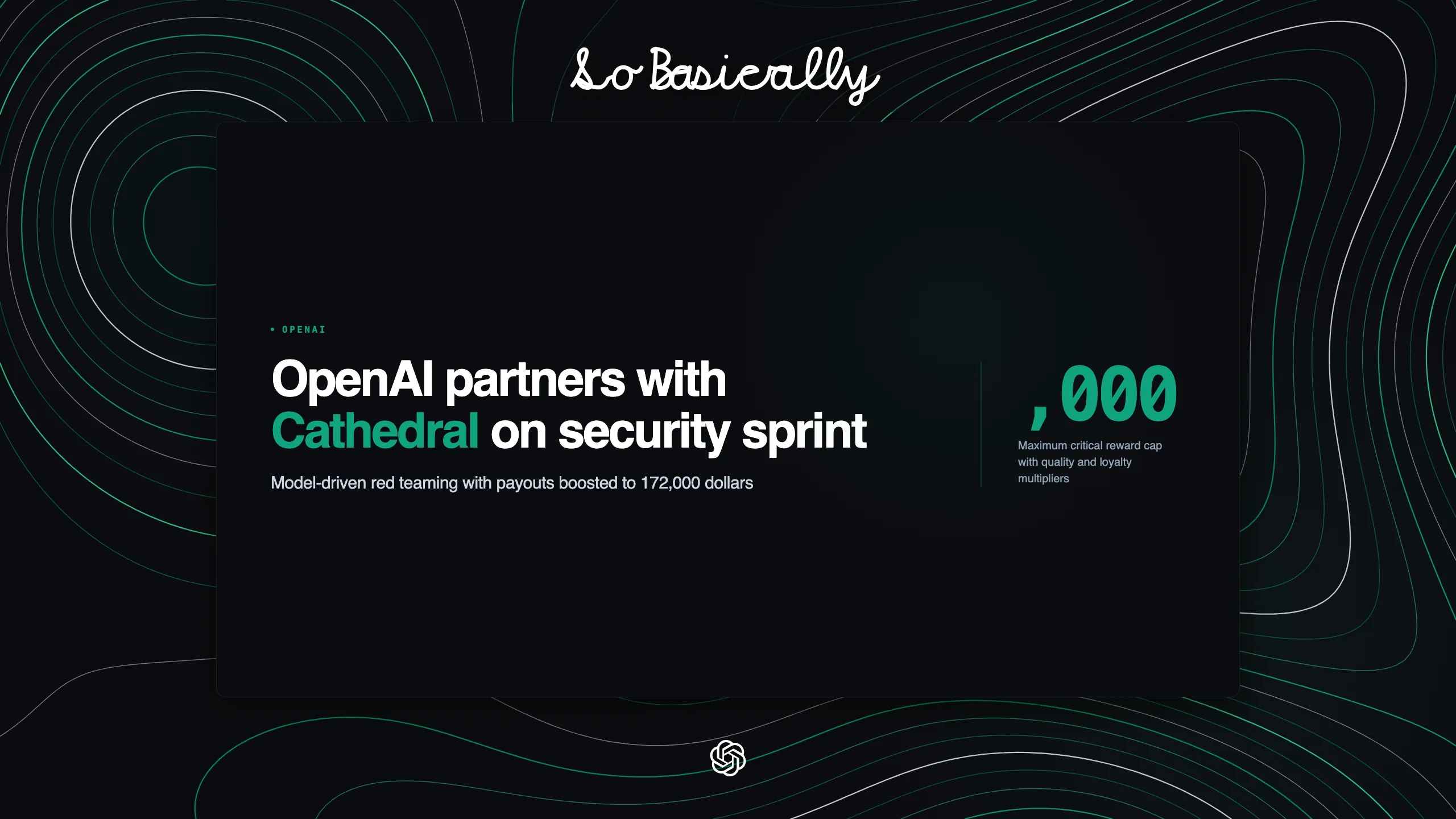
What happened.OpenAI announced an upcoming internal security sprint in partnership with cybersecurity firm Cathedral and substantially revamped its Security Bug Bounty program with quadrupled payout tiers.

Why it matters.Frontier AI labs face persistent targeting by sophisticated actors seeking model weights, proprietary architectures, and training infrastructure data. Relying solely on conventional perimeter defenses proves inadequate when autonomous agents interact with internal APIs and code execution tools. Founders operating critical AI infrastructure should pair automated model-assisted red-teaming with aggressive bounty incentives to uncover latent attack vectors.

  • Model-driven defense: Security researchers from Cathedral will embed alongside OpenAI product engineers, using OpenAI frontier models to stress-test system defenses and probe internal execution boundaries.
  • Quadrupled bounties: Base reward ranges for medium, high, and critical vulnerabilities more than quadrupled, with core product criticals paying up to $30,000 and exceptional findings reaching $100,000.
  • Researcher loyalty bonuses: Adding report quality multipliers and a five-tier researcher loyalty structure elevates maximum potential payouts for exceptional security submissions to $172,000.
Official Source:OpenAI
Decision brief card for OpenAI partners with Cathedral and quadruples bug bounty payouts to $172,000
↳Continues: OpenAI launches Grid Protectors with 1,000 MW grid demand pledge
Read Brief
Source:OpenAI (opens in a new tab)
Decision brief card for Researchers formulate RSI-Env environment for recursive self-improvement

Researchers formulate RSI-Env environment for recursive self-improvement

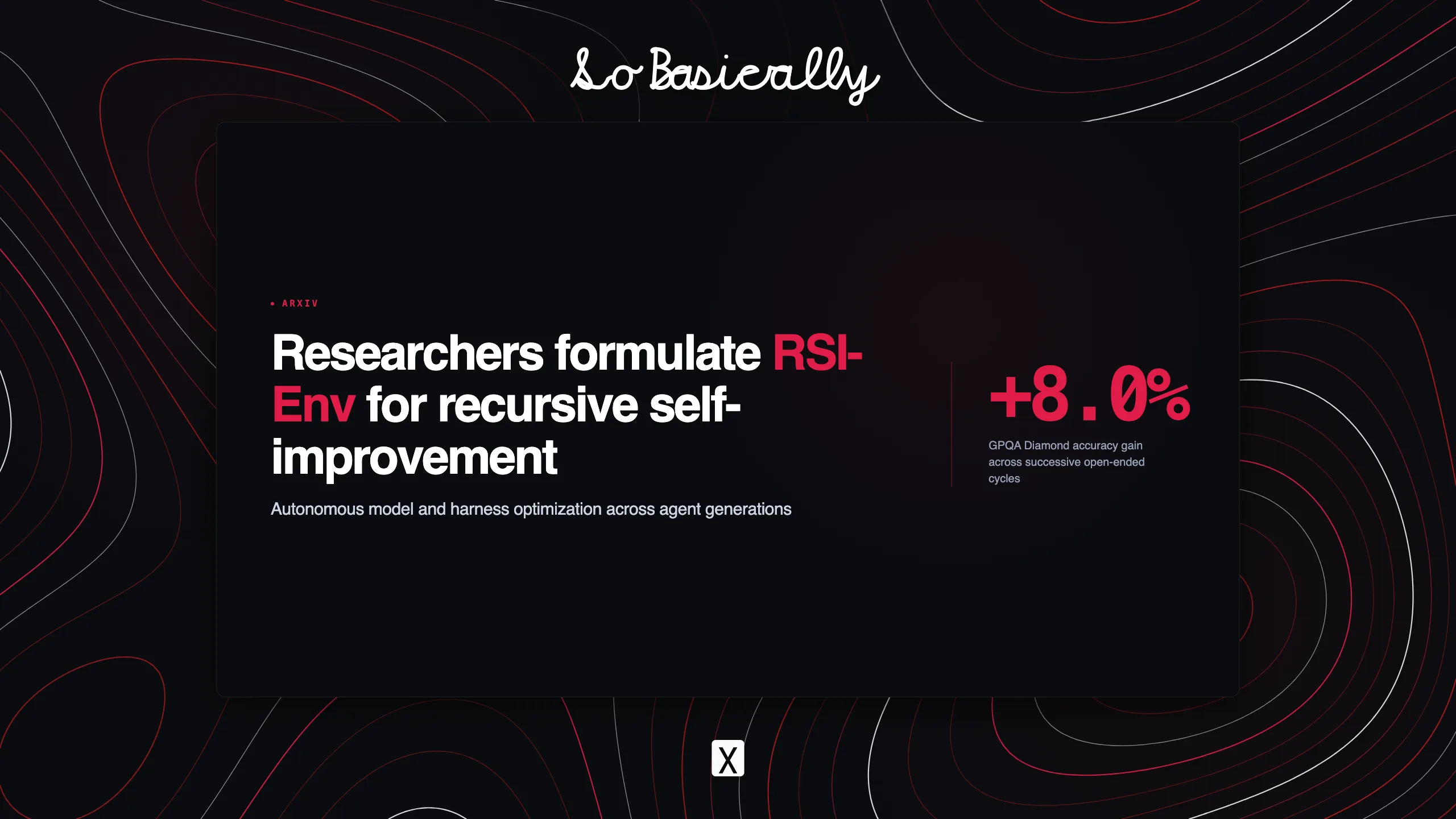
What happened.Computer science researchers introduced RSI-Env, an open-ended benchmark and runtime environment designed to evaluate recursive self-improvement across autonomous model-harness pairings.

Why it matters.Most AI agent benchmarks evaluate static models executing pre-defined tasks without the ability to optimize their underlying code or training parameters. Evaluating continuous, multi-generational self-modification in sandboxed environments provides foundational empirical safety and capability baselines. Engineering teams architecting self-improving agent workflows must implement rigid external supervisor controllers to validate code alterations before generational deployment.

  • Coordinated optimization: RSI-Env enables AI agents to autonomously modify their own neural weights, execution harnesses, and persistent system states across successive generations.
  • Supervised controller: An independent host controller supervises isolated services, verification routines, and semantic versioning to prevent runaway or corrupted self-edits during optimization cycles.
  • Benchmark performance: Starting from a base Qwen3.8-27B model, the Open-General Self elevated GPQA Diamond accuracy from 65.2 to 73.2 percent and SimpleQA accuracy to 88.0 percent.
Official Source:arXiv
Decision brief card for Researchers formulate RSI-Env environment for recursive self-improvement
↳Continues: Researchers formulate Hypergraph Memory for multimodal AI agents
Read Brief
Source:arXiv (opens in a new tab)
CANDIDATE INTELLIGENCE · UNVERIFIED LEADS

The Discovery Wire · Unverified Attention Signals

Candidate storylines identified across developer channels. Under newsroom canon, attention never establishes fact; these leads remain quarantined until supported by Tier 1 official records.

DEVELOPER WIRE

Anthropic updates Claude Code with strict IP protections and message threads beta

Anthropic deployed enhanced intellectual property safeguards and latency optimizations across Claude Code workflows. Kept on watchlist pending independent enterprise developer benchmarking.

STATUS:Awaiting official documentation or verification criteria.
DEVELOPER WIRE

Google expands PlanAssist automated planning trials across UK local councils

DeepMind widened trials for its public-sector planning evaluation system cutting review times by 58 percent. Kept on watchlist pending nationwide audit verification.

STATUS:Awaiting official documentation or verification criteria.
DEVELOPER WIRE

Microsoft and Lumen expand AI-ready optical cloud interconnect fabrics

Microsoft and Lumen continued multi-region fiber routing deployments for enterprise AI clusters. Kept on watchlist pending production latency telemetry.

STATUS:Awaiting official documentation or verification criteria.